Neither Secularism Nor Islamism…
I’m really happy to have published this with New Lines Magazine, an excellent initiative in long-form journalism organized by some of the very best people in the field.
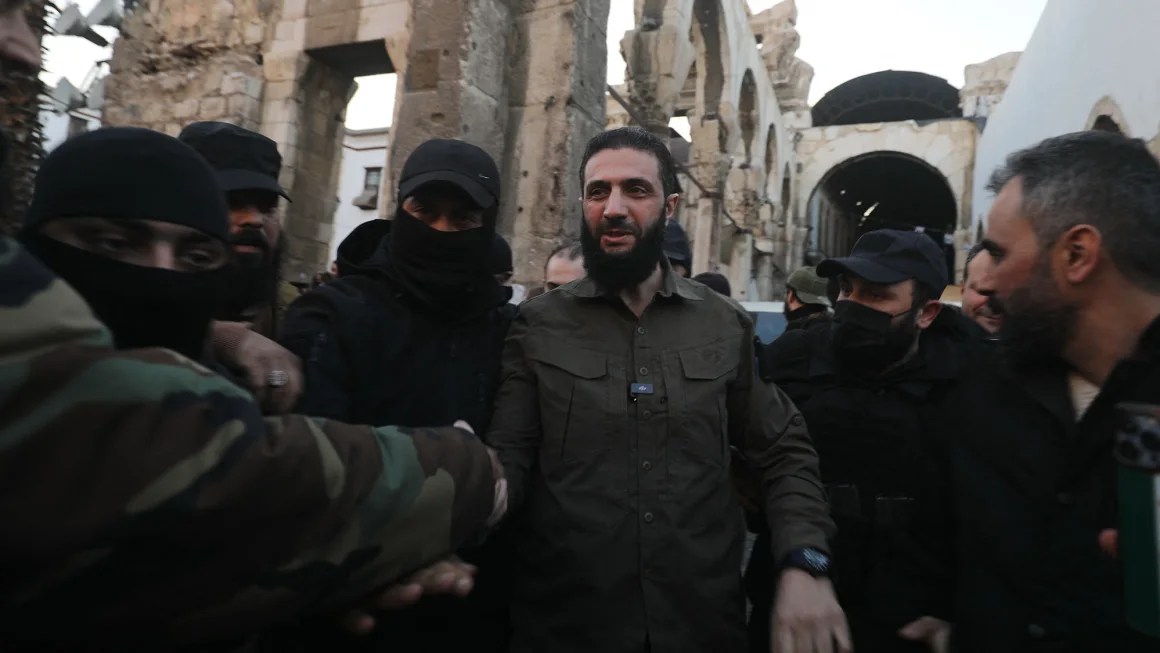
The world is worried about the jihadism of Syria’s new leaders, but the world may be missing the point.
Currently, Abu Muhammad al-Jowlani the jihadist is nowhere to be seen. His alter-ego Ahmad al-Sharaa the politician, however, is on television, and in the presidential palace. He has smoothly assumed the role of head of state, meeting foreign dignitaries, issuing wise advice to the nation, reassuring minorities that their rights will be protected.
So far, al-Sharaa’s political and communication skills match or even supersede al-Jowlani’s military prowess. Some years ago the man was an al-Qaida-linked jihadi, in turban. Then he lived through a Che Guevara stage, in fatigues. That lasted until his triumphant entry to the Ummayad Mosque in Damascus on December 8 last year. Now, going by his real name and no longer a nom de guerre, dressed in tie and suit, he stresses his – that is, Syria’s – desire for domestic and regional stability. And lest anyone still thinks he’s a backward-looking obscurantist, he mocks others for their weird obsessions with the distant past.
On December 22, sitting beside Lebanese Druze leader Walid Junblatt, al-Sharaa referenced Iran’s intervention to defend the Assad regime. Iran had organized Shia militias from as far away as Pakistan to fight in Syria, and had mobilized them with stories about power struggles amongst the immediate successors to the Prophet Muhammad. “Events that happened 1400 years ago… what have they got to do with us?” al-Sharaa asked rhetorically. “What is this mentality? What is this logic?”
It is simultaneously wonderful that Syria has such a skilful leader at this delicate moment and frightening that such a powerful personality overshadows the polity being born. Al-Sharaa’s immense abilities and newfound charisma, and the size of his victory (though it’s not by any means just his) makes it more likely that he will morph again, this time into a national strongman, and that’s probably not what Syria needs as it emerges from under the corpse of the old dictatorship.
Yassin al-Haj Saleh has written of necktie fascists and bearded fascists. It’s not the dress sense that’s the issue here, but the fascism. Thus far, al-Sharaa is doing what the people (presumably) want, and steering away from fascism. He says there will be elections, and that civilians will rule. Of course, what he means by elections remains to be seen. The Salafi-Jihadist current from which he emerges generally considers democracy un-Islamic. So has he genuinely changed his mind on this matter? Will the men under his command accept this change of mind? Will he, and they, henceforth seek to persuade society of their point of view, as would an ordinary political party?
The emphasis on civilian rule is a message of equal importance to Syrians and foreign powers. This suggests that the men with guns will stand aside, or at least relinquish their arms. The foreign Muslim fighters who helped fight Assad are to be disarmed and given Syrian citizenship. Society as a whole is demilitarizing. School children no longer wear paramilitary uniform, and the school day no longer starts with military salutes. Obligatory national service will end and a professional, volunteer army will be built instead. (This is undoubtedly a good thing. National service under the Assads was designed to intimidate and brutalize young men; it was a means of defeating rather than defending society.) Most importantly, the rebel militias are to be dissolved, and the fighters are to operate under the new Ministry of Defence.
In this context, controversy was generated when the caretaker prime minister, Muhammad al-Bashir, appeared in front of a flag which displays the shahada – or profession of faith – calligraphed on a white background, as well as the Free Syrian flag. The shahada flag placed behind a supposedly national figure was sectarian in two ways – because it represented the Islamic religion, and because it belonged to a specific militia, Hayat Tahrir al-Sham. At al-Bashir’s next public appearance, following a storm of criticism, the HTS flag was conspicuous by its absence.
Those inclined towards Islamist governance point out that it was Muslim rebels, fighters in Islamist militias, who liberated Syria. This is certainly true, but it’s a partial truth. The revolution was started, and in many ways kept alive, by unarmed citizens motivated by “freedom, dignity and social justice”. Just focusing on those who participated in the final offensive, the fighters who rose up in Daraa and the Homs countryside are not necessarily Islamist, certainly not in the same way as HTS, though they are often socially conservative. The Druze militias that pushed Assad’s forces out of Sweida province before advancing on Damascus are not Islamist in any way at all. And even the fighters under the HTS umbrella are not necessarily “Salafi Jihadist” in either politics or culture. They have often been seen singing songs like Sufis to celebrate the liberation.
Nevertheless, it’s fair to say that the victorious fighters are sons of a generally socially conservative population to whom Islam – as opposed to any specific Islamist program – has a tremendous appeal. It’s also fair to say – though it’s almost never said outside Syria – that Syria’s Sunni Muslims have been oppressed in part on the basis of their religious identity. Assad security documents show that attending dawn prayers in the local mosque was enough to mark a Syrian for surveillance and potential detention. And the repression of Sunni communities was always disproportionately fierce. From the start of the revolution, protestors in Alawi, Christian or mixed neighbourhoods were hunted down individually and tortured or killed. When Sunni neighbourhoods protested, however, extreme violence was perpetrated against the entire community, not only the protestors. The Assad regime also organized a series of massacres of Sunni women and children in the central part of the country, between Homs and Hama, especially in 2012.
Not just the fighters, therefore, but large sections of society may feel that the time is ripe to implement some form of “Islamic rule”. After all, the first free elections in Tunisia and Egypt brought Islamist parties to power, and those countries hadn’t suffered years of sectarianized war like Syria, nor the trauma associated with war that tends to bring people closer to their religion.
This is neither surprising nor, in itself, problematic. It is natural and logical that a largely believing, largely Muslim society would wish to explore ideas of political organization and statecraft through the prism of its own religion and culture. (Democracy in the Arab and Muslim worlds will inevitably be different from the western versions, which anyway come with their own enormous problems.)
But Syrian society is not only believing, or only Muslim, and many believing Muslims are also firm believers in the necessity of a civil rather than a religious state. The key question now is whether the disputes between segments of society are played out through respectful debate or violence.
An early test came on December 19, when hundreds gathered in central Damascus to demonstrate for “secularism” and a civil state. The Military Operations Administration – the de facto rulers – sent an officer to address the crowd. When he said “No to sectarianism!” the crowd applauded; when he explained that Islam is against sectarianism, the crowd drowned him out with chants of “No to religious rule!”
In this scene one could detect seeds of hope, and of despair too. Hope because people were expressing contrary views in public, and nobody was arrested, or shot. Here at last was real politics, in a country where the penalty for politics two weeks earlier had been death by torture. But also despair, because the officer and the crowd were speaking entirely different political languages, and seemed unable to understand each other.
As videos of the demonstration were shared on social media, it was soon pointed out that many of those participating had two weeks earlier been outspoken supporters of Assad’s war against “terrorists”. Seen in this light, the demonstration was more a protest against the new order by the old ruling class than the commitment to universal freedoms that “secularism” usually denotes in western environments. It was a reminder that conflicts of class are sometimes hidden behind the Islamist-secular binary, and that “secularism” has often been an anti-democratic force in the Muslim world. “Secularism” was one of the slogans used against the elected Morsi government in Egypt, and exploited to reinstate the military regime under General Sisi. There’s no chance that the Assad regime can be restored in the same way – it has completely collapsed – but pro-revolution secularists will still find it very difficult to work with secularists who were recently proud Assadists.
There are legitimate fears of a looming loss of personal freedoms, but currently they are not grounded in actual events. Not only are bars open in Damascus (to use one, highly contested measure of freedom), they are actually protected by the Islamist authorities. On December 18, a man claiming to be from HTS entered a bar in Damascus railing against alcohol. When the patrons called the actual authorities, they arrested the shouting man. The authorities have also told their cadres not to interfere with women’s dress choices. It is notable that HTS in Idlib has not fielded a Hisba Diwan – or religious police – for several years. And that it has just approved Syria’s first ever female provincial governor – Mohsena al-Maythawi, in Sweida province.
Pragmatism and flexibility seem to be the order of the day. The legal code adhered to by Idlib’s HTS-aligned Salvation Government has been applied throughout Syria for this caretaking stage, but with adjustments made according to the social norms of each province. In Tartous, for example, whose mixed population includes many Alawis and Christians, there are no regulations concerning alcohol or hijab.
In some respects, the current HTS vision seems to echo Ottoman decentralization, in which different sectarian (or tribal) communities (or “millets”) followed their own rules. The pre-modern Ottoman system preserved communal rights and a good measure of communal autonomy. What it didn’t do was protect individual rights. A Sunni Muslim had to abide by Islamic law, and an Orthodox Christian by church law, whether they liked it or not. Adapting law according to geography rather than simply to sect, as in the Tartous case, may offer a compromise. If someone in Idlib wants to live a “secular” lifestyle, they could move to Tartous, or at least spend the weekend there; if a resident of Tartous wants to live in a more Islamic environment, they could move to Idlib.
Decentralization happened naturally during the revolutionary years, and was closely entwined with grassroots Syrian experiments in self-governance. At one point – before authoritarian forces, including HTS, squashed them – there were over 800 quasi-democratic local councils running affairs in the liberated areas, each applying a model decided on by locals. It is to be hoped that the principle of local self-organization (which is clearly distinct from federalism) will survive, and that Syrians don’t end up with another overbearing centralised tyranny. Syrians are rightly worried that federalism could lead to regional divisions that might be exploited by hostile foreign states — Israel and Iran in particular. While federalism gives permanent and irreversible powers to the provinces, weakening the central government, the powers granted to provincial authorities under decentralization can easily be withdrawn if they lead to conflict. The powers I suggest for decentralization would in any case cover social and cultural issues, not military or security matters. A mechanism allowing social difference could in fact contribute to national unity and strengthen the nation against foreign threats.
The criterion for judging freedom should be not be how secular or Islamist the polity, but how authoritarian. “Secularism” is often assumed in the west to be synonymous with liberty, but the versions practised in the Muslim world have often been tyrannical. Assad’s secularism, while it allowed people to drink beer and wear miniskirts, was both authoritarian and sectarian. Kemalist secularism in Turkey, like the form practised in Tunisia until 2011, was anti-religious, and actively excluded women who wore hijab, for instainstance, from certain public spaces.
“Islamism”, on the other hand, has, in some, admittedly rare, cases, accommodated civil and human rights. The main revolutionary militia in the Damascus suburb Daraya was called Shuhada al-Islam (or Martyrs of Islam). Like the rest of the Daraya community, its fighters were influenced by the “liberal Islamist” Sheikh Jawdat Said, who emphasised the importance of popular participation in governance, and women’s and minority rights. Shuhada al-Islam was perhaps the only militia in all of Syria which operated under civilian control.
Anti-secularist discourse in Muslim countries has usually been reactive to tyrannical or aggressively westernising forms of secularism. Islamism, likewise, has in practice generally been a form of Muslim nationalism, one which often rejects the boundaries of the states set up in the Muslim world by westerners, or on western models, while implicitly working within that reality. It has been obsessed with capturing the omnipotent post-colonial state and using it to implement its ideological program, and has often grabbed onto symbols of Islamic rule – like the hudood punishments, including amputation and stoning – precisely because these are the aspects of Islamic law which most upset westerners. But as well as strict penalties, Islam requires social justice. Indeed – following the example of the Caliph Umar, who suspended the punishment for theft during a famine – a functioning economy and a measure of economic justice are considered necessary before hudood punishments can be implemented.
Pre-modern Islamic polities were not omnipotent states in the contemporary sense, and didn’t generally police people’s behaviour. In contemporary Syria too, the people should be left to govern themselves in social and ideological matters. Top-down coercion would be resisted, and not only by the sectarian minorities. Another of Yassin al-Haj Saleh’s insights is that there is no “Sunni majority” in Syria, though the majority of Syrians are Sunnis, because members of the Sunni category are divided by class and regional origin, as well as various levels and types of belief and belonging.
Instead of seeking to force the populace into any particular ideological mould, Syria’s new order would do better to strive towards an Islamic vision of a just society in the way that the Justice and Development Party attempted in Turkey, or better still, in the way of Tunisia’s “post-Islamist” Rached Ghannouchi, who sees the freedom to choose to be observant (rather than being forced) as religiously valuable; and likewise, the freedom from an overbearing state, whether secular or religious, to be religiously as well as politically desirable. (Ghannouchi co-founded the Ennadha Party which governed Tunisia after the 2011 revolution, but is presently locked up by the overbearing state under the resurgent dictatorship of Qais Saied.)
For Syria after decades of tyranny and long years of war, the less ideological grandstanding, the more practical work, the better. The positive spirit of religion in action is called for, rather than a performative imposition of symbols.
Sheikh Ahmad Sayasneh, the revolutionary cleric exiled from Daraa and now returned, says this: “Whether the government elected by the people ends up being a religious one or not, the most important thing is that it must govern Syria democratically. The terrorizing or domination of Syria’s citizens must not be a part of the new government.”
And that’s the point. Whether the state is religious or secular, Syria needs a strong society, not a strongman.


 Qunfuz
Leave a comment