The Wounds of the Past, and Transitional Justice
This essay was first published at New Lines Magazine.
In dry hills half an hour’s drive outside Damascus, Sednaya Prison comes into view. A squat three stories covering a good deal of land, it imposes on the vision as we approach from below. Repeated rings of barbed wire and mine fields surround the main building. The Assad regime’s organized graffiti praising the leader and describing the (non-existent) struggle against Israeli occupation still covers the outer buildings which housed the guards and their workshops until the regime collapsed on December 8 2024.
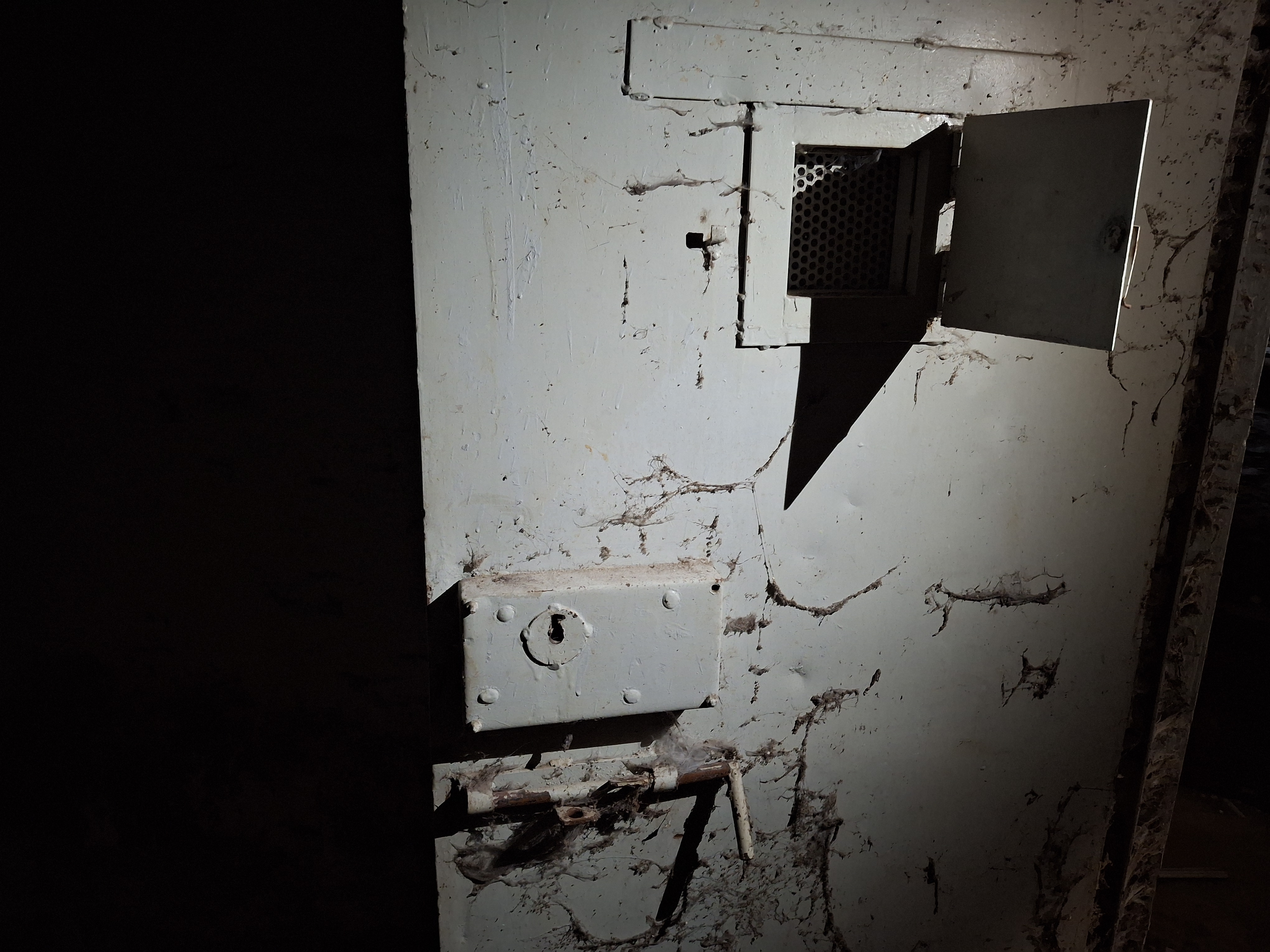
The whirlwind of revolutionary change has hit the place. Rubble and rubbish litter the entrance. I and the photographers climb a few steps into the reception room where prisoners were previously pushed into narrow caged corridors and stripped of their clothes. It isn’t hard to imagine the screams and thuds as new arrivals received their ‘reception party’ beatings. Although on second thoughts, my imagination may be overdoing it. Absolute silence was often enforced on the victims, even during torture.
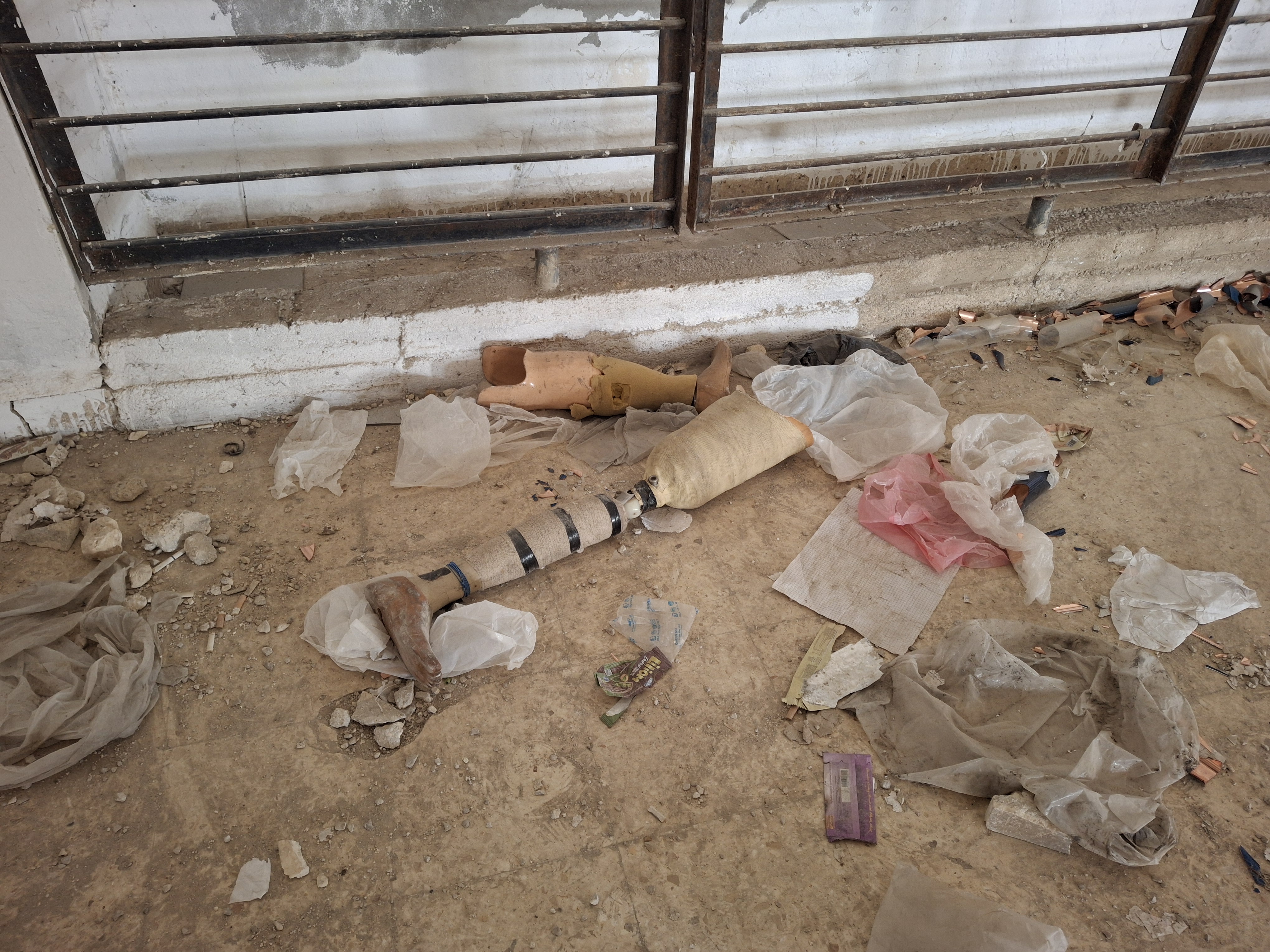
Amongst the detritus here on the filthy tiled floor, a couple of artificial legs lie marooned. They are made of very basic plastic, one to fit beneath a knee, one to replace an entire limb from the hip down. I can’t understand why they’re still here. Surely their owners didn’t discard them when they fled? Later, however, I read the transcript of an interview with a survivor of the prison. He described the reception room process: “If you have a prosthetic leg, they throw it away. If you have glasses, they get rid of them.”
At the center of the prison is a spiral staircase made of metal and surrounded by metal bars. This connects (or for the prisoners, separated) the three stories and the three wings fanning out from the center. Nine cells recede down each corridor. These are the group cells, in which dozens of men were crammed. Very thin, dark brown blankets cover the floor. There is a bad odour or the memory of one, a discomforting sweet staleness.
Down the stairs are the solitary cells, so-called because they aren’t big enough to fit more than one man, though in fact three, four or five men were often forced inside. Each cell contains a dirty squat toilet, from which the men also had to drink. Food was delivered through a slot at the bottom of the heavy metal door. There is no light inside. The prisoners existed in absolute darkness. Sightlessness as well as soundlessness contributed to the deprivation. There is writing on some of the walls nevertheless, apparently etched by fingernails. A name of a man and his city, Tartous. A date in 2014. A count of days, though in the dark the days could only have been guessed at.
The smell is stronger here. One of the photographers explains that in the first days after the liberation streams of human waste flowed from the cells into the hallway. We’re stepping now on blankets put down to absorb the filth. They have hardened in the dry air in the months since, but the smell persists. This is despite the thick clouds of incense currently being burnt upstairs, where the group cells are. That sweetness covers but doesn’t hide the deeper, more disturbing sweetness of persistent degradation.
If this works as a symbol – and we are in need of symbols, of any tools we come across to help us comprehend – it serves to embody the need for a deep cleaning of Syrian society. Superficial treatment won’t do, for the crimes committed in the Assad prisons system can be rightly described as radically evil. Of the at least 130,000 people missing in Assad’s dungeons, only about 30,000 were released in the hours following the fall of the regime. That means at least 100,000 victims were murdered in Sednaya and other prisons, by torture or starvation or medical neglect. Their corpses pack the mass graves found at Qutayfa and many other sites. The victims were not criminals, but people who had spoken, protested, organized, or in some cases fought against the regime.
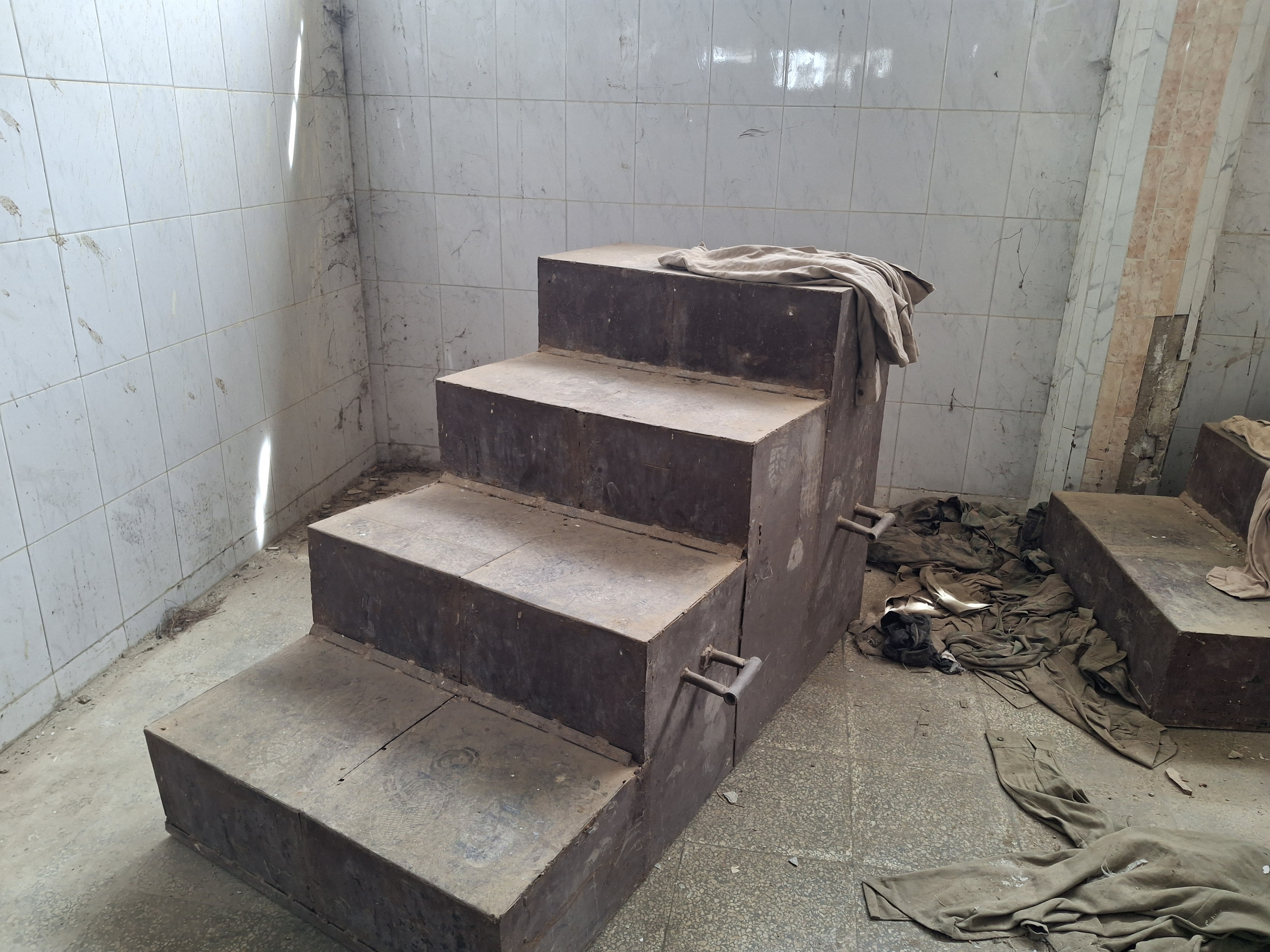
In its 2017 report on the crimes against humanity perpetrated here, Amnesty International referred to Sednaya as Syrians do, as the “human slaughterhouse”. It was certainly a death camp as much as a prison. In one part of the building there is a block of four steps which not long ago led to a noose. On the upper floor there was a “salt room”, apparently for storing corpses until they were transported. But as bad as the fact of this industrial-scale killing is the drawn-out manner of the sadism. We know, for instance, that the activist Mazen Hamada was finally murdered only hours before the regime collapsed, when it was already clear that the game was up. A post-mortem reports nails and screws driven into Mazen’s body. Such slow, gratuitous torment over months and years suggests a sustained level of hatred which is quite impossible to comprehend. This is part of what is so hard to get over.
Another difficulty is the time scale across decades. One of the photographers accompanying me grew up in Mneen, the village beside the prison (not Sednaya village, where the famous convent is, which is actually a few kilometers further on). As a child in the 1980s, he was aware that neighbours were sometimes taken from their homes and vanished for ever into the concrete building on the hill, and that anyone who talked about it aloud, or to strangers, might end up there themselves. Such crimes, and the humiliating silence they imposed on society, can neither be forgotten nor forgiven. Decades of repressed words and traumatized emotions are rising to the surface now.
Syrian civil society is working to negotiate this process. Reconciliation with the past and between the country’s sects and factions cannot be achieved until some measure of justice has been done. And the first step towards justice is to establish the facts of what happened, by documenting the prisons and mass graves, as well as the massacre sites and destroyed cities.
I visited Sednaya Prison as part of my work with the Prisons Museum (where I am the English-language editor). This is a virtual, online museum, though it also curates physical exhibitions. Its first project, the ISIS Prisons Museum, involved filming ISIS prisons in both Syria and Iraq with 360-degree photography, then interviewing hundreds of survivors of these prisons. Forensic analysis cross-referenced with witness testimony and analysis of over 70,000 ISIS documents results in detailed 3D tours of the prison sites as well as special investigations into various aspects of ISIS rule. This can all be seen at the website. New tours and investigations – so far including the Stadium Prison in Syria and the Ahdath Prison in Iraq, and a focus on the Shaitat Massacre – are uploaded regularly.
Now the same methodology is being applied to the Assad regime gulag, and will soon be online at the Syria Prisons Museum. Prisons Museum teams are capturing every name scratched on the walls, noting every architectural and forensic clue, and recording as much witness testimony as possible, in order to allow accurate reconstruction of these crime scenes. As well as preserving the evidence before it is destroyed, this effort leads to accountability. Evidence produced by the Prisons Museum has already helped to convict ISIS war criminals in Germany. Its work on Assad’s prisons will also be available for use in transparent trials.
Documenting and memorializing the crimes of the last fourteen years of war, whoever committed them – and indeed of the last half century of violent dictatorship – is of crucial importance. The horror cannot pass into history until there has been full official and public recognition. The victims and their relatives will not be able to move on until then. There are still some who minimize the crimes, or even discount them as propaganda. Those Assadist and Kremlin narratives that obscure responsibility for specific atrocities persist in Syria, as they do abroad. In some cases, Syrians who supported Assad cling to inconsistencies in reporting — for instance, videos of women prisoners being released were originally, and falsely, attributed to Sednaya — in order to discount all accounts of abuse in the prison.
Documentation forms part of the battle against denialism. By helping establish a common understanding of the facts and a commonly accepted set of legal and humanitarian principles, it also helps build the culture of accountability that the new Syria will need if it is to be a democratic polity that respects human rights.
On April 7 I attended a demonstration in Douma, in the Eastern Ghouta suburbs of Damascus, to commemorate the seventh anniversary of Assad’s 2018 chlorine massacre which killed between 40 and 50 people and injured hundreds more. This wasn’t the worst of the regime’s chemical atrocities – that was the August 21 2013 sarin attack, also on the Ghouta suburbs, which killed up to 1500 people – but it as much as the others has been the subject of international denialism.
The “Don’t Suffocate the Truth” banners held up by relatives of the victims referred to that denialism. Other banners showed gratitude to Syria’s Civil Defense, also known as the White Helmets, an organization which became another target of originally Kremlin-inspired conspiracy theories. Ra’ed Saleh, former head of the White Helmets and now inaugural minister of the transitional government’s Ministry of Emergency and Disaster Management, was present at the demonstration.
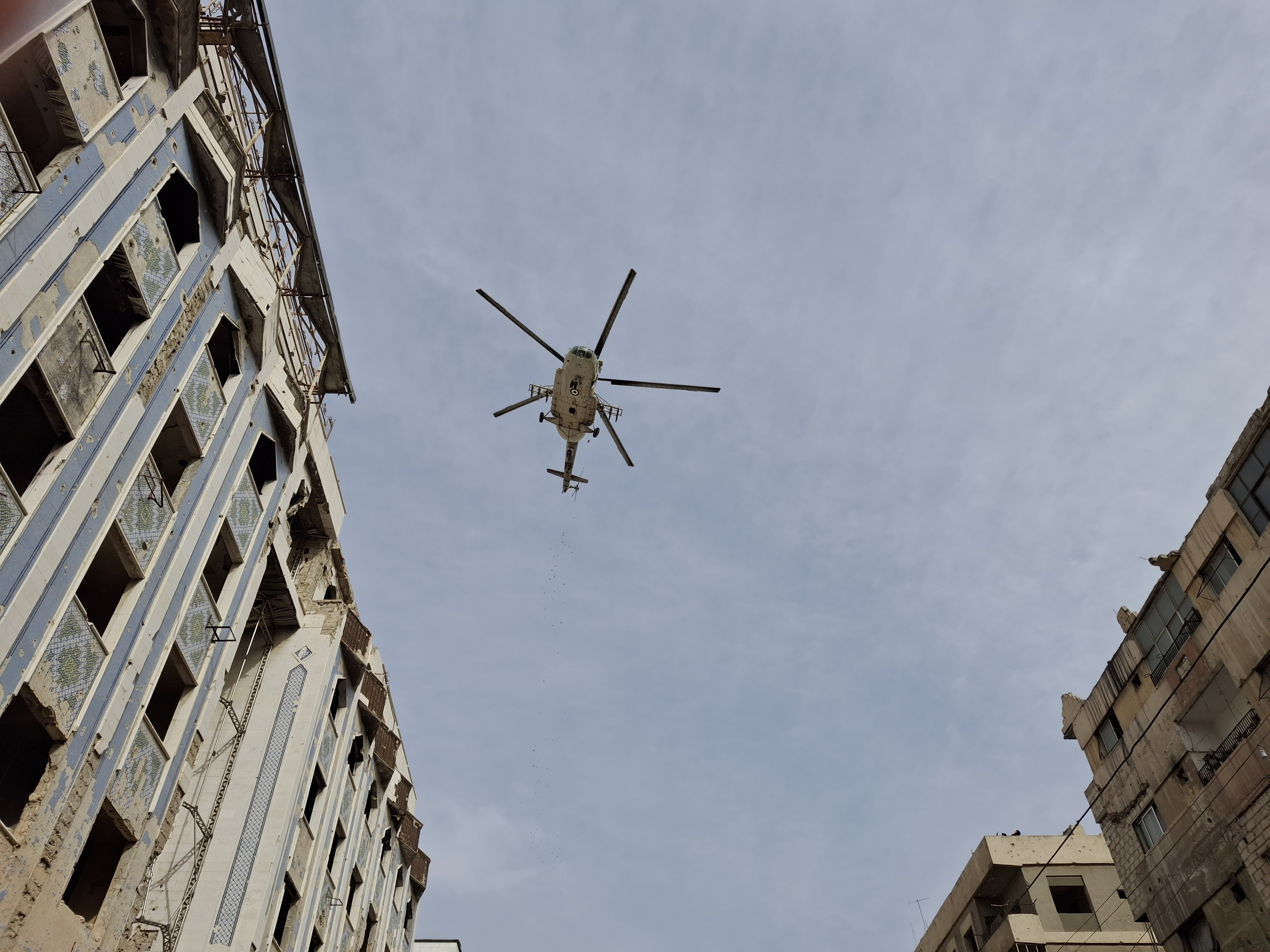
So was a little girl called Sidra, who approached to say hello. I asked if she lived in Douma. In her very tiny voice, she said she did. I asked who she’d come to the demonstration with. I don’t have anyone, she said. The impact of those words only hit me a few minutes later. Sidra looked a lot younger than the thirteen years old she claimed, but malnutrition will do that to a child. This area suffered starvation siege as well as years of continuous bombardment. At the demonstration, in a reconfigured memory of those assaults, a military helicopter passed overhead. This time, instead of dropping gas canisters or explosive barrels, it threw down roses. Here was another awkward symbol – even as boys rushed to grab the flowers, the more traumatized in the crowd flinched.
The fact of victory is its own kind of justice. What was billed as a silent vigil soon became noisier and more celebratory. Some revolutionary celebrities – like the Idlibi journalist Mousa al-Omar – delivered speeches. The crowd cheered a group of waving fighters, then chanted “The People Want the Execution of Bashar”. (The fugitive president is currently under Putin’s wing, in Moscow, nowhere near a courtroom or a noose.) When the noise died down I remembered little Sidra, but I couldn’t find her again in the throng.
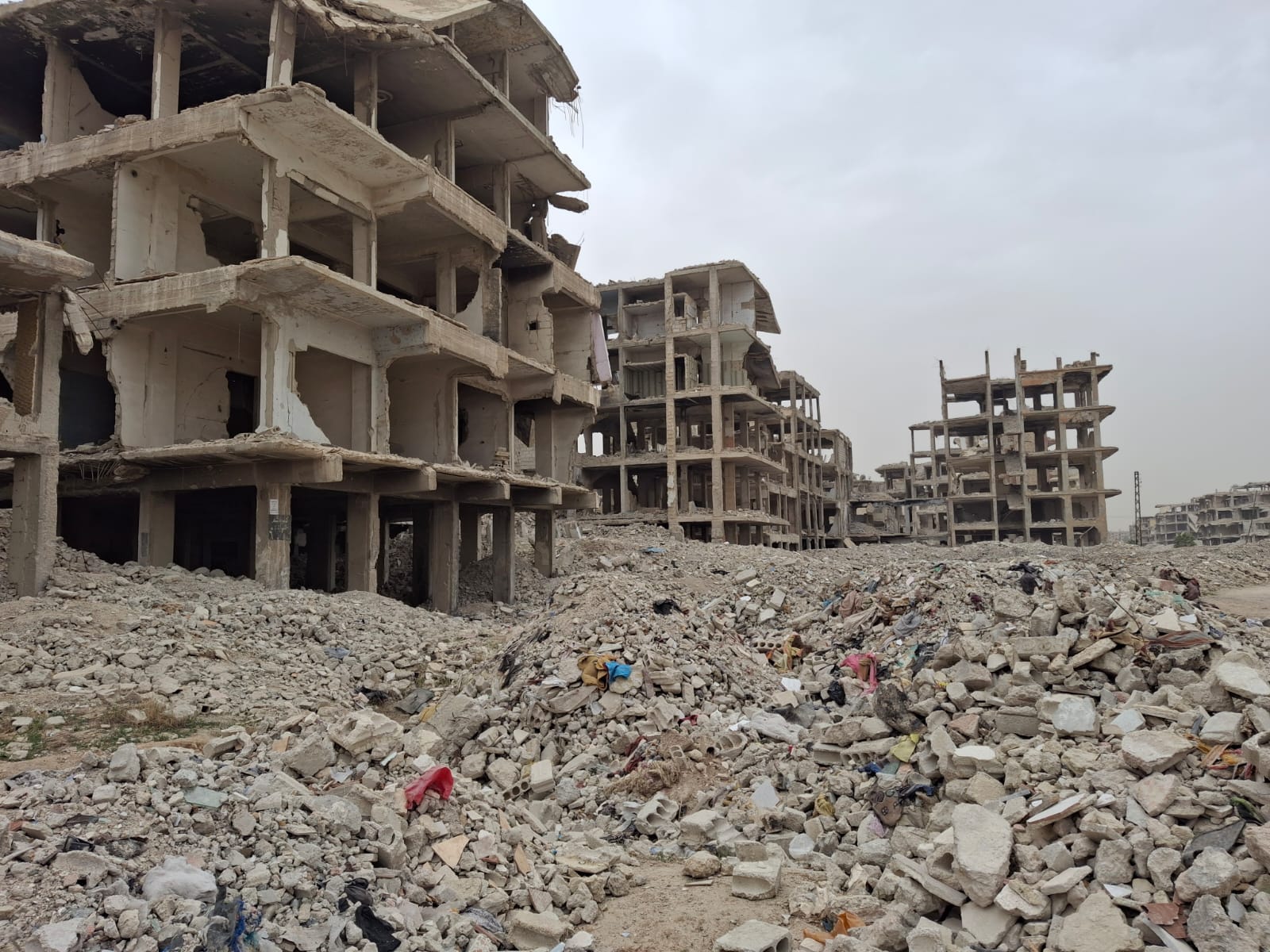
War damage is apparent everywhere in Douma. On another day a friend drove me back to Douma through the suburbs of Jobar, Harasta, and Arbeen. Then we drove back to the city center and through Yarmouk Camp, which once housed the largest Palestinian community in Syria. Twenty five years ago I had friends in Yarmouk, and knew my way around the neighborhood. This time there was nothing to recognize. All of these areas are utterly destroyed, mile after mile. First bombs crumbled the buildings, then regime-organized looters removed the copper pipes, the electrical cables, and the bathroom tiles. It’s a master class in de-development, and another type of crime to be documented, acknowledged, and accounted for.
What is now rubble was once an overwhelmingly Sunni environment. Throughout Syria, Sunnis were particularly targeted by the sectarianizing counter-revolutionary campaign prosecuted by Assad, his mainly Alawite regime, and the international Shia militias Iran sent to assist him. The overwhelming majority of those bombed or tortured to death, or made homeless, were Sunnis. Today the sectarian hangover from that campaign is dangerously wrapped up with the urge for accountability. If not properly addressed, it poses the greatest internal challenge to Syria’s transition.
In April the Economist published the first ever major opinion poll of Syrians. The findings record plenty of good news: 81 percent are pleased with Ahmed al-Sharaa’s rule, and a similar proportion feel freer now than they did under Assad. But it also shows what rapidly becomes clear in conversations – that opinion is divided along sectarian lines. Only six percent of Sunnis are pessimistic about the future, compared to 40 percent of Alawites. The violence in the coastal region that peaked in early March provides logical ground for the pessimism. Though provoked by attacks by regime ‘remnants’ on both civilians and the new security forces, the response by enraged Sunni militants soon degenerated into sectarian atrocities. Civilians including women and children were killed solely on the basis on their Alawite identity. And despite government assurances that all Syrians are the state’s responsibility, the violence continues in fits and starts. It’s not always easy to determine which killings are purely criminal, associated with the general breakdown in order which has accompanied the dissolution of the state, which are revenge attacks against specific Assadist criminals, and which are ‘revenge’ attacks against Alawites in general. But sectarian generalizations are widespread in society. It is a distressingly common opinion amongst Sunnis that Alawites “deserve it”, or that “it’s their turn now.”
The antidote to this is visible and rapid transitional justice, to show the people that in the new Syria criminals are punished, whatever their ‘identity’. Trials should be public and transparent so that every part of society is exposed to the facts of the old regime’s crimes as well as the crimes still ongoing, and so that denialism becomes less sustainable. Then people are much less likely to feel the need to engage in vigilante ‘justice’.
But this isn’t happening, or at least not yet. Apparently some perpetrators of the March violence have been arrested, but none have yet been tried or punished. And there are many examples of Assadist war criminals still enjoying their freedom. Fadi Saqr, one of those associated with the Tadamon massacre, was arrested but then quickly released. Afterwards he went walking in the very neighbourhood where he had committed his crimes. The people of Tadamon were moved to protest, and there were reports that Saqr had been rearrested after that. Later, however, it was revealed that he had been appointed to the committee tasked with establishing peace between communities on the coast. Since then, Mazhar al-Weisi, the transitional government’s justice minister, was seen shaking hands with Ammar Bilal, who was chief prosecutor in the Assad regime’s so-called “Terrorism Court,” which sentenced numerous revolutionaries to death.
The absence of accountability or even a clear roadmap towards accountability causes bubbling resentment in society. Supporters of the transitional authorities explain the tardiness by pointing to a lack of time and capacity. They argue with good reason that a new legal system needs to be built before credible trials can be held, and that anyway there are higher national priorities than trials, such as persuading the US and EU to lift sanctions. (This has now been achieved, though the effects are yet to be felt.) A completely comprehensive purge of criminals would be extremely expensive, and potentially destabilizing, some contend.
But there is also reason to believe that the authorities are dragging their feet because they find accountability to be politically unpalatable. A conference on transitional justice organized by lawyer Anwar al-Bunni in late February was cancelled by the authorities at the last moment. They offered no explanation, but the reason may have been because al-Bunni insists that all parties to the conflict should answer for their crimes. This includes HTS, the militia from which key players in the transitional government emerge, as well as various militias which President Ahmad al-Sharaa is trying to bring under his control in a unified national army.
The transitional government’s opposition to a comprehensive justice process was made explicit by Decree 20, issued on May 16, 2025. The decree stipulated the establishment of a national commission for transitional justice, but limited the scope of the violations to be accounted for to “those caused by the former regime.” Because this ignored the suffering of thousands of victims who were subjected to systematic violations by various other parties in Syria — most notably the victims of the Islamic State — the ISIS Prisons Museum has issued a statement contesting the decision and emphasizing “that transitional justice cannot be treated as a political issue. Rather, it must be a tool for achieving rights, providing justice for all the victims, and uncovering the full truth. The goal is not revenge, but to end impunity and enshrine respect for the dignity of all Syrians.”
The Syrian Network for Human Rights recently published its Vision for Transitional Justice in Syria, a text calling for a victim-centered transitional justice body to be established under national ownership. This would require the transitional government to relinquish control of the process. All the signs are, however, that the government wishes, instead of delegating, to carefully control every aspect of the transition. This is short-sighted. The Syrian people’s trauma is potentially explosive, and it urgently needs to be addressed. Emergent groups like the one called Saraya Ansar al-Sunna — a Sunni identity formation pursuing revenge — dispute the transitional government’s leniency and launch assaults on those whom they claim are criminals. The language they use, and the targeting, are explicitly sectarian. Women and children continue to fall victim to this supposed “revenge.”
It isn’t difficult to see how the situation could spin out of control, or how an actor — foreign or domestic — intent on making the new Syria fail could push it in that direction. Sunni resentment and Alawite fear make perfect ingredients for a larger social breakdown. A devastating car bomb or similar provocation could plunge the country into sectarian war. The current widespread enthusiasm for the future is still dominant, and its energy could yet propel Syria to success, but all could be lost if the related issues of sectarian tension and accountability for war crimes are not quickly and properly addressed.



 Qunfuz
Leave a comment