Author Archive
Arab London
This appeared in Gulf Life (Gulf Air’s inflight magazine):
It’s August and, as well as the Notting Hill Carnival, west London is seeing its yearly influx of Arab tourists. While the visitors are here they’ll rub shoulders with a varied and well-established Arab community.
Unlike some cities, London is too mixed to be ethnically zoned. When I lived a few years ago on the Harrow Road in west London, my neighbours were Poles, Pakistanis, Trinidadians, Lebanese .. I could go on. In London there are no monocultural ghettoes, but there are cultural concentrations, and my Harrow Road bedsit was in the middle of the Arab one.
At lunchtime I would cross the canal to buy steaming bowls of harira from the Moroccan stallholders on the Golborne Road. North towards Willesden I would meet newly-arrived Iraqi refugees, each with a story. If I walked west to Shepherd’s Bush I found Syrian grocers selling olive oil from the old country, and balls of salty shellal cheese. On the Uxbridge Road I could even eat fetteh, the essential Levantine working man’s food, and I prayed with men of all sects in a basement mosque.
Representation
Somebody at Channel 4 has been making an effort. A few weeks ago a documentary called “Dispatches: It Shouldn’t Happen to a Muslim” criticised the rising tide of Islamophobia in the British tabloid media and the corresponding rise in physical attacks on Muslims. The presenter brought up a series of stories which I half remembered hearing before, and half remembered feeling vaguely embarrassed about. Like how the NatWest bank got rid of its piggy bank posters to avoid offending over-sensitive Muslims. Like how British hospitals have to rearrange their wards so the beds all face Mecca. Like how a Muslim hate mob vandalised a house in which British soldiers returned from Afghanistan were to be billeted. All of these stories were completely false. The Sun was not charged with incitement to hatred.
The documentary didn’t take on Islamophobia in the so-called ‘quality press’, legal system or government, and beyond references to the July 7th bombs in London it did not give a wider political context for the surge in Muslim hatred. It did, however, point to how serious the problem is becoming. According to opinion polls, which are slippery by nature, 51% of British people believe Islam in general is to blame for the 7/7 attacks. 26% think the presence of any Muslims in the country is a security threat.
A couple of days later there was a great British screen moment. The screen read: After The Qur’an, Big Brother – which blasphemously reminded me of the Islamic “After your mother, your father.” But “The Qur’an” meant a two hour documentary on various ways of reading the text in various social contexts.
Despite the inevitable simplifications (Iranian women are “uniformly dressed in chadors”) the documentary did an admirable job of showing the range and flexibility of Qur’anic interpretation. Space was given to mullahs and Sufis, liberals and conservatives, the hijabbed and the non-hijabbed, to stake their very different claims on Qur’anic meaning. One interviewee said, “The Qur’an is like a supermarket; you can take what you want.” Although the Tesco’s imagery grates, this is of course correct; like the Bible, the Upanishads and Shakespeare, the Qur’an is vast enough to provide succour to almost any world view.
As a corrective to the unreconstructed ‘essentialist’ orientalist discourses we still hear so much from, the documentary shone a healthy light on the changing nature of Muslim societies. The society chosen for exemplification is Egypt, where almost no urban women wore the hijab thirty years ago but where almost all now do. The reason for the change was, I think, correctly diagnosed as “military defeat and economic failure” leading to a new search for identity.
“The Qur’an” spent a great deal of time examining (or at least quoting) verses which seem to encourage, on the one hand, fighting, and on the other, peaceful co-existence, and decided that the text promotes “tolerance and intolerance in equal measure.”
This made me think of the sometimes contradictory names of God: the Merciful and the Tyrant as well as the First and the Last. It made me think of all the strange binaries in the Qur’an. The words for ‘life’ and ‘death’ are each mentioned 145 times. ‘Spending’ and ‘satisfaction’ occur 73 times each. ‘This life’ and ‘the life after’ 115 times each. ‘The misled’ and ‘the dead’ 17 times each. And so on.
The Qur’an aims for totality, to broaden our horizons. It offers us a language to speak, a vocabulary – for instance – for both war and peace. And it describes itself as a ‘furqan’, a test.
The documentary reached a fine and logical conclusion: that in the Qur’an, “one consistent message comes through: think and think.”
But then it made much too big a deal about the Qur’an being originally written without tanqeet (punctuation distinguishing letters) or harekat (vowel markings), as if this was new information. One German professor’s interpretation of the Qur’an with the help of an Aramaic dictionary was interesting but vastly overblown. The dark-eyed maidens awaiting the faithful in paradise are translated by the professor as ‘bunches of grapes’. The documentary played this as if it would shake the foundations of Islam, but the general idea has always been uncontroversial. A clear majority of Muslims have always known that the descriptions of heaven and hell are symbolic images of the ineffable. The Qur’an (2:26) itself stresses this. At this point in the programme it seemed a bit like the writer had run out of things to say. He could have taken two more minutes on Palestine.
On that subject, the documentary stated: “In the last eight years, over 700 Israelis and over 2000 Palestinians have been killed.” While the real numbers are 1057 Israelis and 4862 Palestinians. http://www.ifamericansknew.org/stats/deaths.html#source The documentary also failed to mention the first and basic fact of the conflict: that most of Palestine was ethnically cleansed in 1948 and the remnant occupied and settled from 1967.
This lack of explanation makes the conflict seem like an ideological struggle between two equal parties, both with equal mythic allegiances to the land. This is misleading for two reasons. First, Israel is a nuclear-armed regional superpower while the Palestinians are stateless and very nearly defenceless. Second, although both sides do have strong mythical-religious claims on the land, and although both speak this resonant language when they are suffering or when they seek to mobilise their friends and allies, the conflict is no more about religion than the Northern Irish conflict was about Catholic-Protestant theology. It’s about territory and power and oppression.
If documentaries fail to give this context, who will? Certainly not the evening news.
While celebrating the 60th anniversary of apartheid Israel the Guardian stated that 250,000 Palestinians were expelled from their homes in 1948. I emailed to complain, and had to wait for more than a week until I received a reply saying that I wasn’t the only one to have questioned the figure, and that the Guardian was researching it. It took another few days for the hardworking research staff to learn that, since the work of Israeli new historians like Ilan Pappe in the 80s and 90s it has been accepted as historical fact that somewhere between 700 and 800 thousand Palestinian refugees were created in 1948. I wonder why it took so long to uncover this uncontroversial fact? I wonder which ‘research sources’ the Guardian relies on? I wonder how long it would have taken the Guardian to apologise if its front page had underestimated the number of Holocaust victims by two thirds? (No, I’m not suggesting that the two tragedies are analogous, but there is a link, made by the Guardian piece itself when it cast Zionism as the solution to the Holocaust).
No-one is more to blame for poor representations of Muslims and Arabs than Muslims and Arabs themselves. This is part of the general sickness. When I was researching Arab novels in English translation I discovered that none of the Arab culture ministries do anything organised to promote Arab writing and art abroad. Israel had a receptive Western audience for its 60th anniversary celebrations, but it was the efforts of its ministries, ambassadors and friends that allowed it to paint itself as a success story. Meanwhile in Egypt, this year’s Nakba commemorations were banned. (How many people in the West understand the word ‘nakba’? And whose fault is that?) I can understand the clients wanting to keep as quiet as possible, but not a country like Syria. Syria has a just foreign policy and a laudable history of ethnic, sectarian and religious co-existence. It is one of the world’s most generous providers of refuge – to Armenians, Palestinians and Iraqis. Despite being a nation of born storytellers, it has totally failed to tell this story internationally.
A Great Day in the Axis of Evil
Since Hizbullah rearranged Lebanon in May, the following has happened:
Syria and Israel have engaged in peace negotiations, under Turkish rather than American auspices, and on terms which are not humiliating to the Syrians and Arabs – so far at least. Bashaar al-Assad has also been well received in Paris, signalling a definite end to the period of European ostracism.
Hamas has negotiated a ceasefire with Israel and – so far – the Israelis are respecting it more than they ever respected ceasefires with the Palestinian Authority.
On July 16th, Israel did what it vowed in July 2006 it would not do: it received its prisoners (or their remains) as part of a prisoner-swap deal with Hizbullah. The Lebanese resistance has now succeeded in having all Lebanese prisoners returned home. Contrast the unanswered pleadings of Mahmoud Abbas, whose US-backed administration has failed to have any of the 11,500 Palestinian prisoners released. More prisoners, in fact, are being taken on the West Bank every night. Contrast the supine regimes in Jordan and Egypt, which have made peace with apartheid Israel while Jordanian and Egyptian prisoners in Israeli prisons are still unaccounted for. The lesson is clear: resistance pays. Obedience to US-Israeli hegemony only results in more weakness.
Israel’s war aims in 2006 were to defang the resistance and remove its deterrent power. In the event, the deterrent power that was removed was Israel’s. Far from surging in hours, 1982-style, through the south and the Bekaa, Israel bled for five weeks in the border villages. By all accounts Hizbullah is better armed now than in 2006, and its deterrent power increased.
After the war, Israel and its Western allies aimed to isolate Hizbullah politically in Lebanon, or at least to push it back from the border. There are UNIFIL troops in the south, but Hizbullah is still there on the ground, keeping a low profile, and actually protecting UNIFIL from al-Qa’ida-type attack. As for isolating the resistance on the Lebanese scene, Hizbullah has foiled the attempt to defang it by proxy, and masterfully, with its usual disciplne, clearing out the militias backed by the US and its clients and then immediately handing positions over to the national army. If it had been stupid, Hizbullah could have taken the government. It didn’t, but it did ensure the capabilities of the resistance. Syria and Qatar worked to encourage the compromise, marginalising the Saudi role. Sinyura and Jumblatt are doing a lot of public word-eating. The resistance has outmanouvered the empire politically as well as militarily.
And now a great, if questionable, surprise: the US is reported to be planning to open an interests section in Tehran, which would be the first official diplomatic contact since the revolution that removed the Shah. It looks like a great day in the axis of evil.
I think it’s still too early to say the direct extension of the war to Iran is impossible. The recent friendliness may be a PR exercise aimed to portray America as the flexible partner. America may intend to take control of European-managed talks with Iran merely so as to obstruct compromise. Mujahideen-e-Khalq and an array of ethno-separatist and sectarian opposition militias are still conducting covert operations against Tehran with American funding and direction, often out of bases in American-occupied Iraq.
But it does look as if the tide has turned against war. America and Israel have been at war with themselves for years over Iran. The publication of the National Intelligence Estimate in November 2007, which concluded that Tehran had halted its nuclear weapons research in 2003, is significant. The agencies went public because they wanted to reign in the neoconservatives who have done so much to hasten the financial, military and moral demise of the American empire. Most of the military hierarchy agree. Observers not blinded by arrogance or ideology can see that Iran is strong, and that its response to attack will be considerable.
Iran isn’t as strong as the propaganda suggests – it’s not a rising nuclear-fascist giant, but a deeply troubled country, globally still weak and unsure of itself. But it’s far better organised and better educated, more stable and more free than any other Middle Eastern state, with the possible exception of Turkey, from Pakistan to Algeria. Including, in at least some ways, Israel.
Selective Sentimentality
Living in Britain again, I am struck anew by the selective sentimentality of government and media, and how popular acceptance of this emotional manipulation results in restrictions on our freedom of expression.
One stirring talking point has been the 15 British soldiers killed in Afghanistan in June, one of them (horror!) a woman. Lots of stuff on TV and in the papers about heroes sacrificing themselves for their country. Not long ago it was revealed (deliberately?) that good prince Harry had been serving in Afghanistan. Disappointing news. A member of the royal family swaggering armed through Asia makes it more difficult to explain away the current British militarism as ‘Blair’s wars’ and not necessarily the British people’s. Harry mumbled patriotically about the wounded ‘heroes’ he’d accompanied back to Britain, and the nation was encouraged to celebrate British toughness rather than question the justification for these pointless wars.
I sympathise with any parent who loses a child, and I sympathise with young working class people who join the army because they can’t see another way to earn a decent wage or develop useful skills. My advice, however, is to keep well away from the army. Joining the military means signing away your individuality – you agree to kill and be killed on behalf of the state. If your country is under attack this may be justifiable, but the wars Britain is now involved in are offensive, unlawful, against the interests of the British people, and doomed to failure. In their classic ‘Black Soldier’, radical proto-rappers The Last Poets discouraged African Americans from fighting in Vietnam, but if you’re white British the sentiment is easily transferred: if you want to fight a noble battle in defence of your community, you should do that at home, as part of your community. Killing the empire’s enemies is not the same as killing yours.
Then there’s the huge fuss over Zimbabwe. I don’t wish to excuse or mitigate the megalomania and criminality of Mugabe’s regime. More than 85 supporters of the opposition have been killed since the election which Mugabe obviously lost, hundreds more have been wounded and tens of thousands displaced. Land redistribution should have started in 1980 when the country achieved independence; it should have been carefully planned and directed to benefit the people socially and economically. Mugabe did it late and theatrically; the process was dictated by crude populism and corruption. Many Zimbabweans today are hungry, and this is in large part the regime’s fault. Drought, AIDS and Anglo-American sanctions are other causes. Africa isn’t helped by geriatric autocrats, and clearly it would be best if Mugabe stood down, or was removed by the people of Zimbabwe.
But let’s keep this in proportion. Saudi Arabia and Egypt are also run by geriatric autocrats, yet I don’t hear the same pulsating of British glands. Egypt arrests and routinely tortures hundreds of opposition members every week. These victims of the American-Mubarak order suffer anal rape and beatings because they are striving to make their own country freer and more dignified – it may be that they deserve the title ‘hero’ more than British boys who travel round the world to blow up the brown people their officers direct them to. Saudi Arabia has never had anything resembling an election. Neither country has an economic policy other than to do what Washington says, and neither, naturally, has an independent foreign policy that represents the interests of the people – which is why the British don’t whimper and whine about such regimes. And I mention only two of the client states.
One person not keeping it in proportion is the ridiculously titled Lord Paddy Ashdown of Norton-sub-Hamdon – the politician who distinguished himself in the run-up to the 1991 Gulf War by camouflaging his face with mud and crawling through TV studios muttering grittily about his SAS experience. Last week he told the Times: “The situation in Zimbabwe could deteriorate to a point where genocide could be a possible outcome – something that looks like [another] Rwanda.” He added that, in that case, international military action, with Britain playing a “delicate role”, would have to be considered.
There COULD be genocide in Zimbabwe, and there could be in Italy. But there isn’t. Talk of ‘delicate roles’ relies on British imperialist amnesia, or worse, an arrogant refusal to recognise that British interference in Africa and Asia has been overwhelmingly destructive. This is why the ‘Britain can go hang’ rhetoric coming from Mugabe will play very well in much of the world. It doesn’t, as the BBC and ITV seem to think, make Mugabe seem ridiculous. Zimbabwe isn’t Britain’s business. Or better put, a Britain informed of its own recent history should feel a little ashamed of itself, a little embarrassed even to say the word ‘Zimbabwe’. When Britain ruled, the country was called Rhodesia after the great colonialist pillager and racist Cecil Rhodes, under whose administration the country’s richest land was seized at gunpoint from its Shona and Ndebele owners.
A government truly interested in human rights, international law and the peaceful cooperation of nations would sanction the state of Israel, with its apartheid system, its continuous ethnic cleansing over the last 60 years, its violations of tens of UN resolutions, its occupation of Syrian and Lebanese land, its holding of eleven thousand political prisoners, and its refusal to sign the Nuclear Non-Proliferation Treaty. A lot more Palestinians have been killed since they elected Hamas than Zimbabweans since they voted against Mugabe.
Instead of sanctioning Israel, which it continues to support militarily, economically, politically and culturally, the British government said on Wednesday it was amending a ban on Hizbullah to cover its entire military wing. The Home Office stated: “This means that it will be a criminal offense to belong to, fundraise and encourage support for the military wing of the organization.”
The statement continued: “Hizbullah’s military wing is providing active support to militants in Iraq who are responsible for attacks both on coalition forces and on Iraqi civilians.”
What is certain is that British and American forces are occupying Iraq against the will of its people, and that they provide active support to militias responsible for attacks on both Iraqi civilians and nationalist resistance fighters. It is possible but unproven that Hizbullah is training some anti-occupation Iraqis, but highly improbable that it is supporting attacks on civilians. The sectarian aspect of the war in Iraq potentially weakens Shia Hizbullah’s position in the Sunni Arab world, and Hassan Nasrallah has frequently spoken out against the targetting of Iraqi civilians. On the other hand, of the million Iraqis dead as a result of the invasion and occupation, at least 310,000 have been killed directly by Anglo-American bullets and bombs. (see http://en.wikipedia.org/wiki/Lancet_surveys_of_casualties_of_the_Iraq_War#cite_note-update-77) Perhaps this is Paddy Ashdown’s ‘delicate role.’ Once again, no embarrassment. Not even a sense of irony.
I don’t belong to Hizbullah’s military wing and I’m not involved in fundraising for anybody except myself, but I have to say that I encourage people to support the military wing morally and politically. It is, after all, the only organisation in modern Arab history to have liberated land occupied by zionists. It is the most disciplined, intelligent force in the region. While Israel’s victims are overwhelmingly civilian, Hizbullah’s are overwhelmingly military. I encourage moral and political support for the resistance, but I don’t go so far as to ask Britons to volunteer. British people, meanwhile, can and do go to fight for the IDF.
And why do I ‘have to’ express my support? As a result of my British patriotism. Because Hizbullah is not al-Qa’ida. Hizbullah does not wish to murder British civilians or to annhilate ‘Jews and Crusaders.’ Hizbullah is engaged in a war it did not start, and is fighting for just principles. If people who support the fight feel they cannot speak openly about their politics in Britain, then Britain faces a very grim future.
Leaving Oman
(This was published in the National newspaper)
 Allow me to make a few generalisations, which will be as unfair as generalisations always are.
There are two kinds of Arab country. On the one hand, those with a vast and living history and a social life that makes London feel cold and dead, but where the people contend with too much political and economic pressure to be more than occasionally happy. And on the other, those countries with the comforts and ease provided by the oil economy, but so culturally dislocated, so alienated from themselves, that you feel Year Zero was declared when the oil started flowing. The kind of place where expats drink too much.
Oman, which I left last week, has in some measure the advantages of both kinds of country, perhaps just the right measure, and I love it. I call it my favourite Arab country, which is a high honour with me.
Advertisements for Myself
My close associate Robin Yassin-Kassab has written a novel called The Road from Damascus. It was published by Hamish Hamilton on June 5th.
You are strongly advised to invest heavily in this book. Buy Buy Buy! Good for house insulation and firestarting as well as reading.
Clearly it is a great honour to have a book published. The exciting moment was on souq al-Khoud one hot evening more than a year ago, when my agent called to say the book was sold. But the publication itself, seeing the book in the bookshops, has softened the trauma of moving from Oman to rural Scotland.
I was in London for a publication lunch at al-Waha on Westbourne Grove. There was agent, publisher and publicist, good people all, and my friend Giles Coren, and the lovely Melissa Katsoulis. There was the writer Diran Adebayo, who was talking about ‘post-black’ universalism in relation to Obama and a girl who left Diran because she thought he was too preoccupied with black issues. Too old-fashioned. He called a friend and told him: “I’ve just been post-blacked.” There was the very intelligent Boyd Tonkin, literary editor of the Independent, and my brother Ahmad who’s in this country doing a medical attachment. There was my son Ibrahim, who easily won his eating competition with Giles.
The food in al-Waha is excellent, but I didn’t much notice it because I was excited and all was fragmentary.
After the meal I went round bookshops with Penguin people signing books so that the sellers would put ‘author-signed’ stickers on them and display them where people might buy them. Amelia told me how publishers have to pay bookshops to put books on display. Even those staff recommendations you see in some shops are not really staff recommendations at all but books the publisher has paid the seller to display. It wasn’t this way when independent bookshops still ruled.
I was interviewed by Tina Jackson for Metro:
http://www.metro.co.uk/metrolife/books/article.html?in_article_id=164195&in_page_id=28
and by David Mattin for the National (a paper recently set up by British journalists in Abu Dhabi):
http://www.thenational.ae/article/20080618/ART/173935917/1007
I met Wassim of the Maysaloon blog (see the link above left), and went to the Revenger’s Tragedy with him. I took Ibrahim to the Dr Who exhibition at Earl’s Court, where we were both scared by a dalek. We went to the British Museum, the Natural History Museum, the IMAX 3-D cinema, and Hampstead Heath. I took him to Scotland, stayed a few days, returned to London, where I met some old friends and a new one: Muhammad Idrees of the Fanonite (see link above left), full of ideas.
The book was reviewed by Maya Jaggi in the Guardian:
http://books.guardian.co.uk/review/story/0,,2285426,00.html
Then by Tim Teeman in the Times:
http://entertainment.timesonline.co.uk/tol/arts_and_entertainment/books/fiction/article4122971.ece
And by Aamer Hussein in the Independent:
And in the evil Daily Mail, but I can’t find it online.
Allan Massie in the Scotsman:
http://living.scotsman.com/books/Book-review-Catalytic-converter.4209015.jp
Abu Kareem has been very kind: http://levantdream.blogspot.com/2008/07/on-qunfuzs-road-from-damascus.html
They are good reviews. They contain two main criticisms: the didactic way in which some of the ideas are presented, and having too much crammed in. Fair enough. For the first, I’d say mine is a novel of ideas (I know the term sounds pretentious), and ideas are not that popular. (I mean, Dostoyevsky got away with endless staged fights between religion and anarchism, so why not me? Is it because I is Anglo-Arab?) Beyond that, I tried not to adopt a didactic tone – I tried to banish it to Qunfuzland – but probably did some of the time, due to lack of experience. Sorry. For the second criticism, the overpacked unwieldiness of plot, perhaps I like the massiveness of my novel and the tenousness of some of its plotting. I’m not sure yet. I can’t reread the novel now – to be honest I hate the sight of it. Having written it, having reread it tens of times, having done a final edit and then a proof read, I feel a kind of nausea when I look at it. I suppose I love it, and my nausea is temporary. But it is obviously a first novel, and the novel I’m writing now has started life much more structured. I’ve learnt a lot and I’m still learning. Alan Massie said cut pages, and that’s what I think whenever I read a contemporary novel.
He also said some of the characters are stereotypes. Maya Jaggi called Gabor “a straw man set up to embody a predatory Orientalism.” I hope that Gabor was more than this, although I admit that’s how he ended up. Because of my opposition to stereotype, and because I thought I was working against stereotype when I was writing, I was at first confused by Allan Massie’s comment. But then I saw that it too was fair enough, because behind the central drama of my two main charcters, the backdrop is satiric. This means that the backdrop characters are stereotypical, or at least try to be. So fair enough, again. Nothing wrong with satire, but it is an immature form. If I’m capable of it I would like to get away from it one day. But it’s a lot easier to write satire, at least some of the time, than to write anything else.
My favourite review is the comment someone left after the previous post.
Meanwhile, for those awaiting more opinionated Middle Eastern ranting: fear not. Normal service will be resumed shortly.
Syria – Israel Peace Talks
This, along with other perspectives, will appear on the forum of the Creative Syria website.
After months of rumours it has been announced that Syria and Israel are engaged in formal peace talks under Turkish auspices. In theory it shouldn’t be difficult for the negotiations to come to a positive conclusion. After all, in 2000 Hafez al-Assad and Ehud Barak came remarkably close to an agreement in which the Golan Heights, occupied by Israel since 1967, would be returned to Syria, and Syria would recognise and establish normal relations with Israel.
Syria would benefit hugely from peace. Apart from the ramifications for national pride, the return of the Golan would constitute a tremendous economic boost. There would be a boom in construction and tourism as well as an easing of water shortages in the Damascus region. An end to military tensions with Israel would make Syria a much more welcoming environment for investors.
Israel would gain a measure of long-term security and some much needed legitimacy (still not nearly enough – that won’t come until Israeli Jews and Palestinian Arabs live as equals in Palestine). Both countries would be able to cooperate to confront the climate change and overpopulation crises that are likely to bite in the near future.
Sense, Mainly
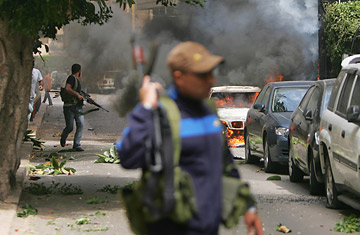 The Lebanese government took the first steps towards dismantling Hizbullah’s vital communications network. The opposition closed roads and demonstrated. Pro-government thugs shot at civilians, as they have done many times before. This time, the opposition responded decisively. Disciplined Hizbullah fighters and their unruly allies from Amal and the Syrian Social Nationalist Party quickly took control of West Beirut. Hundreds of Hariri’s Future militia surrendered. In the Shuf, pro-opposition and pro-government Druze forces fought it out, with the opposition winning. The north was messier. In Tripoli the Sunnis fought, Hariri supporters against Omar Karami’s opposition-linked group. Future men ransacked and burnt offices of the Ba’ath Party, of Ayatullah Fadlallah, Michel Aoun’s Free Patriotic Movement, and the Syrian Social Nationalists. (This party, by the way, is not Syrian but ‘Greater Syrian’; while the Ba’ath envisages a union of all Arab countries, the SSNP wants a state covering Syria, Lebanon, Jordan, Palestine, Iraq, Kuwait and – believe it or not – Cyprus, a Fertile Crescent state.) At the time of writing, things have calmed down in Tripoli.
So far, it looks like a clear victory for the opposition and a resounding defeat for the government and its Saudi and American backers. Hariri and Junblatt have been humiliated. Sinyura said he would let the army decide on Hizbullah’s communications network. The army accepted the offer and promptly declared that the resistance would be protected. It also announced that the Hizbullah-linked head of airport security would be reinstated. The government (if it is still the government) must be bitter that the army, which it had heralded as the symbol of a neutral state, has shown more understanding for the opposition than for the leaders who provoked it.
Sect or Sense?
The Lebanese government wants to remove surveillance cameras at Beirut airport, and has suspended the official in charge of airport security because of his links with Hizbullah. Hassan Nasrallah has responded by warning that the government plans to turn the airport into a base for the CIA and Mossad. For the last two days Hizbullah and Amal supporters have closed roads leading to the airport.
The government aims to dismantle Hizbullah’s communications system, which one minister referred to as “Iran telecom.” Nasrallah describes this move as “a declaration of war,” and he may not be exaggerating. Israeli inability to destroy Hizbullah communications in 2006 meant that Israel was unable to achieve any of its war aims. The destruction of the system now would leave Hizbullah vulnerable to assassinations and full scale military attack from Israel.
The Zanj Revolt
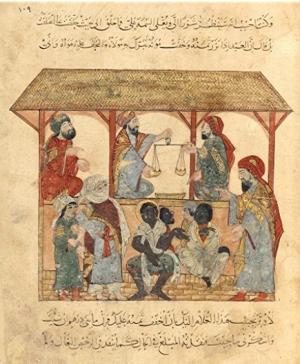 Working in intolerably humid conditions clearing the salt marshes of southern Mesopotamia, fed on a poor diet of dates and semolina, frequently racially abused, the ‘Zanj’ – east African slaves in 9th Century Iraq – rose in their hundreds of thousands in a revolt which lasted for 15 years. They conquered large parts of Iraq, Iran and Bahrain, held the city of Basra for a decade, established their own capital, and even minted their own currency.
As labour intensive activities such as mining and plantation agriculture had expanded in the Muslim empires, so the slave trade had developed, especially the commerce in African slaves. Simultaneously, cultural justifications for the enslavement of Africans multiplied, with many classical writers depicting blacks as slow-witted and bestial. One writer who did not rehearse the stereotype was Jahiz of Basra, himself perhaps of African origin, who wrote: “Everybody agrees that there is no people on earth in whom generosity is as universally well developed as the Zanj. These people have a natural talent for dancing to the rhythm of the tambourine, without needing to learn it. There are no better singers anywhere in the world, no people more polished and eloquent, and no people less given to insulting language. No other nation can surpass them in bodily strength and physical toughness. They are courageous, energetic, and generous, which are the virtues of nobility, and also good-tempered and with little propensity to evil. They are always cheerful, smiling, and devoid of malice, which is a sign of noble character.”
Flooding the Swamp
The metaphor most commonly used to describe terrorism and its backdrop is the one of the mosquitoes and the swamp, in which the mosquitoes are the bombers and the swamp is the much wider public which sympathises with and supports the terrorists, and from which the terrorists recruit. The metaphor is entirely accurate. It is not wishy-washy liberalism but cold logic to state that the only feasible method of defeating anti-Western Islamist terror in the medium to long term is to ‘drain the swamp’, by removing the grievances which inflame hundreds of millions of otherwise reasonable and tolerant Muslims against the West.
This does not mean surrendering Western values to an Islamist agenda but implementing common sense ‘do as you would be done by’ principles. Westerners too would be infuriated by foreign powers which occupied them, or which peppered their land with unwanted military bases, or laid siege to their elected governments, or propped up dictators who abused them.
If the West stopped violently interfering in the Muslim world, the Muslim world would stop violently replying. Certainly, a tiny hardcore of mosquitoes would continue to desire conquest of the infidels, but with their swamp dry, they would soon die off.
Cultural Capital
 One for tourists:
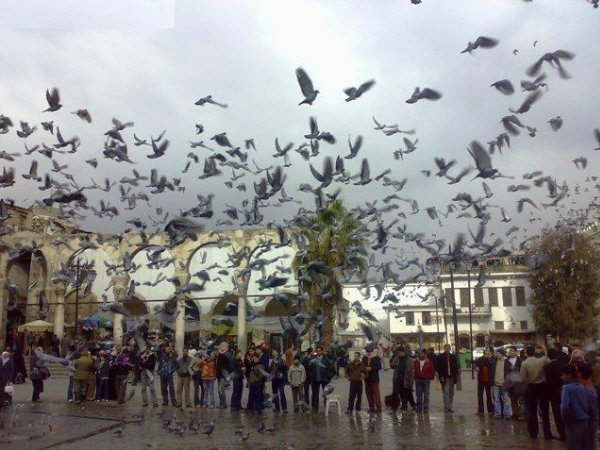
Damascus has been designated the UNESCO Arab cultural capital for 2008. This means different things to different people.
President Bashaar al-Assad, pointing to Syria’s role as the last remaining bastion of Arabism and its unashamed solidarity with Palestinian resistance, says “Damascus is the capital of resistance culture.” This interpretation, while unpopular with neighbouring regimes and the powers that dominate the region, is popular with the Syrian people – even if other aspects of the regime aren’t. And some international visitors this year will come primarily for a little resistance chic. This is the capital which welcomes Hugo Chavez and Hassan Nasrallah with equally widespread arms. Noam Chomsky will be giving a talk. Lebanese and pan-Arab diva Fairouz has already been, to the chagrin of some of her compatriots, to croon patriotic and revolutionary songs.
There will also be lectures and poetry recitals, architectural tours of the old city, theatre and ballet performances, art exhibitions, a film festival, and orchestral, jazz and traditional Arabic music concerts.
Damascus certainly deserves cultural capital status more than some cities that have held the title in previous years. After Beirut and Cairo, Damascus has the best bookshops in the Arab world. Syria has always boasted an impressive range of poets and musicians, and produces TV dramas which are of much higher quality than the Egyptian competition. Its taxi drivers can recite classical and contemporary poetry. Its pop singers sing Nizar Qabbani, the most influential and best loved modern Arab poet. Damascus is a city in which your host is likely to serenade you with his lute after dinner. And it is, as the tourism ministry likes to repeat, the oldest continuously inhabited city in the world.
Myth-Making
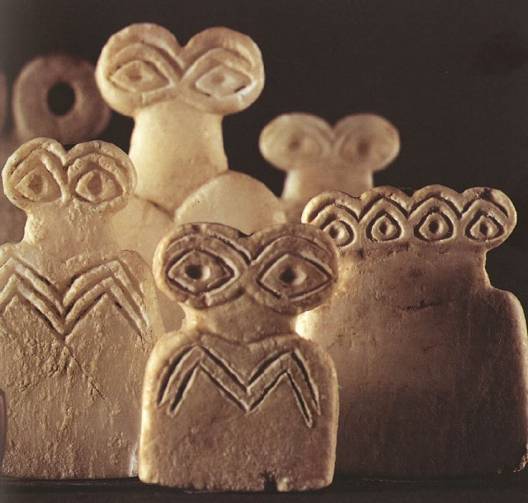 We often project our current political concerns backwards in time in order to justify ourselves. I say ‘we’ because everyone does it. Nazi Germany invented a mythical blonde Aryan people who had always been kept down by lesser breeds. The Hindu nationalists in India imagine that Hinduism has always been a centralised doctrine rather than a conglomerate of texts and local traditions, and describe Muslim, Buddhist, Christian, Sikh, Jain and animist influences on Indian history as foreign intrusions. Black nationalists in the Americas depict ancient Africa as a continent not of hunter-gatherers and subsistence farmers but as a wonderland of kings and queens, gold and silk, science and monumental architecture. To our current cost, Zionists and the neo-cons have been able to reactivate old Orientalist myths in the West, myths in which the entirety of Arab and Islamic history has involved the slaughter and oppression of Christians, Jews, Hindus, women, gays, intellectuals .. and so on.
Such retrospective mythmaking frequently goes to the most absurd extremes in young nations conscious of their weakness or of a need for redefinition (America may be one of these). Probably for that reason it is particularly evident in the Middle East.
A Tour of Upper Egypt
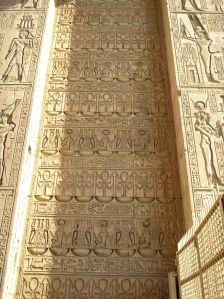 For a long time I’ve been fascinated by the first Mesopotamian civilisations, the Sumerians (whose art, I think, has never been surpassed), Akkadians and Babylonians, but I didn’t have much of an interest in pharaonic Egypt before my recent visit. I’d seen the Pyramids five years ago, and they hadn’t done much for me – perhaps because Cairo has grown around them, or perhaps because I’d seen too many pictures.
But Luxor’s Temple of Karnak astounded me. Unlike the vast, inhuman pyramids, it gives you a sense of the scale and complexity of the people who worked and worshipped here three and a half to four thousand years ago. On the walls, ceilings, statues and obelisks there is plenty of realist depiction as well as the static, formulaic art I expected. In many of the buildings the roof, or at least the lower storey’s roof, is still on. Karnak is far older – and because of the truly ancient religion, it feels far older – than the equally intact Greek stuff I’ve seen in Turkey and Syria.
The architecture of Karnak’s Hypostyle hall must be among the most impressive in the world, and the impression of wandering through its forest of columns is entirely unphotographable. It feels fertile, like an organised swamp, and there are stars painted on the ceiling’s stone beams.
For the first time I saw a continuity between ancient Egyptian and Islamic architecture, the same focus on line, space and light.The arranged columns reminded me, for instance, of the Great Mosque in Fes, with its contradictory evocation of crowdedness and endless expanse. Like the great mosque complexes, Egyptian temple compounds functioned as schools, meeting halls, hospitals and libraries as well as places of worship. Karnak has a sacred lake, and its priests performed ritual ablutions before worship, as Muslims do.
Turf War
We went out for dinner last night with Iraqi friends, refugees from Basra. Muhammad received a call from his family conveying some fairly typical Iraqi news: his sister’s son had made the mistake of walking in a public area. As a result, a random bullet became lodged in his lower leg. At the hospital they sent him away, telling him his wasn’t a serious case.
Our Basrawi friends describe the recent fighting as a war of vested interests, gangs fighting over turf and plunder, with one side backed by the greatest militia presence in Iraq: the Anglo-American occupation. They don’t recognise the mainstream Western media explanation, of the ‘government’ – as if Iraq were an independent nation – ‘clamping down’ – as if the attackers were a consensually accepted authority – on ‘militias and criminal gangs.’


 Qunfuz