Archive for the ‘Iraq’ Category
What Comes Next
This is the extended version of a piece published in today’s Sunday Herald.
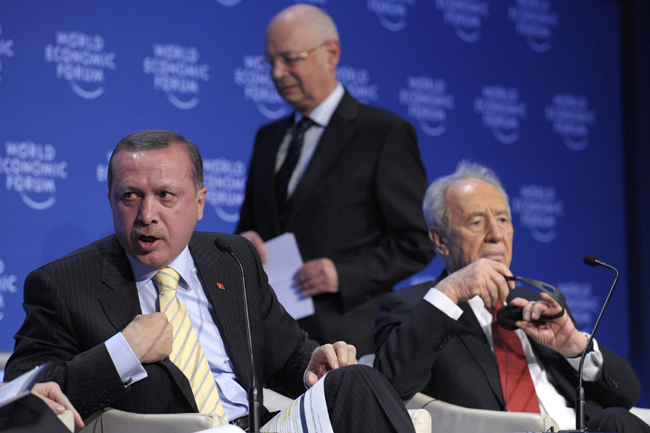
Erdogan reacts to his war criminal neighbour
A strange calm prevails on the Middle Eastern surface. Occasionally a wave breaks through from beneath – the killing of an Iranian scientist, a bomb targetting Hamas’s representative to Lebanon (which instead kills three Hizbullah men), a failed attack on Israeli diplomats travelling through Jordan – and psychological warfare rages, as usual, between Israel and Hizbullah, but the high drama seems to have shifted for now to the east, to Afghanistan and Pakistan. The Arab world (with the obvious exception of Yemen) appears to be holding its breath, waiting for what comes next.
Iraq’s civil war is over. The Shia majority, after grievous provocation from takfiri terrorists, and after its own leaderhip made grievous mistakes, decisively defeated the Sunni minority. Baghdad is no longer a mixed city but one with a large Shia majority and with no-go zones for all sects. In their defeat, a large section of the Sunni resistance started working for their American enemy. They did so for reasons of self-preservation and in order to remove Wahhabi-nihilists from the fortresses which Sunni mistakes had allowed them to build.
The collapse of the national resistance into sectarian civil war was a tragedy for the region, the Arabs and the entire Muslim world. The fact that it was partly engineered by the occupier does not excuse the Arabs. Imperialists will exploit any weaknesses they find. This is in the natural way of things. It is the task of the imperialised to rectify these weaknesses in order to be victorious.
The End of the Arabs?
In 2007 I read Peter W. Galbraith’s “The End of Iraq“, which suggests cutting Iraq into three mini-states, and then responded in two parts. The first part criticises Galbraith’s thesis, and the second part criticises the failures of Arabism. Both are merged below. More recently it has been revealed that Galbraith actually stood to gain financially from the dismantlement of Iraq.
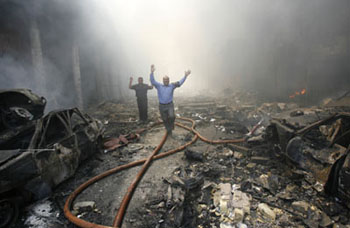
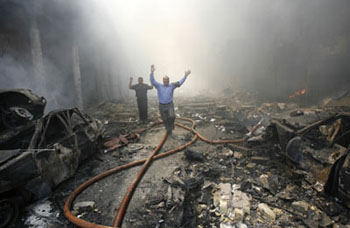
explosion at Baghdad's Mutanabi Street book market
Peter W. Galbraith’s book ‘The End of Iraq’ argues the initially persuasive thesis that Iraqis have already divided themselves into three separate countries roughly corresponding to the Ottoman provinces of Basra (the Shii Arab south), Baghdad (the Sunni Arab centre) and Mosul (the Kurdish north), and that American attempts to keep the country unified are bound to fail. I agree wholeheartedly with Galbraith’s call for America to withdraw from Iraq – America is incapable of stopping the civil war, and is in fact exacerbating it. (update: I stick by this. The civil war has to some extent calmed because of internal Iraqi dynamics, not because of the US ’surge’ – the Sunni forces turned on al-Qaida, and also realised that they had lost the battle for Baghdad and national power. Some groups then allied with the US for a variety of reasons to do with self-preservation). The rest of Galbraith’s argument is much more debatable.
Shoes and Bullets
George Bush has had shoes thrown at him in Baghdad. As he threw the first, Muntadar az-Zaidi shouted, “This is a goodbye kiss from the Iraqi people, dog.” As he threw the second, he added, “This is for the widows and orphans and all those killed in Iraq.” It was gratifying to see the Iraqi journalist’s human response to one of the destroyers of his country, even if it was woefully inadequate. In a just world, Bush would be imprisoned for the rest of his life (I oppose capital punishment even in the most deserving of cases).
Meanwhile the empire’s top criminals continue to spout self-justifying vomit. What do you say about a Condoleezza Rice? In an interview with the Wall Street Journal she says her regime removed the Taliban, but doesn’t say that America helped bring the Taliban to power in the first place, nor that the new Taliban is now winning against the occupation and its warlord/ druglord Afghan allies. She doesn’t say that Pakistan’s previously peaceful borderlands are controlled by the Pakistani Taliban, that hundreds of thousands have been displaced from these areas, that there are regular bomb attacks in Pakistan’s major cities, or that Pakistan faces the real possibility of collapse.
At The Empire’s Edge
Here’s a piece I wrote for the National about Arabs on Hadrian’s Wall.
 Beyond the fleeting days of summer, Hadrian’s Wall in the north of England is a cold place to be. I stood on a high ridge looking down the line of the Wall at black cloud building over the ruins of Housesteads fort. I was fully exposed to the wind, which carried small seeds of rain, and the mud covering my clothes seeped slowly towards my heart. For a moment I dreamt myself into the skin of an ancient soldier, one come here from warmer climes to serve his empire, and I shivered to my frozen toes. Then my son grinned, turned towards the fort, and with a delighted scream charged downwards, slaying imagined barbarians as he went.
We had set out early in the brisk morning from our home in south west Scotland, over bridges and past floods in low-lying fields. Streams gurgled in roadside ditches; pond-sized puddles occupied town centres. There’s enough water here to produce the illusion of hopping island to island through a vast archipelago.
Complex Origins
Sumerians at prayer
From a Muslim perspective, I’m used to seeing Judaism, Christianity and Islam as episodes within the same religion (which is not to deny their differences) – a series of revelations emanating from the same cultural locus. But since so many of the Abrahamic stories are inherited from earlier civilisations, even from the very first to write down stories, it may be that my definition of one religion, or at least one civilisation, should expand to include the earliest myths. Stories so early that we can reasonably guess their roots reach deep into our pre-civilised hunter-gatherer past.
Myth doesn’t mean untruth any more than a great novel does. Myth is heightened truth. A myth is perhaps more ‘true’ than reality because reality unfiltered is unstructured and unexplained. The fact that God uses human myths to talk to humans need not perturb the religious. “wa tilka al-amthal nadribuha lil-nas la’alahum yatafakiroon,” says the Qur’an. “We rehearse these parables to people in order that they may think.” From a religious perspective, the rehearsal of myths in sacred text is proof of God’s understanding of human minds. And where do the myths arise from anyway? From unforgotten events, and from us, from our shared Godstuff.
The Zanj Revolt
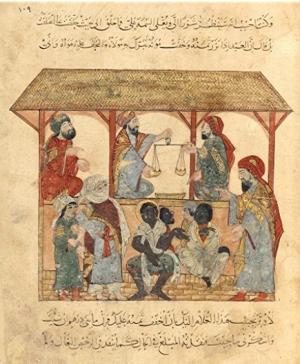 Working in intolerably humid conditions clearing the salt marshes of southern Mesopotamia, fed on a poor diet of dates and semolina, frequently racially abused, the ‘Zanj’ – east African slaves in 9th Century Iraq – rose in their hundreds of thousands in a revolt which lasted for 15 years. They conquered large parts of Iraq, Iran and Bahrain, held the city of Basra for a decade, established their own capital, and even minted their own currency.
As labour intensive activities such as mining and plantation agriculture had expanded in the Muslim empires, so the slave trade had developed, especially the commerce in African slaves. Simultaneously, cultural justifications for the enslavement of Africans multiplied, with many classical writers depicting blacks as slow-witted and bestial. One writer who did not rehearse the stereotype was Jahiz of Basra, himself perhaps of African origin, who wrote: “Everybody agrees that there is no people on earth in whom generosity is as universally well developed as the Zanj. These people have a natural talent for dancing to the rhythm of the tambourine, without needing to learn it. There are no better singers anywhere in the world, no people more polished and eloquent, and no people less given to insulting language. No other nation can surpass them in bodily strength and physical toughness. They are courageous, energetic, and generous, which are the virtues of nobility, and also good-tempered and with little propensity to evil. They are always cheerful, smiling, and devoid of malice, which is a sign of noble character.”
Turf War
We went out for dinner last night with Iraqi friends, refugees from Basra. Muhammad received a call from his family conveying some fairly typical Iraqi news: his sister’s son had made the mistake of walking in a public area. As a result, a random bullet became lodged in his lower leg. At the hospital they sent him away, telling him his wasn’t a serious case.
Our Basrawi friends describe the recent fighting as a war of vested interests, gangs fighting over turf and plunder, with one side backed by the greatest militia presence in Iraq: the Anglo-American occupation. They don’t recognise the mainstream Western media explanation, of the ‘government’ – as if Iraq were an independent nation – ‘clamping down’ – as if the attackers were a consensually accepted authority – on ‘militias and criminal gangs.’
Visiting Syria
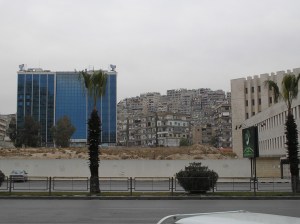
on Mezzeh autostrade
I’ve just given up smoking, again, after a relapse in Syria and Egypt. I mean, what can an ex-smoker do, returning to Sham? In Oman very few people smoke. Abu Dhabi airport, where I spent an hour in transit, is of course smoke-free. But in Damascus airport the passport officials were smoking, and the police, and the baggage handlers, and the passengers. So it continued in the taxi, and in the house, and almost everywhere else. I’m not complaining.
I spent a too-brief ten days in Syria, mainly shivering. It was minus seven one night. Coming out of the hot mineral-water baths (men stepping into the pools clutching their cigarettes) at Jbab and waiting ten minutes for a micro to the city, I froze. My hatless brother-in-law said it’s because I haven’t done military service. He started his in the winter time, standing at attention in his underwear on subzero mountainsides, assaulted by insults and buckets of cold water. “Great days!” he mused. “Happy memories!” So it was cold, but the Syrians grumbled that it hasn’t rained enough this year. There was a big snowfall just after I left, and there’s been another one today.
Very Guarded Optimism
The level of violence in Iraq is still remarkably high, and still nothing works. Compared with the situation a year ago, however, when there were hundreds of killings daily, Iraq today seems like a brave new world. In this very relative oasis of peace it has become possible to glimpse the kind of democracy which could conceivably work in Iraq. A successful democratic system would involve cooperation between local communities (not between sects), with the government a council of councils rather than a powerful centralised state apparatus holding the country together by force
Whenever they have had a chance, local communities have proved their mettle. Remember the role of the early Mahdi Army in stopping the looting triggered by the 2003 invasion, and in establishing basic services for the people. It was mosque committees, Sunni and Shia, which collected money in their neighbourhoods and paid teachers to return to the classrooms, and which organised work teams to repair local infrastructure. This was reminiscent of Hizbullah at its best: people in extremis relying on themselves, and doing what no external authority was willing or capable of doing.
But as we know, it all went horribly wrong. Society fragmented and the logic of violence took over. Local communities were silenced and then splintered by sectarian militias. In my post http://qunfuz.blogspot.com/2007/08/end-of-arabs-part-one.html I wrote about how the American destruction of the state was the major factor catalysing the civil war. Specific American actions led directly to the disaster: the initial unwillingness to countenance Iraqi rule followed by a sectarian approach to ‘representation’, the use of central-American style death squads to fight the Sunni resistance (the expert John Negroponte was imported for this), the dissolution of the army and the police so that criminal and sectarian gangs filled the void.
There was also of course an internal Iraqi dynamic motivating the conflict. Sunni-Shia tensions have bubbled for centuries, which is not to say that they are as essential and timeless as some orientalists would have us believe. The ostentatious Shia revival that followed the invasion, bursting forth like steam from a pressure cooker when the lid is suddenly removed, came as a result of the years of Ba’athist persecution. A frightened and dispossessed Sunni community made the fatal mistake of allowing al-Qa’ida and other Wahhabi nihilists to penetrate the resistance. If Shias preferred to wait to see what the new dispensation would bring them in terms of political power, most of them sympathised with the anti-American resistance. Al-Qa’ida’s bomb attacks, however, targetted first the new police, and then Shia civilians, in mosques and marketplaces, in their tens of thousands. After the April 2006 destruction of the dome of the Askari shrine in Samarra’, sacred to Shias as the burial place of the 11th Imam and as the place where the Imam al-Mahdi went into occultation, Shia militias responded with brute force. A mutual orgy of ethnic cleansing wrecked the country’s ancient fabric. Iraq became a kind of Lebanon, not only in the ferocity of its communal hatreds but also in its transformation into a battleground for regional rivals: Saudi Arabia versus Iran, and America in the paradoxical position of fearing Shia power more than the Sunnis, who were attached by their Saudi ties to the illusory ‘arc of moderation’ even if they housed al-Qa’ida.
In the summer of 2007 things started to improve. It would be unfair not to recognise that new American tactics have had a measure of success in calming Iraq. By putting thousands more American soldiers on the streets, the ‘surge’ concedes the idiocy of Donald Rumsfield’s military theories. But much more important than the surge has been the Sahwa or the ‘Awakening’ movement of Sunni tribes and resistance fighters reclaiming their towns from nihilist thugs. Just as the American invasion was the greatest gift to al-Qa’ida, the clear demonstration of al-Qaida’s brutality and sectarianism in areas where it took control demolished the illusion of its revolutionary purity in the eyes of Iraqis and the wider Muslim world. Sunni communities turned on those they’d previously sheltered and, with al-Qa’ida on the defensive, it became possible for the Shia to reach out to the Sunnis. Simultaneously, popular revulsion with the Mahdi Army’s excesses led Moqtada Sadr to declare a six-month suspension of activities, and to purge his organisation of the more criminal, more Sunni-murdering elements. There are signs too, especially since the farcical Annapolis ‘peace’ summit, of the Arab client states realising that America won’t rescue them from their crises of domestic credibility and regional destabilisation. Only a good working relationship with Iran can do that. Regional peacemaking may be reflected in internal Iraqi peacemaking.
It’s still far too early to be optimistic. Many of the Sunni ‘sahwa’ militias may have calculated that a period of peace, and of getting into the Americans’ good books, will provide them with training opportunities and weapons so that they succeed in round two of the civil war. Hating the excesses of al-Qa’ida does not mean loving the new Shia power structure. The government, consisting mainly of politicians sponsored by Shia and Kurdish militias, has so far agreed to employ only 6% of Sunni volunteers in the state security forces. So it may be that the worst is still to come. Beyond the Sunni-Shia conflict, the battle between Muqtada Sadr’s Iraqi-nativist Mahdi Army and the currently pro-American, traditionally Iranian-backed Supreme Islamic Iraqi Council seems to be on temporary hold. And militia forces are only conducive to peace and order to the extent that they represent local people, not the politics of a local strong man.
But I’ve been reading reports not only of cooperation between Sunni and Shia militias in neighbouring areas, but of mixed militias, and even of mixed militias negotiating the reversal of ethnic cleansing. In some areas of Baghdad, families are actually returning to their homes in areas where the other sect dominates.
This is something to thank God for. If against the odds the trend towards peace continues, a large number of the educated professionals that Iraq has lost may return home. Iraqis will then face two huge challenges: to expel the American occupation, which is digging in for the coming decades, and to either remove the corrupt and failed political elite which arrived with the American tanks or to impress upon it the necessity of non-sectarian national politics and real economic and political sovereignty. These challenges can only be met by a unified Iraqi people. A democracy based on community action could lead to unity. Is good news possible in Iraq?
Osama bin Laden
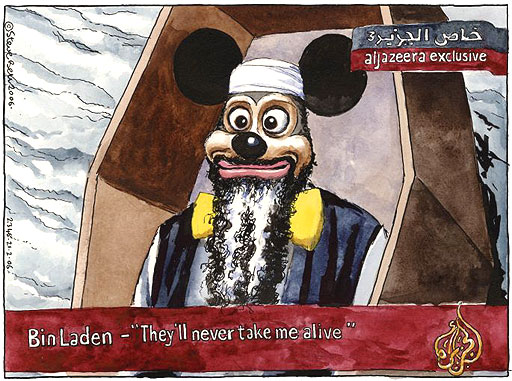
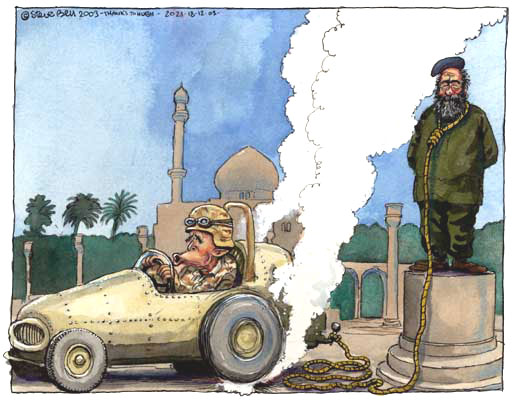
- by Steve Bell
Osama bin Laden squeezed his face back onto our screens at the start of Ramadan. This time, probably advised by his American follower Adam Gadahn, he tailored his discourse to a Western audience, and tainted by association the good names of Noam Chomsky and the anti-globalisation movement. Before Ramadan ends, let me talk briefly about bin Laden and those associated with him.
Still when bin Laden’s name is mentioned in many parts of the Arab world, although less so than a couple of years ago, a cheer goes up. Let’s hope that Martin Amis never reads this; he would see it as proof of his thesis that all Muslims are Wahhabi-nihilists. But cheering for bin Laden is like waving a flag or, more accurately, waving two fingers. It doesn’t mean that the cheering people would like to be ruled by bin Laden or that they subscribe to his programme, as they admit when questioned. Many of these ‘supporters’ would be killed if bin Laden could get his hands on them, either for being ‘heretics’ – like my Ibadhi Muslim students here in Oman – or for being ‘apostates’ – like the men in a bar in Aleppo in the following anecdote. These drinkers were well into their third or fourth bottle of araq when bin Laden came on the TV screen. “I swear by almighty God,” said Osama, his finger wagging, “that the Americans will not sleep soundly in their beds until the children of Palestine sleep soundly in theirs!” Immediately the men surged to their feet and held their glasses towards the TV image. “Kassak!” they roared – which means “Your glass!” or “Cheers!”
This story says it all. Beyond the tiny hardcore of Wahhabi-nihilists, bin Laden won sympathy in the Arab world because the Arabs will support anyone who talks tough against America and Israel. This is a symptom of the frustration and impotence felt by the Arabs, and the utter failure of their leaders to stand against Zionist and imperialist oppression in the region. Cheering for bin Laden is the equivalent of the protest vote. And inasmuch as al-Qa’ida targets America, the victim does not behave in a way designed to win sympathy. Before they had time to consider the implications of the September 11th attacks, many Arabs were impressed that this superpower which routinely trashed Muslim cities could be so dramatically humiliated. Central New York looked like Baghdad or Gaza, and to many that was an understandable cause for celebration. People in China and Latin America also celebrated September 11th. I’ve even heard – from a friend who was living in California at the time – that some Black and Hispanic Americans were gleeful about the attacks.
The End of the Arabs? Part Two
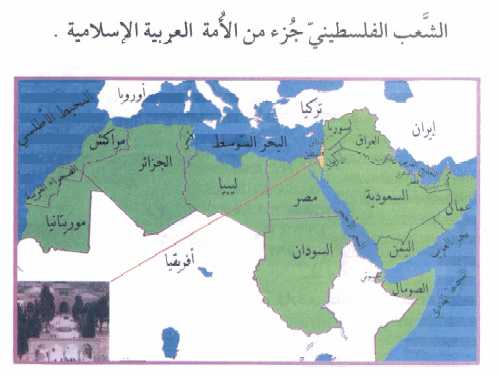 Peter W. Galbraith writes that Iraq is an artificial creation made up of different ethnic groups. This is true, but Iraq is not alone in its artificiality. All states are artificial in that they have been created by historical process and human machination, not by God or nature, and all contain different ethnic groups. More specifically, the centralised nation state in the Middle East (and Africa and much of Asia) is always artificial because the very concept of the nation state is an import from 19th Century Europe. The borders of every Arab state were determined, suddenly, by imperialism, and not by the long processes of war, negotiation and ideological mythmaking that drew borders in Europe. It is this imperialist division of the Arabs which has led to various forms of pan-Arab nationalism.
The definition of ‘Arab’ has expanded over the last hundred and fifty years from describing tribal nomads as opposed to townsmen, to describing the people of the Arabian peninsula, and then to describe all from the Atlantic Ocean to the Gulf who share the heritage of the Arabic language.
The Ba’ath Party went so far as to find religious significance in ‘Arab,’ as is evident from the slogan ‘One Arab Nation bearing an Eternal Message.’ The ‘risala’ or message is what Arabs would previously have assumed to be the revelation of the Prophet (more often called Messenger in Arabic) Muhammad. The word used for ‘nation’ is ‘umma’ – a word previously used to denote the international Muslim community. In fact, Ba’athism should be seen as one of the twentieth century’s many attempts to compensate for the collapse of traditional religion (Nazism, Zionism, Stalinism, contemporary Wahhabism and hedonist consumerism are others).
The End of the Arabs? Part One
 Peter W. Galbraith’s book ‘The End of Iraq’ argues the initially persuasive thesis that Iraqis have already divided themselves into three separate countries roughly corresponding to the Ottoman provinces of Basra (the Shii Arab south), Baghdad (the Sunni Arab centre) and Mosul (the Kurdish north), and that American attempts to keep the country unified are bound to fail. I agree wholeheartedly with Galbraith’s call for America to withdraw from Iraq – America is incapable of stopping the civil war, and is in fact exacerbating it. (update: I stick by this. The civil war has to some extent calmed because of internal Iraqi dynamics, not because of the US ‘surge’ – the Sunni forces turned on al-Qaida, and also realised that they had lost the battle for Baghdad and national power. Some groups then allied with the US for a variety of reasons to do with self-preservation). The rest of Galbraith’s argument is much more debatable.
For a start, he minimises the extent to which the US occupation has contributed to the disintegration of Iraq. I do not wish to deny the sectarian and ethnic fractures which exist in Iraq and other Arab countries, but it is reasonable to expect that any country, having suffered dictatorship, war, sanctions, and then the overnight collapse of all its institutions, would enter a period of chaos and division. Galbraith accurately records Western support for Saddam Hussain throughout the Iran-Iraq war, when he was gassing Kurds, and the American refusal to intervene when Republican Guards were slaughtering southern Shia in 1991 (the massacres happened under the eyes of American forces occupying the south at the end of the Kuwait war). He describes the criminal failure in 2003 of the occupying forces to stop the looting and burning of every ministry except the oil ministry, of military arsenals and even yellowcake uranium stocks the Americans claimed to be so concerned about in the run-up to the invasion, and of the national museum and national library. (He doesn’t examine claims made at the time by Robert Fisk and others that masked men with Kuwaiti accents were bussed in to certain ministries to set fires professionally.) The attack on Iraq’s – and the world’s – heritage is of course a cultural crime far greater than the despicable Taliban destruction of the Bamyan Buddha statues. Bombing and looting ravaged what was left of Iraq’s civilian infrastructure. The Iraqi state was destroyed within the first week of occupation, long before the sectarian killing began.
Bad Signs
Two things. First, Shaikh Yusuf Qaradawi. A ‘moderate conservative’ linked to the Egyptian Muslim Brotherhood, Qaradawi has previously made positive statements about the need for Sunni-Shia unity, particularly in Iraq. At the Doha Inter-Islamic Dialogue Conference a couple of days ago he condemned the cleansing of Sunnis from mixed or Shia areas. “No one can tolerate such unspeakable hatred,” he said. “Sunnis are suffering more in Iraq. I had repeatedly called upon the Shia scholars and leaders in Iraq and Iran to intervene to stop this bloodshed.” He continued, “Iran has influence in Iraq. It can stop this violence and put out the fire that could destroy everything.” Then he went on to complain about Shia attempts to convert Sunnis living in Sunni majority nations.
Qaradawi was right to raise the issue of Shia death squads. He was wrong to keep silent about Salafi/ Baathist/ extremist Sunni terrorism. The Shia of Iraq put up with more than two years of massacres before they began to respond.
Escalation
It seems this broken region, and this broken world, are in for a further escalation of conflict in 2007.
The report of the US Congress-mandated Iraq Study Group recommended that US forces end direct participation in combat operations in Iraq and concentrate on training Iraqi troops instead. It also called for American dialogue with both Iran and Syria for the sake of stabilising Iraq. Although the report failed to recognise the gravity of the problems in Iraq (that there are no ‘Iraqi’ troops, for instance, only militiamen) or to propose serious political solutions, and although its authors still envisaged a long-term American controlling presence in the country, it nevertheless represented an acknowledgment that America is failing in Iraq, and an attempt to limit the damage.
Bush and his people are ignoring the report. Who are Bush’s people? On the one hand, there are traditional right-wing Republicans who are unable to countenance defeat, the kind of people who don’t understand that America was militarily defeated in Vietnam. If it hadn’t been for hippies and weak politicians at home, they think, we’d have smashed the Cong. We won’t be defeated again! And there are neo-con nihilists, believers in ‘creative chaos,’ ideologues often more loyal to Israel’s perceived interests than to America’s. Many commentators have claimed the neo-cons are in decline: I fear not. They have been repositioning, certainly – blaming Bush and Rumsfield for the conduct of the war in Iraq (but not the war itself), making themselves more attractive to the right-wing of the Democratic party. It is very important to remember that as far as large sections of the American ruling class are concerned the Iraq war has not been a failure.
Executing Saddam
 On his excellent ‘In the Axis’ blog (http://www.readingeagle.com/blog/syria/) Brian Anthony complains about the Sunni Arab world and international organisations protesting the execution of Saddam Hussain. Quite rightly, Brian objects to the tendency of many Sunnis to turn a blind eye to Saddam’s crimes. He also suggests that Sunnis may actively support repression of Shia in Iraq.
Saddam was certainly a murderous tyrant. He was helped to power by the CIA first in order to destroy the powerful Iraqi Communist Party, and then funded and armed by the US, Europe and the Gulf regimes to attack revolutionary Iran. He poisoned Iranian cities and Kurdish villages (Iraqi Kurdish militias were in alliance with Iran at the time) with gas. After falling into the American trap and invading Kuwait, he dealt with the 1991 intifada in the south and north of Iraq by annihilating whole clans and villages. This is when the sectarian horror really began to take a grip on Iraq. Tanks painted with the slogan ‘No Shia after Today’ moved into southern cities, and provided ample filling for mass graves. The aunt of one of my friends was driven insane when her sons were tortured to death by Saddam’s mukhabarat: just one story from very many. Saddam didn’t only build the worst secret police state in the Middle East, he actually organised rape squads, and special rape rooms, to destroy Iraqi women and Iraqi family honour. His victims number in the hundreds of thousands, and millions if you include the wars he started.
I still think it is legitimate to oppose his execution for a variety of reasons.



 Qunfuz