Archive for the ‘Sectarianism’ Category
Some Shock, No Awe
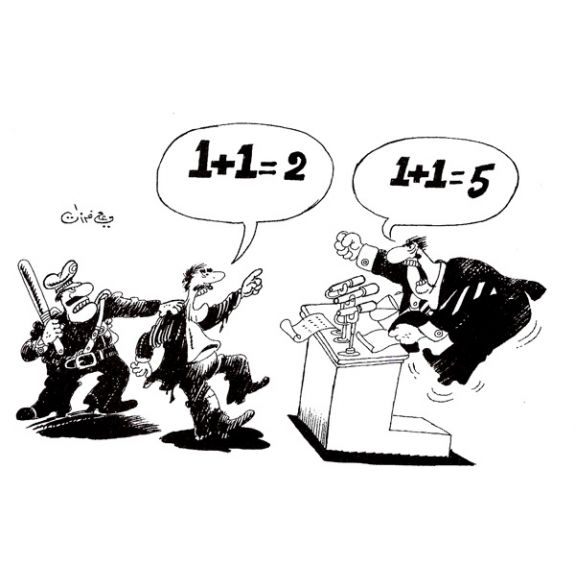
picture by Ali Farzat
By last Friday, if it hadn’t already done so, the Syrian regime effectively declared war on its own people, killing at least a hundred protestors. Throughout this week parts of Syria have fallen under outright siege. The tanks and infantry which haven’t peeped across the occupied Golan since 1973 entered the southern city of Dara’a, cutting roads, telephone and internet, water and electricity. Reports from the city speak of food shortages, generalised terror, and corpses stinking in the streets. Snipers are firing at pedestrians in the Damascus suburb of Douma. Tanks surround the coastal city of Banyas. Madaya, a mountain town on the Lebanese border, is also occupied. The regime may wish to stop weapons being smuggled across the border, or it may wish to stop Syrians fleeing via the smuggling routes. Thousands have crossed to Lebanon in recent days, and at least five hundred have been rounded into the regime’s torture chambers.
The violence has been massive, but also tactically applied. The sudden escalation is intended to shock the population into obedience. Yet live ammunition has not been used everywhere. Security forces have tried not to kill protesting Kurds in the north east, fearing that would trigger a genuine armed insurrection. Demonstrations in central Damascus have been dispersed with batons and tear gas rather than live fire. The regime doesn’t want to kill the sons of important businessmen, not yet at least.
Great Friday
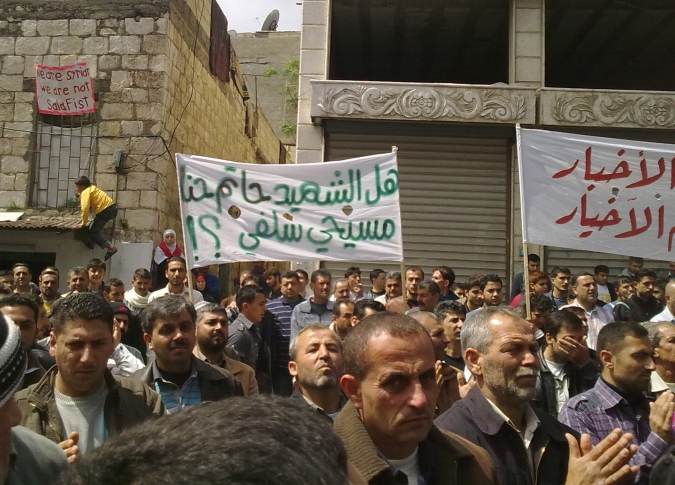
banner reads: was the martyr Hatem Hana, a Christian, also a Salafi?
Yesterday President Bashaar al-Asad lifted the Emergency Law, dissolved the notorious State Security Courts, and legalised peaceful protests.
After the president’s decree, a lawyer asked permission to hold a protest in Hasakeh. He was detained by security forces.
Today – ‘Great Friday’ – large, peaceful, unarmed protests were held in all regions of the country. Police, army and militia used tear gas, electric rods and live ammunition against the people. At least 88 sons and daughters of Syria were murdered. Regime forces prevented some of the wounded from receiving medical help. Other wounded have been arrested from their hospital beds. (Here are ugly scenes in Homs).
Damascus is under lockdown, mukhabarat clustering on every corner. Someone I know tried to cross the city today for entirely apolitical reasons. During the journey he was taken off the bus (with everyone else) and marched to a police station where he was questioned and his details recorded. But protests and gunfire still roared from the suburbs as far into the city’s heart as Meedan.
Words are one thing, actions another. The president’s words have no meaning at all.
Dinosaur in Denial
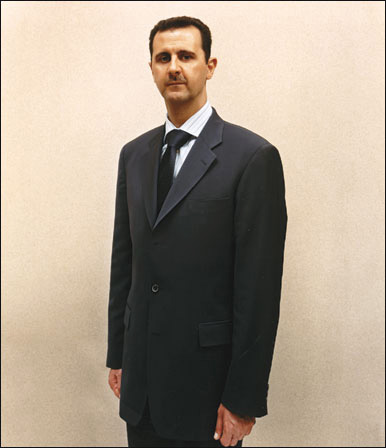 Until recently it seemed that Syria, along with wealthy Saudi Arabia, was the state least likely to fall to the revolutionary turmoil sweeping the Arab region.
The first reason for the Asad regime’s seeming stability is Syrian fear of sectarian chaos. Beyond the Sunni Arab majority, Syria includes Alawis (most notably the president and key military figures), Christians, Ismailis, Druze, Kurds and Armenians, as well as Palestinian and Iraqi refugees. The state has achieved a power balance between the minorities and rural Sunnis while building an alliance with the urban Sunni business class. This means that Syria is the best place in the Middle East to belong to a religious minority, certainly better than in ‘liberated’ Iraq or in the Jewish state, and for a long time domestic peace under authoritarianism has looked more attractive than the neighbouring sectarian and strife-torn ‘democracies’ in Lebanon and Iraq (the American dismantling of the Iraqi state provided a serious blow to Arab democratic aspirations, neo-con fantasies notwithstanding).
Syria Speeding Up
Three weeks ago I wrote that Syria was not about to experience a popular revolution. Although I’m no longer sure of anything after the events in Tunisia and Egypt (and Libya, Algeria, Jordan, Yemen and Bahrain) – and although it’s made me unpopular in certain quarters – I’m sticking to my original judgement. No revolution in Syria just yet.
A Different Kind of Dominoes
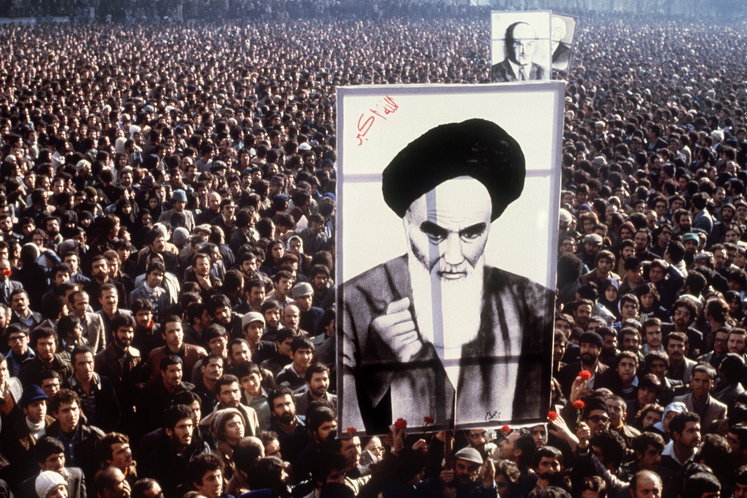
AFP Photo
I ended my last post like this:
“Perhaps in six months’ time non-Arab commentators will decide that the Tunisian revolution was a mere anomaly in an eternally stagnant Arab world. But they’ll be wrong. The revolution will exert a long-term pervasiveness throughout Arab culture, as the Iranian revolution did before it. It will change the air the Arabs breathe and the dreams the Arabs dream.”
Well, it seems I was wrong on the timescale. I should have said six minutes. Today several commentators are indeed arguing that the Tunisian revolution is anomalous. Robert Fisk is pessimistic, contending that the Tunisian people are no match for the combined forces of the Tunisian elite and Western imperialism. Perhaps events will prove him right. Steve Walt fears that those expecting immediate regime change from the Ocean to the Gulf will be rapidly disappointed.
His point is a good one. In the frontline states with Israel, foreign policy issues increase in importance because they have the potential to immediately translate into security issues. The Syrian regime, for instance, may be unpopular for its corruption, bureaucracy, and stifling of dissent, but its foreign policy is broadly in line with Syrian opinion – and in Syria this matters a great deal. The Western clients are more vulnerable to protest, not least because they’re more linked into the ‘globalised’ economy and are thus more vulnerable to dramatic fluctuations in the price of essential goods. Yet even in Jordan legitimate fears of an Israeli intervention (perhaps an attempt to fulfill the Jordan-is-Palestine fantasy) could damp down effervescence. The public in many countries seems too split by sect, ethnicity or tribe to coordinate unified protest. And of course the regimes will now be battening down for fear of Tunisian contagion.
Horror and Hope
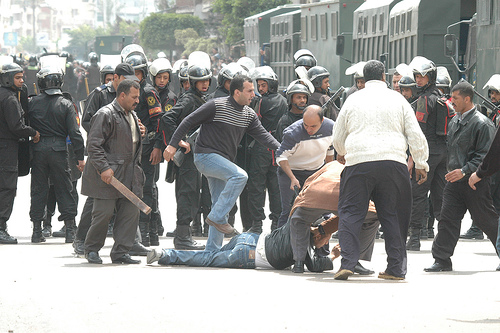
Egyptian police break a Copt's leg. Photo by Nasser Nouri
It currently seems there is a real danger of the Middle East losing its millenia-old diversity. Iraq’s post-invasion civil war separated the country’s Shia and Sunni communities, driving millions into exile. Pro-Western Arab regimes continue to spew vicious anti-Shia propaganda, which is heard by important sections of society. Now Wahhabi-nihilists have declared open season on Iraq’s ancient Christian community. Palestine was cleansed of its natives in 1947/48 and transformed into a Jewish ethno-state. Zionism and a new Muslim chauvinism have reduced the Christian proportion of the West Bank from 15% in 1950 to 2% today. And the New Year brought news of an appalling attack on Egyptian Copts, an increasingly oppressed and alienated community.
Informed observers will know that there is nothing essential or ‘ages-old’ about the emerging sectarian chaos. Sectarianism had receded almost to irrelevance amongst the generations of Arabs that believed they were on their way to true independence. Foreign partitions and occupations did a large part to crush that dream. Totalitarianism and economic and educational failures (often the policies of foreign-backed regimes) did the rest. In Egypt’s case, the Mubarak regime has dealt with its Islamist challenge in two ways: politically, it has rigged elections ever more blatantly and persecuted its visible opponents; socially, it has given way to the most retrograde desires of Islamism (forbidding the construction of churches, banning books) and done its best to whip up petty chauvinism over the most ridiculous of pretexes (for instance the mutual football hooliganism of Egyptian and Algerian fans).
The End of the Arabs?
In 2007 I read Peter W. Galbraith’s “The End of Iraq“, which suggests cutting Iraq into three mini-states, and then responded in two parts. The first part criticises Galbraith’s thesis, and the second part criticises the failures of Arabism. Both are merged below. More recently it has been revealed that Galbraith actually stood to gain financially from the dismantlement of Iraq.
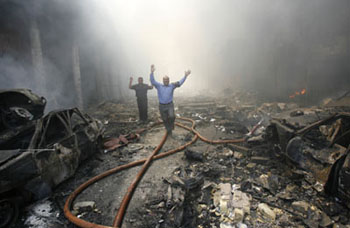
explosion at Baghdad's Mutanabi Street book market
Peter W. Galbraith’s book ‘The End of Iraq’ argues the initially persuasive thesis that Iraqis have already divided themselves into three separate countries roughly corresponding to the Ottoman provinces of Basra (the Shii Arab south), Baghdad (the Sunni Arab centre) and Mosul (the Kurdish north), and that American attempts to keep the country unified are bound to fail. I agree wholeheartedly with Galbraith’s call for America to withdraw from Iraq – America is incapable of stopping the civil war, and is in fact exacerbating it. (update: I stick by this. The civil war has to some extent calmed because of internal Iraqi dynamics, not because of the US ’surge’ – the Sunni forces turned on al-Qaida, and also realised that they had lost the battle for Baghdad and national power. Some groups then allied with the US for a variety of reasons to do with self-preservation). The rest of Galbraith’s argument is much more debatable.
Sectarian Rabble-Rousing
Al-Ahram Weekly, the English language twin of the Arabic daily, is an Egyptian state organ. The Weekly has a broader range of opinion than the tame daily, and does often contain interesting articles. The great Palestinian thinker Azmi Bishara, for instance, can be found in the Weekly. Unfortunately, however, Egyptian regime nonsense concerning the Persian-Shia ‘threat’ is also fed into the mix. This article by Galal Nassar is a sad example. Below is my response to his piece:
Dear Mr Nassar
I am not a Shia Muslim. If I were, I would not be a supporter of the velayat-e-faqih system. I agree with you entirely that the velayat-e-faqih concept is a perversion of traditional Shia ideas. I also agree that velayat-e-faqih leads to authoritarian government, to the detriment of Iranian society.
If it is authoritarianism that bothers you, however, I wonder why you single out Iran, which is at least a semi-democracy. The dictatorship in Egypt seems a much better target, especially after the mass arrests of recent weeks. Another good target is the barbaric dictatorship in Saudi Arabia. As a Sunni Muslim, I am outraged by the Wahhabi perversion of Islam that holds sway in that country.
My Absence, and a Sad Marriage
I apologise from my absence. I’ve been very busy. I’ll be back soon, but for now I’ll post something from Conflicts Forum. I’ll post it because it clarifies the already clear truth that Salafism, whether the Salafis know it or not, has an inherent opposition to genuine resistance in the Arab and Muslim worlds. Below you’ll read about the marriage of Wahhabi nihilism and Arab fascism, and how its purpose is to deepen the Empire’s control by encouraging the people to hate each other. And there is further clarification of how very unlike this twisting, thrusting couple (Mr. Salafi and Mr. Fascist – it’s a same-sex partnership) are organisations like Hizbullah and Hamas.
The honeymoon after the wedding was remarkable for its dog-gnawed corpses, and for the smiles on the faces of fat businessmen and kings.
(I recommend Conflicts Forum’s intelligent and detailed articles. The three-part report on how Hizbullah defeated Israel in 2006 is fascinating.)
Visiting Syria
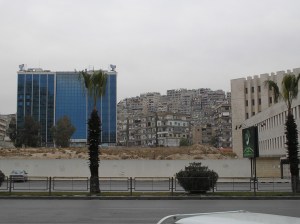
on Mezzeh autostrade
I’ve just given up smoking, again, after a relapse in Syria and Egypt. I mean, what can an ex-smoker do, returning to Sham? In Oman very few people smoke. Abu Dhabi airport, where I spent an hour in transit, is of course smoke-free. But in Damascus airport the passport officials were smoking, and the police, and the baggage handlers, and the passengers. So it continued in the taxi, and in the house, and almost everywhere else. I’m not complaining.
I spent a too-brief ten days in Syria, mainly shivering. It was minus seven one night. Coming out of the hot mineral-water baths (men stepping into the pools clutching their cigarettes) at Jbab and waiting ten minutes for a micro to the city, I froze. My hatless brother-in-law said it’s because I haven’t done military service. He started his in the winter time, standing at attention in his underwear on subzero mountainsides, assaulted by insults and buckets of cold water. “Great days!” he mused. “Happy memories!” So it was cold, but the Syrians grumbled that it hasn’t rained enough this year. There was a big snowfall just after I left, and there’s been another one today.
Osama bin Laden
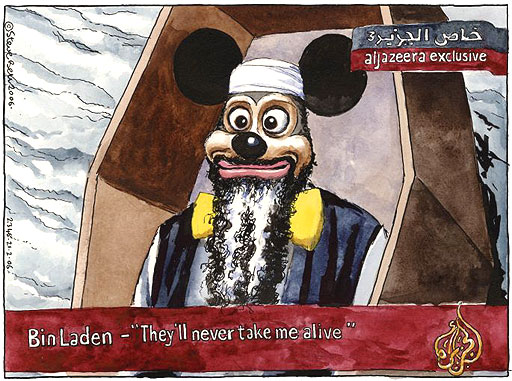
- by Steve Bell
Osama bin Laden squeezed his face back onto our screens at the start of Ramadan. This time, probably advised by his American follower Adam Gadahn, he tailored his discourse to a Western audience, and tainted by association the good names of Noam Chomsky and the anti-globalisation movement. Before Ramadan ends, let me talk briefly about bin Laden and those associated with him.
Still when bin Laden’s name is mentioned in many parts of the Arab world, although less so than a couple of years ago, a cheer goes up. Let’s hope that Martin Amis never reads this; he would see it as proof of his thesis that all Muslims are Wahhabi-nihilists. But cheering for bin Laden is like waving a flag or, more accurately, waving two fingers. It doesn’t mean that the cheering people would like to be ruled by bin Laden or that they subscribe to his programme, as they admit when questioned. Many of these ‘supporters’ would be killed if bin Laden could get his hands on them, either for being ‘heretics’ – like my Ibadhi Muslim students here in Oman – or for being ‘apostates’ – like the men in a bar in Aleppo in the following anecdote. These drinkers were well into their third or fourth bottle of araq when bin Laden came on the TV screen. “I swear by almighty God,” said Osama, his finger wagging, “that the Americans will not sleep soundly in their beds until the children of Palestine sleep soundly in theirs!” Immediately the men surged to their feet and held their glasses towards the TV image. “Kassak!” they roared – which means “Your glass!” or “Cheers!”
This story says it all. Beyond the tiny hardcore of Wahhabi-nihilists, bin Laden won sympathy in the Arab world because the Arabs will support anyone who talks tough against America and Israel. This is a symptom of the frustration and impotence felt by the Arabs, and the utter failure of their leaders to stand against Zionist and imperialist oppression in the region. Cheering for bin Laden is the equivalent of the protest vote. And inasmuch as al-Qa’ida targets America, the victim does not behave in a way designed to win sympathy. Before they had time to consider the implications of the September 11th attacks, many Arabs were impressed that this superpower which routinely trashed Muslim cities could be so dramatically humiliated. Central New York looked like Baghdad or Gaza, and to many that was an understandable cause for celebration. People in China and Latin America also celebrated September 11th. I’ve even heard – from a friend who was living in California at the time – that some Black and Hispanic Americans were gleeful about the attacks.
The End of the Arabs? Part One
 Peter W. Galbraith’s book ‘The End of Iraq’ argues the initially persuasive thesis that Iraqis have already divided themselves into three separate countries roughly corresponding to the Ottoman provinces of Basra (the Shii Arab south), Baghdad (the Sunni Arab centre) and Mosul (the Kurdish north), and that American attempts to keep the country unified are bound to fail. I agree wholeheartedly with Galbraith’s call for America to withdraw from Iraq – America is incapable of stopping the civil war, and is in fact exacerbating it. (update: I stick by this. The civil war has to some extent calmed because of internal Iraqi dynamics, not because of the US ‘surge’ – the Sunni forces turned on al-Qaida, and also realised that they had lost the battle for Baghdad and national power. Some groups then allied with the US for a variety of reasons to do with self-preservation). The rest of Galbraith’s argument is much more debatable.
For a start, he minimises the extent to which the US occupation has contributed to the disintegration of Iraq. I do not wish to deny the sectarian and ethnic fractures which exist in Iraq and other Arab countries, but it is reasonable to expect that any country, having suffered dictatorship, war, sanctions, and then the overnight collapse of all its institutions, would enter a period of chaos and division. Galbraith accurately records Western support for Saddam Hussain throughout the Iran-Iraq war, when he was gassing Kurds, and the American refusal to intervene when Republican Guards were slaughtering southern Shia in 1991 (the massacres happened under the eyes of American forces occupying the south at the end of the Kuwait war). He describes the criminal failure in 2003 of the occupying forces to stop the looting and burning of every ministry except the oil ministry, of military arsenals and even yellowcake uranium stocks the Americans claimed to be so concerned about in the run-up to the invasion, and of the national museum and national library. (He doesn’t examine claims made at the time by Robert Fisk and others that masked men with Kuwaiti accents were bussed in to certain ministries to set fires professionally.) The attack on Iraq’s – and the world’s – heritage is of course a cultural crime far greater than the despicable Taliban destruction of the Bamyan Buddha statues. Bombing and looting ravaged what was left of Iraq’s civilian infrastructure. The Iraqi state was destroyed within the first week of occupation, long before the sectarian killing began.
Bad Signs
Two things. First, Shaikh Yusuf Qaradawi. A ‘moderate conservative’ linked to the Egyptian Muslim Brotherhood, Qaradawi has previously made positive statements about the need for Sunni-Shia unity, particularly in Iraq. At the Doha Inter-Islamic Dialogue Conference a couple of days ago he condemned the cleansing of Sunnis from mixed or Shia areas. “No one can tolerate such unspeakable hatred,” he said. “Sunnis are suffering more in Iraq. I had repeatedly called upon the Shia scholars and leaders in Iraq and Iran to intervene to stop this bloodshed.” He continued, “Iran has influence in Iraq. It can stop this violence and put out the fire that could destroy everything.” Then he went on to complain about Shia attempts to convert Sunnis living in Sunni majority nations.
Qaradawi was right to raise the issue of Shia death squads. He was wrong to keep silent about Salafi/ Baathist/ extremist Sunni terrorism. The Shia of Iraq put up with more than two years of massacres before they began to respond.



 Qunfuz