Archive for the ‘Syria’ Category
Syria Comment
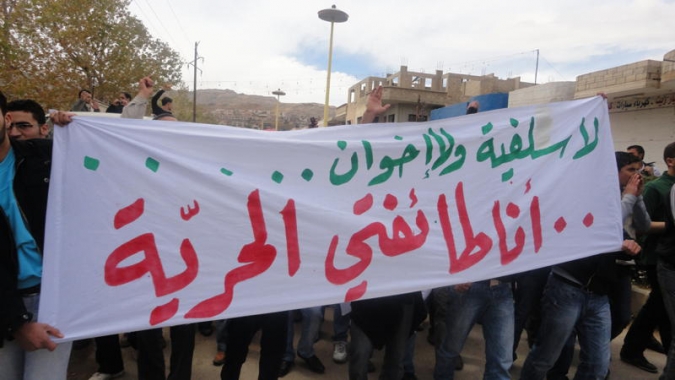
Protest in Zabadani: "My Sect is Freedom."
The Syria Comment website is an indispensable source for news and views on Syria. Unfortunately, it now requires a health warning.
In a recent article Joshua Landis writes that the protestors “failed to provoke a confessional split in the army as happened in Lebanon. Sunni soldiers have not split from Alawis, despite all the talk about “shabbihas,” which is code for Alawis.”
This, as so often in recent weeks, is an example of Syria Comment taking leave of reality in order to slander the uprising. I’ve been following activist websites and facebook pages, and talking to Syrians of a range of backgrounds. I haven’t come across anyone who aimed to achieve a ‘confessional split’ in the army. Of course, the protestors wanted a split in the army, between patriots and the dogs of the state. They wanted Syrian soldiers to refuse to fire on unarmed Syrian people, and it seems in Dara’a they got what they wished for. Nobody wanted a confessional split.
Blundering and Adapting
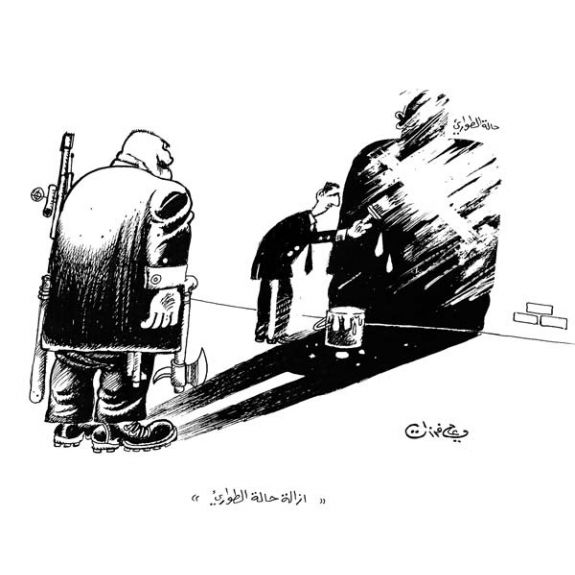
cancelling the state of emergency, by Ali Farzat
Like all Syrians pure or hyphenated I’ve been regarding my father’s country over the last weeks with the utmost horror. The Damascus suburb where I got married is currently sealed off by tanks, its dovecots occupied by snipers. When I lived and worked there, Syria felt like a land of promise. Did it have to come to this?
On the one hand, Hafez al-Asad, father of the present president of Syria, was a ruthless dictator who put down a violent uprising (in the 1980s) by slaughtering 20,000 people in the city of Hama. On the other, his regime brought stability after two decades of non-stop coups, provided services to urban and rural areas alike, educated a middle class to staff the public sector, and based its legitimacy, often with good reason, on a nationalist foreign policy.
The regime liberalised somewhat in the latter years of Hafez’s reign, once the Islamist opposition had been neutralised. Syria remained a dictatorship, dissidents were still jailed, but it was no longer a country of fear. When Bashaar took over from his father eleven years ago Syrians hoped for accelerated reform within continued stability. And the regime did make a good start at liberalising the economy, but reneged on early promises of political reform. The model was China, not Gorbachev’s Russia, but growth levels were never Chinese. The result was the enrichment of a new bourgeoisie simultaneous with the undercutting of safety nets for the poor majority.
Talbeeseh for Um Shurshouh
Syrian revolutionary chants are as distinctive, creative, as powerful and sometimes as comical as their Egyptian equivalents. One of my favourites parodies Qaddafi’s threat to hunt down the Libyan opposition ‘alley by alley, house by house’:
zanga zanga dar dar alley by alley, house by house
bidna rasak ya bashaar we want your head, O Bashaar
In the film below, residents of Um Shurshouh in besieged Homs enjoy a talbeeseh, or bridegroom’s wedding party. The neighbourhood itself is the bridegroom. The leader calls out a verse, and the crowd repeats it.
Traditional calls of welcome to those arriving at the party:
Heroes and Traitors
Despite the mass arrests, the beatings and torture, the besieged towns and suburbs, the blocked-off mosques, and the killings of up to a thousand people, Syrian heroes today demonstrated in Damascus, Aleppo, Homs, Hama, Idlib, Qamishleh, Amouda, Latakia and elsewhere.
The film below was made in Dera’a last month. It is very distubing to watch, but also very inspiring. I love the courage and compassion and the solidarity of those wonderful people who work against bullets and fear to rescue one fallen. That’s the best of syria, and there’s a great deal of it. I challenge anyone to watch the film and then claim that the Syrian regime still enjoys any legitimacy at all. “Khawana!” scream these brave men at their persecutors. “Traitors!”
More videos smuggled through the media blackout can be seen at Sham News.
Salhiyeh
Upmarket central Damascus, Corncob square and the shopping precinct below. ‘Salafi terrorists’ singing the Syrian national anthem. The mukhabarat playing various roles.
صدمة لم يتلوها أي رعب
مع حلول يوم الجمعة الماضي أعلن النظام السوري الحرب الفعلية على شعبه وقتل على الأقل مئة متظاهراً في ذلك اليوم. وخلال هذا الأسبوع وقعت مناطق سورية عدة تحت وطأة الحصار. الدبابات السورية التي لم تقرب صوب الجولان المحتلة منذ عام 1973 نشطت الآن وتحركت لتدخل درعا عروس الجنوب, فأغلقت الطرق والشوارع فيها وقطعت المياه والكهرباء والاتصالات. ثمة تقارير عن نقص في الغذاء في درعا وهيمنة الذعر العام, وجثث ملقاة في الشوارع تتعفن على مهلها. وفي ضاحية “دوما” ينتشر القناصون ويطلقون الناس على المشاة, أما بانياس الساحلية فتحاصرها الدبابات, بينما أصبحت”مضايا” وهي بلدة جبلية على الحدود اللبنانية, بلدة محتلة. لا بد أن النظام يتمنى أن يوقف تهريب الأسلحة عبر الحدود أو أنه يتمنى لو يوقف نزوح السوريين وهربهم عبر منافذ التهريب, فلقد عبر الآلاف من سوريا إلى لبنان خلال الأيام الأخيرة ولقد اعتُقِل خمسمئة شخصاً على الأقل وأُودِعوا غرف التعذيب السورية.
Some Shock, No Awe
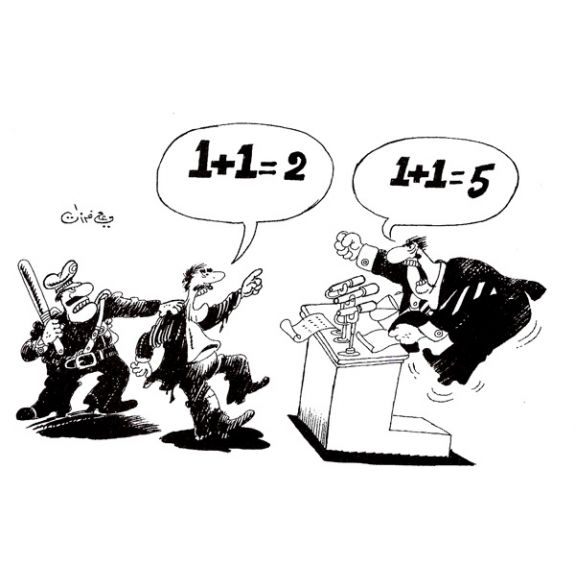
picture by Ali Farzat
By last Friday, if it hadn’t already done so, the Syrian regime effectively declared war on its own people, killing at least a hundred protestors. Throughout this week parts of Syria have fallen under outright siege. The tanks and infantry which haven’t peeped across the occupied Golan since 1973 entered the southern city of Dara’a, cutting roads, telephone and internet, water and electricity. Reports from the city speak of food shortages, generalised terror, and corpses stinking in the streets. Snipers are firing at pedestrians in the Damascus suburb of Douma. Tanks surround the coastal city of Banyas. Madaya, a mountain town on the Lebanese border, is also occupied. The regime may wish to stop weapons being smuggled across the border, or it may wish to stop Syrians fleeing via the smuggling routes. Thousands have crossed to Lebanon in recent days, and at least five hundred have been rounded into the regime’s torture chambers.
The violence has been massive, but also tactically applied. The sudden escalation is intended to shock the population into obedience. Yet live ammunition has not been used everywhere. Security forces have tried not to kill protesting Kurds in the north east, fearing that would trigger a genuine armed insurrection. Demonstrations in central Damascus have been dispersed with batons and tear gas rather than live fire. The regime doesn’t want to kill the sons of important businessmen, not yet at least.
Easter Blood
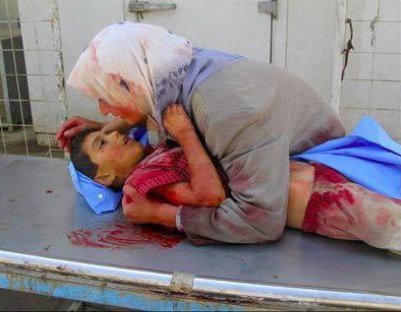 On Friday the saviour died for our sins
That we might live.
Dumuzi, on the blood river’s brink
Takes the plunge.
Israa Yunis, seven years old, takes the plunge
And the little boys of Dara’a whose skulls they smashed
The brave men of Jableh, the warm women of Bayda
The intellectuals, the street kids, the people of truth
Walk into the waves.
الجمعة العظيمة
بالأمس القريب رفع الرئيس بشار الأسد قانون الطوارىء, وحلّ محاكم أمن الدولة سيئة السمعة وسمح بالتظاهر السلمي. ولكن بعد صدور المرسوم الرئاسي تقدم أحد المحامين في الحسكة بطلب إذن لتظاهرة سلمية فاعتقلته قوات الأمن.
واليوم , يوم “الجمعة العظيمة” قامت مظاهرة ضخمة, سلمية وعزلاء في كل المناطق السورية. لجأ الجيش والشرطة والميليشيات إلى استخدام الذخيرة الحية والعصي الكهربائية والغاز المسيل للدموع ضد المتظاهرين. قٌتِل على الأقل 88 ابناً وابنة من أبناء السوريين, ومنعت قوى النظام بعض المصابين من تلقّي المساعدة الطبية اللازمة, بينما تمّ اعتقال مصابين آخرين من فوق أسرّتهم في المشفى. يمكن رؤية هذا
Four Points on Syria
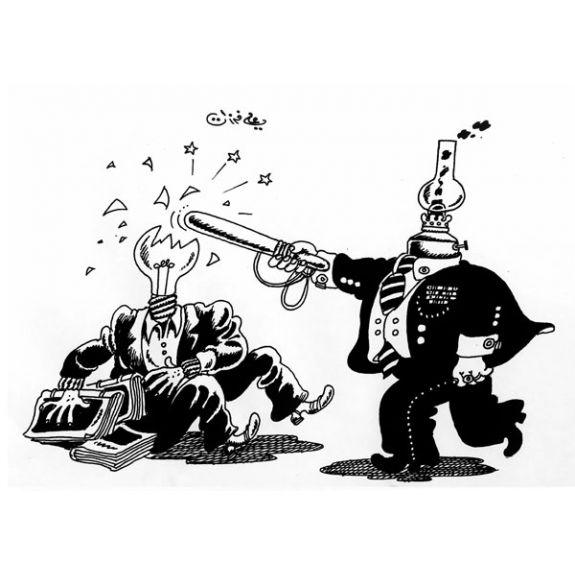
picture by Ali Farzat
1. Obama Should Shut Up
Obama’s claim that the Syrian regime is receiving Iranian assistance to repress protests is a statement which could inflame sectarian hatred inside Syria, as Obama’s Zionist advisors know very well. (This because Iran is Shia, a target of Saudi-Wahhabi propaganda, and the Syrian dictator is an Alawi, whereas the majority of Syrians are Sunnis). Obama gave no evidence to support his claim. The regime may be using Iranian bullets and tear gas. The Egyptian, Tunisian, and Libyan regimes have recently used American bullets and tear gas against their respective peoples. And America has offered its full support to the Saudi occupation of Bahrain and the Khalifa reign of terror there, which includes midnight arrests, extrajudicial executions, the destruction of Shia mosques, and assaults on hospitals and medical staff. The United States continues to assist the same dictatorships it has assisted for decades, and to function as the lifeline of the Zionist apartheid state. Obama’s statement could be a message to the Asad regime: if you distance Iran and the resistance, we will help you survive this crisis. But the Asad regime knows its only popularity arises from its support of resistance. Alternatively, Obama may have decided that Bashaar will fall, and the message is to the Syrian people, to encourage sectarian hatred amongst them and make it more difficult for them to build a stable, inclusive nation after the Asads capable of confronting the Zionist project.
Great Friday
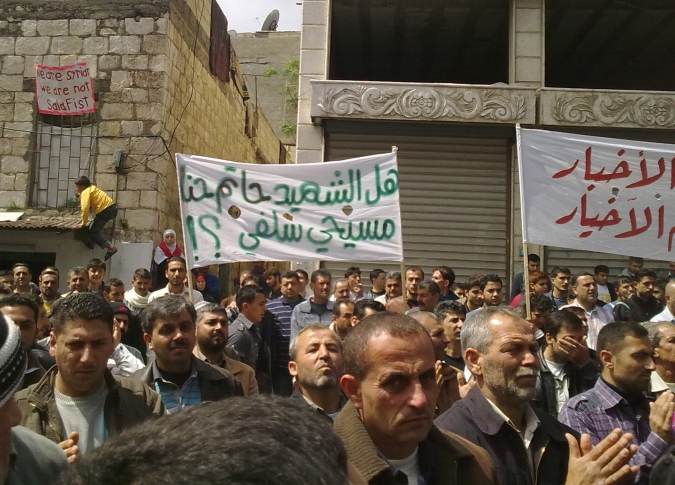
banner reads: was the martyr Hatem Hana, a Christian, also a Salafi?
Yesterday President Bashaar al-Asad lifted the Emergency Law, dissolved the notorious State Security Courts, and legalised peaceful protests.
After the president’s decree, a lawyer asked permission to hold a protest in Hasakeh. He was detained by security forces.
Today – ‘Great Friday’ – large, peaceful, unarmed protests were held in all regions of the country. Police, army and militia used tear gas, electric rods and live ammunition against the people. At least 88 sons and daughters of Syria were murdered. Regime forces prevented some of the wounded from receiving medical help. Other wounded have been arrested from their hospital beds. (Here are ugly scenes in Homs).
Damascus is under lockdown, mukhabarat clustering on every corner. Someone I know tried to cross the city today for entirely apolitical reasons. During the journey he was taken off the bus (with everyone else) and marched to a police station where he was questioned and his details recorded. But protests and gunfire still roared from the suburbs as far into the city’s heart as Meedan.
Words are one thing, actions another. The president’s words have no meaning at all.
Two Syrians
Here are two slightly differing takes on accusations that the protests in Syria have an overly Sunni and anti-minority character. First, from someone in Damascus:
There are claims that the Ismailis weren’t part of these protests but actually al-Salamiya was one of the first towns in Syria to protest after Daraa, then other areas followed.
In Banias last Friday, the Sheikhs invited an Alawite speaker to address the protesters.
I find the word “Islamist” quite problematic. I mean, in Syria many are religious, but Islamists? what does that even mean? They want to impose an Islamic state? Doesn’t that mean that the Syrian people would be supportive of the Ikhwan’s ideology? What’s interesting is that many disapprove of the regime AND the Ikhwan’s ideology, so we’re talking about conservative Muslims not Islamists, conservative when it comes to their daily lives and when it comes to their daughters, but when we talk about Islamists, we’re talking about a political discourse that wants to turn Syria into an Islamic state, a discourse that we haven’t heard thus far in any of these protests, nor from Sheikhs of Banias, Douma and Homs, who addressed the president with a statement and clear demands.
As for the mosques thing, my friends go to mosques to protest there, waiting for Friday prayers to finish. My Alawite, Durz and Kurdish friends in Damascus, who are atheists, go to mosques because there is no other safe place to protest. Just today there were couple of protests in Damascus university trying to initiate something away from mosques. Which is something that we’re trying to do now. We’re talking about a country where a gathering of more than 8 people might be threatened, where sit-ins in front of embassies to support revolutions were violently dispersed. So people skeptical about protests following Friday prayers are not well aware of the situation in Syria, this is how it will start but it will soon change inshalla.
Syrian Protests and Bullets
Three films from demonstrations in Syria yesterday. People protested in the suburbs of Damascus, Hama, Dera’a, the Kurdish north east, the desert town Raqqa and elsewhere. The first film shows a large crowd in Lattakia chanting ash-sha’ab yureed isqaat al-nizam – The People Want the Fall of the Regime. No reservations there. The second film shows security forces firing live ammunition at protestors in Homs. The third is Tartus. They’re chanting bi-rooh bi-dam nafdeek ya Dara’a – With Our Souls and Blood We Sacrifice for you, O Dara’a.
Cage and Wave
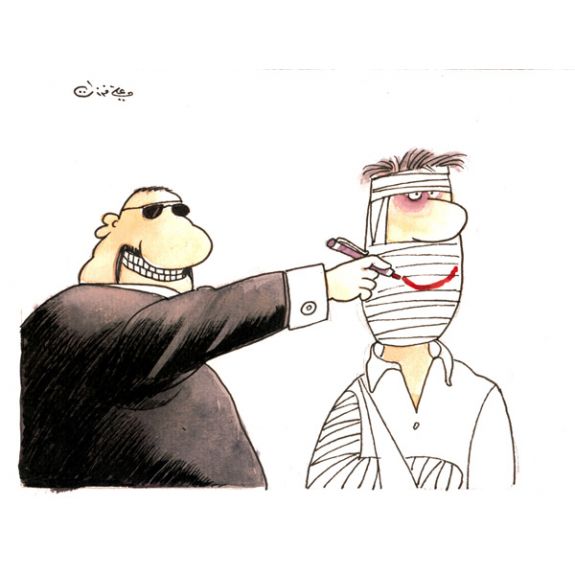
picture by Ali Farzat
This interview with Syria Comment’s Joshua Landis is well worth watching for background on Syria’s sectarian divisions and their influence on current events. I agree with most of what he says but I differ with his interpretation.
Two basic points of Syrian history come through very clearly. Firstly, Syria is not a unified nation in the way that Egypt is. There has been some form or other of centralised control in the Nile valley for thousands of years. Syria’s geography and demography – it’s a country of mountains, competing market cities and desert oases – means that power in Syria has always been much more divided, and that Syrians would feel more at home in an all-encompassing nation larger than the borders drawn by imperialists. Landis points out that in Syria’s brief democracy (the late 40s and early 50s) not one political party accepted the country’s borders. They sought instead either a unified pan-Arab state or a restitution of Bilad ash-Sham, the zone of enormous diversity between the Taurus mountains, the southern desert and the Euphrates river which nevertheless constitutes one market area and enjoys a common Levantine culture. Bilad ash-Sham is sliced today into Syria, Lebanon, Jordan, Palestine-Israel, and a sliver of Turkey.
Secondly, Landis identifies the crucial power division determining politics in contemporary Syria. The pre-police state parliament was dominated by the urban Sunni merchant class, the traditional elite. The army which would soon make the parliament irrelevant was inherited from the French occupation. Partly because the wealthier classes shied away from the army, but mainly for the usual divide-and-rule reasons, the French built a military of minorities – Alawis, Christians, Druze, and marginalised rural Sunnis. The victory of the military over the parliament, and of the military wing of the Ba’ath party over all other parties, was a victory of the countryside over the city, of the periphery over the centre, of sectarian minorities over the Sunni majority. The Ba’ath years therefore oversaw a social revolution in the sense that previously distanced and despised rural classes moved to the cities and entered elites.


 Qunfuz