Sectarian Stories on the Syrian Coast
This article was originally published at New Lines Magazine. The topic – Sunni-Alawite sectarianism on the coast – is also treated in my new book, The Blood Between Us: Syria After the Fall of Assad, available for pre-order here.
In the aftermath of 14 years of war and six decades of divide-and-rule dictatorship, the bonds between Syria’s sectarian and ethnic communities have been strained like never before. The most urgent task before both government and society is to reestablish and strengthen these bonds, yet several outbreaks of violence since the fall of the Assad regime have threatened to break them entirely.
Some of the worst violence has occurred in the northwestern provinces of Latakia, Tartus, Homs and Hama, where Alawite and Sunni Muslim communities rub shoulders. My conversations with people from the coast, including with my relatives, show the extent to which Alawite and Sunni perspectives can diverge, and how intractable intercommunal resentments now are.
Can a national consciousness beyond sect and ethnicity be revived in splintered Syria? By last spring, the new authorities had erected signs around the country reading “Revolution Yesterday, Building Today.” In political terms, the question of what is being built involves the question of what the Syrian revolution was for. Was it a national democratic uprising against dictatorship, or a Sunni Islamist uprising — later a Salafist jihad — against Alawite rule?
The short answer is that it was both (and various other things, too), or perhaps that it started as the former, but war made the latter come to the fore.
The Alawite-led regime’s response to the revolution was designed to create a sectarian conflict that would force loyalty from Alawites and other minorities. The regime rounded up the nonsectarian, nonviolent revolutionary activists first, and at the same time released jihadists from prison. It imposed collective punishment on Sunni areas and organized massacres of Sunni women and children. As time passed, it relied increasingly on foreign Shiite militias to plug the gaps in its repressive apparatus. Under pressure, Bashar al-Assad made it quite clear that his idea of national belonging was based on loyalty. “Syria is not for those who hold its passport or reside in it,” he said. “Syria is for those who defend it.” The sentiment was echoed, but with a sectarian role reversal, by the Islamic State group leader Abu Bakr al-Baghdadi, who said, “Syria is not for the Syrians, and Iraq is not for the Iraqis. The land is for the Muslims, all Muslims.”
All this sectarian rhetoric and practice went a long way to smashing Syrian identity and boosting subnational identities instead. After the liberation from the Islamic State in 2017, and then the Assad regime in 2024, those subnational identities lived on, continuing to offer support to fearful, traumatized people, and to provoke further conflict.
The worst post-Assad violence occurred in March 2025, after Assadist insurgents based in Alawite areas killed hundreds of pro-government fighters. In response, armed civilians mobilized alongside pro-government militias to put down the insurgency, but some went far beyond counterinsurgency operations, humiliating, beating and shooting civilians and burning shops and homes. Around 1,500 unarmed Alawites were killed, including women and children. The killers apparently felt they were exacting a generalized revenge on the community they blamed for their suffering. The anti-Assad activist Hanadi Zahlout reported that the men who killed her brothers in the village of Snobar asked first, “Why do you hate us?” When one of Zahlout’s brothers responded that he didn’t hate them, and had not contributed in any way to Assad’s war, another man said, “You’re an Alawite. You hate us. You killed my two brothers.”
A steady drip of killings and abductions of Alawites has continued since then. Some may be revenge attacks against specific Assadist abusers, but others strike those only guilty by association.
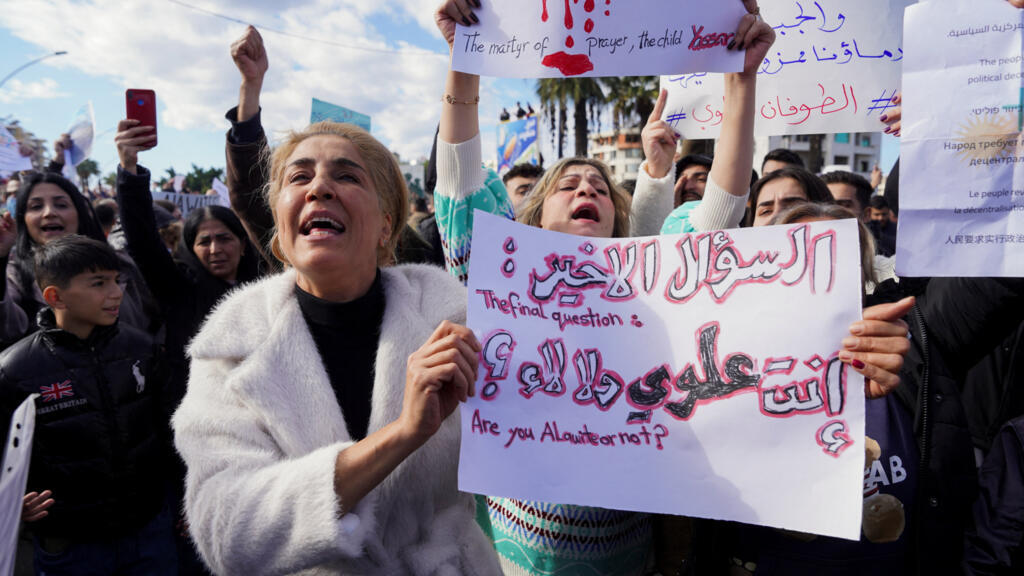
In late November 2025, several hundred Alawites protested in Latakia against the perceived collective punishment of their community. In late December, following the bombing of an Alawite mosque in Homs, Alawites protested again in Latakia, Jableh and Tartus. That time, thousands rather than hundreds attended. On both occasions, counterdemonstrations were held by some of the coast’s Sunni population. Many Syrians noted with pride afterward that General Security forces had guarded the Alawite protesters as they did the Sunnis, even though the Alawites were chanting against the new government. This was a very marked improvement on the Assad regime, when protesters were either shot at the scene or rounded up for detention and torture. It was also an improvement on the behavior of pro-government forces in March. But the General Security presence was unable to stop scuffles breaking out between the opposed communities. At least three people were killed during the December protests, including one member of the security forces. In the following days, angry crowds smashed Alawite-owned shops. The government imposed a curfew in Latakia on Dec. 30.
The Alawite protests were based on very real grievances and expressed the legitimate fear and grief of a community that feels its future is in question. At the same time, they provided cover for masked and armed Assadist insurgents (several of whom were arrested after emerging from their hiding places), and involved denial of Assadist crimes. Some protesters held signs demanding that prisoners be released. While it’s true that the authorities have arrested many men without due process, and that so far there have been almost no transparent trials, those arrested are assumed to be war criminals of the old regime. Calls for their release therefore anger the old regime’s victims.
The man who called the protests — Sheikh Ghazal Ghazal, head of the Supreme Alawite Council — also provokes controversy. Ghazal, mufti of the Alawites in Latakia during Assad’s reign, and someone who never once complained about Assad’s war crimes and crimes against humanity, is today a proponent of “federalism,” and sometimes the protesters chanted for a federal Syria. This in itself was enough to anger the Sunnis of the coast. To many in this aggrieved community, “federalism” sounds like a local return to the Assadist rule under which they suffered so much.
For simple numerical reasons, the coastal Sunnis form a demographic that cannot be ignored. Sunnis and Christians together make up half the population of Latakia and Baniyas cities, and Tartus has a sizable Sunni minority. The countryside is more Alawite, but at least a quarter of the total population of the coastal region is Sunni.
My father’s family are Sunnis from Latakia, and I can attest by experience that the bad blood between the sects runs deeper on the coast than elsewhere in Syria. Those Latakia Sunnis who dislike or distrust Alawites mix the traditional disdain directed by orthodox urbanites against unorthodox country people (because the Alawites used to be confined to the undeveloped mountains) with a more recent resentment of entitled regime-related Alawite officials or mafiosi. They mock the mountain accent and the perceived crude behavior of arriviste Alawites, and each remembers a personal history of humiliations imposed by the thugs previously in power.
I spent time in Latakia with family and friends last summer and asked everyone what they thought about the massacres of Alawites in March. Everybody expressed some degree of sorrow and recognized that innocents had been killed. “There were terrible violations,” said one person, “and they usually affected the innocent. Those who had started the problem [referring to the Assadist insurgents] had already run away.” But another interlocutor, after regretting the slaughter, added a justification. “Some blood had to be spilled,” he said. “Otherwise they wouldn’t have understood that the situation had changed.”
When attacks on entire communities are justified by political expediency, Syrianness itself is in question, and not only on the coast. Last March, a Damascene woman asked me rhetorically what a few dead Alawites mattered compared to “a million dead Sunnis.” Then, in December, during the Latakia protests and counterprotests, a small group of men attacked the statue of Saleh al-Ali, an Alawite who had resisted the French occupation a century ago. This mirrored attacks on statues of Sultan Pasha al-Atrash in Sweida in July. Al-Atrash was a Druze leader who had also resisted the French. Both men are usually considered national heroes, symbols of a common belonging beyond sect or ethnicity, but in some quarters their sectarian difference now outweighs their nationalist value.
Surviving lives marked by violence, many Syrians, and especially the people of the coast, oscillate between value sets. On the one hand, they cherish the diversity, tolerance and inclusivity that characterize most daily interactions; on the other hand, they retreat when wounded into a victim complex that demonizes the enemy sect. The two extremes can often exist in the same person. The man who justified spilling the blood of Alawites, for instance, also talked with a sort of pride of having many Alawite friends.
During the decades of Assad-imposed silence, sectarian fears and resentments could only be expressed in whispers and mutters. During the war years, they were often screamed aloud, and drawn in blood. The sectarian battle of narratives that was amplified by the war continues to set the social terms today, so it’s important to examine the clashing arguments.
One story posits that all Alawites are Assadists, and that the ultimate motivation for the Assadist war on Syrians is sectarian hatred of the Sunni majority. I remember a woman I interviewed in Turkey in 2013 implying this. She’d been widowed and driven from her home in Homs by Assadists. “Is it because we’re [Sunni] Muslims?” she asked rhetorically. “Because we say there’s no god but God? Is that why we lost our youth and our homes?”
The opposing story is that all Sunnis want to wipe out Alawites simply for their difference. I’ve heard this over the years from Alawite friends, and more recently from Alawite victims of violence. Almost always, the story names the hard-line medieval Sunni scholar Ibn Taymiyya, who delivered a fatwa (in the context of a 14th-century Alawite rebellion) calling for the killing of Alawites.
Both stories remove members of the other sect from the realm of flesh-and-blood contemporary reality and imagine them instead as manifestations of an abstract, ancient, essential force. In both, the other sect is seen not as motivated by immediate hopes and fears but by a general malevolence independent of conditions.
Such oversimplified, ahistorical discourses betray a collective lack of imagination, an inability to put oneself in the other’s shoes. Of course, it isn’t ever easy to put oneself in another’s position. Most people only do it occasionally, and almost never when they are blinded by pain, as very many Syrians are today. But the difficulty makes it all the more necessary to point out as often as possible that the factors generating Syria’s sectarian hatred originate in recent political conflict, not in the ancient, essential nature of Alawites or Sunnis, though all sides may resort to old texts and discourses to justify their crimes when the killing is underway.
Whether describing all Sunnis as violent Islamists or casting all Alawites as Assad regime enforcers, these stories assign collective guilt to the other sect while exonerating the “home sect” of any guilt at all. The historical record shows a much more complex reality. Alawites were indeed overrepresented in the Assad regime’s most sensitive and brutal mechanisms, and the regime’s crimes were either approved or ignored in most Alawite communities. Alawites should recognize this and then understand that Sunnis are angry not because they read Ibn Taymiyya but because they blame Alawites in general (unfairly, certainly) for Sednaya Prison, the refugee camps and the Sunni neighborhoods reduced to rubble.
On the other hand, Sunnis should recognize that plenty of Sunni officers, tribes and businesspeople served Assad, and that Alawites often suffered from his rule, too. The first time I heard about “shabiha” was in the 1990s, and from an Alawite family living in rural Latakia. The word later came to mean pro-Assad irregular militia, or just Assadists, but back then it referred specifically to gangs led by members of the extended Assad family that abducted young women, drove cars off the road and beat people up. The Alawites who lived near Qardaha, Assad’s hometown, were often the first victims.
In 2011 and 2012, members of every community protested: Sunnis, Christians, Ismailis, atheists — and Alawites. The Alawite actress Fadwa Souleimane led protests in Sunni parts of Homs. Alawite communities had always produced dissenters, including many members of harshly repressed leftist parties. One such victim was Abdulaziz al-Khair, who was disappeared by the regime in 2012. The dissent, and the repression, reach back through the regime’s history. Abdulaziz’s relative Hasan al-Khair was disappeared in 1980 after writing a poem critical of both the regime and the Muslim Brotherhood. Though many Alawite revolutionaries kept their identities secret for fear of repercussions from both sides, it’s still easy to list prominent examples, like defected colonel Zubaida al-Meeki, writer and feminist Samar Yazbek, leftist activist Samira Khalil or Salem Abu al-Naser, who remained in besieged Aleppo until the very end.
In 2016, as Aleppo fell to Russian bombs and Iranian militias, as sectarian divisions were hardening, an anonymous Alawite initiative called the Declaration of Identity Reform explicitly rejected support for the regime on a sectarian basis. It referred to the Syrian revolution as an “initiative of noble anger,” and called for democracy, the rule of law and secularism.
One factor that made the Dec. 8, 2024, liberation from Assad so easy was that most Alawite soldiers decided in the end to go home rather than fight. Even during the March 2025 insurgency, Alawites often turned in Assadist fighters to the authorities. Likewise, during the massacres that followed, Sunnis often saved Alawite lives. In the summer, I interviewed Abdul Rahman (a pseudonym), who was asked his sect at gunpoint by men who had threatened to enter his home. Abdul Rahman is an Alawite, but with the help of a Sunni neighbor he managed to convince the men that he was Sunni. Afterward, he called another Sunni friend, who came around immediately, bringing a hijab for Abdul Rahman’s wife, and then drove them out of harm’s way. (But even as he pointed out the crucial help he’d received from Sunnis, Abdul Rahman told me the usual story about Ibn Taymiyya as an explanation for the aggression he had suffered.)
With the recent reincorporation of northeastern Syria under central rule, the existential risk of national dissolution that Syrians feared seems to have passed. But stitching up the bonds between communities will be a longer and more difficult task than defeating separatist militias. It will take a real transitional justice process involving genuine dialogue and transparent trials — processes that there have not been nearly enough of. Accompanying those efforts, Syrians need to prioritize better stories than the tired exclusionary ones — more honest, more nuanced narratives that remember how communities were set apart by political machinations, not by their unchanging natures. By such remembering, Syria can build a constructive national politics from the currently dismembered body politic.



 Qunfuz
Leave a comment