The End of the Fairy Tale
An edited version of this piece was published at UnHerd. I disagree with the headline there – Syria Can’t Escape War – though at present it looks like the cycle of violence will keep on rolling. Along with the Assadist violence and the sectarian killings by men linked to the new authorities, there have been deals with the SDF and representatives of the Druze. It’s true that these are only preliminary steps – that the SDF deal was spurred by the American desire to withdraw, for instance, that the PKK may seek to quash part of the deal (SDF integrating into national army) and Damascus may seek to renege on another (decentralization). But if Syrians keep working intelligently, the country can indeed escape war, and build something better. Anyway, here’s the piece:
The sudden collapse of the Assad regime on December 8 2014, without any civilian casualties, felt like a fairy tale. Syrians had feared that the Assadists would make a last stand in Lattakia, the heartland of the regime and of the Alawite sect from which its top officers emerged. Many also feared there would be a sectarian bloodletting as traumatised members of the Sunni majority took generalised revenge on the communities which had produced their torturers. None of that happened then. But some of it has now. On March 6, an Assadist insurgency killed hundreds in Lattakia and other coastal cities. Then men associated with the new authorities, as well as suppressing the insurgency, committed sectarian atrocities, summarily executing their armed opponents, and killing well over a hundred Alawite civilians.
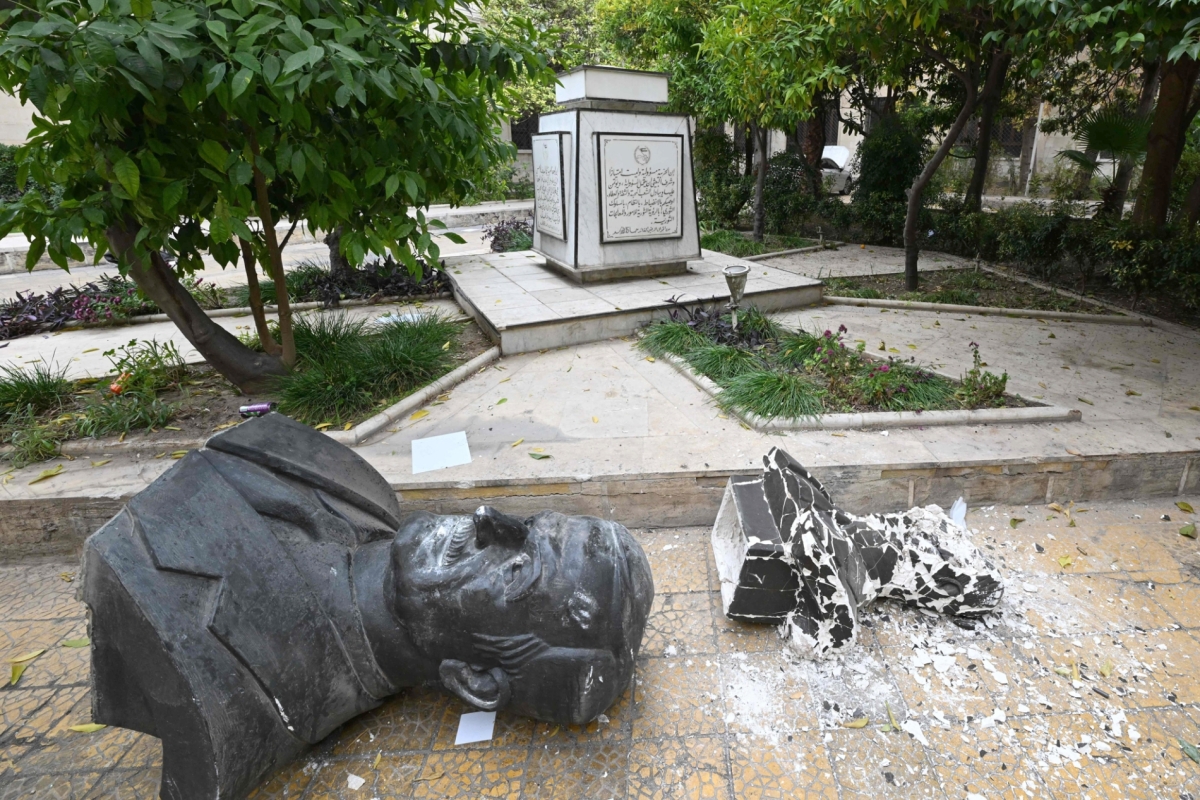
This is the first sectarian massacre of the new Syrian era, and it casts a fearsome shadow over the future. The revolution was supposed to overcome the targeting of entire communities for political reasons. Now many fear the cycle will continue.
The previous regime was a sectarianizing regime par excellence, both under Hafez al-Assad, who ruled from 1970, and under Hafez’s son Bashar, who inherited the throne in 2000. This doesn’t mean that the Assads attempted to impose a particular set of religious beliefs, but that they divided in order to rule, exacerbating and weaponizing fears and resentments between sects (as well as between ethnicities, regions, families, tribes). They carefully instrumentalised social differences for the purposes of power, making them politically salient.
The Assads made the Alawite community into which they were born complicit in their rule, or at least, to appear to be so. Independent Alawite religious leaders were killed, exiled or imprisoned, and replaced with loyalists. Membership in the Baath Party and a career in the army were promoted as key markers of Alawite identity. The top ranks of the military and security services were almost all Alawite.
In 1982, during their war against the Muslim Brotherhood, Assadists killed tens of thousands of Sunni civilians in Hama. That violence pacified the country until the Syrian Revolution erupted in 2011. The counter-revolutionary war which followed can justifiably be thought of as a genocide of Sunni Muslims. From the start, collective punishment was imposed on Sunni communities where protests broke out, in a way that didn’t happen when there were protests in Alawi, Christian or mixed areas. The punishment involved burning property, arresting people randomly and en masse, then torturing and raping those arrested. As the militarization continued, the same Sunni areas were barrel-bombed, attacked with chemical weapons, and subjected to starvation sieges. Throughout the war years, the overwhelming majority of the hundreds of thousands of dead, and of the millions expelled from their homes, were Sunnis.
Alawi officers and warlords were backed in this genocidal endeavour by Shia militants from Lebanon, Iraq, Afghanistan and Pakistan, all of them organized, funded and armed by Iran. These militias – with their sectarian flags and battle cries – were very open about their hatred of Sunnis.
The worst of sectarian provocations were the massacres perpetrated in towns in central Syria, especially in 2012 and 2013, places like Houla, Tremseh, and Qubair. The modus operandi was that the regime’s army would first shell a town to make opposition militias withdraw, then Alawi thugs from nearby towns would move in to cut the throats of women and children. It’s important to note that these were not spontaneous assaults between neighbouring communities, but were carefully organized for strategic reasons. They were intended to induce a backlash which would frighten Alawites and other minorities into loyalty. This fitted with the regime’s primary counter-revolutionary strategy. Early on it had released Salafi Jihadis from prison while rounding up enormous numbers of non-violent, non-sectarian activists. For the same reason, it rarely fought ISIS – which in turn usually focused on taking territory from the revolution.
Soon Sunni extremist organisations provided the response the regime wanted. For example, an August 2013 jihadist offensive in the Latakia countryside killed at least 190 Alawite civilians and abducted many more. When they saw such horrors, many members of minority groups, and some Sunnis too, felt they had no option but to fight to preserve the regime.
But in recent years, HTS – the de facto authority since December 8 2024 – seemed to have learnt to overcome the divide-and-rule strategy. The Islamist militia improved relations with non-Muslims in Idlib, and during and after the liberation battle it sent positive messages to Alawites. It also offered an amnesty to all former regime fighters except top level war criminals. It looked as if the new Syria might avoid further sectarian conflict. After all, throughout the revolution, many Sunnis had worked for the regime, and many Alawis had opposed it, at enormous cost, from the defected General Zubeida Meeki to the actor Fadwa Suleiman.
Nevertheless, the ingredients for an Assadist insurgency in Alawite areas were in place. Men had lost their jobs in the collapsed regime army, and many feared the new rulers. Iranian funds and Hizbullah organization provided the logistics to challenge HTS. On March 6th, coordinated Assadist attacks killed hundreds of the new security forces and dozens of civilians too. Some of the victims were burnt alive. Hospitals and ambulances were targeted.
Across Syria there was a furious popular response. Impromptu demonstrations condemned the insurgency and chaotic convoys of militants and armed civilians headed for the coast. Government and government-affiliated fighters largely succeeded in clearing the rebels from urban areas, but they also committed atrocities. Disarmed Assadist fighters were summarily executed. So too were Alawite civilians, including women and children. (The victims included the family of Hanadi Zahlout, a revolutionary activist.)
According to the Syrian Network for Human Rights, the most consistently reliable monitoring organisation, 211 civilians were killed by Assad loyalists, and at least 420 people were killed by Syrian security forces. The latter number includes both civilians and disarmed fighters who were summarily executed. It is difficult to distinguish between the two because most Assadist fighters wore civilian clothes, but at least 49 women and 39 children are among the dead.
(Update: According to the SNHR on March 13, these numbers have now increased to 207 security forces and 225 civilians killed by Assadists, and 529 people – both disarmed fighters and civilians – killed by men affiliated to the security forces.)
The Assadist assault was never going to restore the old regime, which had totally collapsed, and is widely hated across all parts of society. The true aim of the insurgency’s backers may have been to provoke a sectarian response. That, after all, was the strategy in the previous decade. If so, the insurgency got the desired response. It seems that most atrocities were perpetrated by the notoriously ill-disciplined Syrian National Army (SNA) factions, and by foreign fighters including Chechens. The extent of HTS involvement is not clear. But in a way that is already irrelevant. The crimes against innocents could now turbo-charge an insurgency, preventing Syria from stabilizing and serving the vultures surrounding the country.
First among these are Iran – which lost its most important Arab ally, and its route to Lebanon, when Assad fell – and Israel – which is assiduously working for the partition of the country. For their different reasons, these opposed states share the same desire to keep Syria weak.
Iran and Israel as well as a range of western Islamophobes and “tankies” are seeking to fan the flames with disinformation. Commentators from Elon Musk to George Galloway are helping spread claims that Syrian Christians are being massacred. There is zero evidence of this, but like 40 beheaded babies on October 7, 2023, the story may become fixed in certain corners of the western consciousness.
The next weeks and months will determine if Syria’s future will be something like civil war Iraq, or something much better. President Ahmad al-Sharaa has been doing a good job of giving the impression of stability that is necessary to really stabilise the country, but he has not yet brought the opposition militias together under one disciplined command.
Al-Sharaa has made several speeches since the killings on the coast. He has stressed that nobody is above the law, whoever they may be. It is necessary now to implement these excellent words. An investigative committee has been established, and another committee for outreach to the coastal communities.
Beyond those crisis measures, Syria urgently requires an independent transitional justice process. After decades of violence, Syrians need to air their grievances, to establish the facts of what happened, and to see justice done. Only then can a national consensus be built on past tragedies and future direction; only then will the lure of vigilante justice be neutralized.
So far, several war criminals have been arrested, but none have yet been put on trial. In some cases, criminals have been released shortly after their arrest. For instance, the Assadist commander Fadi Saqr, one of those implicated in the Tadamon Massacre, went walking in the neighbourhood after his release, prompting protests by locals.
Al-Sharaa identified transitional justice as one of the government’s priorities in a January 30th speech, yet on February 27th the authorities prevented a conference on the topic from taking place in Damascus. The conference was organized by the Syrian Center for Legal Studies and Research, which is headed by Anwar al-Bunni, the human rights lawyer who contributed to the first ever trial of an Assadist war criminal – that of Anwar Raslan, found guilty in Germany under universal jurisdiction. No explanation was given for preventing the conference.
There are good reasons for al-Sharaa to feel that he can’t afford a real transitional justice process. For a start, HTS bears its own share of historical guilt. Perhaps in post-liberation retrospect one can justify its gobbling up of other opposition militias for the sake of military efficiency. It’s much harder to justify the organization’s elimination of revolutionary civil society figures like Raed Fares and Hamoud Jnaid, who were murdered in 2018, only six years ago.
Even if the HTS leadership could be exempted from scrutiny, al-Sharaa’s stabilisation strategy involves bringing all military factions under one national umbrella. Putting the faction leaders on trial would contradict this effort. But the crimes committed on the coast by SNA militias show that leniency threatens social peace much more than arrests.
The more that Syrian communities are brought into the governance process, the less ability warlords will have to unsettle the polity. In this respect, there is still grounds for optimism. On March 10th, al-Sharaa signed a deal with the SDF to integrate that militia into the national army and to re-establish central control over north east Syria. If a deal with the Druze militias follows, Israel will be deprived of its main destabilizing tools. To deprive Iran and the Assadist remnants of their power too, military action must be coupled with efforts to appoint anti-Assad Alawites to administrative positions, both on the coast and nationally.
By inclusion, the government must establish sufficient peace for civil society to get to work. Syrians themselves must be able to do the hard work of addressing and overcoming their trauma. A culture of citizenship is the only true antidote to sectarian splintering.



 Qunfuz
Leave a comment