Ahmad al-Sharaa in the White House
This article was first published at Time magazine.
On November 10, President Donald Trump met Syria’s transitional president Ahmad al-Sharaa at the White House. The meeting was remarkable in many ways. It was the first time that a Syrian president had ever been hosted in the White House. Trump and al-Sharaa had briefly met before, in Riyadh, Saudi Arabia, on May 14. That date was almost as remarkable as the meeting itself, because it was the twentieth anniversary to the day of Ahmad al-Sharaa’s arrest by American troops for membership of al-Qaeda in Iraq. When al-Sharaa later started fighting in Syria, the US not only declared him a terrorist, it put a $10 million bounty on his head.
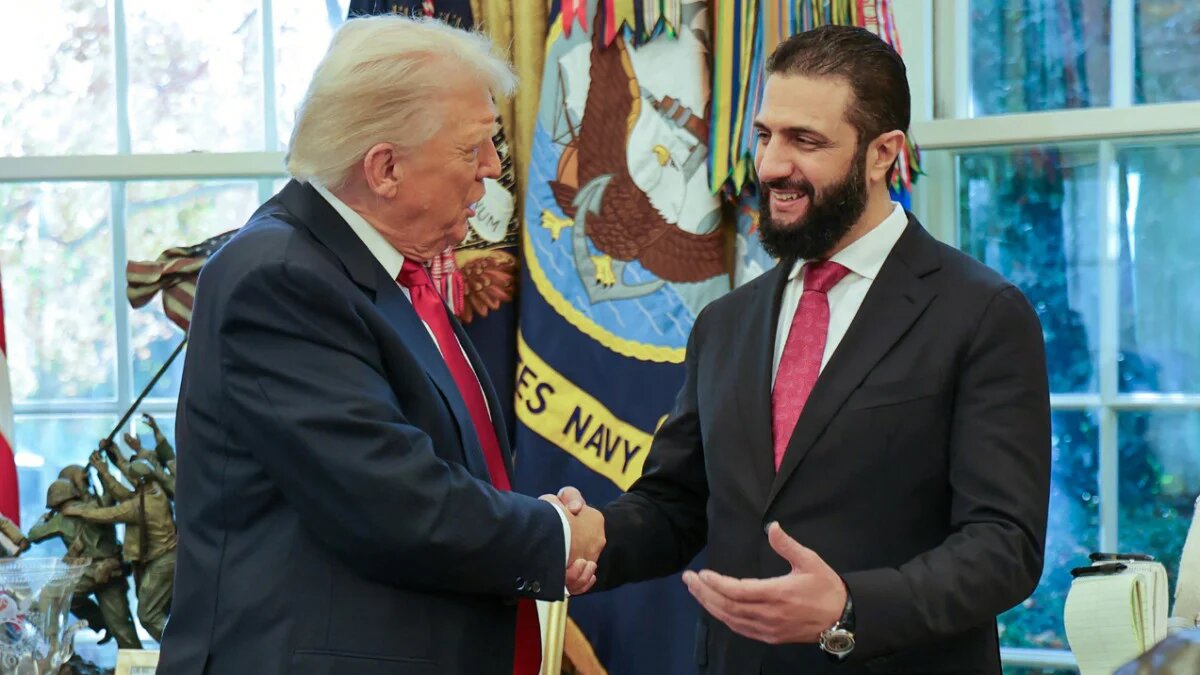
The White House welcome looks like a new dawn for Syrian-American relations, given that the US has sanctioned Syria as a ‘state sponsor of terrorism’ since 1979 – and that further sanctions were added by the Reagan, George W. Bush and Obama administrations.
And it’s certainly quite a turnaround for a former jihadist – though perhaps not as much as it first seems. Al-Sharaa was in prison for most of the Iraqi civil war, so he didn’t participate in attacks on Shia civilians. Released just as the Syrian Revolution was beginning in March 2011, he returned to Syria to establish a militia called Jabhat al-Nusra, which later transformed into Hayat Tahrir al-Sham (HTS). These organizations focused on fighting Assad and the Iranian militias that supported him. They never attacked the West, and they steered clear of the mass civilian casualty operations favoured by Iraqi jihadists.
Al-Sharaa broke definitively with ISIS in 2013, and has fought it continuously since 2014. In power, he aims for good relations with the world rather than apocalyptic war. And where ISIS fielded a morality police to impose a dress code, in al-Sharaa’s Damascus, women wear what they like.
The US had conducted multiple anti-ISIS operations in HTS-ruled Idlib, including the one that killed ISIS ‘caliph’ Abu Bakr al-Baghdadi in 2019. Though there was no direct coordination, HTS fighters did not attack the US special forces. Indirect understandings intensified into direct cooperation when al-Sharaa assumed power on December 8 last year, leading to at least eight joint operations. Now, after the meeting in the White House, Syria has announced its formal integration into the Global Coalition against ISIS. This will lead to still more joint action. Even more significantly, the Syrian Democratic Forces (SDF) – the Kurdish-led militia that controls large parts of northeastern Syria – can no longer claim to be the Coalition’s boots on the ground. This is a step towards Syria’s reunification under central authority.
Even if worries about al-Sharaa’s jihadism are overblown, he still carries problematic baggage. Some in Syrian civil society worry that he is concentrating too much power in the presidency, and about the lack of transparency in decision-making. Several years ago his organization was accused of assassinating civil society figures like activist and journalist Raed Fares. But neither autocratic governance nor killings of journalists tend to obstruct US friendships with Middle Eastern states. Israel killed the journalist and US citizen Shireen Abu Akleh, after all, and Saudi Arabia killed the journalist and US resident Jamal Khashoggi.
A bigger problem is that al-Sharaa’s troops are often indisciplined and abusive. Since Syria’s liberation from Assad, two major bouts of fighting have degenerated into sectarian massacres – in March, when some pro-government militias committed atrocities against Alawites, and in July, when they targeted Druze.
Fortunately there is evidence that al-Sharaa’s government recognizes the gravity of these events. Sources tell me that hundreds of men have been arrested for violations committed against non-Sunni Muslim civilians, but that the arrests have not been publicized.
Why would the government not publicize the arrests? It is important to do so, to show Syrians, particularly frightened minority communities, that a state of law is being built. The answer may be that the government is terrified of having a public argument with its Sunni Islamist base. And it’s a well founded fear. Recently two men arrested for killing a Shia Muslim were released when their townsmen closed roads and demanded that Shia supporters of Assad be punished first.
Fourteen years of war have broken the social bonds between sects, villages, and even between families. Al-Sharaa calculates that kick-starting the broken economy will stabilize Syria. If traumatized, dispossessed men have jobs and homes, they will be less angry and less likely to resort to violence.
The Trump administration agrees. All of the executive sanctions on Syria have now been lifted by President Trump, and most of the statutory measures imposed by Congress and the Senate are on their way to being lifted.
It is in the whole world’s interests for Syria to stabilize. For 14 years the country has exported terrorists, refugees and narcotics like Captagon. If the new government fails, global security will pay the price.
That’s why US Special Envoy Tom Barrack recently said, “There is no Plan B” for Syria. Hence the historic meeting in the White House.



 Qunfuz
Leave a comment