Posts Tagged ‘Ahmad al-Sharaa’
A Nobel Prize for Syria?
This article was first published at New Lines Magazine.
On Aug. 25, Mazloum Abdi, the commander in chief of the Syrian Democratic Forces (SDF), a Kurdish-led militia that had ruled swaths of northern and eastern Syria for over a decade, announced the group’s dissolution. This marked the end of the process of integrating SDF fighters into the Syrian Ministry of Defense. Three all-Kurdish brigades of the national army now serve in Hasakah and Qamishli, with a fourth in Kobani. That means Kurdish-majority areas are policed and guarded from external threats by local Kurds rather than by outsiders. Abdi has been appointed as an adviser to the Syrian presidency.
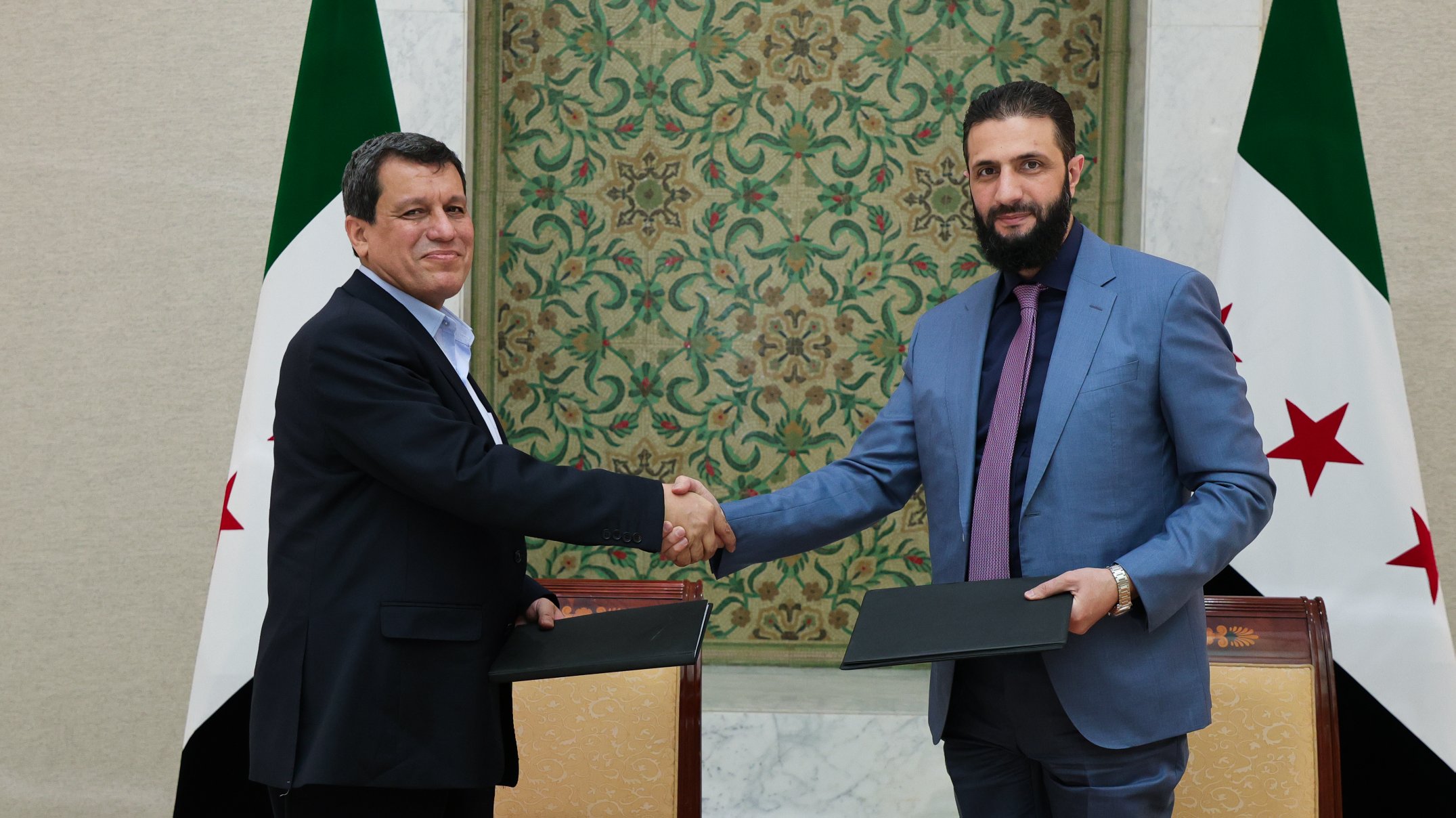
The integration process is a compromise for both sides. The dissolution of the SDF comes in concert with the winding up of the Autonomous Administration of North and East Syria (AANES) and the “Rojava” (or “Western Kurdistan”) experiment. This is experienced as liberation for many Arabs and others in northeastern Syria, who found SDF rule oppressive, but it also represents the end of Kurdish autonomy, leaving many Kurds wounded and worried about the future. For their part, many Syrian Arabs are discomfited that parts of their country are still managed by people who until recently ran their own state project, and who don’t necessarily believe in a unified and sovereign Syria.
But still, the process has more or less worked, and the northeast is no longer at war. A Syrian solution has been arrived at, rather than an international conflict. It could have all happened very differently, and Abdi and Syria’s transitional President Ahmad al-Sharaa should be credited with avoiding much worse scenarios.
In late November and early December 2024, while al-Sharaa’s Hayat Tahrir al-Sham (HTS) rebels were seizing Syria’s western cities from the collapsing regime of Bashar al-Assad, from Aleppo in the north via Homs to Damascus in the south, the Turkish-aligned militias of the so-called Syrian National Army (SNA) advanced eastward into SDF-controlled territory. Backed by the Turkish air force, the SNA took Tel Rifaat and Manbij from SDF control. In Manbij, according to a Kurdish resident I interviewed for my recent book on post-Assad Syria, SNA fighters and Arab residents together drove Kurds from their homes, which they then looted.
Motivated by homesickness as well as revenge, the SNA fighters wanted to continue. Many of them had been pushed out of their home areas in eastern Syria by the Islamic State group, then prevented from returning by the SDF. There were clear signs, too, that the Arab population of northern and eastern Syria would welcome a larger battle. As HTS arrived in Damascus, armed civilians attacked checkpoints in the city of Deir ez-Zor, and Arab fighters in the SDF defected. The city had liberated itself by Dec. 11, 2024, three days after Assad’s flight to Moscow.
The encouragements for war were plentiful. Both sides would have found powerful state backers: Turkey sponsoring Damascus, and Israel the SDF. The SDF had no wish to compromise with its archenemies. For their part, the SNA fighters were raring to go.
But al-Sharaa restrained them. Instead, he and Abdi signed the March 10, 2025, agreement to reintegrate the northeast into the Syrian state. This statement of intent was supported by the United States but opposed by hard-liners on both sides. The procedural nitty-gritty was consigned to committees. Each side understood the terms of the agreement differently. Often, the process seemed destined to fail.
Yet al-Sharaa and Abdi persevered, reining in both their respective hard-liners and cadres on the ground. For this reason, I’ve heard one Syrian journalist suggesting, and only partly tongue in cheek, that the two men deserve the Nobel Peace Prize.
Perhaps they do — even Henry Kissinger won the Nobel once, so it’s not a high bar — but if they do, it’s for their intelligent reading of reality rather than for any inherently pacific orientation. Both men have risen by accurately evaluating the potentials and risks presented by their changing environments. Both have survived the vicissitudes of the long Syrian conflict by understanding that war, like politics, is the art of the possible. When fighting is likely to achieve their aims, they fight. When it’s more likely to lead to disaster, they usually refrain. Unlike Assad or Israel’s Prime Minister Benjamin Netanyahu, their judgment has only rarely been clouded by hubris.
Read the rest of this entry »Unfulfilled Promises
Qantara has published an article of mine in not one but three languages. The German version is here. The Arabic version is here. And the English version is here on the Qantara site, and reprinted below.
*
When Syria’s Assad regime collapsed in December 2024, it was replaced at first by a wave of euphoria. The final rebel offensive had taken a mere 11 days to reach Damascus from Idlib. Assad’s army made no last stand in the capital, as many had feared it would, but simply dissolved. The final battles involved no sectarian massacres and almost no civilian casualties. The tyranny that had ruled by terror for over half a century ended with a whimper rather than a bang.
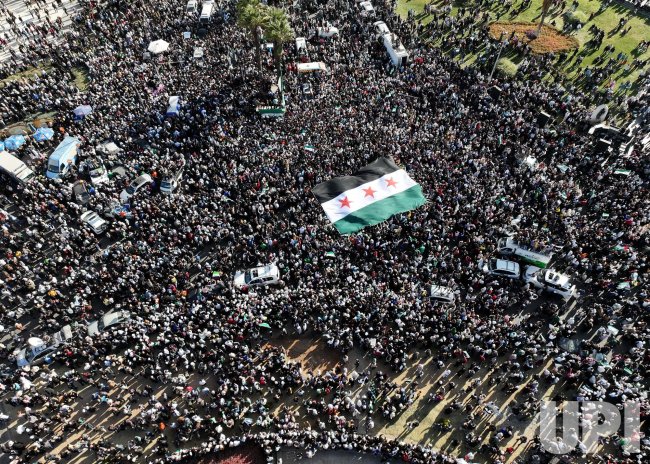
Syrians couldn’t believe their luck. After decades in which public gatherings had been banned, men and women, the secular and the religious, rushed to the streets to celebrate. The triumphant gunfire and ululations of the first days soon mellowed into bouts of communal dancing and flag-waving in city squares. The revolutionary song “Raise your head up high / You’re a free Syrian” was amplified everywhere.
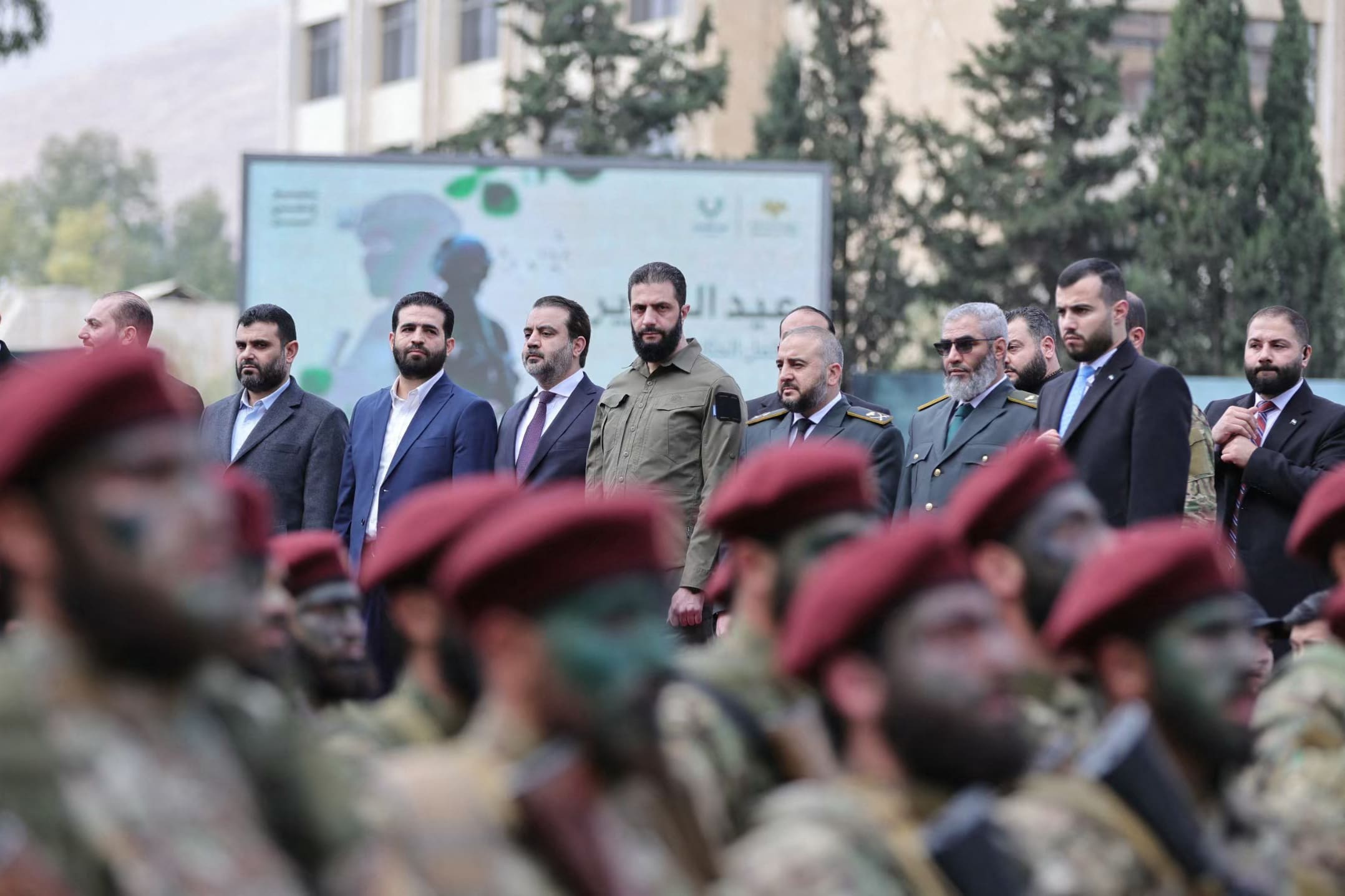
Numerous smaller celebrations lit up the country’s destroyed cities and villages as displaced people returned home and were finally reunified with their relatives. More than 3 million Syrians, including both refugees and the internally displaced, have returned to their areas of origin. And the wild enthusiasm unleashed by the liberation has persisted. Even a year later, I saw people arriving in Damascus airport dressed in the revolutionary flag.
In reality, liberation took a lot longer than 11 days. It followed almost 14 years of revolution and war during which the regime was slowly hollowed out and the country splintered into militia fiefdoms. Over half the population was driven from their homes. Many Syrians had to resort to sub-national identities – sectarian, regional or ethnic – for solidarity and protection. The civic and democratic revolution that produced hundreds of self-governing local councils was largely drowned in violence, crushed by local warlords and foreign states.
So, though the regime collapsed, it isn’t quite correct to say that the revolution won. What happened is that the strongest rebel militia—Hayat Tahrir al-Sham (HTS), with Ahmad al-Sharaa as leader—assumed power when Assad fled. Many of the original civil revolutionaries were disturbed by this. My colleague Amer Matar, director of the documentation project the Prisons Museum and the person who gave me the title for my book on the new Syria, put it bluntly: “Ten years ago [al-Sharaa’s] group was cutting off the heads of revolutionaries. How can we trust these people? There is blood between us.”
It was certainly problematic that an authoritarian Islamist militia had achieved power in multicultural Syria, but it could have been so much worse. HTS had been moderated by the exigencies of power while it ruled the Idlib pocket. It had moved away from Salafi-Jihadism towards the traditional Sunni mainstream. It allowed civil society to participate in service provision and learned to tolerate a certain level of dissent. This wasn’t an ISIS takeover, as some propagandists claimed, but the arrival in government of a militia that had fought ISIS and al-Qaeda and had already cooperated with powers like Turkey and the United States.
Most Syrians support their new government and praise its undoubted achievements. Without the discipline and military prowess of HTS, the liberation would not have happened. Since then, the HTS-led government has brought the formerly SDF-ruled northeast back under central control, securing the survival of the Syrian state. Its deft diplomacy has reconnected a long-isolated Syria to the world and helped lift US and EU sanctions. The economic improvements—like all-day electricity in some regions—are obvious, even if the economy is still in crisis.
Yet the government is “revolutionary” only in the narrow sense that it follows the collapse of the old order. Rather than establishing a transitional council representing the various currents of Syrian politics—leftist, liberal and nationalist as well as Islamist—it has kept real power within its own circle. It did organise a brief “National Dialogue”, but one that was neither truly national nor a real dialogue.
So far, there has been too much rule by presidential decree. One hopes this is temporary, given the necessity of rebuilding homes and returning and registering refugees before meaningful national elections can be held, but there are concerns about the slow pace of political reform. No law on political parties has been legislated, for instance, so Syrians still don’t have the opportunity to organise politically on a national level.
Read the rest of this entry »The Power Shifts Changing the Middle East
I was pleased to be invited again to speak with Faisal al-Yafai on The Lede podcast, connected to the excellent New Lines Magazine. We spoke about Ahmad al-Sharaa’s visits to both Moscow and Washington DC, the role of ideology in today’s Middle East, and even Scottish independence! Raya Jalabi of the Financial Times tals first about the Iraqi militias and the regional changes since & October 2023.
Ahmad al-Sharaa in the White House
This article was first published at Time magazine.
On November 10, President Donald Trump met Syria’s transitional president Ahmad al-Sharaa at the White House. The meeting was remarkable in many ways. It was the first time that a Syrian president had ever been hosted in the White House. Trump and al-Sharaa had briefly met before, in Riyadh, Saudi Arabia, on May 14. That date was almost as remarkable as the meeting itself, because it was the twentieth anniversary to the day of Ahmad al-Sharaa’s arrest by American troops for membership of al-Qaeda in Iraq. When al-Sharaa later started fighting in Syria, the US not only declared him a terrorist, it put a $10 million bounty on his head.
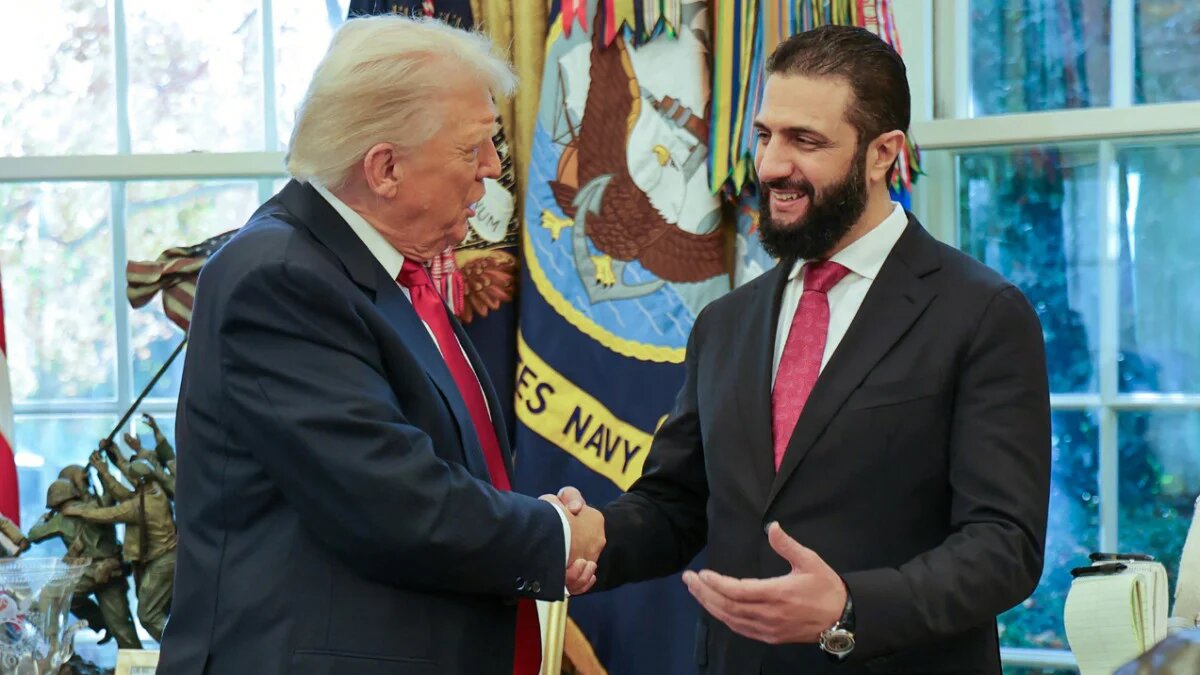
The White House welcome looks like a new dawn for Syrian-American relations, given that the US has sanctioned Syria as a ‘state sponsor of terrorism’ since 1979 – and that further sanctions were added by the Reagan, George W. Bush and Obama administrations.
And it’s certainly quite a turnaround for a former jihadist – though perhaps not as much as it first seems. Al-Sharaa was in prison for most of the Iraqi civil war, so he didn’t participate in attacks on Shia civilians. Released just as the Syrian Revolution was beginning in March 2011, he returned to Syria to establish a militia called Jabhat al-Nusra, which later transformed into Hayat Tahrir al-Sham (HTS). These organizations focused on fighting Assad and the Iranian militias that supported him. They never attacked the West, and they steered clear of the mass civilian casualty operations favoured by Iraqi jihadists.
Al-Sharaa broke definitively with ISIS in 2013, and has fought it continuously since 2014. In power, he aims for good relations with the world rather than apocalyptic war. And where ISIS fielded a morality police to impose a dress code, in al-Sharaa’s Damascus, women wear what they like.
The US had conducted multiple anti-ISIS operations in HTS-ruled Idlib, including the one that killed ISIS ‘caliph’ Abu Bakr al-Baghdadi in 2019. Though there was no direct coordination, HTS fighters did not attack the US special forces. Indirect understandings intensified into direct cooperation when al-Sharaa assumed power on December 8 last year, leading to at least eight joint operations. Now, after the meeting in the White House, Syria has announced its formal integration into the Global Coalition against ISIS. This will lead to still more joint action. Even more significantly, the Syrian Democratic Forces (SDF) – the Kurdish-led militia that controls large parts of northeastern Syria – can no longer claim to be the Coalition’s boots on the ground. This is a step towards Syria’s reunification under central authority.
Read the rest of this entry »Constructive Criticism
Here I am on the Eon podcast with some post-Suwayda constructive criticism for the Syrian transitional authorities.
The End of Eternity
A slightly edited version of this text was published at the Guardian.
The liberation of Syria was long hoped for, but unexpected. Over the last weeks, Syrians have experienced the full range of human emotions, with the exception of boredom.
On the first two Assad-free Fridays, millions of celebrants swelled the streets to chant and sing and speak formerly forbidden truths. There was a huge presence of women, who had been less visible in the years of war. Relatives are meeting again and assuaging their pain as hundreds of thousands return from the camps of exile. At the same time, millions are having to accept at last that their loved ones have been tortured to death. It now appears that most of the 130,000 lost in Assad’s prisons (a bare minimum figure) are dead. Dozens of mass graves have already been discovered.
Working hard to crawl out from under the corpse of one of the worst torture states in history, Syrians are now looking to the future.
A key factor in the final fall of the regime was the remarkable discipline and social intelligence shown by the HTS-led rebel coalition. When it became clear that neither Christians nor unveiled women were being harassed in liberated Aleppo, that there was no looting, and that Shia towns which had hosted murderous foreign militias were not subjected to revenge attacks, then tens of thousands of Assad soldiers felt safe enough to defect or desert.
But some still harbour deep suspicions of HTS leader Ahmad al-Sharaa, previously known as Abu Muhammad al-Jolani. He also has enormous charisma, which might ease the path to a new dictatorship. So far, however, the signs are more hopeful than that. Al-Sharaa is popular precisely for his non-dictatorial qualities.
Read the rest of this entry »