Author Archive
More Double Standards
Here’s my third post in a row on Israel-Palestine, and there may be another to come. I don’t intend to narrow the focus of the blog to one area, however important; but bear with me a little as I comment on the hypocrisy (briefly – several volumes could be filled on the subject) of Western responses to recent events.
Following the killing of 130 Palestinians in a week, more than half of them non-combatants, a Palestinian has shot dead eight young Israelis in the Mercaz Harav yeshiva in West Jerusalem, the part of the city which was occupied in 1948. Not only has most of the Western media given this attack more coverage than the deaths of the 130 Gazans (there are many days on which the death toll in Gaza reaches seven or eight and the Western media doesn’t even notice), it has also described the attack as an ‘escalation.’ I won’t discuss whether or not the attack was justified or wise, but I will say that it was an entirely predictable and understandable response to the suffering of Gaza, and that to call it an ‘escalation’ – when the occupying Zionist army perpetrates such crimes against the occupied on an average day – is simply grotesque.
Cartoons and Delusions
At least 76 Palestinians have been killed by the Zionist occupation in the last three days, 17 of them children. Three Israelis have been killed. Before I go any further I’d like to explain something which shouldn’t need explaining. A scorecard like 76 to three will not make the Palestinians surrender. On the contrary, it will make them fight with more commitment and devotion. For decades Israeli Jews have been working on the assumption that the more disproportionate the casualties, the more massacres they perpetrate, the more terror they strike into the hearts of the defeated, the closer their ultimate victory comes. The murder-them-into-submission theory has of course been proved wrong again and again. Their invasion of South Lebanon in 1978 and their blitzkrieg of 1982 created Hizbullah, the most effective and intelligent fighting force in the Arab world’s modern history. As for the Palestinians, through the long decades of their dispossession they have grown in resilience, toughening until, by the outbreak of the Second Intifada, they had lost their fear. Occupied Palestine is certainly exhausted. Unsurprisingly, given the murderous international campaign directed against it, the political leadership is splintered. But this fact remains: Palestinian fearlessness and will to resist is now an unchangeable reality.
Egyptian Novels
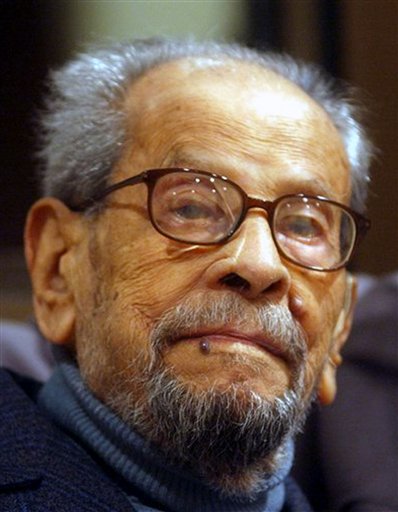
Nobel Laureate Naguib Mahfouz
In the contemporary Arab world, Bilad ash-Sham, or the Levant, surely comes first for poetry. Whether you’re looking for Muhammad Maghout’s bitter satire, anti-romanticism, and defence of the poor and the peasants, or for Mahmoud Darwish’s lyrical nationalism — whether you appreciate the modernist obscurity of Adonis or the powerful simplicity of Nizar Qabbani; you will turn to Syria and Palestine for your verse fix. The Arabs certainly do. For poetry in the Middle East isn’t the elite preoccupation it has become in the West. Taxi drivers and market men will quote you snippets of Qabbani’s love poetry or angry anti-occupation verse according to their temperament and the twist of the conversation. Even the illiterate may know some Qabbani from hearing it quoted in the café or crooned by the Iraqi singer Kazem as-Saher, with orchestral accompaniment. When Arab rappers want to express hardcore identity, they proclaim: “I’m an Arab like Mahmoud Darwish!” (the ‘Dam’ crew from Palestine.) That’s how uncissy Arab poetry is.
But for the Arabic novel, a genre which is only a century old (although there are much earlier precursors), the action is centred in Egypt, unsurprisingly – Egypt with its huge population and its indefinable, unmeasurable metropolis.
The most famous of Egyptian novelists is Naguib Mahfouz. Amongst the Arabs his books are bestsellers in garish covers, and many have been made into classic films. His international reputation was sealed when he became the first Arab to win the Nobel Prize for Literature in 1988. Reflecting changes in 20th century Arab reality, his style developed from heroic through realist to magical realist or romantic symbolist.
“Maps for Lost Lovers” and writerly responsibility
Update 2015: With the passage of time, much of this review embarrasses me. So people and perspectives change. My current view is better summed up by my words at the 2015 Shubbak festival, which Brian Whitaker reports:
There is a beautiful novel called Maps for Lost Lovers by Nadeem Aslam who is Pakistani-British, and I would recommend that everybody reads the novel as a work of literature because it is beautifully, beautifully written and characterised.
It works as a novel, but there is no good Muslim character in it. They are real characters and you can sympathise with them even when they are doing horrible barbaric things. But they are all doing horrible barbaric things from the moment they get up in the morning, and its the kind of horrible barbaric things that British Pakistanis do that you read about in the Sun newspaper.
So of course there is an issue, but we cant tell Nadeem Aslam that he’s a representative British Pakistani writer and therefore he has to write a nice version of British Pakistanis in order to educate the white population that some of them are all right. He’s writing what he wanted to write about and what was real for him, and he did it really well. I think the critique should focus on the social context. It’s not Nadeem Aslam’s fault so much as the Sun newspaper’s fault.
And here’s the thing I originally wrote:
I’ve recently read Nadeem Aslam’s finely-constructed and richly metaphorical novel “Maps for Lost Lovers”, which portrays a British Pakistani community and its rigid boundaries over a year of daily life and crisis. Save for some occasionally unconvincing dialogue, the writing is beautiful and poetic. Unlike, for example, Martin Amis, Aslam respects his characters, who are well-rounded and complex enough to evoke sympathy even when they behave badly. He shows them busy with gossip, work, poetry – and plenty of murder. For example, a book shop owner is murdered for money by his relatives in Pakistan. At the heart of the book, Chanda and Jugnu are murdered by Chanda’s brothers for ‘living in sin.’ Chanda wants to divorce her husband so she can marry her lover, but her husband has disappeared for years, and she doesn’t know where to. Another girl is murdered by a ‘holy man’ during exorcism-beatings. And so on: a litany of crimes motivated by ‘honour’ and superstition.
One subplot revolves around a woman being forced by sharia law to marry another man before returning to a husband who has divorced her once while drunk. The actual regulation is this: if a man divorces his wife THREE times he cannot remarry her unless she has been married to someone else and that marriage has also collapsed. This is generally understood as a warning to husbands not to divorce their wives without considering the consequences. Furthermore, a divorce announced when the husband is angry or intoxicated is not recognised. As for the stranded Chanda, sharia would automatically grant her a divorce if her husband disappeared for a day longer than a year. Fair enough, Aslam is writing about uneducated people’s partial and skewed understanding of their religion, or of their confusion of tradition and religion, but this point will be lost on non-Muslim readers.
Nubians
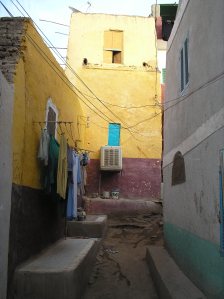 Crossing the Nile from Aswan to Elephantine Island feels like travelling to a different country. Squashed – for now – between the ruins of Abu and a gated luxury hotel are the Nubian villages of Siwa and Koti and their shared agricultural land. This was where I spent most of my four days in Aswan, returning from museums and cemeteries to the living, to banana and palm groves, rice paddies and cane fields, and the narrow alleys and painted houses of the Nubians.
I smoked with them, played dominoes, laughed and talked at great length. I returned late each night to my toothbrush in the hotel in Aswan, but they invited me to sleep in their house. They fed me a spicy cheese which tastes similar to Syrian shingleesh, but in liquid form, and fool bean paste, tomatoes and carrots full of flavour, spicy fried liver. It was the best food I ate in Egypt, a country without a decent restaurant culture, even in Cairo, so a country where the best food is simple, rural.
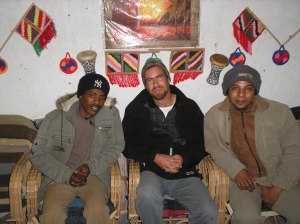 In the downstairs room, three three-month-old crocodiles captured from Lake Nasser stretched their necks, destined for early execution and then stuffing, or mummification – it’s the same word in Arabic. A few days later I visited the temple at Kom Ombo where sacred crocodiles once splashed in a riverside pool, and where a mummified-crocodile graveyard was excavated. So the Nubians have been stuffing animals for a very long time. My hosts told me the Nubians were the originators of ancient Egyptian civilisation. This is a simplification, to say the least, and one which reminds me of other nationalist narratives in the Middle East. In Syria you hear how Arab-Semitic culture gave the world language. Iran, so some Iranians say, was the factor that civilised a previously barbaric Arab Islam. Most absurdly, Kemalist nationalism in Turkey, with its ‘sun-language theory’ and other idiocies, claims that the Sumerians were actually ‘Turanian’ Turks, that the Turks colonised India when the Indians lived in trees, and so on. But the Nubians, being a small, divided people – and pushing the rice pudding bowl towards me as they talked – won my sympathy.
Visiting Syria
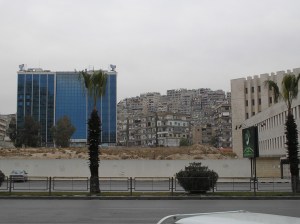
on Mezzeh autostrade
I’ve just given up smoking, again, after a relapse in Syria and Egypt. I mean, what can an ex-smoker do, returning to Sham? In Oman very few people smoke. Abu Dhabi airport, where I spent an hour in transit, is of course smoke-free. But in Damascus airport the passport officials were smoking, and the police, and the baggage handlers, and the passengers. So it continued in the taxi, and in the house, and almost everywhere else. I’m not complaining.
I spent a too-brief ten days in Syria, mainly shivering. It was minus seven one night. Coming out of the hot mineral-water baths (men stepping into the pools clutching their cigarettes) at Jbab and waiting ten minutes for a micro to the city, I froze. My hatless brother-in-law said it’s because I haven’t done military service. He started his in the winter time, standing at attention in his underwear on subzero mountainsides, assaulted by insults and buckets of cold water. “Great days!” he mused. “Happy memories!” So it was cold, but the Syrians grumbled that it hasn’t rained enough this year. There was a big snowfall just after I left, and there’s been another one today.
Dysfunctional State – Dysfunctional World
The assassination of Benazir Bhutto, although it happened across the Gulf of Oman, feels remarkably close, for both personal and public reasons. On a personal level, the event strikes up sparks of memory. As a very young man I worked for The News, an English-language paper, on the Murree Road in Rawalpindi. I loved that office and all the great people in it, the long late chaotic nights through which we typed and laughed and drank tea. I remember Liaquat Bagh just a little down the road, the park named after Pakistan’s first prime minister Liaquat Ali Khan, who was assassinated there, and where Benazir was killed last December 27th. I remember People’s Party supporters firing shots into the sky outside the office on the night when Benazir was appointed prime minister, for the second time, in 1993. When I read about bombs and sectarian mayhem in Karachi, Islamabad, Swat or Gilgit I remember the immense beauty and carnivalesque energy of Pakistan, the music I heard there, the Sufi festival I visited, the wealth and poverty I saw, and the intelligent, enthusiastic people I met.
Very Guarded Optimism
The level of violence in Iraq is still remarkably high, and still nothing works. Compared with the situation a year ago, however, when there were hundreds of killings daily, Iraq today seems like a brave new world. In this very relative oasis of peace it has become possible to glimpse the kind of democracy which could conceivably work in Iraq. A successful democratic system would involve cooperation between local communities (not between sects), with the government a council of councils rather than a powerful centralised state apparatus holding the country together by force
Whenever they have had a chance, local communities have proved their mettle. Remember the role of the early Mahdi Army in stopping the looting triggered by the 2003 invasion, and in establishing basic services for the people. It was mosque committees, Sunni and Shia, which collected money in their neighbourhoods and paid teachers to return to the classrooms, and which organised work teams to repair local infrastructure. This was reminiscent of Hizbullah at its best: people in extremis relying on themselves, and doing what no external authority was willing or capable of doing.
But as we know, it all went horribly wrong. Society fragmented and the logic of violence took over. Local communities were silenced and then splintered by sectarian militias. In my post http://qunfuz.blogspot.com/2007/08/end-of-arabs-part-one.html I wrote about how the American destruction of the state was the major factor catalysing the civil war. Specific American actions led directly to the disaster: the initial unwillingness to countenance Iraqi rule followed by a sectarian approach to ‘representation’, the use of central-American style death squads to fight the Sunni resistance (the expert John Negroponte was imported for this), the dissolution of the army and the police so that criminal and sectarian gangs filled the void.
There was also of course an internal Iraqi dynamic motivating the conflict. Sunni-Shia tensions have bubbled for centuries, which is not to say that they are as essential and timeless as some orientalists would have us believe. The ostentatious Shia revival that followed the invasion, bursting forth like steam from a pressure cooker when the lid is suddenly removed, came as a result of the years of Ba’athist persecution. A frightened and dispossessed Sunni community made the fatal mistake of allowing al-Qa’ida and other Wahhabi nihilists to penetrate the resistance. If Shias preferred to wait to see what the new dispensation would bring them in terms of political power, most of them sympathised with the anti-American resistance. Al-Qa’ida’s bomb attacks, however, targetted first the new police, and then Shia civilians, in mosques and marketplaces, in their tens of thousands. After the April 2006 destruction of the dome of the Askari shrine in Samarra’, sacred to Shias as the burial place of the 11th Imam and as the place where the Imam al-Mahdi went into occultation, Shia militias responded with brute force. A mutual orgy of ethnic cleansing wrecked the country’s ancient fabric. Iraq became a kind of Lebanon, not only in the ferocity of its communal hatreds but also in its transformation into a battleground for regional rivals: Saudi Arabia versus Iran, and America in the paradoxical position of fearing Shia power more than the Sunnis, who were attached by their Saudi ties to the illusory ‘arc of moderation’ even if they housed al-Qa’ida.
In the summer of 2007 things started to improve. It would be unfair not to recognise that new American tactics have had a measure of success in calming Iraq. By putting thousands more American soldiers on the streets, the ‘surge’ concedes the idiocy of Donald Rumsfield’s military theories. But much more important than the surge has been the Sahwa or the ‘Awakening’ movement of Sunni tribes and resistance fighters reclaiming their towns from nihilist thugs. Just as the American invasion was the greatest gift to al-Qa’ida, the clear demonstration of al-Qaida’s brutality and sectarianism in areas where it took control demolished the illusion of its revolutionary purity in the eyes of Iraqis and the wider Muslim world. Sunni communities turned on those they’d previously sheltered and, with al-Qa’ida on the defensive, it became possible for the Shia to reach out to the Sunnis. Simultaneously, popular revulsion with the Mahdi Army’s excesses led Moqtada Sadr to declare a six-month suspension of activities, and to purge his organisation of the more criminal, more Sunni-murdering elements. There are signs too, especially since the farcical Annapolis ‘peace’ summit, of the Arab client states realising that America won’t rescue them from their crises of domestic credibility and regional destabilisation. Only a good working relationship with Iran can do that. Regional peacemaking may be reflected in internal Iraqi peacemaking.
It’s still far too early to be optimistic. Many of the Sunni ‘sahwa’ militias may have calculated that a period of peace, and of getting into the Americans’ good books, will provide them with training opportunities and weapons so that they succeed in round two of the civil war. Hating the excesses of al-Qa’ida does not mean loving the new Shia power structure. The government, consisting mainly of politicians sponsored by Shia and Kurdish militias, has so far agreed to employ only 6% of Sunni volunteers in the state security forces. So it may be that the worst is still to come. Beyond the Sunni-Shia conflict, the battle between Muqtada Sadr’s Iraqi-nativist Mahdi Army and the currently pro-American, traditionally Iranian-backed Supreme Islamic Iraqi Council seems to be on temporary hold. And militia forces are only conducive to peace and order to the extent that they represent local people, not the politics of a local strong man.
But I’ve been reading reports not only of cooperation between Sunni and Shia militias in neighbouring areas, but of mixed militias, and even of mixed militias negotiating the reversal of ethnic cleansing. In some areas of Baghdad, families are actually returning to their homes in areas where the other sect dominates.
This is something to thank God for. If against the odds the trend towards peace continues, a large number of the educated professionals that Iraq has lost may return home. Iraqis will then face two huge challenges: to expel the American occupation, which is digging in for the coming decades, and to either remove the corrupt and failed political elite which arrived with the American tanks or to impress upon it the necessity of non-sectarian national politics and real economic and political sovereignty. These challenges can only be met by a unified Iraqi people. A democracy based on community action could lead to unity. Is good news possible in Iraq?
The Reluctant Fundamentalist
I’ve now read three September 11th novels, by which I mean novelistic responses to the issues raised by the attacks. The first was ‘Saturday’ by Ian McEwan. I usually feel somewhat cheated by McEwan’s novels, and this was no exception. He goes to such trouble to develop characters, setting and plot, raising your expectations to such a pitch that you feel you’re about to learn something unforgettable about life and human beings, and then it all fizzles out. ‘Saturday’ covers a day in the life of a London doctor called Henry Perowne. The day begins with Perowne worrying over a mysterious plane in the sky, wondering if it’s going to fly into a London landmark. Later he avoids the huge demonstration against the approaching invasion of Iraq. Perowne wonders how he feels about it all, comes to no conclusion, goes to play squash. He has an altercation with a thuggish person who scratches the paint from his car, and in the evening the same thug breaks into his house like a symbol of the intrusive messy world. I’ve forgotten how it ends. McEwan has been attacked for being a neo-conservative, or a liberal interventionist, or just as hopelessly complacent and bourgeois as his protagonist, but he has defended himself by pointing out that McEwan is not Perowne – an obvious truth. If we start blaming authors for what their characters say we end up like the fools in Egypt who demonstrated against Haider Haider’s novel ‘A Banquet of Seaweed’ (waleema li-‘ashaab al-bahr) because one of Haider’s characters – who later commits suicide – expresses atheistic beliefs. Nevertheless, it’s a shame that McEwan’s treatment of the post-September 11th world focusses only on Western self-absorption. What the events require is a new engagement with the darknesses and resentments of the world beyond our narrow conception of it, a new sense of the interconnections of the West and elsewhere, for better and for worse.
Then I read John Updike’s ‘Terrorist’, which I’ve previously discussed on this blog (http://qunfuz.blogspot.com/2006/11/updikes-terrorist.html ). My great respect for Updike as a writer perhaps made me too charitable in that evaluation. If anybody hasn’t read his series of ‘Rabbit’ novels, I strongly recommend them, for their wonderful style, their tragi-comedy, and for their vast scale which encompasses key moments in American history as well as in Harry ‘Rabbit’ Angstrom’s life. In these books Updike is clearly writing about what he knows and understands. In “Terrorist”, he clearly isn’t. His main protagonist, despite being mixed-race and mixed-up, is a stereotype, and so are all the Arabs and Muslims in the book – either dirty and threatening, or ‘good niggers’ who ardently support the attack on Iraq and report to the CIA. Nothing new is said about the motivations of anti-American terrorism or about the effect of the American empire on the world. Updike’s analysis goes no further than Martin Amis’s. He sees the causes of conflict to be sexual, not political, and believes that America is targetted as a result of its supposed moral degeneracy. But Muslims haven’t attacked the bikini beaches of Brazil, and such ‘analysis’ is as self-congratulatory as Henry Perowne’s bourgeois complacency.
Last night I finished ‘The Reluctant Fundamentalist’ by Mohsin Hamid. This is a simpler novel than the two described above, and is stylistically unremarkable. It is, however, a genuine consideration of real issues raised by September 11th. In its organisation and the cumulative metaphorical power of its subplots it is much more than competent. It is a confessional narrative, told by a Pakistani to an American in a restaurant in Lahore. The anguished first-person self-revelation is reminiscent of Dostoyevsky’s ‘Notes From Underground’, but Hamid’s Changez is a fundamentally balanced character. It’s the times, and the empire, that are out of joint, and Changez’s story is of righting himself by retreating from America. Educated at Princeton and working for a company which values businesses due to be sold off and stripped, Changez finds himself smiling when he sees TV reportage of the twin towers falling. This prompts a deepening examination of his identity, his allegiances, and his relationship with America. Parallels are implied between Muslim countries and the doomed employees of the companies Changez evaluates. The key here is not religion, but corporate capitalism and traumatic economic change. Changez’s boss Jim says, “We came from places that were wasting away.” He means, on the one hand, Pakistan, and on the other, old industrial America. ‘The Reluctant Fundamentalist’ is a catchy but not very apt title. There is very little theology in the book. By the end of the story Changez is not at all an Islamist, but discovers he has to oppose the corporate American empire in order to remain mentally and morally healthy.
There’s plenty of on-target comment about American reaction to September 11th. Like this: “I had always thought of America as a nation that looked forward; for the first time I was struck by its determination to look back. Living in New York was suddenly like living in a film about the Second World War; I, a foreigner, found myself staring out at a set that ought to be viewed not in Technicolour but in grainy black and white. What your fellow countrymen longed for was unclear to me – a time of unquestioned dominance? of safety? of moral certainty? I did not know – but that they were scrambling to don the costumes of another era was apparent. I felt treacherous for wondering whether that era was fictitious, and whether – if it could indeed be animated – it contained a part written for someone like me.”
The attack on the empire makes Changez aware of America as an empire. The final straw for him is when he hears someone describing the Janissaries, the Christian slaves taken as boys from their parents by the Ottoman empire and turned into an elite warrior class to defend the sultan. Is Changez a latter-day reversed Janissary?
In an effective subplot, Changez has an almost-girlfriend who is obsessed by the memory of her dead boyfriend. In her depression, “She glowed with something not unlike the fervour of the devout.” Themes of nostalgia and commingled, confused identities seep into other parts of the novel, where they are relevant to Changez, Pakistan, and America. These are the correspondences and suggested patterns that novel writing is all about. ‘The Reluctant Fundamentalist’ deals profoundly with politics without needing to limit itself to political discourse, and so succeeds as a novel. The novel is the most holistic form there is, in that it treats spirituality, identity, sex, politics, and so on, without drawing ideological lines between them. In that respect, the novel is a specimen of life.
Mohsin Hamid is a Pakistani who studied and worked in America and now lives in London. He has the cross-cultural experience to write a novel like this. But is it ridiculous to expect a more monocultural Anglo-Saxon writer to approach similar themes – of empire and resistance, of defensive nostalgia and confident self-reinvention – without resorting to stereotype and media cliché? Is a broader perspective really so difficult?
Democracy
Response to Creative Syria’s discussion of Syrian regional alliances (see previous post) was dominated by arguments about democracy between an Israeli poster and others. The Israeli accused anybody who supported any aspect of Syrian government policy of being an apologist for dictatorship, and there, unfortunately, the debate stuck. If you agree with an undemocratic regime, he implied, you are not worth listening to. Here I will write a little against the propagandist uses and religious idealisation of the word ‘democracy,’ a word considered as little and used as injudiciously as the word ‘terrorism.’
First there is the irony of a Zionist lecturing us about democracy. We often hear the preposterous claim that Israel should be defended because it is ‘the only democracy in the Middle East,’ when in fact it is an ethno-democracy or an apartheid democracy. Israeli state apparatus rules over a population equally split between Jews and Arabs. The ‘Arab Israelis’ are at best second class citizens, disadvantaged and under threat of transfer. (There are 20 laws which discriminate against the Arab Israeli minority. For more information visit Adalah . The oppressed Arabs of the occupied West Bank and Gaza only have voting rights in a non-existent state. And this vaunted state of human freedom is possible because most of the indigenous inhabitants of Israel-Palestine have been driven into exile. Establishing a state for the Jews in an Arab country and then calling it a democracy has been one of the blackest jokes of modern history.
Syria’s Regional Alliances
CreativeSyria (see the link on the left) organises a ‘Creative Forum’ where bloggers consider an aspect of Syrian politics. This time the topic is Syria’s regional alliances. My contribution, which I copy below, is on CreativeSyria along with several more opinions. I think Wassim’s is excellent, far more comprehensive than mine. But here’s mine:
For a time the pattern of alliances in the Middle East was organised into monarchical-conservative and republican-nationalist camps. Following the 1991 Kuwait war, there was a realignment which pitted a Saudi-Syrian-Egyptian alliance against a disgraced and battered Baathist Iraq and its perceived allies such as the Jordanian monarchy. Because the Damascus Declaration countries were the three key Arab mashreq states, some pretence at the centrality of Arab alliances in the region was still possible. But since the 2003 invasion and subsequent dismantling of Iraq a new set up seems firmly established. On one side stands Syria, Iran, Hizbullah and Hamas; on the other Saudi Arabia, Egypt, Jordan, the March 14th Lebanese, Mahmoud Abbas, and (implicitly) Israel.
Osama bin Laden
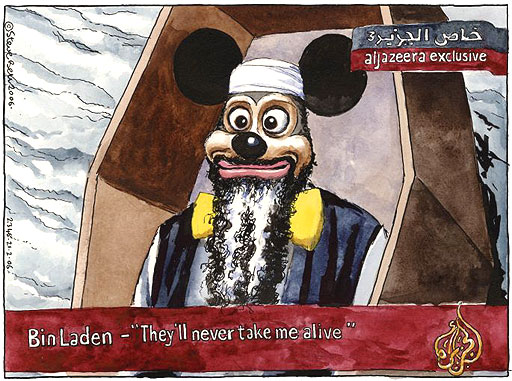
- by Steve Bell
Osama bin Laden squeezed his face back onto our screens at the start of Ramadan. This time, probably advised by his American follower Adam Gadahn, he tailored his discourse to a Western audience, and tainted by association the good names of Noam Chomsky and the anti-globalisation movement. Before Ramadan ends, let me talk briefly about bin Laden and those associated with him.
Still when bin Laden’s name is mentioned in many parts of the Arab world, although less so than a couple of years ago, a cheer goes up. Let’s hope that Martin Amis never reads this; he would see it as proof of his thesis that all Muslims are Wahhabi-nihilists. But cheering for bin Laden is like waving a flag or, more accurately, waving two fingers. It doesn’t mean that the cheering people would like to be ruled by bin Laden or that they subscribe to his programme, as they admit when questioned. Many of these ‘supporters’ would be killed if bin Laden could get his hands on them, either for being ‘heretics’ – like my Ibadhi Muslim students here in Oman – or for being ‘apostates’ – like the men in a bar in Aleppo in the following anecdote. These drinkers were well into their third or fourth bottle of araq when bin Laden came on the TV screen. “I swear by almighty God,” said Osama, his finger wagging, “that the Americans will not sleep soundly in their beds until the children of Palestine sleep soundly in theirs!” Immediately the men surged to their feet and held their glasses towards the TV image. “Kassak!” they roared – which means “Your glass!” or “Cheers!”
This story says it all. Beyond the tiny hardcore of Wahhabi-nihilists, bin Laden won sympathy in the Arab world because the Arabs will support anyone who talks tough against America and Israel. This is a symptom of the frustration and impotence felt by the Arabs, and the utter failure of their leaders to stand against Zionist and imperialist oppression in the region. Cheering for bin Laden is the equivalent of the protest vote. And inasmuch as al-Qa’ida targets America, the victim does not behave in a way designed to win sympathy. Before they had time to consider the implications of the September 11th attacks, many Arabs were impressed that this superpower which routinely trashed Muslim cities could be so dramatically humiliated. Central New York looked like Baghdad or Gaza, and to many that was an understandable cause for celebration. People in China and Latin America also celebrated September 11th. I’ve even heard – from a friend who was living in California at the time – that some Black and Hispanic Americans were gleeful about the attacks.
A Ramadan Reflection
Verse 18 of Sura 39 of the Qur’an says:
“Those who listen to the Word (the Qur’an) and follow the best meaning in it: those are the ones whom Allah has guided and those are the ones endowed with understanding.”
Or, in Muhammad Asad’s translation:
Those “who listen closely to all that is said, and follow the best of it: it is they whom God has graced with His guidance, and it is they who are truly endowed with insight!”
Muhammad Asad’s translation is wonderful both for the language and for the erudite and open minded notes which take on board classical Islamic scholarship as well as modern intellectual currents. (Asad, born Leopold Weiss, was a fascinating figure. Perhaps I’ll dedicate a posting to him one day). Here is his note on this verse:
Statement of Belief
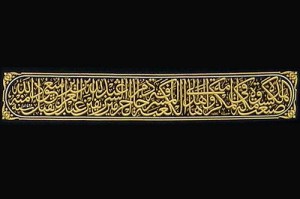 I’m a Muslim in that I feel allegiance to the Muslims as a people. It’s not a blind patriotism. I don’t feel allegiance to any particular sect, doctrine or government. As a member of this cultural group (or groups), somebody who lives with and sympathises with and loves many believing Muslims and their overwhelmingly warm and humane culture, I recognise that the Qur’an is the source text that is crucial to us. We do with it what we can. The range of what we’ve done throughout history is astounding.
There is the Islam of the Sultan and the Islam of the Sufi. The Sultan’s rulebook religion, the god-idol that fits into the human mind. And the Sufi’s tradition of peaceful wandering, of poverty, of shrines and poetry, of Qawwali songs and intoxication. It is the latter that attracts me, the Sufi’s but not the Sultan’s Islam. The Islam of Hallaj, not of the authorities who mutilated and murdered him.
If you ask which Islam is inspired by the Qur’an, I must reply that both are.
I am Marxist enough to believe that religions are for the most part products of the material conditions from which they arise. Islam arose from a culture of Beduin raiding and enforced tribal consensus, and yet managed to move beyond this to something new, still pointing further to possibilities for future development. I believe it is possible, but by no means inevitable, for Muslims of the present and future to make an Islamic society better than the society made by the Prophet’s companions.
The End of the Arabs? Part Two
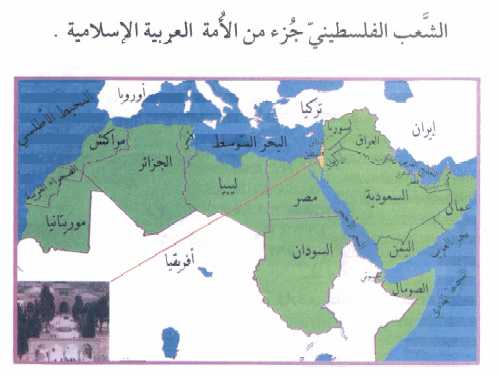 Peter W. Galbraith writes that Iraq is an artificial creation made up of different ethnic groups. This is true, but Iraq is not alone in its artificiality. All states are artificial in that they have been created by historical process and human machination, not by God or nature, and all contain different ethnic groups. More specifically, the centralised nation state in the Middle East (and Africa and much of Asia) is always artificial because the very concept of the nation state is an import from 19th Century Europe. The borders of every Arab state were determined, suddenly, by imperialism, and not by the long processes of war, negotiation and ideological mythmaking that drew borders in Europe. It is this imperialist division of the Arabs which has led to various forms of pan-Arab nationalism.
The definition of ‘Arab’ has expanded over the last hundred and fifty years from describing tribal nomads as opposed to townsmen, to describing the people of the Arabian peninsula, and then to describe all from the Atlantic Ocean to the Gulf who share the heritage of the Arabic language.
The Ba’ath Party went so far as to find religious significance in ‘Arab,’ as is evident from the slogan ‘One Arab Nation bearing an Eternal Message.’ The ‘risala’ or message is what Arabs would previously have assumed to be the revelation of the Prophet (more often called Messenger in Arabic) Muhammad. The word used for ‘nation’ is ‘umma’ – a word previously used to denote the international Muslim community. In fact, Ba’athism should be seen as one of the twentieth century’s many attempts to compensate for the collapse of traditional religion (Nazism, Zionism, Stalinism, contemporary Wahhabism and hedonist consumerism are others).


 Qunfuz