Archive for the ‘Syria’ Category
Iran Shoots Itself in the Foot
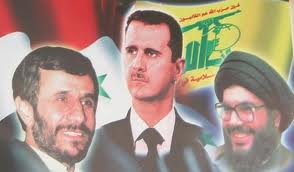 This was written for the excellent Lobelog.
In August 2012 Egyptian President Muhammad Morsi attended a meeting of the Non-Aligned Movement (NAM) in Tehran. His presence at the conference was something of a diplomatic victory for the Iranian leadership, whose relations with Egypt, the pivotal Arab state, had been at the lowest of ebbs since the 1979 revolution.
Egypt’s President Sadat laid on a state funeral for the exiled Iranian shah. A Tehran street was later named after Khalid Islambouli, one of Sadat’s assassins. Like every Arab country except Syria, Egypt backed Iraq against Iran in the First Gulf War. Later, Hosni Mubarak opposed Iranian influence in Iraq, Syria, Lebanon and Palestine, worked with the US and Saudi Arabia against Iran’s nuclear program, and was one of the Arab dictators (alongside the Abdullahs of Jordan and Saudi Arabia) to warn darkly of a rising “Shi’ite cresent”. Not surprisingly, Iran was so overjoyed by the 2011 revolution in Egypt that it portrayed it as a replay of its own Islamic Revolution.
Iran also rhetorically supported the revolutions in Tunisia and Libya, the uprising in Yemen, and, most fervently, the uprising in Shia-majority Bahrain.
In Syria, however, Iran supported the Assad tyranny against a popular revolution even as Assad escalated repression from gunfire and torture to aerial bombardment and missile strikes. Iran provided Assad with a propaganda smokescreen, injections of money to keep regime militias afloat, arms and ammunition, military training, and tactical advice, particularly on neutralising cyber opponents. Many Syrians believe Iranian officers are also fighting on the ground.
Discussing Assad’s Speech at the Opera House
“It was operatic in its otherworldly fantasy, unrelated to realities outside the building,” wrote Rami Khouri of Bashaar al-Assad’s latest speech, delivered as the bombs fell on southern Damascus. I was a guest on the BBC World Service to discuss the speech alongside Patrick Seale (Hafez al-Assad’s biographer), Syria Comment’s Joshua Landis, Faisal Yafai of the National, and Dr Yazan Abdullah. You can listen to the conversation here.
Woman in the Crossfire
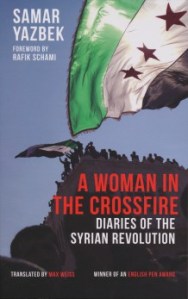 ‘A Woman in the Crossfire: Diaries of the Syrian Revolution’ by novelist Samar Yazbek is part journalism, part personal memoir, and all literature. It’s literature of the instantaneous sort, a staggered snapshot of the first four months of the revolution, a public history of “a country succumbing to the forces of death,” and an interior history too. Yazbek tells us about her headaches, her insomnia and Xanax addiction, her crying fits, her fears for her daughter and herself, her constant panic. How sometimes in the speeded-up context the rush of information precedes all feeling: “The daily news of killing,” she writes, “was more present inside of me than any emotion.”
Samar Yazbek has always been problematic. Having consecrated herself “to the promise of a mysterious freedom in life,” she left home (in Jableh, on the coast) at sixteen, later divorced her husband and lived in Damascus, a single mother, working in journalism and writing sexually controversial novels. When Syria rose up against the Asad regime she publically supported the victims and their cries for freedom. And she’s an Alawi, a member of the president’s largely loyalist sect, of a well-known family. As an unveiled and obviously independent woman, a secularist and daughter of a minority community, her support for the revolution proved the lie of regime propaganda, which characterised the uprising as Salafist from the start.
So leaflets slandering her were distributed in the mountains. She was called a traitor, made recipient of death threats, publically disowned by family and hometown. Naturally she was visited by the mukhabarat and made to experience, vicariously at least, the domestic wing of regime propaganda – for the theatre of blood is as important inside Syria as the projection of civilised moderation used to be abroad – by being walked through a display of meat-hooked and flayed torturees.
Hypocrisy, As Usual
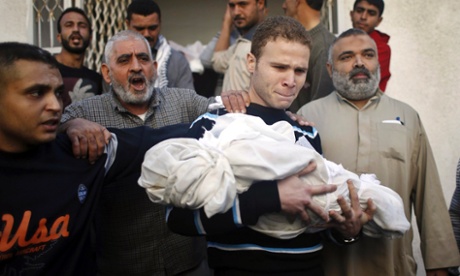
Omar al-Masharawi, son of a BBC cameraman in Gaza, murdered by Zionist bombs.
Israel has launched yet another attack against the Gaza Strip, striking the densely-populated and besieged territory from the air and the sea, and as usual the United States, Canada and Britain have lined up in support of Zionist terrorism.
Speaking from a system poisoned by the Israel lobby, State Department spokesman Mark Toner says: “There is no justification for the violence that Hamas and other terrorist organizations are employing against the people of Israel. We call on those responsible to stop these cowardly acts immediately. We support Israel’s right to defend itself.” Confusing Zionist settlers for ‘the Jewish people’, confusing perpetrator with victim, and then parroting outmoded ‘war on terror’ propaganda, Canadian foreign minister John Baird vomits the following: “Far too often, the Jewish people find themselves on the front lines in the struggle against terrorism, the great struggle of our generation.” Then Britain’s foreign minister William Hague makes the following immoral and illogical comment: “I utterly condemn rocket attacks from Gaza into southern Israel by Hamas and other armed groups. This creates an intolerable situation for Israeli civilians in southern Israel, who have the right to live without fear of attack from Gaza.”
Two things must be said. First, this round of escalation, like the 2008/2009 slaughter, was started by Israel. It is totally mendacious to pretend otherwise. The Hamas government in Gaza refrained from stopping other groups from firing missiles as a result of Israel’s murder of a disabled man and of a twelve-year-old boy in Gaza. Here is a timeline of events. Second, the settlers of southern Israel do not have the right to live without fear of attack while the original inhabitants of ‘southern Israel’ are herded into refugee camps. Eighty percent of people in Gaza are descendants of refugees ethnically cleansed from their villages and towns by Zionist militias in 1947 and 1948.
Finally, Leadership
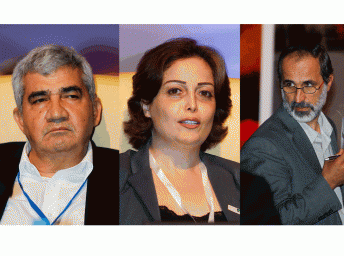
l-r: Saif, Atassi, Khatib (Reuters photo)
Following my previous comment on the astounding failures of Syrian political elites, I must report some optimism. The Syrian National Council has accepted its place within the new Syrian National Coalition (it makes up a third of the new body), and the Coalition has won recognition by the Arab League, France, Japan and others.
The Coalition’s choice of leaders is the most inspiring sign, one which suggests both that the Coalition is no foreign front, and that another, much more positive aspect of Syria is finally coming to the fore.
President Ahmad Muaz al-Khatib is a mosque imam, an engineer and a public intellectual. He is Islamist enough for the Islamists and less extreme Salafists of the armed resistance to give him a hearing, but not Islamist enough to scare secularists and minority groups. He has written books on the importance of minority religious rights and women’s rights in a just Islamic society. His speeches since assuming his position have reached out to minorities and to the soldiers in Asad’s army, who he described as victims of the regime.
Vice President Riyadh Saif is a businessman, former MP, and a liberal democrat.
And Vice President Suheir al-Atassi, daughter of foundational Ba’athist Jamal al-Atassi, is a human rights activist, a secular feminist, a founder of the Syrian Revolution General Commission, and a key activist of the grassroots Local Coordination Committees. She is the sort of person who should have been representing the Revolution at the highest level from the very start.
All three leaders have been active participants in the revolution inside Syria, and all three have suffered imprisonment. All three are known and respected by Syrians inside the country.
Syrian National Mess
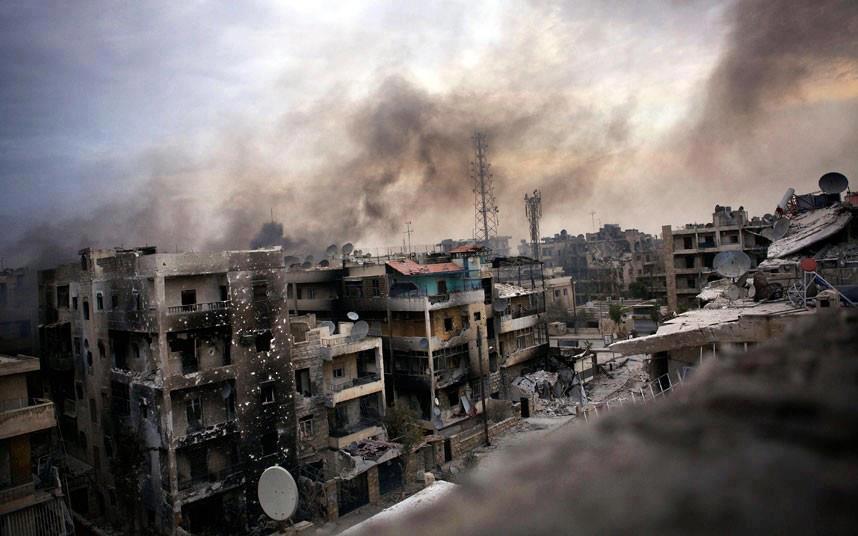 George Sabra has been elected new head of the Syrian National Council. He seems like a good man and his first interviews suggest he’s an effective talker. But his election comes as the SNC loses the last of its relevance. Despite the gravity of its historic responsibility, the Council failed to connect properly with revolutionaries on the ground, it failed to do enough to reassure minorities, or to aid refugees, it put all its eggs in the basket of a foreign military intervention which was never going to happen, it overrepresented the Muslim Brotherhood, it was bedevilled by factional and ego-based conflict, and its self-renewal process ended up with no women in the leadership. Foreign governments have lost interest in it. Crucially the grassroots Local Coordination Committes say the SNC no longer represents them. Other opposition bodies and individuals outside the SNC (some of them doubtless secretly backed by the regime) have added to the sniping and backstabbing.
Today the news is that a new, broader body has been formed to coordinate the fight against Asad, to implement law in liberated areas, and to oversee the post-Asad transition. It’s called the National Coalition of the Syrian Revolutionary Forces and the Opposition, or the Syrian National Coalition. Perhaps this initiative will be more successful than others; we’ll see. Very sadly, it took Qatari and American badgering and perhaps promises of better weaponry (at this late stage with the country in flames and the resistance finally capturing heavy weaponry for itself) to force the ‘opposition’ to coalesce. You’d think Syria’s elite politicians would have been self-motivated to compromise and act by the destruction and mass slaughter in their homeland, by the urgency of the tragedy, by the vacuum allowing nihilists and potential warlords to call shots. But no. While Syria’s grassroots revolutionaries are unparalleled heroes, seemingly capable of endless self-sacrifice, Syrian political elites have failed their people massively.
The Revolution Becomes More Islamist
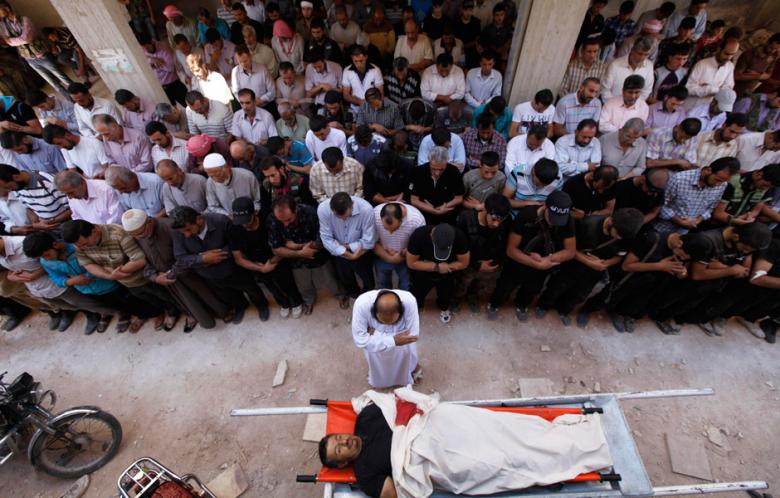
photo by reuters/ zain karam
Like ‘armed gangs’, armed Islamists are one of the Syrian regime’s self-fulfilling prophecies. Most grassroots organisers and fighters are secularists or moderate Islamists, but the numbers, organisational power and ideological fervor of more extreme and sectarian Islamists are steadily rising. So why is the revolution taking on an increasingly Islamist hue? Here are some points in order of importance.
First, the brute fact of extreme violence. As the saying goes, “there are no atheists in foxholes.” Not only is faith intensified by death and the threat of death, and by the pain and humiliation of torture, but tribal and sectarian identities are reinforced. We want to feel like we when in death’s presence, not like I, because I is small and easily erased. So in Syria at the moment many Sunnis are identifying more strongly as Sunnis, Alawis as Alawis, Kurds as Kurds, and so on. This is very sad and it immeasurably complicates the future task of building a civil state for all, but it is inevitable in the circumstances. The violence was started by the regime, and the regime is still by far the greatest perpetrator of violence, including aerial bombardment of villages and cities, and now the liberal use of child-killing cluster bombs.
Second, beyond patriotic feelings for Palestine and Iraq and an unarticulated sense that their government was corrupt, two years ago most men in the armed resistance were apolitical. Finding themselves having to fight, and suddenly entered onto the political stage, they search for an ideology within which to frame their exciting and terrifying new experience. At present, the most immediately available and simplest ideology on offer is Salafism. As well as for their stark message, Salafists are winning recruits because of their organisational and warfaring skills honed in Iraq and elsewhere, and because of their access to private funds from the Gulf. If this were the sixties, the revolutionaries growing beards would have had Che Guevara in mind (and if much of the ‘left’ in the world were not writing off the revolution as a NATO/Saudi/Zionist conspiracy, the left might have more traction). At present, Salafism is in the air. It’s unfortunate, but it’s the historical moment. And why were all these young men apolitical before the revolution? Why hadn’t they learned more of debate and compromise? Simply put: because politics was banned in Asad’s Syria.
In Praise of Hatred
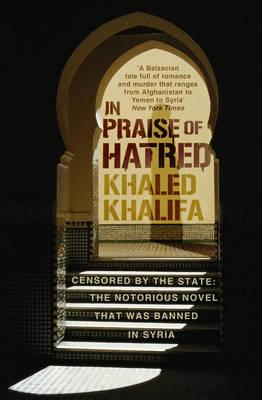 I was honoured to be asked to write the introduction to the English translation of Khaled Khalifa‘s third novel, In Praise of Hatred – set in Syria in the 1980s and essential background reading for the current tragedy. Four paragraphs of the introduction are reprinted below, and then Maya Jaggi’s review in the Guardian.
So how brave and necessary it was to write a fiction of the events. In our narrator’s harsh euphemism, Alawis are “the other sect” and the Ba‘ath Party is “the atheist party”, but the historical references are unmistakeable. Khalifa plays one of the noblest roles available to a writer: he breaks a taboo in order to hold a mirror to a traumatised society, to force exploration of the trauma and therefore, perhaps, acceptance and learning. He offers a way to digest the tragedy, or at least to chew on its cud. In this respect he stands in the company of such contemporary chroniclers of political transformation and social breakdown as Gunter Grass and JM Coetzee.
In purely literary terms as well as politically, the novel rises to a daunting challenge: how to represent recent Syrian history, which has often been stranger and more terrible than fiction.
For a start, it’s a perceptive study of radicalisation understood in human rather than academic terms. It accurately portrays violent Islamism as a modernist phenomenon, a response to physical and cultural aggression which draws upon Trotsky, Che and Regis Debray as much as the Qur’an, and contrasts it with the more representative Sufism of Syrian Sunnis.
Next, it examines the dramatic transformations of character undergone by people living under such strain, the bucklings and reformations, the varieties of madness. The characters here are fully realised and entirely flexible, even our bitter narrator, and their stories are told in a powerfully rhythmed prose which is elegant, complex, and rich in image and emotion. There is musicality too in the rhythm of the episodes, the subtle unfolding of the plot.
The Fall of the House of Asad
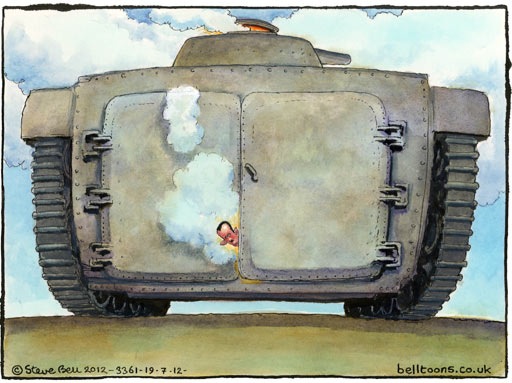
steve bell’s asad
This review of David Lesch’s book was written for the Scotsman.
Until his elder brother Basil died in a car crash, Bashaar al-Assad, Syria’s tyrant, was planning a quiet life as an opthalmologist in England. Recalled to Damascus, he was rapidly promoted through the military ranks, and after his father’s death was was confirmed in the presidency in a referendum in which he supposedly achieved 97.29% of the vote. Official discourse titled him ‘the Hope.’
Propaganda aside, the mild-mannered young heir enjoyed genuine popularity and therefore a long grace period, now entirely squandered. He seemed to promise a continuation of his father’s “Faustian bargain of less freedom for more stability” – not a bad bargain for a country wracked by endless coups before the Assadist state, and surrounded by states at war – while at the same time gradually reforming. Selective liberalisation allowed for a stock market and private banks but protected the public sector patronage system which ensured regime survival. There was even a measure of glasnost, a Damascus Spring permitting private newspapers and political discussion groups. It lasted eight months, and then the regime critics who had been encouraged to speak were exiled or imprisoned. Most people, Lesch included, blamed the Old Guard rather than Bashaar.
“I got to know Assad probably better than anyone in the West,” Lesch writes, and this is probably true. Between 2004 and 2008 he met the dictator frequently. His 2005 book “The New Lion of Damascus” seems in retrospect naively sympathetic. He can be forgiven for this. Most analysts (me included), and most Syrians, continued to give Bashaar the benefit of the doubt until March 2011.
Save the Children in Za’atari Camp
Save the Children has released a report on the suffering of Syria’s children, based mainly on interviews with children in Jordan’s very basic Za’atari refugee camp. The Guardian reports on it here. I contributed to a discussion of the report on the BBC World Service’s World Have Your Say programme. My interjections come between thirteen and seventeen minutes.
Blasphemy
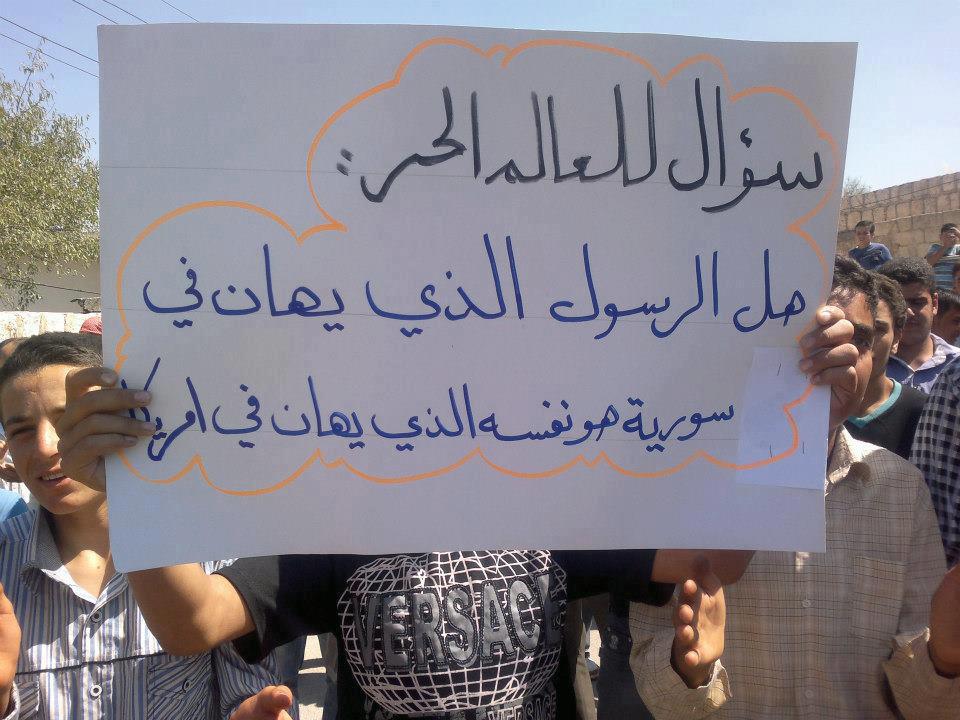
“Is the Prophet who is being insulted in Syria not the same Prophet who is being insulted in America?”
This video is not suitable for children nor for those of a nervous disposition. I include myself in the latter category. At first I couldn’t watch it, then I made myself do so in order to hear the words. Before the usual “Freedom? You want freedom?” the torturee is forced to declare that Bashaar al-Asad is his ‘lord’ (the Arabic word ‘rabb’, which means God). The violent (but very small) protests which have swept the Muslim world in response to a ridiculous low-budget smear of the Prophet Muhammad are in part the expression of a deeply humiliated people who remember Western support of Zionism and Muslim dictatorships, Western invasions of Iraq and Afghanistan, and so on. They are in part the result of the failure of Arab and Muslim dictatorships to build functioning education systems, and a symptom of a profound and generalised despair that requires wounded symbols through which to manifest itself. Most importantly, they are signals of an opportunistic power play by the extreme right-wing Salafist minority. It’s a case of extreme right-wing Islamophobes, Zionists, Coptic extremists and American Republicans on the one hand and extreme right-wing Islamists on the other, feeding off each other. The furore has made the ridiculous anti-Islam film a Youtube hit. Nobody would have heard of it had Egyptian Islamists not publicised it, and had the American ambassador to Libya, apparently a friend of the Arabs who was critical of US policy on Palestine, not been murdered. As with all the episodes in the ‘culture wars’, it’s an enormous diversion from the really serious issues. The torture video here was first pointed out by the Syrian activist Wissam Tarif. He asked a simple question. Where are the furious demonstrations against this blasphemy? Why have no Syrian embassies been burnt following the repeated bombing of mosques and churches, the murder, rape, torture and humiliation of tens of thousands of Syrian Muslims?
To Kill, and to Walk in the Funeral Procession
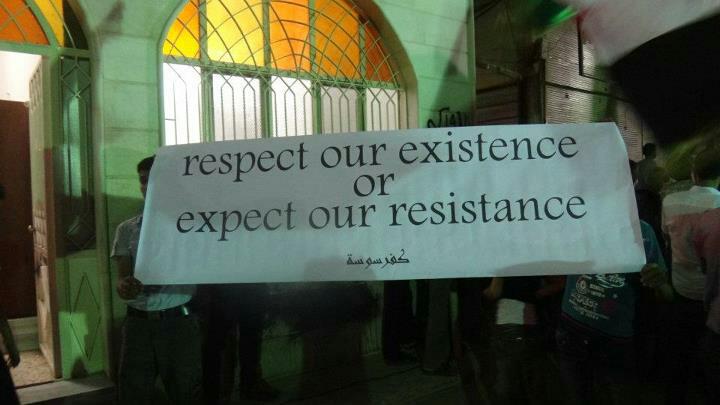
photo by Razan Ghazzawi
Updated with a postscript noting Robert Fisk’s obscene pro-regime propaganda while embedded with the regime army in Daraya, and the response of the LCCs to Fisk’s nonsense.
The Syrian regime is now perpetrating crimes against humanity at a pace to match its crimes in Hama in 1982 and at the Tel Za’atar Palestinian camp in 1976. All of Syria is a burning hell. Savage aerial bombardment (such as that causing the apocalypse here in Kafranbel, which held such beautifully creative demonstrations) and continuous massacres have raised the average daily death toll to well above two hundred, most of them in Damascus and its suburbs. The other day 440 people were murdered in twenty four hours.
The worst hit area has been the working class suburb of Daraya. I visited people in Darayya some years ago, and once bought a bedroom set for a friend’s wedding in the town. I remember it as a lively, friendly, youthful place. Last year Daraya became a cultural centre of the revolution. Ghiath Matar and others developed wonderful methods of non-violent protest there. When security forces arrived to repress demonstrations, Darayya’s residents handed the soldiers flowers and glasses of water. But Matar was murdered, and Daraya has been repeatedly raided, its young men detained and tortured, its women and children shot and bombed. Nevertheless, for some months the regime was kept out of Daraya. The town ruled itself in a civilised manner, successfully keeping a lid on crime and sectarianism.
The recent pattern is already well established (remember the massacre at Houla), but this time has played out on a larger scale. The regime bombed Daraya for days, mainly from artillery stationed on the mountains overlooking Damascus. Once any armed resistance had retreated, soldiers and shabeeha militia moved in, with knives and guns. This stage reminds one of Sabra and Shatila. It seems there was a list of suspected activists and resistance sympathisers, but the field executions included old men, women and children. About three hundred bodies have been counted so far, found in the street or in basements or in family homes.
World Have Your Say
Me, Jenan Moussa, Bilal Saab and others discuss recent developments in Syria on the BBC World Service’s World Have Your Say.
All Things Considered
Me discussing Syria’s Christians on BBC Radio Wales with Harry Hagopian, the lovely Nadim Nassar, and the strange English priest and admirer of the tyrant Christopher Gilham.
http://downloads.bbc.co.uk/podcasts/wales/atc/atc_20120805-1030a.mp3%20%20target=_blank
Summary for the Standard
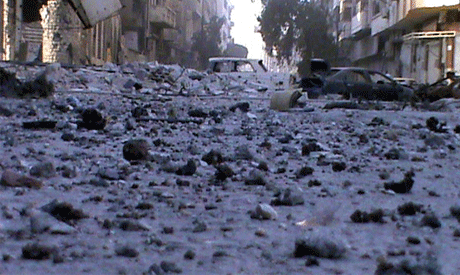
picture by AFP
This was first published by London’s Evening Standard (second story on the page).
In important ways, the regime has been collapsing for a couple of months. The Free Syrian Army – hundreds of militias made up of defected soldiers and volunteers – has liberated rural territory in the north and centre of Syria and controls sections of Homs and other cities. A steady stream of defections, including such prominent figures as General Manaf Tlass, has swollen the opposition.
Significantly, the regime has lost its support base in Damascus and Aleppo, where the arrival of refugees from other cities, terrible economic conditions and news of the Houleh massacre have provoked a wave of strikes and demonstrations.
Battles have raged in the suburbs. Now Operation Damascus Volcano has entered the capital. It’s an impressive show of coordinated popular and armed resistance, met by helicopter gunships, artillery fire and roving bands of thugs. The escalation renders the deadlocked international management of the crisis entirely irrelevant.


 Qunfuz