Archive for the ‘Syria’ Category
Blanket Thinkers
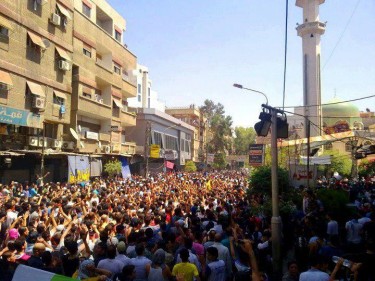
Yarmouk camp demonstrates
One of my infantile leftist ex-friends recently referred to the Free Syrian Army as a ‘sectarian gang’. The phrase may well come from Asa’ad Abu Khalil, who seems to have a depressingly large audience, but it could come from any of a large number of blanket thinkers in the ranks of the Western left. I admit that I sometimes indulged in such blanket thinking in the past. For instance, I used to refer to Qatar and Saudi Arabia as ‘US client states’, as if this was all to be said about them. I did so in angry response to the mainstream Western media which referred to pro-Western Arab tyrannies as ‘moderate’; but of course Qatar and Saudi Arabia have their own, competing agendas, and do not always behave as the Americans want them to. This is more true now, in a multipolar world and in the midst of a crippling economic crisis in the West, than it was ten years ago. Chinese workers undertaking oil and engineering projects in the Gulf are one visible sign of this shifting order.
The problem with blanket thinkers is that they are unable to adapt to a rapidly shifting reality. Instead of evidence, principles and analytical tools, they are armed only with ideological blinkers. Many of the current crop became politicised by Palestine and the invasion of Iraq, two cases in which the imperialist baddy is very obviously American. As a result, they read every other situation through the US-imperialist lens.
The Milgram Experiment in Syria
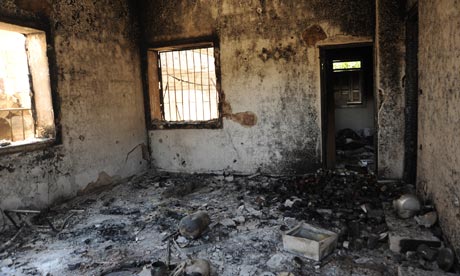
Howleh. picture by Kaveh Kazemi/ Getty Images
It has thrown students out of top-floor windows. It has shelled cities from the land and from the air. It has raped women and men and tortured children to death. Now with the massacres at Howleh and Qubair – in which Alawis from nearby villages, accompanied by the army, shelled, shot and stabbed entire families to death – the Syrian regime has escalated its strategy of sectarian provocation. Here Tony Badran explains very well the sick rationale behind these acts.
To a certain extent the regime’s plan has already worked. Now it seems inevitable that sectarian revenge attacks will intensify. In general, sectarian identification is being fortified in the atmosphere of violence created by the regime and added to by the necessary armed response to the regime. Sectarian hatred will deepen so long as the regime survives to play this card.
The regime wants us to understand the conflict in purely sectarian terms. Many Syrians recognise this and are resisting it. At this impossibly difficult time it’s good to remember the Alawi revolutionaries, who are heroes, and crucial to the revolution, heroic in the way Jewish anti-Zionists are heroic.
What do I mean by heroic? A disproportionate number of Alawis owe their livelihood to the regime. To fight for a post-regime future means to fight for a future in which their community will be, at best, less favoured than at present. This takes moral and political courage. Many Alawis have grown up surrounded not, as most Syrians have, by anti-regime mutterings, but by the happy version. To break with this version requires a psychological transformation, something as big as growing up. More concretely, there are family pressures – and family is so important in Syria. Very many Alawis are employed in the security forces. If your uncle is an officer in the mukhabarat, therefore, you don’t find it easy to publicly oppose the regime. It takes courage to do so, and the kind of confidence in your own judgment which will allow you to discount the arguments of your elders and authorities. Only a few people have such strength. (Of course it takes much more strength to live in a Sunni neighbourhood being beseiged and bombed, but this is a different kind of strength.)
Arm the Guerrillas
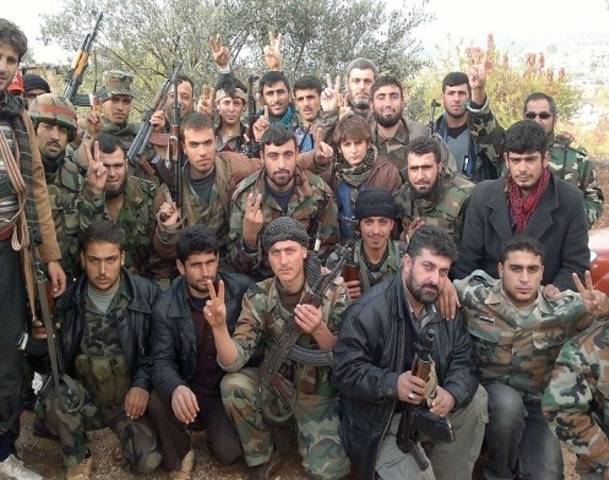
picture by Reuters
This was published at Foreign Policy.
There are some, perhaps many, Syrians who detest their government and are entirely aware of its treasonous nature — yet wish for the demonstrations and the guerrilla actions of the Free Syrian Army (FSA) to stop and for President Bashar al-Assad’s regime to regain control as soon as possible. They take this position out of a profound pessimism: They believe it is impossible to uproot the surveillance-and-torture state and its deep sectarian substructure, that more people will die the longer the unrest continues, that the economy will collapse further, and that nothing will alter the end — Assad’s inevitable victory. Some Syrians go so far as to say that the regime itself, or a branch of it, is surreptitiously encouraging demonstrations so as to have an “excuse” to teach the new generation an unforgettable lesson.
I can’t agree with this defeatist perspective on principle — the principle being my refusal to give in to despair, and my faith in the ability of human beings to change their circumstances. I understand it, however, and I understand that I might share it if I were living in the heart of the horror instead of in Scotland. But apart from principle, I think the assumption underlying the defeatist perspective is mistaken. Yes, the regime is still able to kill, and will continue or even intensify its killing. However, it has lost control of the country and won’t be able to reestablish it.
The much-maligned United Nations observers have confirmed what news reports had already suggested: Large areas of the Syrian countryside and provincial cities are either under FSA control or nobody’s. Regime forces are able to infiltrate and punish areas under the revolutionaries’ sway, but they dare not linger. Sometimes, they are not even able to move in. When the Assad regime recently attempted to retake Rastan, the FSA destroyed a number of armored vehicles and killed 23 soldiers, forcing the military to retreat.
Not Writing About Syria
picture by Paul Klee
I haven’t been writing about Syria at my previous pace. The time is not right.
This is a time for Syrian internet activists, those still surviving, to send us their videos. It’s a time for gathering evidence – although no more evidence is needed.
It’s a time for reporters to write, for committed foreign journalists to smuggle themselves inside and tell the tale. (You could call the murdered journalists martyrs, because they chose to go to a place where they knew they might die, and they did so for the sake of the truth.)
People who have specific human stories to tell should tell them. I hear the occasional story, and I might relay some of them; but I am not there. I am observing from Scotland.
This time is the beginning of a long process of creative mulling for those who will eventually produce novels and films concerned with the tragedy.
Most of all it’s a time in which people scream and suffer and die, a time to wait for the next explosion, or the next kick at the door, or for the return of the rapists, or for the next shriek of pain and humiliation from the neighbouring cell. It’s a time for burying children at night, hastily, in silence. And the suffering continues with glacial inevitability. Fate doesn’t seem to plan an end to it, not yet.
Sectarianism and Honesty

the Syrian dictator accompanied by the Sunni mufti
This was published in the excellent Ceasefire magazine.
Ba‘athism began as a conscious attempt to supercede the sectarian and regional divisions which plague the Arab world. That’s why many of its early ideologues were Christians or members of other minority groups. The Ba‘athist slogan umma arabiya wahida zat risala khalida – One Arab Nation Bearing an Eternal Message – employing the word for ‘nation’ which previously designated the international Muslim community, and the word for ‘message’ previously associated with the Prophet Muhammad’s divine message – suggests that this variety of Arabism actually intended to supercede religion itself, or to become a new religion.
In Iraq it all went wrong very quickly. Saddamist Ba‘athism in effect designated ethnic Arabs of the Sunni sect as true Arabs, the Shia majority as quasi-Persian infiltrators, and the Kurds as an enemy nation. Saddam even wrote a characteristic pamphlet called ‘Three Things God Should Not Have Invented – Persians, Jews and Flies’, and so demonstrated the slip from nationalism to fascism.
Syria was somewhat different, somewhat more sophisticated. Despite the fact that the president and his top spies and generals were Alawis from the Lattakkia region, only Sunni Islam and Christianity were taught in the education system (to the chagrin of traditional Alawi shaikhs). When the president prayed in public he prayed in the manner of the majority, Sunni-style. In the last couple of decades the regime sought to broaden its base by coopting Sunni businessmen as well as soldiers from the minority groups. And the majority’s rituals and religious festivals were never banned as they were in Iraq.
The Karachi Literature Festival
I’ve recently come back from an excellent three weeks in Pakistan visiting universities, farms, shrines and old friends. I started at the Karachi Literature Festival. In the session below, I, Stefan Weidner and Anouar Benmalek discuss the Arab Spring.
Here’s me doing a creative writing class at the festival. Part one. And part two. It’s probably very boring to watch on video except perhaps for the less formal question and answer at the end.
The Liberation of the Golan
Today demonstrators marched against the Syrian regime in Majdal Shams on the occupied Golan Heights. (For believers in the sectarian narrative, most of the people here happen to be Druze, not Sunnis). One of their slogans was ash-sha‘ab yureed tahreer al-jowlan – The People Want the Liberation of the Golan. The Syrian regime, which has slaughtered over 6,000 civilians since the revolution started, hasn’t fired a bullet over the Golan since 1973. In the clip below Asad loyalists confront the protestors, but are outnumbered. The demonstrators shout almowt wala almuzuleh – Death Rather Than Humiliation – and illi yiqtil sha‘abu kha’in – He Who Kills his People is a Traitor.
It’s interesting to note that the Golan was occupied by Zionists in 1967, before most of the demonstrators were born, and illegally annexed in 1982. The very Syrian drama unfolding on these ‘Israeli’ streets proves – if proof were needed – the absurdity of Zionist hopes that Arab national identity on occupied territory will gradually evaporate.
Now The Bombs
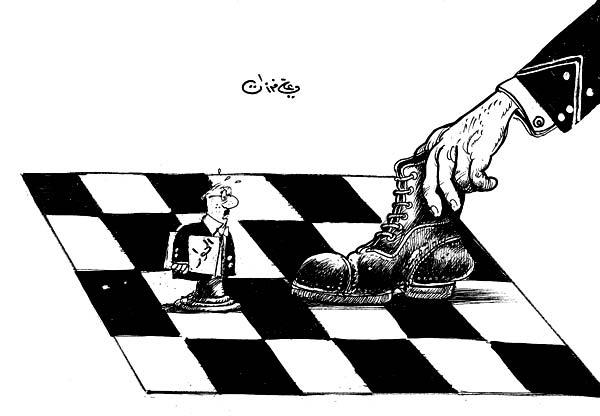
by Ali Farzat
Many Syrians have been awaiting this moment with dread. A further step down into bloody chaos and incipient civil war, a further step into the dark. This morning two car bombs exploded at security installations in Kafar Souseh, Damascus. At least thirty people were killed and over 100 injured.
Who’s to blame? There is no evidence of anyone’s guilt, and there won’t be any credible evidence while the criminal Asad regime remains in power and continues to lie and to block journalists’ access. This means that pro-regime people will follow the regime line and blame al-Qa’ida, and anti-regime people will blame the regime. I make no bones about it: I’m firmly in the anti-regime camp. Those who followed my writing before this year will know that I was once willing to give the regime the benefit of the doubt. Not any longer. This year I’ve been forced to admit that the regime is a lot less intelligent, a lot less sophisticated, than I thought. Back in February it had enough popularity to lead a genuine reform process. It’s entirely possible that Bashaar al-Asad, had he played this revolutionary year right, could have won a real election. But he didn’t play it right. From the start his regime slaughtered peaceful protestors and subjected thousands to torture, including children, even to death. Worst of all, the regime instrumentalised sectarianism in an attempt to divide and rule. After months of attacks by armed Alawi gangs on predominantly Sunni lives and property there are now instances of ‘revenge’ attacks on innocent Alawis, and tit for tat sectarian killings particularly in Homs and its surrounding countryside. All of this could have been predicted months ago. Of course, the mechanics of these killings is as obscure as that behind the bomb attacks in Damascus today. Some revolutionaries believe the regime is behind the killings of Alawis too, because it aims to spark a sectarian war which it thinks it can win. And we must not forget that sectarian war is still – to the credit of the Syrian people – not the dominant strain in the conflict. There are thousands of defected soldiers, many of whom have seen their comrades gunned down. If they had chosen to they could have attacked the minorities in a coordinated fashion. They haven’t. And the Alawi actress Fadwa Sulaiman is still leading demonstrations in the Sunni heart of Homs.
Sarmada

Fadi Azzam
A slightly shorter version of this review appeared in The Independent.
Places have moods, this novel reminds us. Sometimes Sarmada, a mountain village rising from the Hauran plain of southern Syria, is all “oblivion, dust and tedium”; at other times it’s a shimmering delight, each rock, tree, spring, cliff and cave owning rich meanings and histories. Sarmada is also “a Sheherazade”, a generator of tales, so many tales we can’t possibly hear them all. “I thought about telling her the joke about the overweight fortune-teller,” Azzam writes, “but..”
Like the Arabian Nights, “Sarmada” contains stories within a frame story. The frame and trigger is a meeting with Azza Tawfiq, an expert in chaos theory at the Sorbonne who (following the Druze tenet of transmigration) believes she lived in Sarmada in a past life as a murdered girl called Hela Mansour. Bemused, disbelieving, the narrator returns from “chasing dreams in Paris and delusions in Dubai” to excavate the village’s memories, at first on Azza’s behalf.
Turn It Up
For Syrians it’s an exhilarating experience simply to express honest political opinions out loud in a public place. For decades anti-regime gripes have been expressed in private, in whispers. Many were frightened to speak even in the home, lest the children repeat what they’d heard at school. But now people are screaming and singing against the regime every morning, afternoon and night. The sense of solidarity amongst the revolutionaries – breaking the fear barrier together, facing possible torture and death together – is enormous. These two films demonstrate the sometimes carnivalesque quality of the revolution as well as the Syrian people’s musicality. In the first, filmed in Da’el in the Hawran, a romantic tune is turned into an anti-Asad anthem. In the second, filmed in the Baba Amro neighbourhood of Homs, the authorities cut electricity to a protesting area; the protestors illumine their mobile phone screens and keep on going. Both films should be watched with the volume on maximum.
Revolutionary Alawis
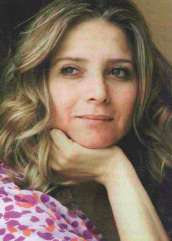
Samar Yazbeck
Novelist, screenwriter and journalist Samar Yazbeck in interview: “The regime has indeed destroyed the Alawite religion, a peaceful religion, as it engaged in things foreign to the faith, leading some to become its Alawite thugs. But many of us are opponents, in jail, in exile, or banned from travel. The regime is playing with sectarianism to terrify “its” minority and get support. A game that will end, but first, I fear, there will be clashes between the communities. ”
In this interview an Alawite member of the Syrian Revolution General Council based in Homs argues, “We need to break down the myth that the regime is the defender of Alawites and other minorities. It is just defending itself, and using us for its own ends.”
And in this interview actress Fadwa Sulaiman explains why she’s thrown her lot in with revolutionaries in a besieged area of Homs (she’s currently on hunger strike): – “I just wanted to go just to say we Syrians are one people. I wanted to contradict the narrative of the regime.“
Reporting Syria

Egyptians in Solidarity with Syria
The Syrian regime’s blanket ban on journalist access has some carefully selected exceptions. Robert Fisk, for instance, who seems to be compensating for the naive anti-Syrian and pro-March 14th line in his reporting of Lebanon over the last years by treating the statements of Syrian regime figures – professional liar Boutheina Shaaban is one – with great naivety. At least he didn’t apply the ‘glorious’ epithet to her which he used to describe Walid Jumblatt’s wife. Fisk’s book on Lebanon “Pity the Nation” is a classic, his account of the massacres at Sabra and Shatila remain fresh in the mind (the blood-footed flies clambering over his notebook), and for many years he was one of the very few English-language journalists with some real knowledge of the Middle East. Sadly, his knowledge doesn’t extend to a working familiarity with Arabic. In several recent articles he has informed us that that the slogan of the Ba‘ath Party – umma arabiya wahda zat risala khalida – means ‘the mother of the Arab nation.’ In fact it means ‘one Arab nation with an eternal message’. Fisk is confusing ‘um’ – mother – with ‘umma’ – nation. It’s a rather disastrous mistake. Someone ought to tell him about it.
Nir Rosen is an excellent journalist who clearly does speak Arabic and who makes the effort to talk to ordinary people rather than just politicians and PR people. His book “Aftermath” is essential reading for anyone who wants to understand how the American occupation of Iraq catalysed an outbreak of Sunni-Shia sectarian hatred across the Arab world. His recent visit to Syria (see here and here and here and here) seems to have been both above and below regime radar. While he appears to have been smuggled in to certain locations he also interviews such regime figures as the state Mufti Hassoun – someone once known for his touchy-feely liberalism and his campaign against honour killing now making absurd threats about armies of pro-Asad suicide bombers lying low in Western countries. Unfortunately, Rosen sees Syria through the prism of Iraq’s sectarian war. He expects to find expressions of sectarian hatred, and he finds them aplenty. He can’t be blamed for making it up, because sectarian hatred certainly does exist in Syria, and because he honestly reports what people say to him. The danger of this method, however, is twofold. First, his selection of informants necessarily reinforces his bias. He does interview some pro-regime Sunni figures (like Hassoun) but chooses not to interview Alawi, Christian, Ismaili or secularist figures who support the revolution. He doesn’t consider such people to be representative of the revolution because he’s decided that the dynamic must be sectarian, even if the Ismaili town of Selemiyeh has been demonstrating for months and secularists like Suhair Atassi are very prominent in the revolution’s Coordination Committees. (Indeed, Burhan Ghalyoun, the head of the umbrella Syrian National Council, to which many demonstrations have proclaimed allegiance, is fiercely anti-clerical).
Fadwa Sulaiman
Samar Yazbeck, Ibrahim Qashoush, Rasha Omran, Ali Farzat, Mai Skaf, Khaled Khalifa, Samih Shqair – there’s an impressive list of Syrian writers, musicians and artists who have bravely and unambiguously supported the people’s aspirations for dignity. And now the actress Fadwa Sulaiman. Here she is in besieged Homs leading chants of ‘no Salafis, no Brotherhood, the Syrians want freedom’ and ‘One, One, the Syrian People are One.’ Here she is on Jazeera (Arabic) interviewed via skype. And, below, here she is announcing her hunger strike until the prisoners are released and the siege of the besieged cities is lifted. Laila Al-Attar’s translation of her words follows after the page break.
Syrian Eid al-Adha 2011
Not a great Eid in Syria. The traditional open air Eid prayers turned into anti-regime demonstrations and, as usual, the regime’s insecurity forces fired at the demonstrators. At least twenty three people were murdered today, including an infant. Many of the dead were in the central city of Homs, which has been a veritable war zone for weeks, the site of clashes between loyalist and defected soldiers as well as tank bombardments and sniper fire from the regime. In the last four days, since the regime supposedly agreed to release prisoners and withdraw its forces from civilian areas according to the Arab League plan, at least 80 people have been reported killed in the city.
There is one piece of very important good news, however. Burhan Ghalyoun, leader of the Syrian National Council, delivered an Eid address to the Syrian people which was carried by al-Jazeera. Ghalyoun, who does not wish to become a future president, was truly presidential. He appealed to those Syrians still hesitant or afraid to support the revolution, assuring them that the future Syria will be a state of citizenship and equal rights, and that minorities will be protected. Bringing larger sections of the Alawi and Christian minorities on board is the only way for the revolution to move forward, so Ghalyoun’s speech is most welcome, and long overdue. The English translation which follows after the break was posted at al-Jazeera’s live blog, but I found it at the excellent Walls.


 Qunfuz