Archive for the ‘Syria’ Category
Pre-Ramadan Massacres
Ramadan begins tomorrow. Every night throughout the month Muslims will congregate for taraweeh prayers; in Syria, each night’s taraweeh will turn into anti-regime protests. During Ramadan people work less and therefore have more time for meditation – and for protesting. The security forces repressing these protests will be tired and snappy. The protestors will be quick-tempered from thirst and hunger, and also in many cases less frightened of death. For a pious Muslim, to die in Ramadan while standing up for justice is a very good death. At the same time, fighting in Ramadan is frowned upon. Regime violence during the holy month will outrage people even more than usual.
The regime would like to frighten everybody into their homes before the fasting starts. Hence the escalation today. The city of Hama, where between 10 and 20,000 people were massacred by the regime in 1982, was invaded by traitors before dawn. Up to 45 have been killed so far, and numbers are rising quickly. In the east, Deir-ez-Zor is also under tank attack. Several have been killed. A child has been murdered in Albu Kamal, right on the Iraqi border. And Moadamiya and other suburbs of Damascus are being attacked. Hundreds have been taken away and many injured. Reports are coming in of heavy gunfire in Homs. (Updated figures at lunchtime claim 121 have been murdered so far today throughout the country).
Does the regime want to provoke an armed reaction? (In the tribal areas near the Iraqi border, it probably will). Or does it really think that after months of massacres Syrians will be intimidated by a larger slaughter? The barbarity, idiocy and treason of this regime are beyond doubt. As uniformed Syrians murder civilian Syrians, the Golan remains under Zionist occupation – as it has been since Hafez al-Asad lost it in 1967 – and the many Israeli violations of Syrian sovereignty, which the state assured us would be avenged ‘at a time and place of Syria’s choosing’, have not been avenged. The brave security forces of the Asad thugs – great at invading Syrian cities, shooting women dead, mutilating little boys. Absolutely shit at defending Syrian people, dignity and territory. I do hope the Free Syrian Army is real. (Joshua Landis thinks it isn’t; but then, Joshua Landis has, repulsively, started to refer to pro-regime Syrians as ‘pro-stability.’)
Burhan Ghalyoun on Syria and Palestine
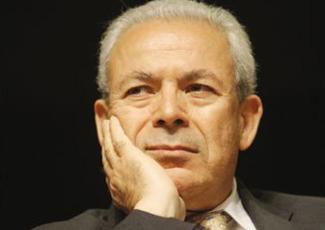
pic from alawan.org
Jadaliyya has translated an interview with prominent Syrian oppositionist Burhan Ghalyoun – well worth reading. He addresses those Syrian intellectuals still “poisoned by the idea that the regime is the foundation for an opposition and resistance to Israel, even though Rami Makhlouf, one of the regime’s pillars, stated that the security and stability of Israel is tied to the stability of Syria’s current regime,” and continues: “There is no danger for the Palestinian cause in the shadow of a democratic Syrian system. The Syrian people are closest to the Palestinian people, and they are more protective of the Palestinian cause, the Golan Heights, and Arab solidarity than the current regime whose leaders have made the country feudal and do not care for anything except for protecting their own interests and existence.”
Read the interview in full after the break.
Syria Update
I’ve been keeping quiet about Syria recently. I’ve been working on other projects. The main reason for this is that I have nothing new to say. The regime continues to spew meaningless words concerning ‘reform’ and ‘dialogue’ even as it escalates its assaults on urban areas and its campaigns of arrest and torture. The rate at which the regime murders the innocent is still shocking, but is substantially less than in earlier months. There is evidence that the killings are now more targetted against protest leaders and organisers – in other words against the intelligent leadership of the next generation. Pro-regime propagandists continue to speak about the Syrian people (their own people) the way Zionists speak about the Palestinian people. Anti-regime violence, understandably, seems to be rising. Very worryingly, there appear to have been sectarian clashes between Alawis and Sunnis in Homs. The regime, with its appalling instrumentalisation of sectarianism since the intifada began, its use of irregular Alawi-majority militias (as the Americans used Shia and Kurdish militias to terrorise restive Sunni areas in Iraq), and through its black operations, bears full responsibility for this. It is to the credit of Syrians that almost universal revulsion met news of the sectarian fighting. Most protestors reaffirmed their commitment to national unity. The protests, meanwhile, have grown to enormous proportions. The governorates of Hama, Deir ez-Zor, Idlib and Homs appear to be lost to the regime. Damascus and Aleppo are now definitely involved. Ramadan will bring a further intensification.
When I get to it, I will write more fully about Hizbullah’s blunder in supporting the regime. Hizbullah used to be wildly popular in Syria because it was perceived as an organisation dedicated to fighting for the oppressed. Now that it’s taken to supporting the Syrian oppressors against the Syrian oppressed, Hizbullah is widely despised in Syria. Its own stupidity achieved what decades of Wahhabi-Saudi, Zionist and Western propaganda could not. Here’s an article by Hamid Dabashi on that.
And here’s a fair documentary from the BBC on the situation in Syria, featuring the brave and long-suffering Riyadh as-Saif.
All Things Considered
I was a guest on BBC Wales’s All Things Considered, a religious programme, talking about Christians in the Arab world in the light of the Arab revolutions. Also talking are the Right Reverend Bill Musk, based in Tunisia, Bishop Angelos, who serves the Coptic community in London, and the Reverend Christopher Gillam, who admires the Syrian regime and overemphasises Syrian Christian opposition to the uprising. Apologies for my voice, which was heavy with cold.
Outside/ Inside
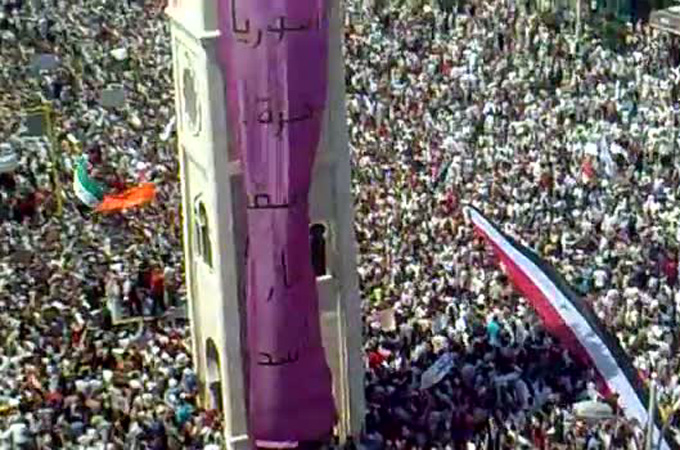
Hama (Reuters picture)
For days Syrian security forces stayed out of Hama; not even traffic police were seen in the city. During these days, no armed gangs emerged from the shadows to terrorise and loot. Christians and Alawis were not rounded up and shot. Nobody was whipped for wearing an unIslamic haircut. All that happened was day and night demonstrations against the regime swelled into crowds of hundreds of thousands – men and women, adults and children.
Perhaps the security forces stayed out of the city on the request of Hama’s governor, and perhaps that’s why he was sacked. Now security forces have entered the city and brought plenty of insecurity in their wake. At least sixteen Hamwis were killed yesterday.
Slaughter in this city – over sixty protestors were murdered there a few weeks ago – reminds Syrians of the greatest wound in their contemporary history: the Hama massacre in 1982, when 10,000 were killed at the lowest estimate, by aerial and artillery bombardment and in house to house murder sprees. There are reports that poison gas was used, and of dismemberments and rapes, but no-one really knows. No journalists slipped inside the city. There was no satellite TV, no internet, no mobile phones. Still, a thousand stories escaped the net, and every Syrian has heard some; stories whispered, not told. Hama, ‘the events’, is the great taboo.
Pride
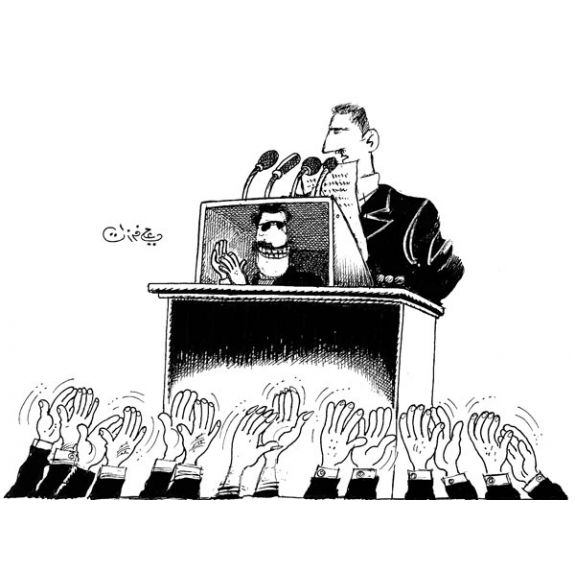
picture by Ali Ferzat
Bashaar al-Asad’s speech this week was undoubtedly a sign of weakness. Apart from a phone call to Lebanon, the ‘president’ (how insubstantial the word now sounds) hadn’t been seen or heard for two months. Turkey, the West, even Russia wanted to see a proactive, present president dealing with the crisis; Syrians began to wonder if the man was under house arrest, or sedated, or dead. So finally he turned up, only to repeat vague and unsubstantiated noises about ‘reform’, ‘dialogue’, and the like. All entirely meaningless – the killings and arrests continue regardless. The greater part of the speech focussed on the alternative reality which lives in regime heads – on conspiracies, germs, saboteurs, vandals, infiltrators. At the start of the trouble, the president said, he’d thought the ‘armed groups’ contained only 10,000 men. Imagine his surprise when he learnt there were in fact 64,000!
The only change was one of style. This time al-Asad was careful not to giggle. (A Facebook page was set up the day before the speech, called – in Arabic – ‘Bashaar, if you laugh tomorrow, we’ll shit on you.’) The camera was careful to pull away from the president when the audience applauded, lest he break into one of his gormless smiles. But he wasn’t smiling. There was very definitely fear in his eyes. And he’d lost weight. Not as much as lost by 1400 corpses, but a good few kilos.
Facebook Detox
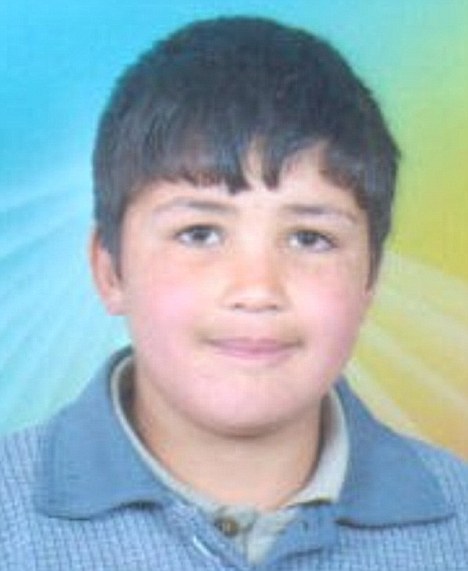
Hamza al-Khateeb
Today, following a period of Facebook madness, I deactivated my account. Unlike reefer madness, this one was a by-product of the Arab revolutions. Since January I’ve been updating statuses, liking pages, linking to articles, posting youtube videos. And, regrettably, I’ve been getting into fights. I don’t mean physical fights. My computer screen is still intact. I mean Facebook fights. Sometimes these are reasonably polite altercations; sometimes they aren’t polite at all. At all times they eat up time. Hours and hours of time. Time I could have spent reading Tolstoy or trying to play the saxophone or walking across the fields.
Getting into fights on Facebook is undoubtedly a symptom of psychological problems. I possess many social skills, diplomacy not included. I am overly passionate. Plus I am too sensitive for someone who is also a rhetorical bruiser – like a soft-jawed weakling who packs an iron fist (which sounds like Bashaar al-Asad; but this becomes too ugly). Beyond my own issues, however, Facebook presents challenges to any human being more used to communicating through the contexts fine-tuned over millenia – face to face, or in a crowded room, or by private or public letter. All these situations contain subtle mechanisms for conflict resolution or avoidance. Facebook doesn’t.
Asad, Shaaban and Me
I was on BBC Radio 4’s The World Tonight again last night, again talking about Syria. Boutheina Shaaban – translator of Chinua Achebe’s excellent novel ‘Things Fall Apart’ into Arabic, but someone who has clearly forgotten the value of words – comes before me. Unfortunately the dispute over Abdullah Gul at the end (I was right) made me forget what I was talking about.
What Next?
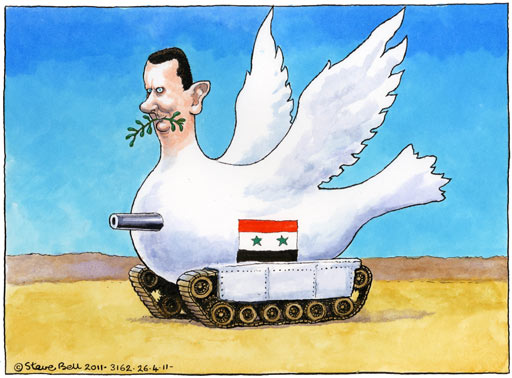
Steve Bell's Bashaar
Here’s today’s Guardian article in its pre-sub-edited form.
Last January Syria seemed, along with Saudi Arabia and other Gulf states, to be amongst the least likely candidates for revolution. If President Bashaar al-Asad had run in a real election, he may well have won.
It’s difficult remembering it today: most Syrians did grudgingly credit the regime with ensuring security and prosecuting a vaguely nationalist foreign policy. It’s that keen desire for security, the overwhelming fear of Iraq-style chaos, which keeps a section of Syrians fiercely loyal to the regime even now.
To start with, although they were inspired by revolutions in Tunisa and Egypt, most protestors didn’t aim for regime change. The first demonstration – in the commercial heart of Damascus – was a response to police brutality. That one ended peacefully, but when Dera’a protested over the arrest of schoolchildren the regime spilt blood. Outraged, communities all over the country took to the streets, and met greater violence, which swelled the crowds further. A vicious circle began to spin. All the intelligence, and the nationalist pretensions, peeled away from the government to reveal a dark and thuggish core.
More Radio
I was interviewed on KCRW’s To the Point. The programme focuses on Syria, Libya and foreign intervention. I was in august company – Anthony Shadid, New York Times correspondent and author of the wonderfully-written book on Iraq, Night Draws Near; as well as Blake Hounshell of Foreign Policy magazine. I’m on between 14.40 and 23.00, and then again from 36.00 to 37.15.
Spontaneous Expression of Love
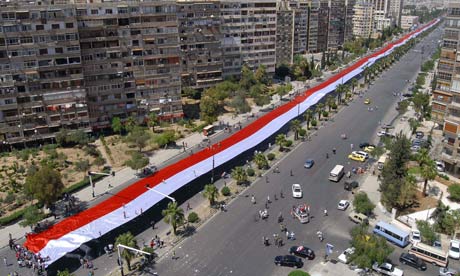
photo by Muzaffar Salman/AP
The regime brought thousands of supporters onto the streets of Damascus today. The picture shows them carrying a two-kilometre-long flag along Mezzeh Autostrade – this supposedly proves that the regime, despite its mass murder of Syrian civilians, is a patriotic one. Some of the loyalist demonstrators will be genuine supporters of the president. Many will be civil servants, teachers and schoolchildren told to do their duty. That’s how official demonstrations work in Syria.
I remember the run-up to the final referendum on Hafez al-Asad’s reign. Every night extended news bulletins screened grim-faced crowds shaking their fists on snowy hillsides or stiffly dancing debke in enormous stadiums. The newsreaders described these spectacles as spontaneous expressions of joy and loyalty. When the president won 99.something percent of the vote, the newsreaders called it ‘a marriage of people and leader.’
In honour of today’s occasion, I’m reposting the short story below. It’s inspired by an organised riot which I witnessed in Damascus in the late 1990s.
The Screen
There were no classes. Instead we marched down to the square and began to shout slogans. At first the teachers led us but soon we got into a group with no teachers and we could shout what we wanted.
Ya Blair Ya haqeer
dumak min dum al-khanzeer
O Blair, you are mud
Your blood is swine’s blood
It was hard to say the words because I was laughing so loud. Muhannad squashed his nose with his finger and oinked like a pig.
Selmiyyeh?
pic by Rex Features
This piece was published at Foreign Policy.
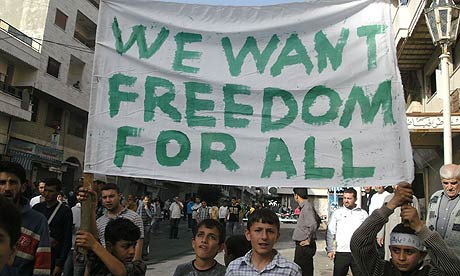
“Selmiyyeh, selmiyyeh” — “peaceful, peaceful” — was one of the Tunisian revolution’s most contagious slogans. It was chanted in Egypt, where in some remarkable cases protesters defused state violence simply by telling policemen to calm down and not be scared. In both countries, largely nonviolent demonstrations and strikes succeeded in splitting the military high command from the ruling family and its cronies, and civil war was avoided. In both countries, state institutions proved themselves stronger than the regimes that had hijacked them. Although protesters unashamedly fought back (with rocks, not guns) when attacked, the success of their largely peaceful mass movements seemed an Arab vindication of Gandhian nonviolent resistance strategies. But then came the much more difficult uprisings in Bahrain, Libya, and Syria.
Even after at least 1,300 deaths and more than 10,000 detentions, according to human rights groups, “selmiyyeh” still resounds on Syrian streets. It’s obvious why protest organizers want to keep it that way. Controlling the big guns and fielding the best-trained fighters, the regime would emerge victorious from any pitched battle. Oppositional violence, moreover, would alienate those constituencies the uprising is working so hard to win over: the upper-middle class, religious minorities, the stability-firsters. It would push the uprising off the moral high ground and thereby relieve international pressure against the regime. It would also serve regime propaganda, which against all evidence portrays the unarmed protesters as highly organized groups of armed infiltrators and Salafi terrorists.
Read the rest of this entry »
On the Radio
I was on BBC Radio 4’s The World Tonight the other night to comment on the situation in Syria.
Then Jeb Sharp of the BBC interviewed me for PRI’s The World.
Civil War
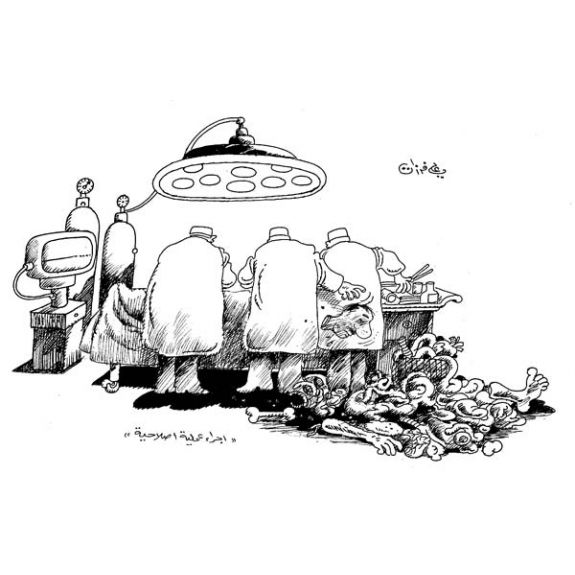
'reform operation' by Ali Ferzat
Will Syria experience a civil war? There’s already a civil war of narratives, pitching the regime’s version against everyone else’s, and a social civil war, in which Syrians find themselves shocked by the responses of their friends and relatives, and find new friends and unexpected allies, realigning their perspectives and values as they do so. Many Syrians are still so scared of the unknown, and so deep in the slave mentality, that they wish to believe what the old authority tells them.
But decreasingly so. Most people have a time limit on their gullibility, or their self-deception. The lies of state TV and the ridiculous ad-Dunya channel, though they come as thick as summer flies, cannot cover the dazzlingly obvious – that the regime is torturing children to death, shooting women and old men, and randomly arresting, beating and humiliating the innocent. That Syria’s tanks and helicopter gunships should be liberating the Golan, not slaughtering Syrians. That the protestors are patriots seeking their basic rights. (I gave up having the argument about Salafis and foreign infiltrators weeks ago on the basis that anyone who wants to believe the regime version will believe it regardless of facts and logic.)
There are still diehards who point to Syria’s social and cultural ills as a reason for sticking with the regime. Give it a chance, they say. Let it reform, as it will undoubtedly do. The alternative is sectarian civil war.
Regime Versus Alawis
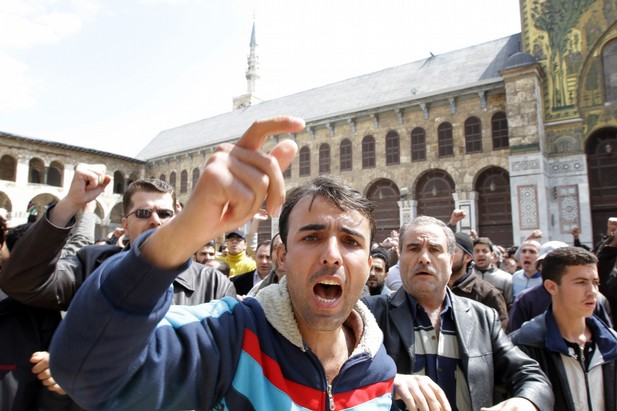 Amid debate with Joshua Landis in the comments section of the previous post, I wrote this:
Another point about sectarianism. Remember the fight bewtween Alawis and Ismailis some years ago in Masyaf (was it Masyaf?). There was a good piece about it on Syria Comment. Somebody at the time (perhaps Joshua) pointed out that the fight wouldn’t have reached the proportions it did if there had been respected civil society figures who could have knocked the young men’s heads together. But there weren’t any such figures, because any natural authority figure was perceived as a threat by the regime and had been removed. Masyaf is a microcosm of Syria.
Then a visitor called AK posted the following comment, which is very worth reading.
Syrians lived together even before the arrival of Al Assad family to power. Mind you, majority of Alawii are poorer now than forty years ago. You just need to visit any Alawii village (including Kurdaha) to establish that yourself..


 Qunfuz