Posts Tagged ‘the Muslim Brotherhood’
For Syrian Democracy
In Syria, the pro-government media celebrity Jamil Hassan is releasing videos arguing against political parties. He fears that they will be based on sect, ethnicity or region, and will therefore generate division and stop progress (as happened in Iraq). He wants instead ‘unity’. But ‘unity’ doesn’t exist, and can’t be wished into existence. There are differences of opinion among Syrians as there are among the people of any nation, and there always will be. This is because different Syrians have different economic positions, different educations, different life experiences, and different personalities, even before we arrive at sect or ethnicity. The question is, how do Syrians work together in a unified political space even though they disagree? What mechanism can be built to allow for debate, for peaceful transitions of power, and for popular participation? The answer is democracy.

Democracy is not only a question of national parliaments and political parties. Local democracy and workplace democracy are important too. But parliament and parties are essential. Syria still awaits the long-promised Parties Law to allow political parties to operate officially, to open bank accounts, and so on.
Certainly political parties need to be regulated so that they don’t simply replicate sectarian, ethnic and regional divisions. Syria needs national parties based on ideas – for instance, an Islamist party (or several), a leftist party, a liberal party, a nationalist party. These would be vehicles allowing Syrians from different regions/ sects to work together. Otherwise, sects, ethnicities, regions and tribes will be the only organising factors in society – and that will lead to an Iraq-style conclusion. Democracy is not a panacea, but without a democratic mechanism, a new dictatorship will inevitably solidify, and future generations will find themselves unable (again) to change it except by war.
The next three paragraphs are taken from the third chapter of my new book, The Blood Between Us.
“Even if the people had been able to choose their representatives directly, there were no parties to vote for. According to article 14 of the Constitutional Declaration, ‘the State shall protect the right to political participation and the formation of parties on national foundations according to a new law’. By late November, this new law has not yet been drafted. Nothing is stopping Syrians from holding meetings and discussing political programmes, but until such time as a party law is operative, there can be no legal recognition for any party, no bank account opened on a party’s behalf, and so on.
The president’s attitude to parties is perhaps reflected in the words of his media advisor Ahmed Mouaffaq Zaidan, a former Al Jazeera journalist once linked to the Muslim Brotherhood. In an article titled ‘When will the Muslim Brotherhood in Syria dissolve itself ?’ Zaidan urges the Brotherhood’s Syrian branch to do just that, to support the work of the transitional government.
Some might say the Muslim Brotherhood has already in effect dissolved, or maybe that it has expanded so far that it is no longer a party. Mazen Gharibah puts it like this: ‘It could be argued that the Brotherhood hasn’t existed for a long time. It is like McDonalds now – a franchise which covers lots of different movements.’ Nevertheless, the call to disband is frightening. In this stage, parties should be being created, not dissolved. And the precedent given by Zaidan is perhaps even worse than the call itself. He points out that the Syrian Muslim Brotherhood dissolved itself between 1958 and 1961, during the union with Egypt. But the dissolution of political parties by the United Arab Republic was a disaster from which the Arabs have never recovered. Nasser’s single-party corporate state became the model for the totalitarian dictatorships in Syria, Iraq and Libya. In all of those countries, dissent was eliminated and political activity was only permitted taht saqaf al-dowleh, under the ceiling of the state. All of those countries eventually collapsed into civil war.”
All Things Considered
I was a guest on BBC Wales’s All Things Considered, a religious programme, talking about Christians in the Arab world in the light of the Arab revolutions. Also talking are the Right Reverend Bill Musk, based in Tunisia, Bishop Angelos, who serves the Coptic community in London, and the Reverend Christopher Gillam, who admires the Syrian regime and overemphasises Syrian Christian opposition to the uprising. Apologies for my voice, which was heavy with cold.
Outside/ Inside
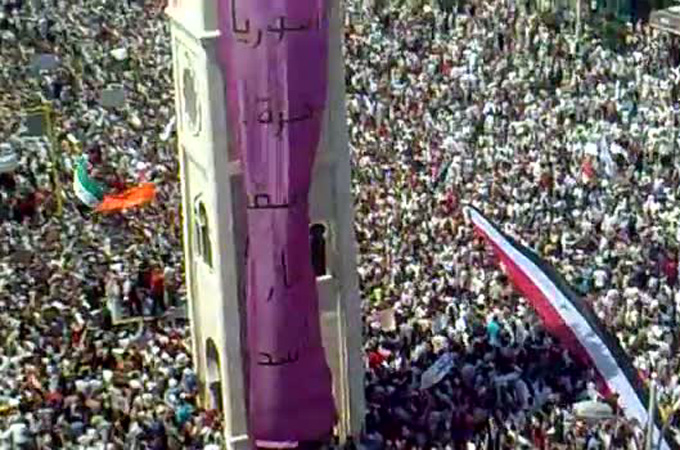
Hama (Reuters picture)
For days Syrian security forces stayed out of Hama; not even traffic police were seen in the city. During these days, no armed gangs emerged from the shadows to terrorise and loot. Christians and Alawis were not rounded up and shot. Nobody was whipped for wearing an unIslamic haircut. All that happened was day and night demonstrations against the regime swelled into crowds of hundreds of thousands – men and women, adults and children.
Perhaps the security forces stayed out of the city on the request of Hama’s governor, and perhaps that’s why he was sacked. Now security forces have entered the city and brought plenty of insecurity in their wake. At least sixteen Hamwis were killed yesterday.
Slaughter in this city – over sixty protestors were murdered there a few weeks ago – reminds Syrians of the greatest wound in their contemporary history: the Hama massacre in 1982, when 10,000 were killed at the lowest estimate, by aerial and artillery bombardment and in house to house murder sprees. There are reports that poison gas was used, and of dismemberments and rapes, but no-one really knows. No journalists slipped inside the city. There was no satellite TV, no internet, no mobile phones. Still, a thousand stories escaped the net, and every Syrian has heard some; stories whispered, not told. Hama, ‘the events’, is the great taboo.
Sovereignty
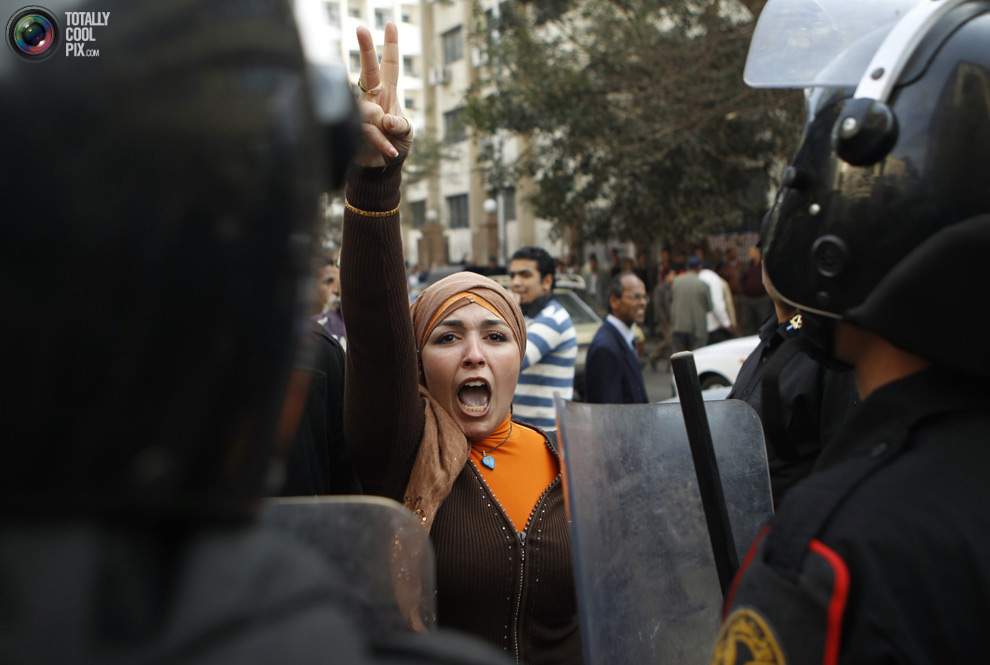
Photo by Amr Abdallah Dalsh/ Reuters
My past experience talking to Egyptians, in Egypt and around the world, is that 95% of them hate Husni Mubarak and the humiliation he’s brought upon their once great country. When I ask of their hopes for change, they answer with the bitter resignation common to all Arabs: “Nothing will change. His son will come after him. People are more interested in football, or their next meal.” Arabs from other countries also despair of escaping their state of stagnation. Some like to repeat the Arabic phrase al-‘arab jarab, or ‘the Arabs are scabies.’
But that was then. That was until the Tunisian revolution, which has now reached the centre of the Arab world. Egypt’s Friday of Rage was a beautiful revolutionary moment, when individuals, having witnessed the strength of their protesting compatriots over the previous days, suddenly realised they were not alone. After Friday prayers, a nation claimed sovereignty over its streets – young people, the unemployed, professionals, workers, students, families. The people who didn’t demonstrate provided food, drinks and tear gas remedies to those who did (which means that womens’ participation has been much greater than TV pictures show). On at least one occasion, Christians guarded a Muslim mass prayer under assault by police.
And in Suez, Luxor, Alexandria and Cairo they defeated the police. They torched police stations and police vehicles, as well as the headquarters of the ruling (and absurdly named) National Democratic Party. (The Israeli embassy, meanwhile, has helicoptered its entire staff out of Cairo. One slogan being chanted: ya mubarak ya ameel/ ba’at biladak l-isra’il, or ‘Mubarak you Foreign Agent, You Sold your Country to Israel.’ Tonight the only Israeli flag flying in the Arab world is in Amman.)