Archive for the ‘Syria’ Category
Dinosaur in Denial
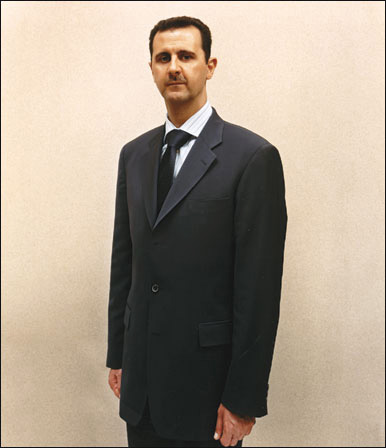 Until recently it seemed that Syria, along with wealthy Saudi Arabia, was the state least likely to fall to the revolutionary turmoil sweeping the Arab region.
The first reason for the Asad regime’s seeming stability is Syrian fear of sectarian chaos. Beyond the Sunni Arab majority, Syria includes Alawis (most notably the president and key military figures), Christians, Ismailis, Druze, Kurds and Armenians, as well as Palestinian and Iraqi refugees. The state has achieved a power balance between the minorities and rural Sunnis while building an alliance with the urban Sunni business class. This means that Syria is the best place in the Middle East to belong to a religious minority, certainly better than in ‘liberated’ Iraq or in the Jewish state, and for a long time domestic peace under authoritarianism has looked more attractive than the neighbouring sectarian and strife-torn ‘democracies’ in Lebanon and Iraq (the American dismantling of the Iraqi state provided a serious blow to Arab democratic aspirations, neo-con fantasies notwithstanding).
Syrian Bloodbath
 Some (I hope exaggerated) reports say that well over a hundred people were killed in the southern Syrian city of Dera’a yesterday. And after Friday prayers today, enraged Syrians took to the streets in nearby Sunamayn, in central and suburban Damascus, in towns such as Tell and Ma’adumiyeh in the Damascus countryside, and in the cities of Homs, Hama and Lattakiya. They chanted “God, Syria, Freedom – That’s All,” and “With our Souls and Blood We Sacrifice for You, O Dera’a.” And they did sacrifice; reports suggest that many more were killed and injured by the state’s bullets this afternoon.
The officially-sanctioned chants usually heard in Syria promote sacrifice for President Bashaar al-Asad. Today a group of pro-regime demonstrators rather lamely replaced Freedom with Bashaar, as in “God, Syria, Bashaar – That’s All.” But it doesn’t work any more. Bashaar, previously perceived by many as innocent of his father’s regime’s crimes, now has blood on his hands. His name sounds like the antithesis of freedom.
Syria Shaking
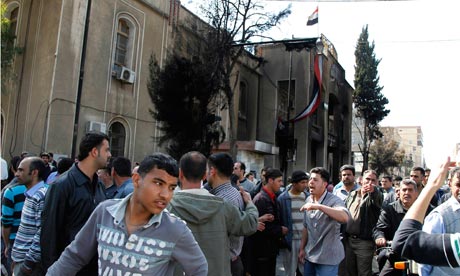
photo by Khaled al-Hariri/ Reuters
A few weeks ago fifteen children were arrested in the southern Syrian city of Dera’a for writing revolutionary slogans on walls. This led to a series of demonstrations calling for the children’s release, the sacking of local officials, and an end to the decades-long state of emergency. Last Friday security forces opened fire on protestors, killing five people. Predictably, state violence redoubled the people’s rage. A Ba’ath Party office was burned and a phone company belonging to the president’s corrupt cousin Rami Makhlouf was attacked. Inspired by Tahreer Square and Pearl Roundabout, protestors then set up tents beside Dera’a’s Omari mosque and stated their intention to stay until their demands were met. Last night security forces attacked the mosque, killing six people.
Syria Speeding Up
Three weeks ago I wrote that Syria was not about to experience a popular revolution. Although I’m no longer sure of anything after the events in Tunisia and Egypt (and Libya, Algeria, Jordan, Yemen and Bahrain) – and although it’s made me unpopular in certain quarters – I’m sticking to my original judgement. No revolution in Syria just yet.
Breaking Knees
Zakaria Tamer’s “Breaking Knees” tugs us rushing straight into the Big Topics: religion, politics, sex and death. It deals with imprisonment, literal and figurative, its characters entrapped in unhappy marriages and by their personal inadequacies, ignorances and fears, as well as by dictatorship, bureaucracy and corrupt tradition. It sounds grim, but “Breaking Knees” is a very funny book.

by Ali Farzat
Tamer is a well-known Syrian journalist and writer of children’s books. His literary reputation, however, rests on his development of the very short story (in Arabic, al-qissa al-qasira jiddan), of which there are 63 here. Each is a complex situational study, a flash of life or nightmare, each with at least one beginning, middle and end. Some are as clear as day; some are seriously puzzling. Some are no more than extended, taboo-breaking jokes.
It’s certainly satire. Tamer uses an elegant, euphemistic language (referring, for instance, to “that which men have, but not women”) to tell some very plain tales. Delicious irony abounds. In bed an adulterous woman begs her lover “not to soil the purity of her ablutions.” In the street afterwards she frowns at a woman without a headscarf and says “in a voice full of sadness that immoral behaviour had become widespread.”
Tunisia in Syria?
The Guardian published this piece on Syria tacked onto the end of this piece on Egypt. Unfortunately they cut my paragraphs on sectarianism, the most important part of my argument. I should add that, after today’s great revolutionary awakening in Egypt, I am no longer certain of anything. Everything has changed.
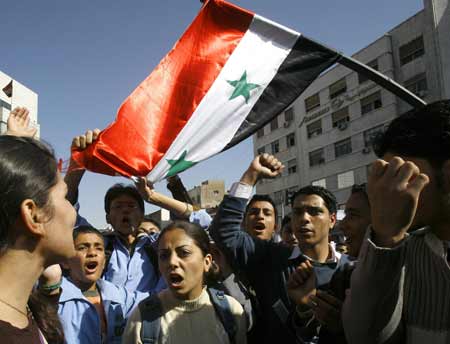
2008 demonstration against US bombing of Syria. photo - Xinhua/ Reuters
With its young population, and a bureaucracy run by the same authoritarian party for four decades, Syria is by no means exempt from the pan-Arab crisis of unemployment, low wages and the stifling of civil society, conditions which have now brought revolution to Tunisia. Nevertheless, in the short to medium term it seems highly unlikely that the Syrian regime will face a Tunisia-style challenge.
A state-controlled Syrian newspaper blamed the Tunisian revolution on the Bin Ali regime’s “political approach of relying on ‘friends’ to protect them.” Tunisia’s status as Western client was only a minor motivator for the uprising there, but still al-Watan’s analysis will be shared by many Syrians. Unlike the majority of Arab states, Syria’s foreign policy is broadly in line with public opinion – and in Syria foreign policy, which has the potential to immediately translate into a domestic security issue, matters a great deal. The regime has kept the country in a delicate position of no war with, but also no surrender to, Israel (which occupies the Golan Heights), and has pursued close cooperation with Lebanese and Palestinian resistance movements as well as emerging regional powers such as Turkey and Iran. This is appreciated by ‘the street’, and the president himself is no hate figure in the mould of Ben Ali or Mubarak. Where his father engineered a Stalinist personality cult, mild-mannered Bashaar al-Asad enjoys a reasonable level of genuine popularity. Much is made of his low-security visits to theatres and ice cream parlours.
Sabriya
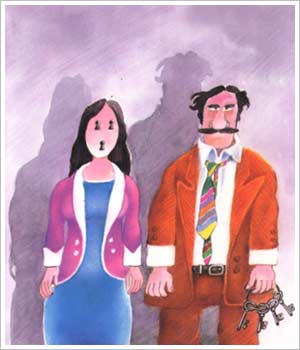
by Ali Farzat
It’s Damascus: bustling alleyways and courtyards crammed with silence. Sabriya is secretly in love with Adil. Her brother Sami is secretly in love with Nermin. Both loves are chaste and built on idealism, and both are doomed. Adil and Sami join the 1925-27 revolt against the French occupation. Sami is killed by the enemy. Nermine is badgered into marrying a wealthy old man, then ends up eloping with her hairdresser. Sabriya’s fiance Adil is killed, probably by Sabriya’s bullying brother Raghib who doesn’t like the idea of her marrying a baker’s son. Sabriya is left alone to care for her dying mother, then her dying father. Finally she kills herself, leaving her journal for her niece to read, and a message: “Do not let your life be in vain.”
“Sabriya: Damascus Bitter Sweet” (in Arabic, “Dimashq Ya Basmat al-Huzn”, or “Damascus, O Smile of Sadness”) was published in Syria and then transformed into a controversial and wildly popular muselsel, or television series. (If the Egyptians are famous in the Arab world for films, the Syrians do muselselat, particularly period dramas). This elegantly-written, carefully-dramatised period novel is nostalgic but also very current in its concerns.
Ulfat Idilbi explicitly links the struggles for national rights and women’s rights. When Sabriya participates (wearing niqab) in a women’s demonstration against the French, she says: “For the first time I felt I was a human being with an identity and an objective, in defence of which I was ready to die.”
Syria’s Diversified Options
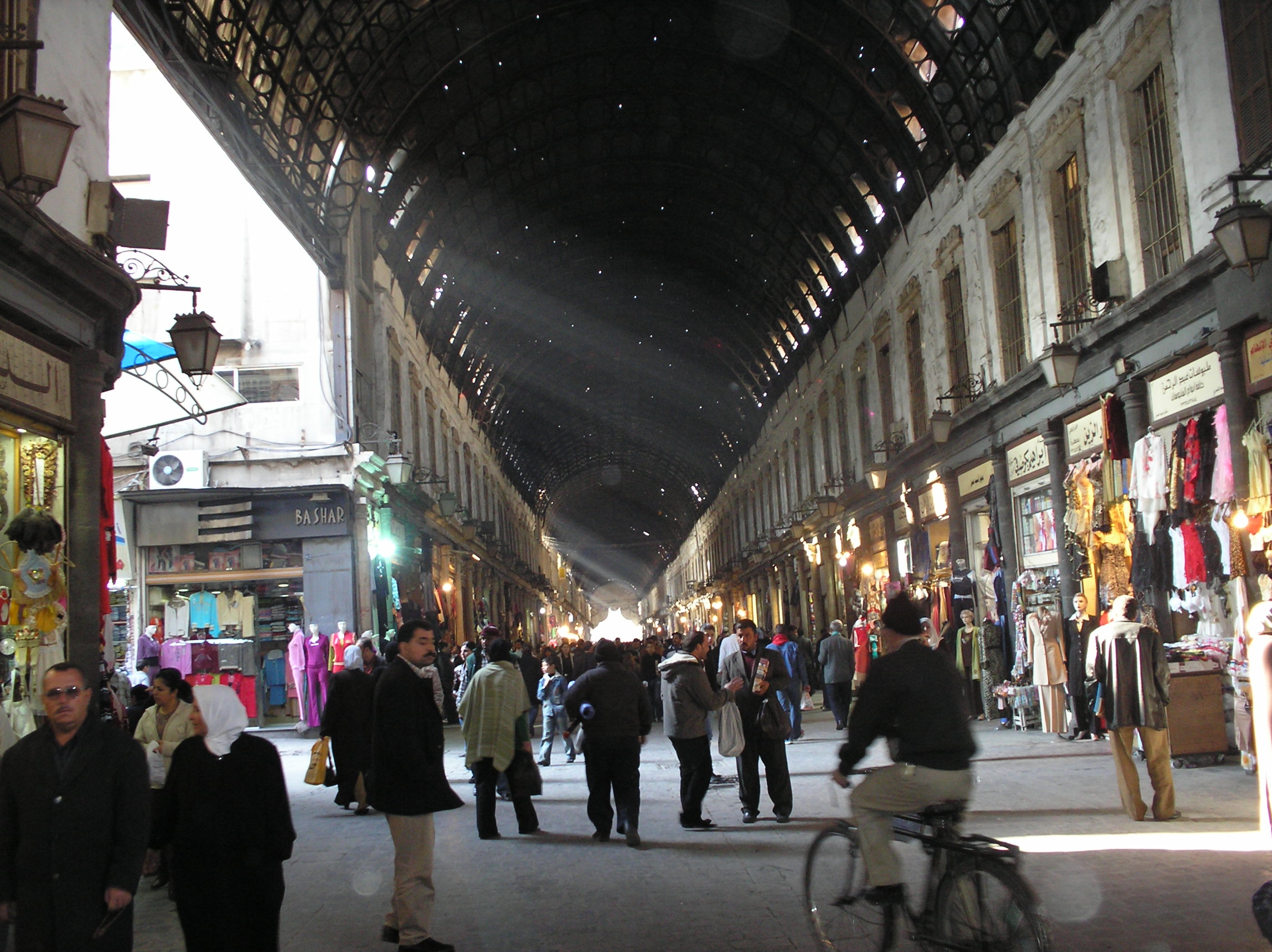
French bullet holes in the ceiling
This was written six months ago and recently published in Political Insight.
A sigh of relief blew across Syria when the Bush administration was retired. Bush had backed Israel’s reoccupation of West Bank cities, described Ariel ‘the Bulldozer’ Sharon as “a man of peace”, given Syria two million Iraqi refugees and an inflation crisis, and blamed Syria for the assassination of Lebanese prime minister Rafiq al-Hariri. Veiled American threats of “regime change” scared the Syrian people – who observed the blood rushing from neighbouring Iraq – almost as much as they scared the regime itself.
Obama’s re-engagement signalled an end to the days of considering Syria – in the predatorial neo-con phrase – “low-hanging fruit”, but American overtures have remained cautious, the new administration’s policy severely limited by its commitments to Israel and the domestic Israel lobby. Obama nominated Robert Ford as the first American ambassador to Damascus in five years, but the appointment has since been blocked by the Senate. In May, Obama renewed Bush-era sanctions, citing Syria’s “continuing support for terrorist organizations and pursuit of weapons of mass destruction and missile programs,” which, “continue to pose an unusual and extraordinary threat to the national security, foreign policy, and economy of the United States.”
So not much has changed. The neoconservative language is still in place, the same elision of distance between American and Israeli interests, and between anti-occupation militias and al-Qa’ida-style terrorists, plus a flat refusal to understand that the countries really under unusual and extraordinary threat of attack are Syria, Lebanon, and – Netanyahu’s “new Amalek” – Iran.
What Comes Next
This is the extended version of a piece published in today’s Sunday Herald.
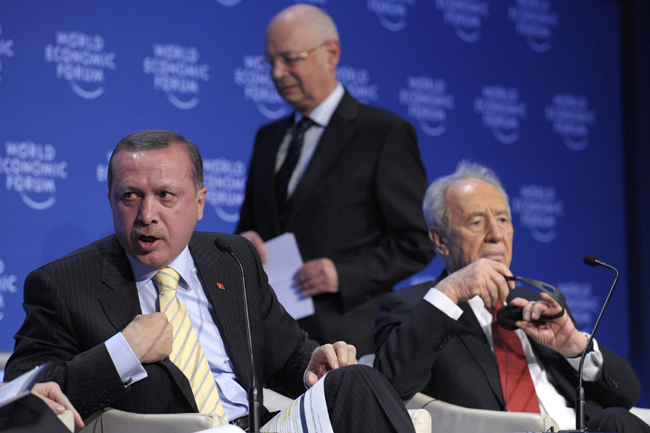
Erdogan reacts to his war criminal neighbour
A strange calm prevails on the Middle Eastern surface. Occasionally a wave breaks through from beneath – the killing of an Iranian scientist, a bomb targetting Hamas’s representative to Lebanon (which instead kills three Hizbullah men), a failed attack on Israeli diplomats travelling through Jordan – and psychological warfare rages, as usual, between Israel and Hizbullah, but the high drama seems to have shifted for now to the east, to Afghanistan and Pakistan. The Arab world (with the obvious exception of Yemen) appears to be holding its breath, waiting for what comes next.
Iraq’s civil war is over. The Shia majority, after grievous provocation from takfiri terrorists, and after its own leaderhip made grievous mistakes, decisively defeated the Sunni minority. Baghdad is no longer a mixed city but one with a large Shia majority and with no-go zones for all sects. In their defeat, a large section of the Sunni resistance started working for their American enemy. They did so for reasons of self-preservation and in order to remove Wahhabi-nihilists from the fortresses which Sunni mistakes had allowed them to build.
The collapse of the national resistance into sectarian civil war was a tragedy for the region, the Arabs and the entire Muslim world. The fact that it was partly engineered by the occupier does not excuse the Arabs. Imperialists will exploit any weaknesses they find. This is in the natural way of things. It is the task of the imperialised to rectify these weaknesses in order to be victorious.
Two Stages of the Syrian Ba’ath
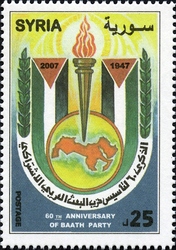
stamp commemorating the 60th anniversary of the Ba'ath's founding
Again inspired by Hanna Batatu’s excellent book, here are some notes on the first two of the three stages of the Ba’ath Party in Syria. I haven’t mentioned the party’s development in Iraq.
The first Ba’ath was the old Ba’ath, and it was led by ideals. The party’s founders, Michel Aflaq (a Christian) and the two Bitars (Sunnis) were the sons of grain merchants from the Damascus suburb of Maydan, and were genuinely motivated by the desire for a unified Arab state. They were of the commercial class that felt most immediately the loss of the natural Arab marketplace entailed by the Sykes-Picot partition and the actions of the French Mandate. The French had ceded Arab-majority areas north of Aleppo to Turkey, and in 1939 handed over the entire Iskenderoon governorate (which had an Arab and Alawi majority) in return for Turkish neutrality in the approaching European war. From 1925 to 26 the Druze had risen against the French under the anti-sectarian slogan ‘Religion is for God and the Homeland For All.’ The Ghuta peasant-gardeners, aflame with the nationalism of nearby Damascus, also struck, and the French bombarded the Ghuta with artillery and planes. The 1948 fall of Palestine added impetus to the pan-nationalist agenda. Sunnis from Deir ez-Zor, now cut off from their kinsmen and marketplaces in Iraq, were also attracted to Arabism.
Before it became a party of policemen and bureaucrats the Ba’ath was a party of schoolteachers (the leadership) and schoolboys (the mass membership). Pedagogic aims run deep in the Ba’ath’s family history. The subject of instruction at this stage was an unfeasibly romantic vision of the Arabs, something beyond the traditional nationalist picture of the Arabs as a people united by language and culture, in other words by historical forces. The Ba’ath saw the Arabs as a nation outide history, as an eternal creative force and unified will (Henri Bergson’s philosophy was important), and Ba’athist rhetoric transported spiritual language into nationalist discourse. Umma Arabiya Wahida, goes the slogan, Zat Risala Khalida. Or One Arab Nation Bearing an Eternal Message. Umma hitherto referred to the Islamic community, not the Arabs, and Risala is the word used for God’s message transmitted by Muhammad, the Rasool. Like Zionism, Stalinism, fascism and hedonist-consumerism, the Ba’ath was one of the 20th Century’s attempts to secularise and channel people’s religious impulses, to provide a substitute for the crumbling or crumbled traditional religions.
Five Books on Syria; Batatu on the Peasants
Inspired by the Browser interview concerning my five favourite books on Israel-Palestine, I’ve come up with a list of five on Syria. These are all books available in English, so my selection is inevitably skewed. I’ll name them, then talk at length about the first on the list, the Batatu book.
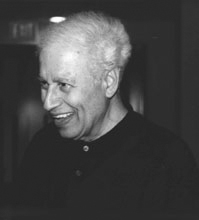
Hanna Batatu
1. Hanna Batatu. “Syria’s Peasantry, the Descendants of its Lesser Rural Notables, and Their Politics.”
2. Patrick Seale. “Asad: The Struggle for the Middle East.”
As essential for understanding power machinations in the US, the USSR, Palestine, Israel and Lebanon as in Syria, this is a biography of Syria’s ruthless, inscrutable, masterful dictator, Hafez al-Asad. Nation builder or gangster, as you will, but surely the most important Syrian of the 20th century.
3. Samuel Lyde. “The Asian Mystery Illustrated in the History, Religion, and Present State of the Ansaireeh or Nusairis of Syria.”
Maghut’s Shade and Noon Sun
 Syrian writer Muhammad al-Maghut was born the son of a peasant farmer in the dusty town of Salamiyah in 1934, during the French occupation. As a young man he joined the Syrian Social Nationalist Party, the second biggest mass party in Syria after the Ba’ath. Like the Ba’ath, the secular SSNP appealed to religious minorities – al-Maghut was of Ismaili origin. Unlike the pan-Arabists of the Ba’ath, it envisaged a fertile crescent state including Syria, Lebanon, Palestine, Jordan, Iraq, Kuwait and even Cyprus. Al-Maghut was locked up on several occasions for SSNP membership. During his first imprisonment – in Mezzeh prison in 1955 – he met the influential poet Adonis and started writing poetry himself.
As a poet he deserves to be much more widely known. Along with Adonis and Nizar Qabbani he was a modernist, using free verse instead of the traditional Arabic forms. Like Qabbani he aimed to be accessible to the ordinary people, but his ‘lover narrator’ is perhaps better suited to our twisted times than Qabbani’s. Certain verses sum up the decadent atmosphere very well indeed. The following remind me of those Gulf Arabs and others who profit from the prostitution of refugee women from occupied Iraq:
Lebanon is burning – it leaps, like a wounded horse, at the edge of the desert/ and I am looking for a fat girl/ to rub myself against on the tram/ for a Beduin-looking man to knock down somewhere. My country is on the verge of collapse/ shivering like a naked lioness/ and I am looking for two green eyes/ and a quaint café by the sea/ looking for a desperate village girl to deceive.”
The Search

On a couple of occasions – that I know of – I’ve had my irises scanned. These in the airports where I get pulled over for the stupid questions. In theory, a computer link can now tie my iris to my bank account, credit rating, police record, driving license and passport details – all in the sharpest microsecond.
The town centre has been replaced by a shopping mall, owned and controlled. People take more interest in Angelina Jolie’s romantic life than in the course of political events. The politics on show are soap opera, and the soap opera is determined a ‘British value’. According to the new points system for migrants, access to Britishness can be speeded up by campaigning for a political party (I presume they don’t mean Hizb ut-Tahrir), while ‘active disregard for British values’ – which might or might not mean protesting against imperialist wars – will retard membership of the club.
The great Englishman Dr. Johnson said, “Patriotism is the last refuge of a scoundrel.” And on that sound note allow me to introduce a short story by the Syrian writer Ibrahim Alloush, translated by Domenyk Eades.
Syria’s Tolstoy
A book review for the Guardian:
 Syria, more than most, is a land of stories and storytellers. The farmers and shopkeepers describe early Islamic battles or episodes from the Crusades as if they’d attended in person. A gathering of friends is quickly elevated into group performance of jokes, laments, myths, and conspiracies. Even the Syrians’ surnames suggest stories: there are families called The-Milk’s-Boiled, Sip-The-Yoghurt, and Undone-Belt. “The deeper you swim into our stories,” a village rhetorician once told me, “the more you understand that they have no floor.”
Yet Syria is better known for its poets, and its TV dramas, than for its novelists. Egypt, with its unending metropolis, is the home of the Arabic novel, and Egypt produced the Arabs’ master of fiction, Naguib Mahfouz. But a flame equally bright now burns from Damascus, via Germany. Here is the Great Syrian Novel, and its author Rafik Schami.
In “The Dark Side of Love” Schami exploits all the resources of the classic realist novel and then goes a little further, forging a new form out of Syrian orality. His basic unit is not chapter or paragraph, but story; a thousand bejewelled anecdotes and tales are buried here, ready to spring, but each is sculpted with such dazzling surety into the whole that reading the book is always compulsive. In its final, self-exposing passage, Schami compares his method to mosaic work, in which every shiny object is a beauty of itself, yet which in combination, at a distance, reveal a still greater beauty. The novel is even Tolstoyan in its marrying of the personal, social and political spheres, of private with national life.
At The Empire’s Edge
Here’s a piece I wrote for the National about Arabs on Hadrian’s Wall.
 Beyond the fleeting days of summer, Hadrian’s Wall in the north of England is a cold place to be. I stood on a high ridge looking down the line of the Wall at black cloud building over the ruins of Housesteads fort. I was fully exposed to the wind, which carried small seeds of rain, and the mud covering my clothes seeped slowly towards my heart. For a moment I dreamt myself into the skin of an ancient soldier, one come here from warmer climes to serve his empire, and I shivered to my frozen toes. Then my son grinned, turned towards the fort, and with a delighted scream charged downwards, slaying imagined barbarians as he went.
We had set out early in the brisk morning from our home in south west Scotland, over bridges and past floods in low-lying fields. Streams gurgled in roadside ditches; pond-sized puddles occupied town centres. There’s enough water here to produce the illusion of hopping island to island through a vast archipelago.


 Qunfuz