Archive for the ‘Syria’ Category
Bomb in Damascus
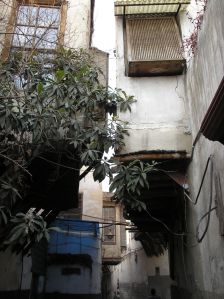 This morning a car bomb exploded in Mahlak street, Damascus, at a junction with the airport road and not far from Sitt Zainab. Seventeen are dead and 14 injured. That sounds like a powerful bomb, killing more than it maims.
In 1997 I found myself walking over what appeared to be blood and oil stains in the Victoria area of the city. There were soldiers gathering shards of glass and hosing the street down. Bystanders were subdued, not meeting your eye. I asked someone what had happened and he mumbled something about a gas leak. In fact a bus had been blown up minutes after leaving the old station at Baramkeh, and nine people had been killed. Afterwards there were whispers about Lebanese Maronites (the Lebanese Sunnis still supported Syria) being behind it, and of course Israel was a suspect. But the whole thing was kept as quiet as possible. The deal the regime has made with the people is: allow us corruption and thuggishness if we give you in return a foreign policy which doesn’t shame you and, most fundamentally, a guarantee of security. Exploding buses are a message from whoever sends them to the Syrian people, and the literal translation of the message is: the regime can’t protect you.
Complex Origins
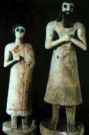
Sumerians at prayer
From a Muslim perspective, I’m used to seeing Judaism, Christianity and Islam as episodes within the same religion (which is not to deny their differences) – a series of revelations emanating from the same cultural locus. But since so many of the Abrahamic stories are inherited from earlier civilisations, even from the very first to write down stories, it may be that my definition of one religion, or at least one civilisation, should expand to include the earliest myths. Stories so early that we can reasonably guess their roots reach deep into our pre-civilised hunter-gatherer past.
Myth doesn’t mean untruth any more than a great novel does. Myth is heightened truth. A myth is perhaps more ‘true’ than reality because reality unfiltered is unstructured and unexplained. The fact that God uses human myths to talk to humans need not perturb the religious. “wa tilka al-amthal nadribuha lil-nas la’alahum yatafakiroon,” says the Qur’an. “We rehearse these parables to people in order that they may think.” From a religious perspective, the rehearsal of myths in sacred text is proof of God’s understanding of human minds. And where do the myths arise from anyway? From unforgotten events, and from us, from our shared Godstuff.
Syria – Israel Peace Talks
This, along with other perspectives, will appear on the forum of the Creative Syria website.
After months of rumours it has been announced that Syria and Israel are engaged in formal peace talks under Turkish auspices. In theory it shouldn’t be difficult for the negotiations to come to a positive conclusion. After all, in 2000 Hafez al-Assad and Ehud Barak came remarkably close to an agreement in which the Golan Heights, occupied by Israel since 1967, would be returned to Syria, and Syria would recognise and establish normal relations with Israel.
Syria would benefit hugely from peace. Apart from the ramifications for national pride, the return of the Golan would constitute a tremendous economic boost. There would be a boom in construction and tourism as well as an easing of water shortages in the Damascus region. An end to military tensions with Israel would make Syria a much more welcoming environment for investors.
Israel would gain a measure of long-term security and some much needed legitimacy (still not nearly enough – that won’t come until Israeli Jews and Palestinian Arabs live as equals in Palestine). Both countries would be able to cooperate to confront the climate change and overpopulation crises that are likely to bite in the near future.
Cultural Capital
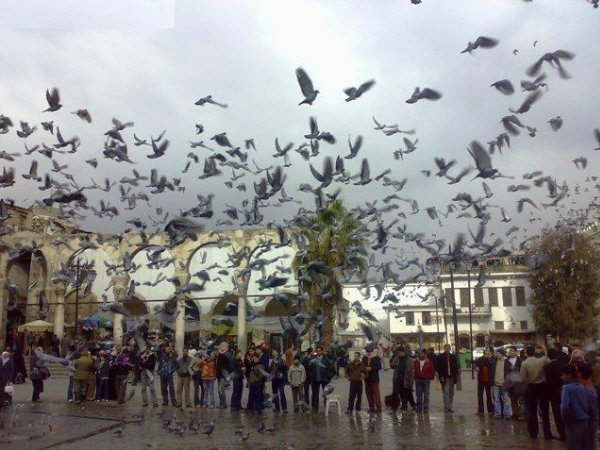 One for tourists:
Damascus has been designated the UNESCO Arab cultural capital for 2008. This means different things to different people.
President Bashaar al-Assad, pointing to Syria’s role as the last remaining bastion of Arabism and its unashamed solidarity with Palestinian resistance, says “Damascus is the capital of resistance culture.” This interpretation, while unpopular with neighbouring regimes and the powers that dominate the region, is popular with the Syrian people – even if other aspects of the regime aren’t. And some international visitors this year will come primarily for a little resistance chic. This is the capital which welcomes Hugo Chavez and Hassan Nasrallah with equally widespread arms. Noam Chomsky will be giving a talk. Lebanese and pan-Arab diva Fairouz has already been, to the chagrin of some of her compatriots, to croon patriotic and revolutionary songs.
There will also be lectures and poetry recitals, architectural tours of the old city, theatre and ballet performances, art exhibitions, a film festival, and orchestral, jazz and traditional Arabic music concerts.
Damascus certainly deserves cultural capital status more than some cities that have held the title in previous years. After Beirut and Cairo, Damascus has the best bookshops in the Arab world. Syria has always boasted an impressive range of poets and musicians, and produces TV dramas which are of much higher quality than the Egyptian competition. Its taxi drivers can recite classical and contemporary poetry. Its pop singers sing Nizar Qabbani, the most influential and best loved modern Arab poet. Damascus is a city in which your host is likely to serenade you with his lute after dinner. And it is, as the tourism ministry likes to repeat, the oldest continuously inhabited city in the world.
Visiting Syria
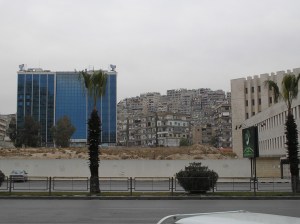
on Mezzeh autostrade
I’ve just given up smoking, again, after a relapse in Syria and Egypt. I mean, what can an ex-smoker do, returning to Sham? In Oman very few people smoke. Abu Dhabi airport, where I spent an hour in transit, is of course smoke-free. But in Damascus airport the passport officials were smoking, and the police, and the baggage handlers, and the passengers. So it continued in the taxi, and in the house, and almost everywhere else. I’m not complaining.
I spent a too-brief ten days in Syria, mainly shivering. It was minus seven one night. Coming out of the hot mineral-water baths (men stepping into the pools clutching their cigarettes) at Jbab and waiting ten minutes for a micro to the city, I froze. My hatless brother-in-law said it’s because I haven’t done military service. He started his in the winter time, standing at attention in his underwear on subzero mountainsides, assaulted by insults and buckets of cold water. “Great days!” he mused. “Happy memories!” So it was cold, but the Syrians grumbled that it hasn’t rained enough this year. There was a big snowfall just after I left, and there’s been another one today.
Syria’s Regional Alliances
CreativeSyria (see the link on the left) organises a ‘Creative Forum’ where bloggers consider an aspect of Syrian politics. This time the topic is Syria’s regional alliances. My contribution, which I copy below, is on CreativeSyria along with several more opinions. I think Wassim’s is excellent, far more comprehensive than mine. But here’s mine:
For a time the pattern of alliances in the Middle East was organised into monarchical-conservative and republican-nationalist camps. Following the 1991 Kuwait war, there was a realignment which pitted a Saudi-Syrian-Egyptian alliance against a disgraced and battered Baathist Iraq and its perceived allies such as the Jordanian monarchy. Because the Damascus Declaration countries were the three key Arab mashreq states, some pretence at the centrality of Arab alliances in the region was still possible. But since the 2003 invasion and subsequent dismantling of Iraq a new set up seems firmly established. On one side stands Syria, Iran, Hizbullah and Hamas; on the other Saudi Arabia, Egypt, Jordan, the March 14th Lebanese, Mahmoud Abbas, and (implicitly) Israel.
What’s Wrong With Travel Writing
I’ve recently read “Cleopatra’s Wedding Present” by Robert Tewdwr Moss, a well-written account of travels through Syria in the late 1990s. Moss is an evocative and sensuous writer. His sense of place and time is highly accurate: I immediately recognised the streets he described, and wanted to tell him how things have changed. (But it’s impossible to tell Moss anything now. He was stabbed to death by a rent boy in London shortly after finishing this book).
The strength of characterisation – of Syrians and foreign tourists – in the book suggests that Moss would have made a great satirical novelist. There are also strong set pieces on some of the archeological highlights of Syria, such as Queen Zenobia’s desert city of Palmyra, Saladin’s castle in the green Lattakian mountains, and the ‘dead cities’ around Aleppo – Byzantine settlements which were suddenly and mysteriously vacated, leaving mosaics, churches and olive presses for archeologists to puzzle over.
Syrian Opposition
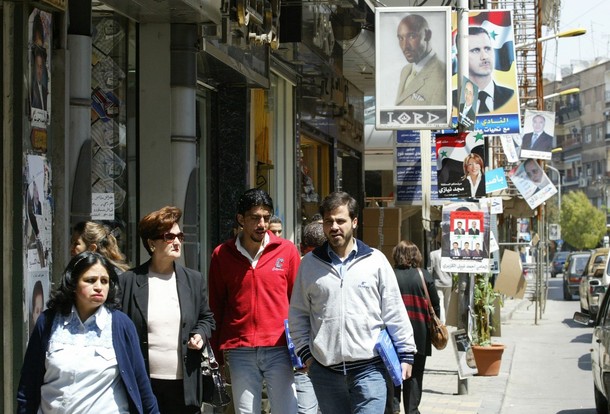 The Arabs of the Levant and Iraq love talking politics. This is one of the more rewarding things about spending time with them. In Syria, for instance, instead of enduring conversations about cars, house prices or football, you can immerse yourself in big issues: God and death, revolution and gender, secularism and resistance.
But because normal political life in Syria – organising parties, holding meetings and rallies, writing articles critical of the government – is criminalised, most people have no defined political affiliation. And it is of course impossible to accurately research political opinion, so any pronouncements on the views of Syrians are inevitably based on anecdotal evidence.
With that reservation, here are some pronouncements on the political views of Syrians. I base them on conversations with my Syrian relatives, my wife’s family, and many friends and colleagues from three years residence in the country and several long visits.


 Qunfuz