Archive for the ‘Syria’ Category
The Arab of the Future
This was my review for the Guardian of Riad Sattouf’s graphic memoir.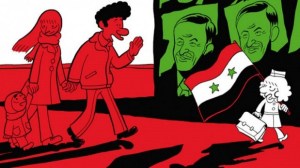
The graphic novel has proved itself over and over. It already has its classical canon: Spiegelman on the Holocaust, Satrapi on girlhood in Islamist Iran, and (perhaps most accomplished of all) Joe Sacco’s ‘Footnotes in Gaza’, a work of detailed and self-reflexive history. Edging towards this company comes Riad Sattouf’s ‘The Arab of the Future’, a childhood memoir of tyranny.
Little Riad’s mother, Clementine, is French. His father, Abdul-Razak, is Syrian. They meet at the Sorbonne, where Abdul-Razak is studying a doctorate in history. Those with Arab fathers will recognise the prestige value of the title ‘doctoor’. But Abdul-Razak is more ambitious. He really wants to be a president. Studying abroad at least allows him to avoid military service. “I want to give orders, not take them,” he says. When humiliated, he sniffs and rubs his nose.
Abdul-Razak is a pan-Arabist who believes the people (“stupid filthy Arab retards!”) must be educated out of religious dogma. For reasons of both vanity and ideology he turns down an Oxford teaching post for one in Libya. The family takes up residence in a flat which doesn’t have a lock, because Qaddafi has ‘abolished private property’. Little Riad sees Libya all yellow, its unfinished buildings already crumbling. He sings the Leader’s speeches with kids in the stairwell and queues with his mother for food (only eggs one week, just bananas the next).
Binet, Hitler and Putin
 This (slightly subedited) was first published at the New Arab/ al-araby al-jadeed.
I’ve just finished “HHhH”, an excellent ‘non-fiction novel’ by the French writer Laurent Binet. It tells the true story of Operation Anthropoid, the assassination of top Nazi official Reinhard Heydrich co-ordinated by the Czechoslovak resistance and the British government.
In the Nazi surveillance agency, the SS, Heydrich was second in command only to Heinrich Himmler (or perhaps he was even more important than his boss – “HHhH” is the German acronym for ‘Himmler’s Brain is Called Heydrich’). He was the highest official in Nazi-occupied Czechoslovakia, and the chief architect of the ‘final solution’ for Europe’s Jews – the Holocaust.
The larger background to the drama of the assassination is Britain and France’s betrayal of Czechoslovakia, the final layer in these states’ disastrous appeasement of Hitler in the 1930s.
Germany had been defeated in World War One. The post-war settlement forced Germany to pay enormous reparations to the victors. This national humiliation was immediately followed by economic collapse and social disorder. Hitler emerged from this context, a strong leader promising to restore German order and pride, identifying enemies domestic and foreign, and lamenting the scattering of the German people across various borders.
With Syria Solidarity UK
It was a pleasure to give a talk at the LSE. The talk was organised by the brilliant Syria Solidarity UK.
Here is Part One:
and (after the break) Part Two:
Free City Radio
By now I’m repeating myself, but here I am talking about the Syrian revolution and our book on Canada’s Free City Radio. Topics include democracy, how Assad engineered a war, and the meanings of the word ‘jihad’.
‘Democratic Confederalism’ or Counter-Revolution?
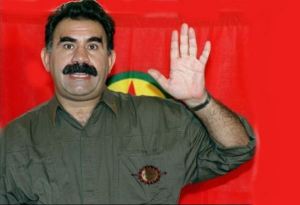
Abdullah Ocalan (the Turkish ‘c’ is pronounced ‘j’)
This is my latest article for al-Araby al-Jadeed/ the New Arab.
The first fact is this: the Kurds have suffered a terrible historical injustice. The Arabs were rightly enraged when Britain and France carved bilad al-Sham (the Levant) into mini-states, then gave one of them to Zionism. But the post-Ottoman dispensation allowed the Kurds no state at all – and this in an age when the Middle East was ill with nationalist fever. Everywhere the Kurds became minorities in hyper-nationalist states.
Over the years an estimated 40,000 people have been killed in Turkish-Kurdish fighting, most of them Kurds. In the late 1980s, Saddam Hussain’s genocidal Anfal campaign murdered somewhere between 50 and 200,000 Iraqi Kurds. In Syria, where Kurds formed about 10% of the population, or around two million people, it was illegal to teach in Kurdish. Approximately 300,000 Kurds (by 2011) were denied citizenship by the state, and were therefore excluded from education and health care, barred from owning land or setting up businesses.
While oppressing Kurds at home, President Hafez al-Assad (Bashaar’s father) cultivated good relations with Kurdish groups abroad. This fitted into his regional strategy of backing spoilers and irritants as pawns against his rivals.
KCRW
I was talking alongside journalists Anne Barnard and Borzou Daragahi, and aid worker Dalia al-Awqati, on KCRW, a Californian radio station. The discussion concerns the Munich theatre and the effects of the military onslaught on Syrian civilians. If you follow this link you’ll hear it. I come in between 20.40 and 27.15.
Shouting on TRT World
There’s an urgent need for discussion between revolutionary Syrians and Syrians who are scared of the revolution. The two sides need to hear each other. Alawis and others have good reason to fear aggressive forms of Islamism and the possibility of generalised ‘revenge’ against their community when the regime falls.
The TV argument below, of course, is not the discussion required. On the revolution’s side, for a start, there’s me, resident in Scotland and not at all a ‘proper’ Syrian revolutionary. And on the other side is an outright propagandist called Ammar Waqqaf, a deliberate purveyor of misinformation and a slanderer of the Syrian people.
Where are the serious representatives of anti-revolution Syrians? The ones who are able to recognise the genocidal slaughter and displacement suffered by their Sunni neighbours? The ones who don’t (pretend to) consider an imperialist invasion of the country to be an expression of sovereignty? The sad truth is that such people are silenced and eliminated by the regime, which has silenced and eliminated oppositional or just independent Alawis over decades.
The shouting starts at 4.37.
‘Iran the Protector’
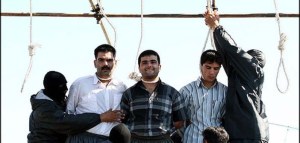
Iran executes more people than any country except China. Many victims are Ahwazi Arabs or from other minorities. Many are political dissidents. And many, of course, are Shia Muslims.
This was published at al-Araby al-Jadeed/ the New Arab.
I recently gave a talk in a radical bookshop in Scotland. The talk was about my and Leila al-Shami’s “Burning Country: Syrians in Revolution and War”, a book which aims to amplify grassroots Syrian revolutionary voices and perspectives. My talk was of course critical of the Iranian and Russian interventions to rescue the Assad regime.
During the question and answer session afterwards, a young man declared: “You’ve spoken against Iran. You’ve made a good case. But the fact remains, Iran is the protector of Shia Muslims throughout the region.”
In reply I asked him to consider the Syrian town of al-Qusayr at two different moments: summer 2006 and summer 2013.
During the July 2006 war between Israel and Hizbullah, hundreds of thousands of Lebanese fled south Lebanon and south Beirut – the Hizbullah heartlands where Israeli strikes were fiercest – and sought refuge inside Syria. Syrians welcomed them into their homes, schools and mosques. Several thousand were sheltered in Qusayr, a Sunni agricultural town between Homs and the Lebanese border.
It made no difference that most of these refugees were Shia Muslims. They were just Muslims, and Arabs, and they were paying the price of a resistance war against Israeli occupation and assault. That’s how they were seen.
Their political leadership was also widely admired. The kind of people who would resist the pressure to pin up posters of Hafez or Bashaar al-Assad might still raise Hassan Nasrallah’s picture. During the 2006 war, very many Syrians of all backgrounds donated money to the refugees and to Hizbullah itself. The famous actress Mai Skaf was one such benefactor.
How quickly things changed. By 2012 Mai Skaf was embroiled in an online war with Hizbullah. “I collected 100,000 liras for our Lebanese brethren who fled the July 2006 war to Syria,” she posted on Facebook, “bought them TV sets and satellite dishes to follow what was happening in their countries, and bought their children shoes and pajamas. Now I am telling Hassan Nasrallah that I regret doing that and I want him to either withdraw his thugs from Syria or give me back my money.”
The Darkest Days
 I’m very happy to be published at al-Araby al-Jadeed, or the New Arab, which has attracted some very on-point political and cultural voices, in both languages.
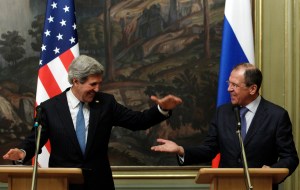
Syria is entering its darkest stage yet. Intense Russian bombardment and Iranian-backed militias have almost encircled rebel-held Aleppo. The city’s last hospital has been hit by a Russian airstrike. In the liberated south too – where provincial elections were recently held – the revolution is being driven back. Hundreds of thousands of new refugees are fleeing, seeking shelter in caves or under trees. Several refugee camps have also been bombed.
Russia is winning the country back for Assad, supposedly for the sake of stability. But the notion that the revolutionary areas of the Arab world can return to stability under the old security states is every bit as a-historically nostalgic and supernatural as the Islamist idea that the Muslims can return to peace and justice under a medieval caliphate.
The Arab revolutions erupted for a reason – because, over decades, the regimes had failed their people economically, politically, socially and culturally. The regimes collapsed inevitably – are still collapsing – under the the weight of this historical failure.
Faced with a democratic uprising and incapable of genuine reform, Syria’s Assad regime provoked a civil war. Five years later it has lost four-fifths of the country, a reality which massive imperialist intervention – the Iranian-organised trans-national Shia jihadists on the frontlines and the Russian bombers overhead – is only now changing.
‘Burning Country’ Extract: On Islamisation
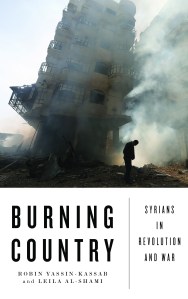 The excellent Books pages at the National have published an extract from our book “Burning Country: Syrians in Revolution and War” (now available in the US too). Before the extract comes an introduction to the book and the situation.
The revolution, counter-revolutions and wars in Syria are terribly misunderstood, particularly in the English-speaking West, by policy makers and publics alike. There are many shining exceptions, but in general poor media coverage, ideological blinkers and orientalist assumptions have produced a discourse which focuses on symptoms rather than causes, and which is usually unencumbered by grassroots Syrian voices or any information at all on Syrian political and cultural achievements under fire.
The consequent incomprehension is disastrous for two reasons – one negative, one positive.
First, the exponentially escalating crisis in Syria is a danger to everybody – Syrians and their neighbours first, but Europe immediately after. Russia’s terror-bombing is creating hundreds of thousands of new refugees. Meanwhile there’s good reason to believe President Putin is funding far-right anti-immigrant parties across Europe. It is very possible that this year’s flood of refugees will re-establish Europe’s internal borders, destroying the ‘Schengen’ free movement area, seen by some as Europe’s key political achievement since World War Two. With eleven million homeless, traumatised people on the eastern Mediterranean, terrorism is sure to increase. And the long-term geopolitical consequences of allowing, even facilitating, Russia, Iran and Assad to crush the last hopes of democracy and self-determination in Syria will create a still more dangerous world for our children. Yet European heads are being buried in the sand. Some still imagine a peace process is underfoot.
And the positive reason. Amidst the depravities of war, Syrians are organising themselves in brave and creative ways. The country now boasts over 400 local councils, most democratically elected, as well as tens of free newspapers, radio stations, women’s centres, and an explosion in artistic production. We shouldn’t just be feeling sorry for Syrians, but learning from them too. Their democratic experiments are currently under full-scale international military assault. They may be stamped out before most non-Syrians have even heard of them.
BBC Radio: the Depopulation of Syria
If you follow this link, I’m speaking between 6 minutes and 10.30 minutes on the international assault on Syria, the complicity of the United States, and the demographic realities which mean this is far from over.
Speaking at Chatham House
Here I am on stage at Chatham House last week with the journalist Mina al-Oraibi. Mina was a lot more optimistic about Russia’s ‘peace process’ than I was. Am I allowed to point out without seeming rude that the process has already dramatically collapsed?
On the Media, Diplomacy and Pacification
Thanks to the people at Chatham House who interviewed me and then made this short film.
At Amnesty
Our book Burning Country was launched on January 20th at Amnesty International in London. I was in conversation with the lovely Kristyan Benedict. Here’s the video, and here’s Amnesty’s article on the event.
With the Rethink Rebuild Society
I really enjoyed meeting the Rethink Rebuild Society, organised by Manchester’s very active Syrian community. Orient News did a report (in Arabic), and here it is (thanks Jwan):


 Qunfuz