The Ghouta Slaughter and Arab Responsibility
This article was first published at the New Arab.
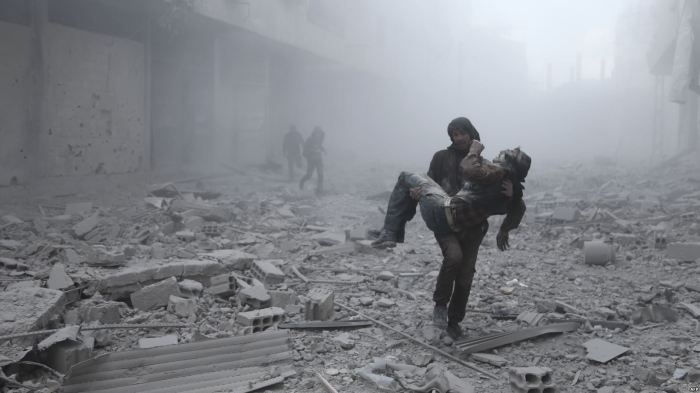 In 2011, people in the eastern Ghouta (and throughout Syria) protested for freedom, dignity and social justice. The Assad regime replied with gunfire, mass arrests, torture and rape. The people formed self-defence militias in response. Then the regime escalated harder, deploying artillery and warplanes against densely-packed neighbourhoods. In August 2013 it choked over a thousand people to death with sarin gas. Since then the area has been besieged so tightly that infants and the elderly die of malnutrition.
Seven years into this process – first counter-revolutionary and now exterminatory – the Ghouta has tumbled to the lowest pit of hell. This didn’t have to happen. Nor was it an accident. Local, regional and global powers created the tragedy, by their acts and their failures to act. And Arab and international public opinion has contributed, by its apathy and relative silence.
Blame must be apportioned first to the regime, and next to its imperialist sponsors. Russia shares the skies with Assad’s bombers, and is an equal partner in war crime after war crime, targeting schools, hospitals, first responders and residential blocks.
Then Iran, which kept Assad afloat by providing both a financial lifeline and a killing machine. Iran’s transnational militias provided 80% of Assad’s troops around Aleppo, and some surround the Ghouta today. Their participation in the strategic cleansing of rebellious (and overwhelmingly Sunni) populations helped boost a Sunni jihadist backlash and will continue to provoke sectarian conflict in the future.
But the blame stretches further. American condemnations of the current slaughter, for instance, ring very hollow in Syrian ears. The Obama administration, focused on achieving a nuclear deal with Iran, ignored Iran’s build-up in Syria. It also ensured the Free Syrian Army was starved of the weapons needed to defend liberated zones. And by signalling his disengagement after the 2013 sarin atrocity, Obama indirectly but clearly invited greater Russian intervention. Since the rise of ISIS, the United States has focused myopically on its ‘war on terror’, bombing terrorists – demolishing cities and killing civilians in the process – but never deploying its vast military might in a concerted manner to protect civilians. Objectively, despite the rhetoric, the US has collaborated with Russia and Iran.
French President Emmanuel Macron, meanwhile, called for a humanitarian truce to allow civilians to evacuate. This sounds humane, and if the fall of Aleppo is any guide, it’s probably the best scenario Ghouta residents can expect. But the proposal’s lack of ambition illustrates the current dysfunction of the global system. Instead of acting to stop the slaughter and siege, European statesmen support mass population expulsion, requesting only that it be done as gently as possible.
Burning Country New Edition
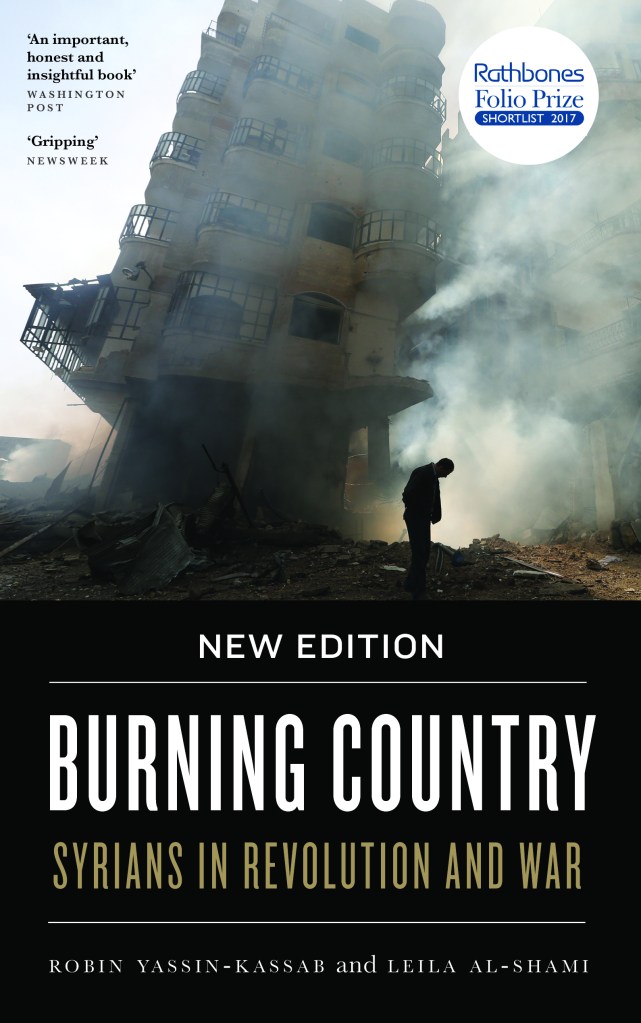
A new edition of our book Burning Country: Syrians in Revolution and War will be released on February 20th. It contains a long new chapter called Syria Dismantled, which attempts to update the situation from the summer of 2015 to the present. It covers the stages of defeat through Daraya to Aleppo, the Russian assault and Iran’s militia surge, and the sectarian cleansing, and the PYD’s expansion, and Turkey’s intervention… Of course it’s already out of date.
But buy it, do, and ask your local library and bookshop to stock it. In order to understand the current situation (globally, not just in Syria), it’s necessary to understand how the democratic revolution started – and how the counter-revolution’s response sparked an endless series of wars. More importantly, our book does its best to give voice to Syrians themselves, those who dared to create new possibilities, and who paid an unfathomable price.
Published by Pluto in the UK, distributed by Chicago University Press in the US.
Here it is on British Amazon, and here on the American site.
Frankenstein in Baghdad
This review was first published at the New Statesman.
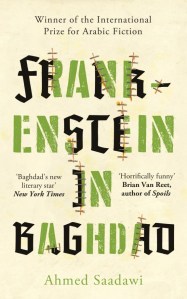 Baghdad, 2005. Occupied Iraq is hurtling into civil war. Gunmen clutch rifles “like farmers with spades” and cars explode seemingly at random. Realism may not be able to do justice to such horror, but this darkly delightful novel by Ahmed Saadawi – by combining humour and a traumatised version of magical realism – certainly begins to.
After his best friend is rent to pieces by a bomb, Hadi, a junk dealer, alcoholic and habitual liar, starts collecting body parts from explosion sites. Next he stitches them together into a composite corpse. Hadi intends to take the resulting “Whatsitsname” to the forensics department – “I made it complete,” he says, “so it wouldn’t be treated as trash” – but, following a storm and a further series of explosions, the creature stands up and runs out into the night.
At the moment of the Whatsitsname’s birth, Hasib, a hotel security guard, is separated from his body by a Sudanese suicide bomber. The elderly Elishva, meanwhile, is importuning a talking portrait of St. George to return her son Daniel, who – though he was lost at war two decades ago – she is convinced is still alive.
In what ensues, some will find their wishes fulfilled. Many will not. After all, the Whatsitsname’s very limbs and organs are crying for revenge. And as each bodily member is satisfied, it drops off, leaving the monster in need of new parts. Vengeance, moreover, is a complex business. Soon it becomes difficult to discern the victims from the criminals.
Militant Buddhist-Nationalism and the Rohingya Tragedy
This was first published at the National.
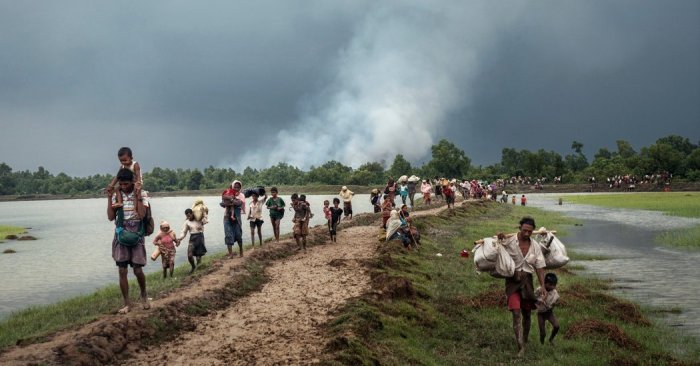 The Rohingya Muslims are currently the world’s most persecuted minority. Since last year at least 625,000, over half the total population, have fled slaughter in Myanmar (also known as Burma). This is only the latest wave in a series of killings and expulsions starting in 1978. The UN calls it a ‘textbook example’ of ethnic cleansing.
Two recently-published books provide necessary background to the Rohingya tragedy. Francis Wade’s “Myanmar’s Enemy Within: the Making of a Muslim Other” contextualises events politically and historically. Azeem Ibrahim’s “The Rohingyas: Inside Myanmar’s Genocide” covers similar ground while, as the title suggests, convincingly arguing that Myanmar “stands on the brink” of genocide, a crime defined by the UN as the “intent to destroy, in whole or in part, a national, ethnical, racial or religious group.”
The Rohingyas have been designated as ‘Foreigners’ since 1978. The Myanmar state today describes them either as Indians imported by the British or as recent illegal immigrants from Bangladesh. Both books dispute this revisionism. Ibrahim begins Rohingya history as far back as 3,000BCE, when Indo-Aryan people arrived in what is now Arakan (or Rakhine province), while Wade presents evidence of an 11th Century CE Muslim community composed of stranded Indian, Arab and Perisan sailors.
Ibrahim’s account of ancient and colonial history is the most detailed. Rohingyas lived alongside Rakhine people who were connected linguistically and religiously to the Burman, the dominant ethnicity in today’s Myanmar. Though Arakan was influenced by the ancient Burmese kingdom, it wasn’t conquered until 1784. Over the next four decades 30,000 Muslims fled Burmese-Buddhist rule, until the British annexed Arakan in 1826. Burma – with Arakan and its Rohingyas attached – won its independence in 1948.
The Rohingyas entered the new state at a disadvantage. Their loyalty to the British during the 1942 Japanese invasion had sparked conflict with the Rakhine. Nevertheless they participated in national life. Some joined the army and others served in parliament. They were included as an ethnic group in the 1961 census.
In 1962 Myanmar’s military seized power. At this point Wade’s book takes the lead in describing the rage for national homogeneity motivating these Burman generals, in a country where minority groups make forty percent of the population. The army waged wars to subdue the Shan, Kachin and Karen peoples, amongst others. In the 1960s, it expelled Indian and Chinese residents.
Syria’s Opposition Should Support Kurdish Autonomy
This was published first at The New Arab.
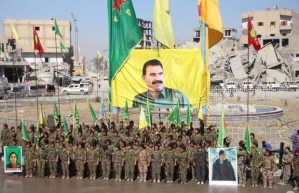
‘There is no life without the leader’. PYD militants raise Abdullah Ocalan’s picture in Raqqa
The Kurdistan Workers’ Party, or PKK, is a Marxist-Leninist turned authoritarian-anarchist (yes, that is an oxymoron) Kurdish separatist party-militia at intermittent war with the Turkish state. The Democratic Union Party, or PYD, is a PKK-offshoot set up while Abdullah Ocalan was hosted in Syria by Hafez al-Assad. Given its focus on the war against Turkey rather than civil rights in Syria, the PYD was usually tolerated by the regime.
As the revolution began liberating territory in 2012, Assad forces withdrew from Kurdish-majority areas without a fight, handing them over to PYD control. Thereafter the PYD monopolised arms and aid money, repressed opposition parties, and shot at protestors.
At the same time, it won an undoubted national victory for the Kurds. After decades of enforced ‘Arabism’, locals finally policed their own neighbourhoods and children were taught in their mother tongue. Through the commune system, the PYD also promoted a measure of local democracy. The allocation of 40% of commune seats to women is evidence of the party’s impressive commitment to gender equality.
As well as the PYD’s avowed secularism, the fact that its territories were not subjected to Assad’s scorched earth inoculated them against penetration by transnational jihadists. The PYD’s political innovations, meanwhile, won the admiration of many leftists and anarchists in the west. Sadly this support was often uncritical, and generally ignored similar democratic self-organisation experiments in the liberated but heavily bombed territories beyond PYD rule.
At first, the PYD governed Syria’s three Kurdish-majority areas, that is the Afrin, Kobani and Jazira cantons. These areas (collectively called Rojava, or Western Kurdistan) are non-contiguous. Kurdish autonomy could work there, but not statehood.
The PYD, however, was able to take advantage of both Russia’s war on the rebels and the American-led coalition’s war against ISIS to join up and expand its territory. In February 2016, in alliance with Russia, the PYD captured Tel Rifaat, Menagh, and surrounding areas close to Afrin. These Arab-majority towns were governed by civilian local councils and defended by non-jihadist rebels. Both people and rebels were driven out by Russian air power (Russian bombs destroyed all three of Tel Rifaat’s health centres during the assault) accompanied by the PYD’s troops on the ground. Next, in July 2016, the PYD captured the Castello Road leading into Aleppo, assisting the Assad regime’s siege on the city and eventually its fall (in December) to Assad’s Iranian-backed militias.
Return to the Dark Valley
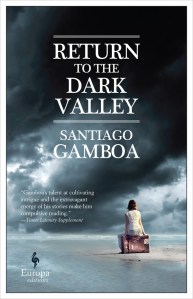 This review was written for a page which was never born.
Santiago Gamboa’s “Return to the Dark Valley” is a very accessible work of postmodern noir shot through with philosophy and poetry.
Among the characters populating this polyphonic novel are Tertullian, an Argentinian neo-fascist who claims paternity from the Pope and believes in “necessary destructions”; Palacios, a priest who founds an anti-Communist death squad; and Manuela Beltrán, a poet emerging from a dark past and wondering if there’s “a certain spirituality in excess”.
Their plots run parallel for most of the book, converging thematically around rape, revenge, and deception, and eventually cohering around a Colombian intellectual called the Consul – an alterego for Gamboa, who was once Colombia’s cultural attaché in New Delhi. The Consul’s biography of poet Arthur Rimbaud, from enfant terrible in Charleville and Paris to voluntary exile in Harar, Ethiopia, forms the spine of the novel and, with its interest in migration and the impossibility of true return, reflects the concerns found in the dramatic monologues.
The story jumps from Rome and Madrid (where Boko Haram beseiges the Irish embassy) via Berlin to Bogota and Cali. Its kaleidoscopic nature aims to suggest our contemporary sense of accelerating dislocation.
The shifts in voice and genre are masterfully played. Gamboa’s Consul says that in an increasingly readerless world only the most versatile writers will survive, and Gamboa has versatility in spades, as well as the intoxicatingly prolific fluency of a Roberto Bolaño, with whom he is frequently compared. His writing is exuberant, sometimes extravagant, and makes reliably compulsive reading.
The Common Enemy
This was first published at (the highly recommended) AlJumhuriya.
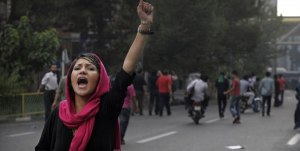 Do revolutions move in circles? The uprisings which shook the Arab world in 2010 and 2011 were in some ways prefigured by Iran’s Green Movement protests of 2009. The years since have been so dominated by counter-revolution and war that many have despaired of forward movement. Yet one year after Iranian proxies crushed the revolution in Syria’s Aleppo, sparks of revolution are flying in Tehran.
These protests differ from those of 2009 in several important respects. The Green Movement was centred in Tehran, it was largely middle class, and it supported the reformist wing of the Islamic Republic against more authoritarian conservatives. The current protests, in contrast, are fiercest in the provinces, are largely working class, and often express rejection of the Islamic Republic itself.
It remains to be seen how far this angrier, more radical opposition movement will undermine or transform Iranian governance. On the one hand, its working-class character cuts at the heart of the regime’s legitimacy. The mustadafin or ‘downtrodden’ are supposed to be the base and prime beneficiaries of the Khomeinist wilayet al-faqih system, and yet they are chanting for the death of the Supreme Leader. On the other hand, this same subaltern fury may play into regime hands by scaring the middle classes. There is, after all, the Syrian example to point to, an image to strike fear into the hearts of rebellious people everywhere. If a regime is pushed too far, look, the result is war, terrorism, social collapse and mass exile.
The Syrian example deployed as a threat may save Iran’s regime. The tragic irony here, of course, is that the Iranian regime has played a crucial role in creating the Syrian example. It is indeed to a large extent responsible for the disaster.
Thank You for the Cancer
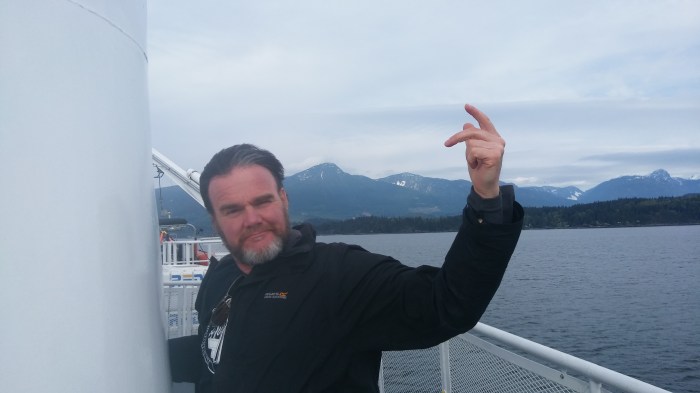 Writerly wisdom states that the best possible outcome of a writing course is to find a person who will become a critical reader of your work in its early stages, someone on your wavelength. I found that person in Adrian Barnes, while we were doing an online MA in Creative Writing. He lived in British Columbia, I was living in the Sultanate of Oman, but we became closer than the screen.
Adrian had already written several self-published novels and a volume of poetry. His “Satan a la Mode” – a Carrollian book of word-play, farce and philosophy – was completed and would later (in 2012) be published with illustrations by Yuliya Kashapova. While our course lasted he was working on a wonderful (sadly still-unpublished) novel called “Neverhasbeen.” He also parented his sons, taught college students, started several local newspapers, wrote songs, and sang and played the guitar.
In 2012 he published “Nod”, which is literary science fiction, an intellectual treatment of a sleepless apocalypse. Readers recognised its strength, and the book took off. There’s even talk of a TV version. Adrian’s writing career seemed truly underway.
Then one day he was driving to visit a friend in the US, listening to James Brown on the stereo, and realised he could only hear the great man’s voice, not the backing music. He went for tests, and was told he had a brain tumour, or more precisely, a Glioblastoma Multiforme, with a kill rate of over 99%.
He underwent an operation to cut the thing out. He woke up in pain and confusion to be told the operation had been unsuccessful. Thereafter he was unable to read and found writing almost impossible. Time bewildered him.
I’m having trouble with words and numbers – and getting more and more heavy. But, weird though this may sound, I am beginning to wonder if it’s actually a good thing.
I can’t believe in words and numbers. Instead I am in the midst of reality, and what I see is love. Now that sounds kind of hippie-like, but it’s true (the hippies got a lot right, though we love to mock them). I see love and joy, and things I want to do – or not do – and they don’t have a lot to do with words and numbers.
The Rohingya and Other Outsiders
This was first published at the New Arab.
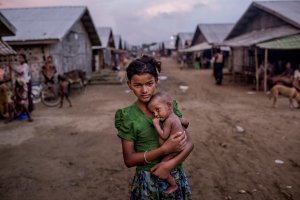 I recently had my DNA analysed to illuminate my geographical ancestry. My mother is English and my father Syrian, so you’d expect at least two locations to show. As it happens, I contain Western European, Caucasian, Southern European, Middle Eastern, Irish and Iberian, with small amounts of Scandinavian, North African and South Asian. This demonstrates not only that I am a mixture, but that my parents are too, that everyone is. It reminds us that ethnic distinctions are accidents of cultural history rather than markers of race or even of family purity. It means very similarly mixed blood flows in the veins of those who consider themselves in nationalist terms, for instance, as distinct Arabs, Kurds or Turks.
Ethnicities are fluid, yet European empires and post-colonial states sought to name and thus delimit them from historical flux. When the British arrived in the state called Burma or Myanmar after the Bamar, the dominant group, they set about categorising cultures and races, considering the two categories to be almost interchangeable. In the 1931 census the British named 139 ethnic groups. By 1982, independent Burma’s military junta had reduced this to 135 ‘national races’ qualifying for citizenship.
The Rohingya Muslims of Rakhine state are not included, though they are the descendants of Indian and Persian traders who first arrived here over a thousand years ago. Their numbers increased when early Burmese kings raided Bengal for slaves, and during British rule when workers came from India. Today the Burmese state denies their existence as a community, considering them illegal immigrants from Bangladesh. In recent weeks at least 620,000 Rohingya have been driven from their homes. Villages have been torched, women gang-raped, untold numbers have been hacked or burnt to death. A United Nations official called it a textbook example of ethnic cleansing.
Burning Country in the Guardian
It’s great to find our book selected as one of the best on Syria (in Pushpinder Khaneka’s World Library, here) alongside a couple of contemporary classic novels, In Praise of Hatred and The Dark Side of Love. An excerpt from my introduction to Khaled Khalifa’s In Praise of Hatred is here, and my review of Rafik Schami’s The Dark Side of Love is here.
Interview with Mohsin Hamid
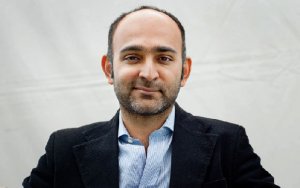 It was a pleasure to interview Mohsin Hamid, author of ‘The Reluctant Fundamentalist’ and ‘Exit West’, for the National. This here is the less edited version.
How did you become a writer? Put another way, why do you write?
I’ve always been a fantasist. Like many children, I used to play make-believe, and I still spend several hours a day living in my imagination. Why didn’t I grow out of it? Most people do, or at least are happy for their imaginings to be guided – they enter worlds made by others, in books or films.
I suspect it’s because I’m uncomfortable with the world as it is. I am mixed and mongrelised. I’ve lived my life between Pakistan, the UK and the US, so I’m foreign everywhere. Then, as I get older, my parents’ generation is passing away. Like everyone, I can’t provide the level of security for my children I’d like to. I experience the vulnerability that we all share.
I’m the type of person who requires unreal activity in order to function. If I don’t write fiction for extended periods I become unsettled, anxious, uncertain. I’m less of a pain to be around when I’m writing.
Your writing is distinguished by its clarity. The prose seems effortless, and the volumes are fairly thin. Yet once you told me a novel takes seven years to write. So how much rewriting is necessary?
My first two novels took seven years each. The third took six, and the fourth only four. I start with some ideas. I explore and build them up. I write an outline and fill notebooks. I even write a draft. Oftentimes these ideas don’t work, or they lead to a dead end. Then I may write a draft which shares no words with the first but is nevertheless influenced by it. The first draft of “Exit West” looked like the final product – the first time it happened – though many ideas from the draft were abandoned. I start with something that demands engagement. As I deal with it, my thoughts begin to clarify.
I’m fortunate in having honest readers – my wife first, but also my agent, and editors. And I write for an imaginary reader, not Pakistani or American, not male or female. In other words, I write novels that I’d like to read, that leave a lot open. I write half-novels if you like, not very long, which leave space for the reader to react and imagine.
Your writing, though very accessible, is often formally adventurous. What does form mean to you?
Form is the starting point. I use it in the same way poets used to use metre and rhyme, not as a restriction but as a set of rules to produce inspiration. Form makes possible the kind of story that readers can relate to intuitively. Form brings with it rhythms and patterns. Even if these are not evident, the way the mind works means they are helpful. Form provides vital architecture. The correct form depends on the nature of the story. This is what I must figure out: what’s the story about? What form suits it? What language fits the form?
You see, I don’t accept the notion that there is a stable thing called reality which the novel simply reflects. Humans are complex bio-chemical machines, and reality blurs quickly. What parts of me are talking to what parts of you? My construct of myself is a fiction. I often behave in ways that contradict this fiction. Through form, the novel can reveal the way in which reality is constructed, and how our selves themselves are constructed. Form allows writer and reader to enter a shared domain. We are aware it’s made up, so it can be still more potent than what we call reality.
A Syrianized World
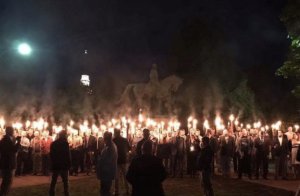 Alongside the chants of ‘Blood and Soil’, ‘You Will Not Replace Us’, ‘White Lives Matter’ and ‘Fuck You Faggots’, some of the privileged fascists rallying at Charlottesville, Virginia gave their opinions on the Syrian issue. “Support the Syrian Arab Army,” they said. “Fight the globalists. Assad did nothing wrong. Replacing Qaddafi was a fucking mistake.”
It’s worth noting that these talking points – support for Assad and the conspiracy theories which absolve him of blame for mass murder and ethnic cleansing, the Islamophobia which underpins these theories, the notion that ‘globalists’ staged the Arab Revolutions, and the idea that the Libyan revolution was entirely a foreign plot – are shared to some extent or other by most of what remains of the left.
In 2011 I expected that Syria’s predominantly working-class uprising against a sadistic regime that is both neo-liberal and fascist would receive the staunch support of leftists around the world. I was wrong. Britain’s Stop the War coalition marched furiously when it seemed America might bomb the regime’s military assets, but ignored America’s bombing of Jihadist groups and Syrian civilians, as well as Assad’s conventional and chemical attacks on defenceless people, and Russian and Iranian war crimes. Key figures in Jeremy Corbyn’s Labour Party followed the StW line. Diane Abbott called the police when Syrians attempted to speak at a StW event. During the final assault on liberated Aleppo last winter, Emily Thornberry suggested to Channel 4 News that Assad protected Christians, that the problem would be solved if ‘jihadists’ left, and that the Assadist occupation of Homs was an example to be emulated – never mind that liberated Aleppo contained democratic councils, that its revolutionaries included people of all religions and sects, or that 80% of Assad’s troops in that battle were foreign Shia jihadists organised by Iran – nor that the vast majority of Homs’s people remain in refugee camps, too terrified to return. John McDonnell gave a speech in Trafalgar Square on May Day under a Stalinist flag and the Baathist flag – that’s the flag of a previous genocide and the flag of a genocide still continuing. It wasn’t him who put the flags up, but he didn’t ask for them to be taken down.
In 2011 I should have known better. Leftists had long made excuses for the Soviet occupation of eastern Europe and the genocidal occupation of Afghanistan. Noam Chomsky, to pick one, made excuses for Pol Pot and Milosevic (today, of course, he rehearses the conspiracy theories which claim Assad’s innocence of sarin gas attacks, and channels like Democracy Now repeatedly offer him and others a platform to do so).
We Crossed A Bridge and it Trembled
This review first appeared at the Guardian. (I would recommend my and Leila’s book Burning Country as the best social, political, historical and cultural contextualiser of the Syrian Revolution, and Yassin al-Haj Saleh’s The Impossible Revolution as the best analysis – and one of the best political books you’ll ever read about any topic – but I would certainly recommend this remarkable book for its method. The entire story is told through the voices of Syrians themselves.)
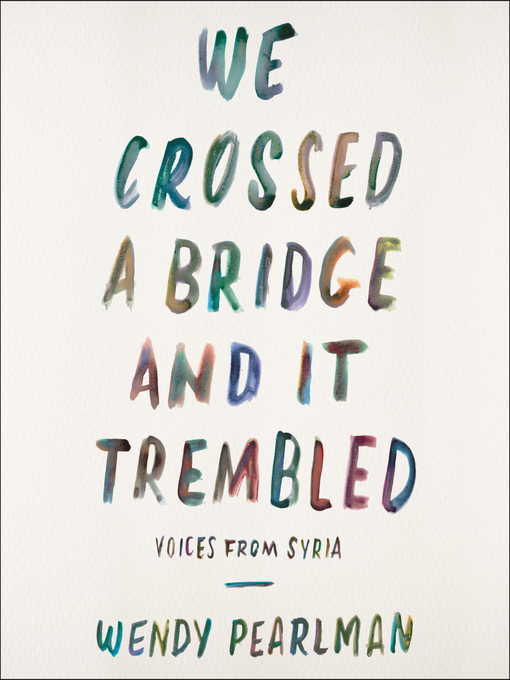 Everyone talks about Syrians, but very few are actually talk to them. Perhaps that’s why Syria’s revolution and war have been so badly misunderstood in the West – variously as a US-led regime-change plot, or an ancient Sunni-Shia conflict, or a struggle between secularism and Jihadism.
“We Crossed a Bridge and It Trembled” bucks the trend. Here the story is told entirely through the mouths of Wendy Pearlman’s Syrian interviewees, hundreds of them, from all social backgrounds, Christians and Muslims, Ismailis and Druze, rural and urban, middle-class and poor. These best of all possible informants – the people who made the events, and who suffer the consequences – provide not only gripping eyewitness accounts but erudite analysis and sober reflection.
The introduction, alongside a concise overview of developments from 1970 to the present, describes Pearlman’s method. She interviewed refugees (who are therefore overwhelmingly anti-regime) in locations stretching from Jordan to Germany. And she interviewed in Arabic, enabling “a connection that would have been impossible had I relied on an interpreter.” The result is testament both to Syrian expressive powers and the translation’s high literary standard.
These heart-stopping tales of torment and triumph are perfectly enchained, chronologically and thematically, to reflect the course of the crisis. They begin with life under Hafez al-Assad’s regime, “not a government but a mafia”, when children were trained to lie for their families’ security. “It was a state of terror,” says Ilyas, a dentist. “Every citizen was terrified. The regime was also terrified.”
The City Always Wins
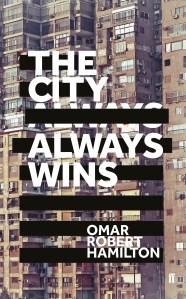 An edited version of this review appeared first at the Guardian.
“The City Always Wins”, the astounding debut novel by British-Egyptian film-maker Omar Robert Hamilton, opens after the seeming triumph of the Egyptian revolution’s early stage has passed, though it is remembered, cinematically, as “an explosion of light, sound and epic consequence with no room for ego or doubt.”
Now the revolutionaries are flailing in various tides of counter-revolution. The new Muslim Brotherhood government forces through a constitution which ignores key revolutionary demands. Brotherhood ‘security’ and a revived police force torture and murder at will. The army kills too, and prepares to seize total control. To emphasise these reversals, parts one, two and three of the novel – though the story moves forward chronologically – are titled respectively Tomorrow, Today and Yesterday.
Crowds are evoked through disputatious voices. A large and striking cast of characters struggles in night-time streets, chokes in traffic or on tear gas, argues in bars, and waits in hospitals and morgues. They are brought together through the figure of Khalil. Palestinian-Egyptian, and American born, Khalil’s problematised nationality, and people’s responses to it, is one way in which the novel questions the nature of community. Khalil’s partner Mariam is a medical worker seeking a life worthy enough to “conquer death with memory”, and a feminist in the way she lives and loves, though she never mentions the word.
Khalil co-founds Chaos, a magazine, website and podcast (in the real world, Hamilton co-founded a media collective called Mosireen). The office “becomes a cerebral cortex at the centre of the information war.” Significantly, the novel begins at the massacre of (mainly Christian) protestors outside Maspero, the state media HQ. Later, Khalil will have reason to repeat: “I wish we had taken Maspero.”
The revolutionaries set up illegal radio transmissions, write manifestos, crowd-source, make public art. Increasingly they also tend the wounded, comfort the bereaved, and find lawyers for the detained. Some of the people here are real, like the imprisoned activist Alaa Abd el-Fattah, Hamilton’s cousin, to whom he dedicates the book.
‘Sectarianization’
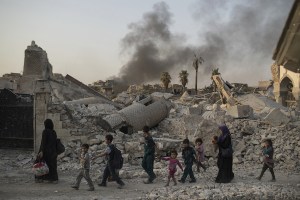
The remains of the Nuri mosque amidst the remains of the ancient city of Mosul, Iraq. photo by Felipe Dana/ AP
An edited version of this article was published in Newsweek.
In his January 20 Inaugural Address, President Trump promised to “unite the civilised world against radical Islamic terrorism which we will eradicate completely from the face of the earth.”
To be fair, he’s only had six months, but already the project is proving a little more complicated than hoped. First, ISIS has been putting up a surprisingly hard fight against its myriad enemies (some of whom are also radical Islamic terrorists). The battle for Mosul, Iraq’s third-largest city, is almost concluded, but at enormous cost to Mosul’s civilians and the Iraqi army. Second, and more importantly, there is no agreement as to what will follow ISIS, particularly in eastern Syria. Here a new Great Game for post-ISIS control is being played out with increasing violence between the United States and Iran. Russia and a Kurdish-led militia are also key actors. If Iran and Russia win out (and at this point they are far more committed than the US), President Bashar al-Assad, whose repression and scorched earth paved the way for the ISIS takeover in the first place, may in the end be handed back the territories he lost, now burnt and depopulated. The Syrian people, who rose in democratic revolution six years ago, are not being consulted.
The battle to drive ISIS from Raqqa – its Syrian stronghold – is underway. The Syrian Democratic Forces (SDF), supported by American advisors, are leading the fight. Civilians, as ever, are paying the price. UN investigators lament a “staggering loss of life” caused by US-led airstrikes on the city.
Though it’s a multi-ethnic force, the SDF is dominated by the armed wing of the Democratic Union Party, or PYD, whose parent organisation is the Kurdistan Workers Party, or PKK. The PKK is listed as a terrorist organisation by the United States (but of the leftist-nationalist rather than Islamist variety), and is currently at war with Turkey, America’s NATO ally. The United States has nevertheless made the SDF its preferred local partner, supplying weapons and providing air cover, much to the chagrin of Turkey’s President Erdogan.
Now add another layer of complexity. Russia also provides air cover to the SDF, not to fight ISIS, but when the mainly Kurdish force is seizing Arab-majority towns from the non-jihadist anti-Assad opposition. The SDF capture of Tel Rifaat and other opposition-held towns in 2016 helped Russia and the Assad regime to impose the final siege on Aleppo.
Eighty per cent of Assad’s ground troops encircling Aleppo last December were not Syrian, but Shia militiamen from Lebanon, Iraq and Afghanistan, all armed, funded and trained by Iran. That put the American-backed SDF and Iran in undeclared alliance.


 Qunfuz