Posts Tagged ‘Donald Trump’
Ahmad al-Sharaa in the White House
This article was first published at Time magazine.
On November 10, President Donald Trump met Syria’s transitional president Ahmad al-Sharaa at the White House. The meeting was remarkable in many ways. It was the first time that a Syrian president had ever been hosted in the White House. Trump and al-Sharaa had briefly met before, in Riyadh, Saudi Arabia, on May 14. That date was almost as remarkable as the meeting itself, because it was the twentieth anniversary to the day of Ahmad al-Sharaa’s arrest by American troops for membership of al-Qaeda in Iraq. When al-Sharaa later started fighting in Syria, the US not only declared him a terrorist, it put a $10 million bounty on his head.
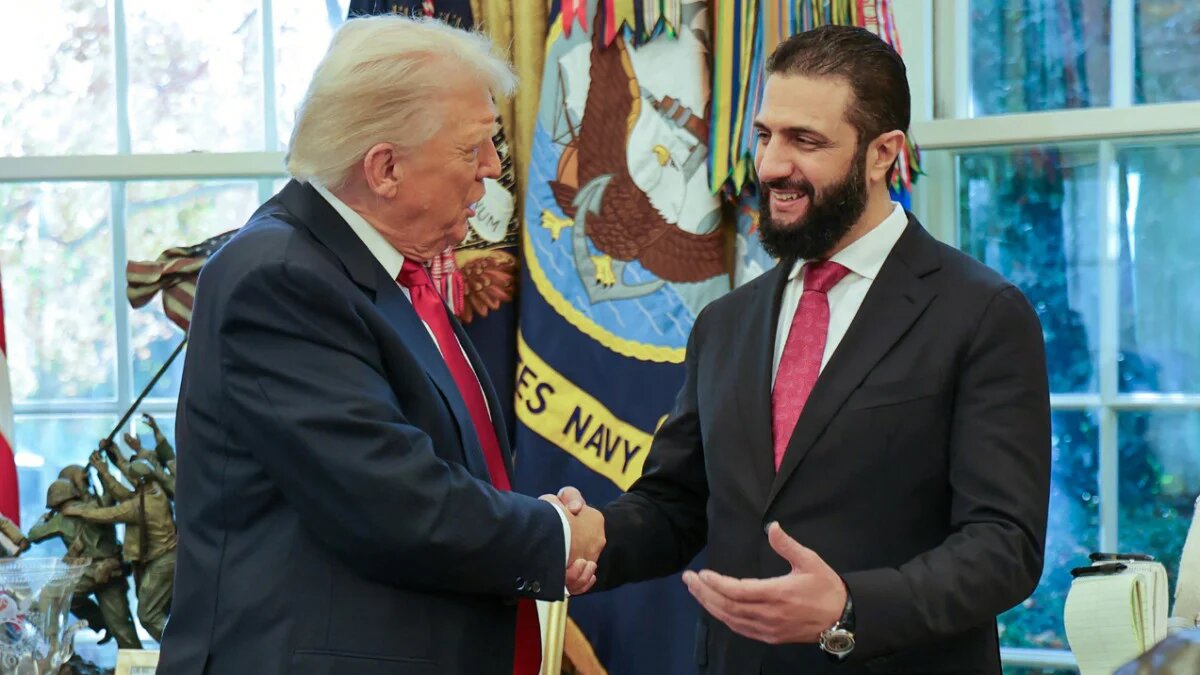
The White House welcome looks like a new dawn for Syrian-American relations, given that the US has sanctioned Syria as a ‘state sponsor of terrorism’ since 1979 – and that further sanctions were added by the Reagan, George W. Bush and Obama administrations.
And it’s certainly quite a turnaround for a former jihadist – though perhaps not as much as it first seems. Al-Sharaa was in prison for most of the Iraqi civil war, so he didn’t participate in attacks on Shia civilians. Released just as the Syrian Revolution was beginning in March 2011, he returned to Syria to establish a militia called Jabhat al-Nusra, which later transformed into Hayat Tahrir al-Sham (HTS). These organizations focused on fighting Assad and the Iranian militias that supported him. They never attacked the West, and they steered clear of the mass civilian casualty operations favoured by Iraqi jihadists.
Al-Sharaa broke definitively with ISIS in 2013, and has fought it continuously since 2014. In power, he aims for good relations with the world rather than apocalyptic war. And where ISIS fielded a morality police to impose a dress code, in al-Sharaa’s Damascus, women wear what they like.
The US had conducted multiple anti-ISIS operations in HTS-ruled Idlib, including the one that killed ISIS ‘caliph’ Abu Bakr al-Baghdadi in 2019. Though there was no direct coordination, HTS fighters did not attack the US special forces. Indirect understandings intensified into direct cooperation when al-Sharaa assumed power on December 8 last year, leading to at least eight joint operations. Now, after the meeting in the White House, Syria has announced its formal integration into the Global Coalition against ISIS. This will lead to still more joint action. Even more significantly, the Syrian Democratic Forces (SDF) – the Kurdish-led militia that controls large parts of northeastern Syria – can no longer claim to be the Coalition’s boots on the ground. This is a step towards Syria’s reunification under central authority.
Read the rest of this entry »‘Sectarianization’
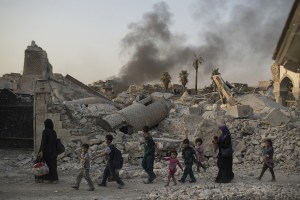
The remains of the Nuri mosque amidst the remains of the ancient city of Mosul, Iraq. photo by Felipe Dana/ AP
An edited version of this article was published in Newsweek.
In his January 20 Inaugural Address, President Trump promised to “unite the civilised world against radical Islamic terrorism which we will eradicate completely from the face of the earth.”
To be fair, he’s only had six months, but already the project is proving a little more complicated than hoped. First, ISIS has been putting up a surprisingly hard fight against its myriad enemies (some of whom are also radical Islamic terrorists). The battle for Mosul, Iraq’s third-largest city, is almost concluded, but at enormous cost to Mosul’s civilians and the Iraqi army. Second, and more importantly, there is no agreement as to what will follow ISIS, particularly in eastern Syria. Here a new Great Game for post-ISIS control is being played out with increasing violence between the United States and Iran. Russia and a Kurdish-led militia are also key actors. If Iran and Russia win out (and at this point they are far more committed than the US), President Bashar al-Assad, whose repression and scorched earth paved the way for the ISIS takeover in the first place, may in the end be handed back the territories he lost, now burnt and depopulated. The Syrian people, who rose in democratic revolution six years ago, are not being consulted.
The battle to drive ISIS from Raqqa – its Syrian stronghold – is underway. The Syrian Democratic Forces (SDF), supported by American advisors, are leading the fight. Civilians, as ever, are paying the price. UN investigators lament a “staggering loss of life” caused by US-led airstrikes on the city.
Though it’s a multi-ethnic force, the SDF is dominated by the armed wing of the Democratic Union Party, or PYD, whose parent organisation is the Kurdistan Workers Party, or PKK. The PKK is listed as a terrorist organisation by the United States (but of the leftist-nationalist rather than Islamist variety), and is currently at war with Turkey, America’s NATO ally. The United States has nevertheless made the SDF its preferred local partner, supplying weapons and providing air cover, much to the chagrin of Turkey’s President Erdogan.
Now add another layer of complexity. Russia also provides air cover to the SDF, not to fight ISIS, but when the mainly Kurdish force is seizing Arab-majority towns from the non-jihadist anti-Assad opposition. The SDF capture of Tel Rifaat and other opposition-held towns in 2016 helped Russia and the Assad regime to impose the final siege on Aleppo.
Eighty per cent of Assad’s ground troops encircling Aleppo last December were not Syrian, but Shia militiamen from Lebanon, Iraq and Afghanistan, all armed, funded and trained by Iran. That put the American-backed SDF and Iran in undeclared alliance.
Reinvention versus Trumpism
Malcolm X
This was first published at the New Arab.
While we were in New York to talk about “Burning Country”, I visited the 9/11 Memorial, a commemoration of the spectacle that arguably set the tone for the 21st Century. I was advised to visit by a friendly progressive professor, the host of one of our events. He said the attached museum was a good example of America’s self-portrayal as the world’s supreme victim. He wasn’t alone. Philip Kennicott in the Washington Post described the museum as “an oversized pit of self-pity, patriotic self-glorification and voyeurism.”
I didn’t really agree about the museum, and the memorial to the day when the twin towers were hit and almost three thousand civilians killed seemed to me tasteful and correct.
At the precise site of each tower’s base there are two-tiered pools of falling water. These enormous bottomless basins are inversions of the towers, the very opposite of phallic triumphalism. Each implies absence and a hidden abyss. In a way they are beautiful, superficially calming, and their noise nearly drowns the rush of the city around. But ultimately they are terrible, because gravity’s incessant pull on the water, the sound and sight of continuous descent, is a reminder of the terror of jumping, falling people, those who chose to plunge rather than burn, and of the tumbling shoes, the floating paper, the towers themselves collapsing, so many tons of metal and concrete, so many volumes of dust and smoke.
In the museum the focus is on the trauma experienced by the victims. There are first-hand accounts played on audio, and photographs and films of shocked New Yorkers gazing skyward, or running for their lives, or trudging slowly, whitened by dust. A shock, literally out of the blue, for an America almost entirely untouched on its own soil by war, at least since its civil war (though native-Americans and African-Americans must be excluded from this peaceable account of history).
Two Assassinations and a Brexit
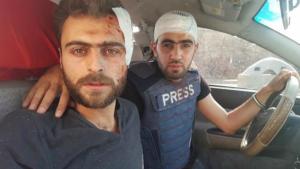
Khaled al-Issa (left) and Hadi Abdulllah, after the air raid, before the controlled explosion
This was published at al-araby al-Jadeed/ The New Arab.
On June 16th Jo Cox, a proponent of EU membership, a compassionate supporter of refugees, and the most articulate voice for revolutionary Syria in the British parliament, was shot, stabbed and kicked by a middle-aged man screaming “Britain First!”
On the same day Syrian citizen journalists Khaled al-Issa and Hadi Abdullah, 48 hours after surviving an air raid, were severely injured in an assassination attempt by controlled explosion.
Jo died in hospital shortly after she was attacked. In a different world, the kind she fought for, she would have been an honoured guest in free Syria. Khaled al-Issa died of his wounds on June 24th. Having survived Assad and ISIS-inspired brushes with death, it was probably Jabhat al-Nusra, Syria’s al-Qaida affiliate, that got him in the end. In a different world Khaled would be reporting on the achievements of post-dictatorship Syria. In this world, however, the very best are being murdered. The very worst are growing in power.
East and west, violent and nativist authoritarianism is on the rise. The British media focused on characterisations of Jo’s murderer, Thomas Mair, as a troubled loner rather than as a terrorist. Had he screamed ‘Allahu Akbar’ rather than ‘Britain First’ as he stabbed and shot, the emphasis would certainly have been different.


 Qunfuz