Posts Tagged ‘Russia’
The Sky Wept Fire
I write a short column about books for our very local newspaper. I’m sharing one of the columns here so that people learn of Mikail Eldin’s remarkable book.
I’ve written here before about the ISIS Prisons Museum. Now we’ve launched another website dedicated to documenting the prisons of the Assad regime, the Syria Prisons Museum. Both websites have an ‘articles’ section which displays accounts of imprisonment under various other political detention systems around the world, from Iran to Guantanamo Bay. It is interesting to see how the tools of torture and technology of abuse are often very similar even in regimes which are supposedly ideologically very different. Such horrors cross borders more easily than people.
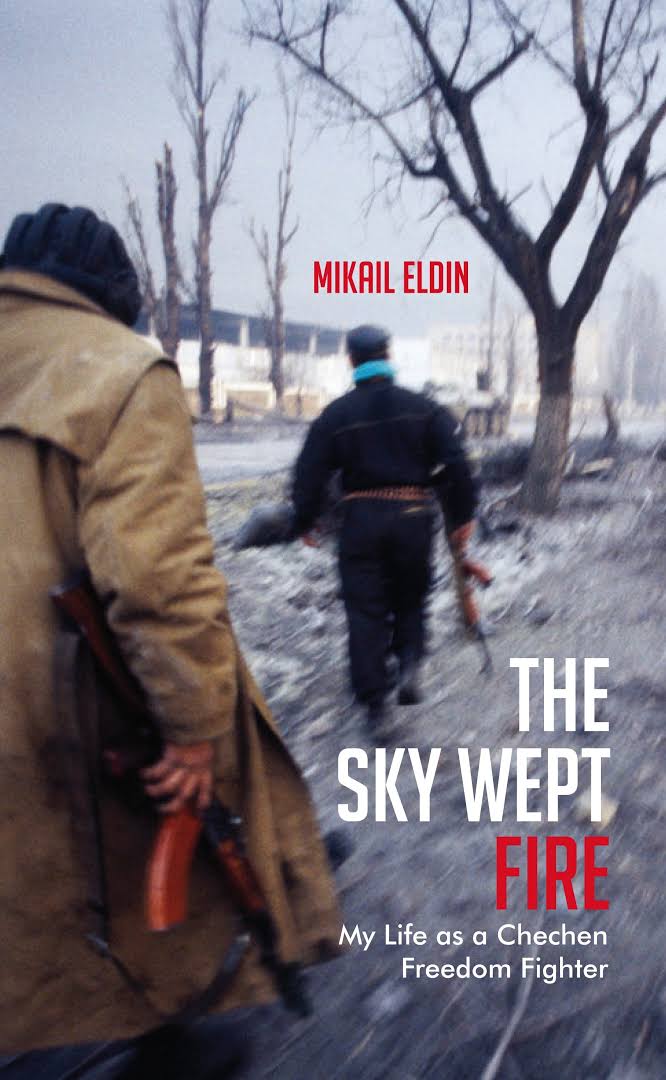
It was in this context that I contacted Mikail Eldin. As a partisan journalist with Chechen independence fighters, he was captured and very brutally interrogated by the Russians before being transferred to an almost equally brutal filtration camp. I asked him to write an account of his imprisonment for the Prisons Museum. He did so – in Russian – and I ‘translated’ it, though I speak no Russian and can’t even read the alphabet, using Google Translate. There were a couple of places in the text where I needed clarification, but basically, the new technology has rendered the job of translator obsolete. Which is somewhat frightening, I think – but that’s another story.
I was so impressed by Mikail’s article that I decided to read his book, “The Sky Wept Fire”, which was translated not by AI but by Anna Gunin, who had put me in touch with him. Mikail was detained during the first Chechen independence war (1994-1996), but he witnessed the second war too (1999-2009). War is, of course, much better experienced vicariously. “It is only possible to write beautifully about war if you have never witnessed it from within,” Mikail writes. I think I disagree, because he has managed to do it. I do agree, however, when he writes, “This is not a seductive story of war for the adventurous or the romantic.” It’s a determinedly unromantic, unsentimental account of terrible events and behavior, but also of the contrary trend, of self-sacrifice and brotherhood.
The writing often slips into second person, that is, Mikail often addresses himself as ‘you’, like this: “You sever yourself from the past and reject the future…” Not much writing does this, and I always like the effect when it does. (Mohsin Hamid’s novel “How to Get Filthy Rich in Rising Asia” does it really effectively, because it’s in part a satire of the self-help genre.) I asked Mikail why he’d chosen the second person, and he responded, “It was very difficult psychologically to describe these events. So I unconsciously began writing this way, distancing myself from them. But in the end, it turned out well.”
The book describes Chechen political and cultural background, and landscapes and cityscapes, and the details of battle, and physical pain and relief. But its treatment of the psychological aspect is the most engaging. This is a raw but also subtle account of the ravages of imperialism, and also of the stark beauties of mountainous Chechnya, a place to visit in an alternate dimension, if it were only free.
The Power Shifts Changing the Middle East
I was pleased to be invited again to speak with Faisal al-Yafai on The Lede podcast, connected to the excellent New Lines Magazine. We spoke about Ahmad al-Sharaa’s visits to both Moscow and Washington DC, the role of ideology in today’s Middle East, and even Scottish independence! Raya Jalabi of the Financial Times tals first about the Iraqi militias and the regional changes since & October 2023.
Thank You So Much
A message from the father of the murdered nine-year-old Ibrahim Shayban to Russia, China and Bashaar al-Asad.
The Russian and Chinese vetoes to protect the Syrian regime from UN Security Council condemnation are reminiscent of all those American vetoes to protect Israel. Both countries have their reasons for shielding the Syrian regime: Russia’s naval base at Tartus, discomfort over the way the Libya No Fly Zone slipped into more overt intervention, the fear that UN condemnation may one day focus on Russian abuses in Chechnya and Chinese abuses in Tibet and Xinjiang. But both countries should consider their own interests more creatively. Ultimately, their influence in Syria and the wider region will depend on their image in Syrian and Arab eyes. The Syrian regime will not be there for ever. The Syrian people will.
Iran is another state which has repeatedly shot itself in the foot since the Arab revolutions began, first by mischaracterising as Islamic uprisings the deposings of Mubarak, Bin Ali and Qaddafi, then by opposing the revolution which seems most similar to Iran’s in 79 – the Syrian revolution. Iran used to be popular in Syria even amongst many sectarian-minded Sunni Muslims. It used to be popular in the wider Arab region. This popularity was Iran’s best guarantee against marginalisation and even military attack from the region’s pro-Western forces. But its popularity has evaporated this year.
Back to Ibrahim. He was martyred while leaving a mosque in the Qaboon suburb of Damascus. His funeral was held today in Meydan, in the heart of the city. Here’s some footage. Apparently insecurity forces killed two of the mourners when they came out of the mosque into the street.
Commentators have been telling us that central Damascus remains quiet. It’s true that many areas have been quiet, either because the upper middle class inhabitants still support the regime or are sitting on the fence, or because of the overbearing police and mukhabarat presence on the streets. Damascus has certainly not slipped out of regime control, as Homs, Hama, Deir ez-Zor and Idlib sometimes have. Yet Damascus has been bubbling for a long time. Pro-regime commentators will say that Kafar Souseh (which has demonstrated frequently since Shaikh Rifa’i of the Rifa’i mosque was shot) is a suburb, not the city itself – which is true, if Camden Town isn’t part of London. Suburbs further out – like Harasta, Douma, Muadamiya – have been veritable war zones for months. Imagine if Streatham, Hackney, Tottenham and Ealing were in a state of war and commentators told us ‘London remains quiet.’ And Meydan and Rukn ad-Deen have witnessed frequent, large demonstrations, and savage repression. These places are as central as Chelsea and Kensington. Smaller, briefer demonstrations have occurred in high-class Malki, in Sha‘alaan, Shaikh Muhiyudeen, Baghdad Street, Muhajireen. You can’t get more central. The last place is within earshot of Bashaar al-Asad’s house. If the quietness of Damascus reassures the regime, I think they’d better start panicking.


 Qunfuz