The End of Eternity
A slightly edited version of this text was published at the Guardian.
The liberation of Syria was long hoped for, but unexpected. Over the last weeks, Syrians have experienced the full range of human emotions, with the exception of boredom.
On the first two Assad-free Fridays, millions of celebrants swelled the streets to chant and sing and speak formerly forbidden truths. There was a huge presence of women, who had been less visible in the years of war. Relatives are meeting again and assuaging their pain as hundreds of thousands return from the camps of exile. At the same time, millions are having to accept at last that their loved ones have been tortured to death. It now appears that most of the 130,000 lost in Assad’s prisons (a bare minimum figure) are dead. Dozens of mass graves have already been discovered.
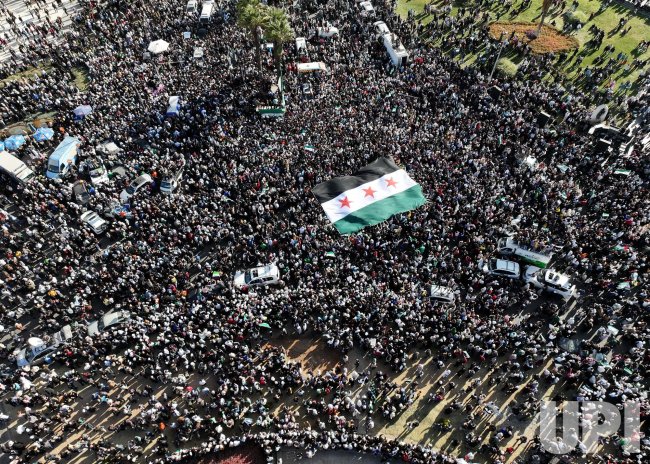
Working hard to crawl out from under the corpse of one of the worst torture states in history, Syrians are now looking to the future.
A key factor in the final fall of the regime was the remarkable discipline and social intelligence shown by the HTS-led rebel coalition. When it became clear that neither Christians nor unveiled women were being harassed in liberated Aleppo, that there was no looting, and that Shia towns which had hosted murderous foreign militias were not subjected to revenge attacks, then tens of thousands of Assad soldiers felt safe enough to defect or desert.
But some still harbour deep suspicions of HTS leader Ahmad al-Sharaa, previously known as Abu Muhammad al-Jolani. He also has enormous charisma, which might ease the path to a new dictatorship. So far, however, the signs are more hopeful than that. Al-Sharaa is popular precisely for his non-dictatorial qualities.
Indeed, the first motivator for the moderation of HTS since the revolution began in 2011 has been its need to be accepted by the complex, multicultural, and assertive Syrian society. Al-Sharaa wouldn’t be where he is today if he hadn’t followed a pragmatic and accommodating path, and he knows it. “Someone who rigidly clings to certain ideas and principles without flexibility,” he told CNN, “cannot effectively lead societies or navigate complex conflicts.”
Thus far at least, al-Sharaa appears intelligent enough to understand that neither he nor his political current can rule Syria on their own. HTS played a key role in the liberation, but it wasn’t the only player. Rebels from Daraa, the Homs countryside, and the east Ghouta, and the Druze militias in Sweida, all liberated themselves.
The HTS-led coalition has assured all sectarian and ethnic communities that their rights will be respected, and issued directives that women’s dress choices should not be interfered with. (In Idlib, HTS stopped fielding a religious police years ago). All rebel groups will soon dissolve in favour of a professional national army.
Muhammad al-Bashir has been appointed prime minister of a Transitional Government until March 2025. Al-Bashir was previously head of the Salvation government in Idlib, which was HTS-aligned, but civilian, technocratic, and fairly successful in its provision of services. So far so good, but there is a need for greater inclusion, particularly in the process of drawing up a new constitution. Inclusion here means not just symbolic participation, or quotas, but the kind of practical involvement that will ensure unity and stability by giving key constituencies the sense that they hold a stake in the new order. Among these constituencies are Alawis – from which Assad and most of the old regime emerged – and secularists. Both are currently feeling bruised, though cautiously optimistic.
The opposition’s Coalition – which covers a range of currents, from the Muslim Brotherhood through nationalists to liberals – contains illustrious individuals who should be brought in, but is disabled by its lack of governance experience, and of relevance, and its proximity to foreign powers, especially Turkey.
The strongest guarantor of accountability will be civil society. There were once over 800 quasi-democratic local councils governing affairs in liberated territory. As refugees return, society will grow in strength.
The biggest challenges at present, therefore, are not domestic. Syria has been liberated from Russia and Iran, but other occupations remain, and even expand. North east Syria is wracked by its own complexities and other people’s wars. Turkey and the Turkish-Kurdish PKK are clashing. Turkish-funded militias notorious for their criminality have abused and murdered civilians. So has the US-backed SDF, a coalition dominated by the PKK (not “the Kurds”, as commentators insist on calling it; Syrian Kurds are as politically diverse as anyone else, and many fled PKK authoritarianism for Iraqi Kurdistan).
The new government will have to negotiate the diminishment of these opposing forces. As I write, the SDF is seeking to avoid a Turkish invasion of Kobani by declaring the city a demilitarized zone. It is to be hoped that the PKK core will withdraw to its base in the Qandil mountains of Iraq, that the Kurdish parties it banned will be able to operate again, and that Kurds will flourish in a post-Arabist Syria. Already, al-Sharaa has assured them this will be the case. It would be good if Syria became post-Islamist too. The less ideological grandstanding, and the more practical work, the better everyone will cooperate.
An even more serious challenge is the enmity of the west. The EU and the US are not lifting sanctions on Syria, though the regime has gone, which makes them unprecedented ‘pre-emptive’ sanctions. Worse, Israel, armed and excused by the US, UK, and Germany, has invaded still more Syrian territory (after its theft of the Golan Heights) and is bombing security centres as well as military targets, presumably to destroy evidence of collaboration with Assad.
This unprovoked assault, an attempt to render the country defenceless (against ISIS as well as Israel) is a shameful and stupid way to welcome newly independent Syria. I predict Syria will eventually manage to defend itself. It’s already seen off one set of regional and international imperialists.
The future will certainly be influenced by hostile foreign powers, but the Syrian people will play the leading role in the drama. That’s because on December 8th, eternity came to an end, the statues of the tyrants fell, and history resumed.


 Qunfuz
Dear Robin,
Very happy to see a national newspaper publishing an article by you. Thank you for all your work enabling me to have a better understanding of Syria.
Have a happy new year.
jane
Jane
December 24, 2024 at 11:01 am