Author Archive
The End of the Arabs? Part One
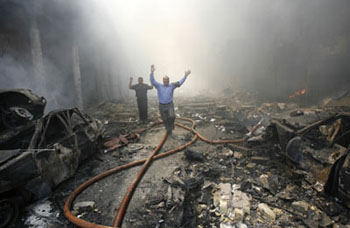 Peter W. Galbraith’s book ‘The End of Iraq’ argues the initially persuasive thesis that Iraqis have already divided themselves into three separate countries roughly corresponding to the Ottoman provinces of Basra (the Shii Arab south), Baghdad (the Sunni Arab centre) and Mosul (the Kurdish north), and that American attempts to keep the country unified are bound to fail. I agree wholeheartedly with Galbraith’s call for America to withdraw from Iraq – America is incapable of stopping the civil war, and is in fact exacerbating it. (update: I stick by this. The civil war has to some extent calmed because of internal Iraqi dynamics, not because of the US ‘surge’ – the Sunni forces turned on al-Qaida, and also realised that they had lost the battle for Baghdad and national power. Some groups then allied with the US for a variety of reasons to do with self-preservation). The rest of Galbraith’s argument is much more debatable.
For a start, he minimises the extent to which the US occupation has contributed to the disintegration of Iraq. I do not wish to deny the sectarian and ethnic fractures which exist in Iraq and other Arab countries, but it is reasonable to expect that any country, having suffered dictatorship, war, sanctions, and then the overnight collapse of all its institutions, would enter a period of chaos and division. Galbraith accurately records Western support for Saddam Hussain throughout the Iran-Iraq war, when he was gassing Kurds, and the American refusal to intervene when Republican Guards were slaughtering southern Shia in 1991 (the massacres happened under the eyes of American forces occupying the south at the end of the Kuwait war). He describes the criminal failure in 2003 of the occupying forces to stop the looting and burning of every ministry except the oil ministry, of military arsenals and even yellowcake uranium stocks the Americans claimed to be so concerned about in the run-up to the invasion, and of the national museum and national library. (He doesn’t examine claims made at the time by Robert Fisk and others that masked men with Kuwaiti accents were bussed in to certain ministries to set fires professionally.) The attack on Iraq’s – and the world’s – heritage is of course a cultural crime far greater than the despicable Taliban destruction of the Bamyan Buddha statues. Bombing and looting ravaged what was left of Iraq’s civilian infrastructure. The Iraqi state was destroyed within the first week of occupation, long before the sectarian killing began.
You Muslims!
This summer my son and I spent a few days in the house of a friend of mine from university days, a friend from a very different background, but a very good friend, very intelligent and very funny, who has always treated me with respect and a great deal of generosity. It was wonderful to see him. The problem was his girlfriend. (Now ex-girlfriend, so I dare write this without jeopardising the friendship).
The first thing she said to my eight-year-old son, after “hello,” was, “Do you feel uncomfortable because I’m not all covered up?” Some minutes later at the dinner table she squeezed her eyes at him and then me, and asked, “What nationality are you?” I should stress here that I’m a native speaker of English, and that my son, although he’s never lived in Britain, has inherited my proper British accent. By now it was apparent that there was an obsessional block in this woman’s head.
A little later my friend (as he does) said something silly about gay people. The girlfriend cast worried glances at me, then my son, and said in the childish tone some people adopt when instructing children, “I think gay people are great!” These educative comments continued, quite irrelevantly. The most absurd, aimed meaningfully at my little boy, was “I really enjoy getting drunk sometimes!” Normally I would argue back, but I was in the very uncomfortable position of being a guest in my friend’s house. Anyway, my son was grown-up enough to understand that this strange woman had a strange agenda.
A Step Forward
Last summer I spent seven days on a ten-day meditation retreat in England. With the background of the attack on Lebanon, it formed the matter of my first posting on this blog, called ‘Taking a Step Back from Taking a Step Back.’ (see http://qunfuz.blogspot.com/2006_09_01_archive.html) Although I found the meditation itself fascinating and beneficial, the atmosphere at the retreat was poor, and the ‘teaching’ of the guru, Indian industrialist Goenka, was dogmatic, undemocratic and unintelligent. Even slightly cultlike: silence was demanded, but still we heard Goenka chanting on cassette as we tried to meditate; linguistic thought was bad, we weren’t allowed to make notes, read, or ask questions considered impractical, yet listening to Goenka talk for an hour and a half on video every evening was compulsory. Goenkaism makes a big deal of not being a religion, of Buddhism not being a religion, but in actuality it has the full set of taboos and set explanations demanding belief, from reincarnation to the leader figure, to qualify it as a religion in the worst possible sense. I wasn’t looking for a new religion, but for an opportunity to learn more about meditation in a supportive environment. So I left on the seventh day, and I’m very happy I did. I’m also glad I spent the seven days there, but Goenkaism left a bad taste in my mouth.
This summer my wife and I spent a week on a meditation retreat at Gaia House in Devon. It has left me questioning all tastes. I mean it was good.
Palestines
Here is my response to recent events in occupied Palestine. It’s quite long .. but not nearly as long as the Palestinian tragedy.
Fatah was established as a revolutionary liberation movement, the party of the Palestinian masses wherever they were, the movement which energised the Palestine Liberation Organisation and took it out of the hands of the Arab regimes. Arafat, Abu Jihad and other leaders resisted and negotiated, and withstood even the 1982 seige of Beirut, until the rulers of the world were obliged to recognise the PLO as the sole legitimate representative of the Palestinian people. The PLO included various small Marxist factions, but its centre was Fatah. The word means ‘opening’ or ‘victory’, and is a back-to-front acronym of harakeh at-tahrir al-watani al-filastini, or the Palestinian National Liberation Movement.
Gonu
 The first I heard of it was the Monday evening when a friend called to say that his son’s birthday party had been postponed due to the hurricane warning. Hurricane warning? Five minutes later my brother-in-law called about it too. You’ll forgive me for not taking it too seriously. For a start, we’re not in a hurricane zone. There has never before been a cyclone (as Indian Ocean hurricanes are called) in the Arabian Sea. There have been a few tropical storms, but they fail to make headway into the dry and dusty Gulf. Secondly, Oman had cried wolf a month previously when an Indian holy man predicted a storm and a tidal wave which would destroy the Qurm area. He said disaster would strike on a Wednesday, and a hysteria – which made the expatriate population chuckle – rapidly spread, so that children were kept home from school and more than a few workers failed to go to work. Nothing happened, of course. Except that the Indian holy man was imprisoned for starting the panic.
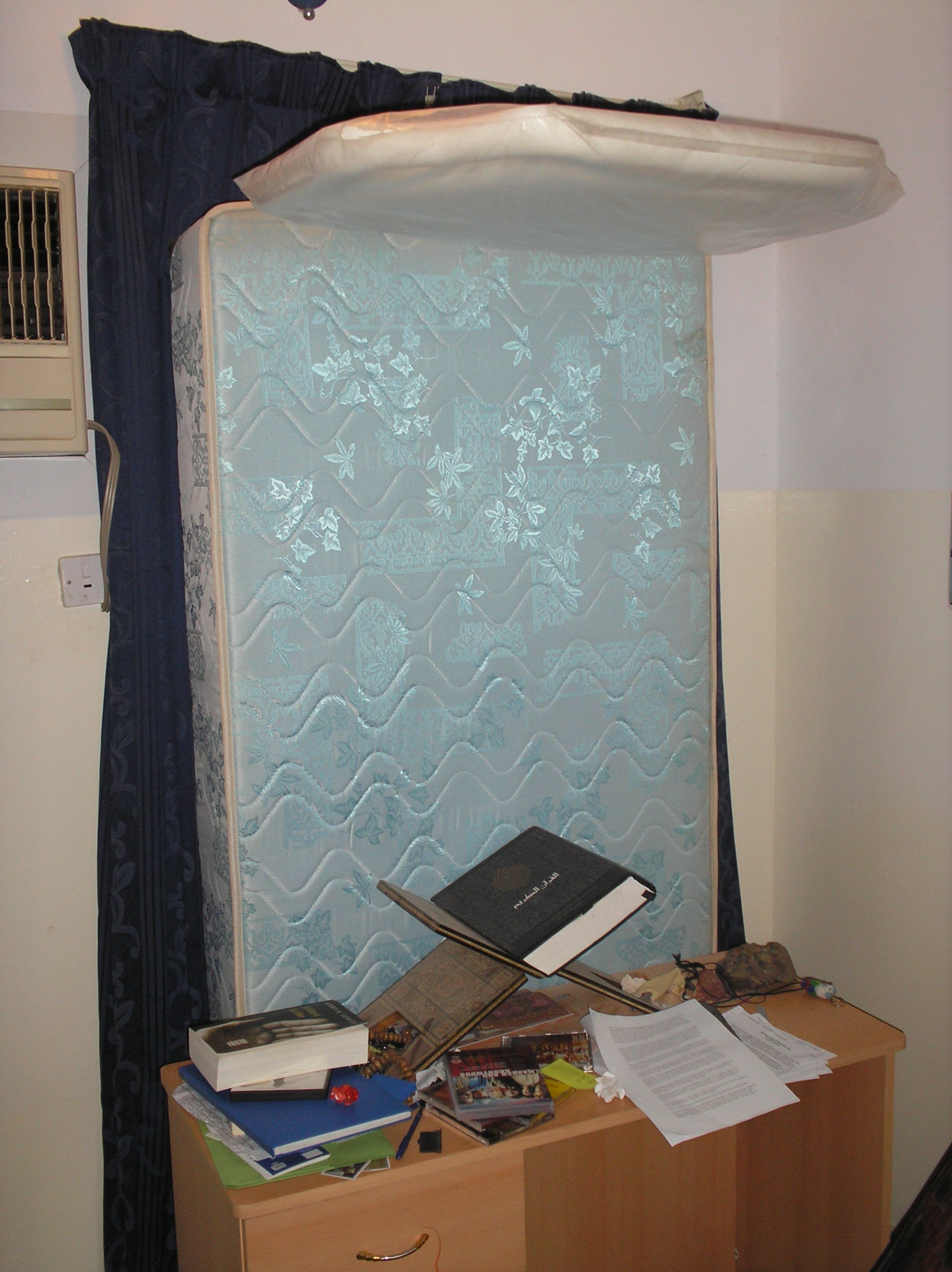
But there it was on the Omani TV station. Warnings to stock up on drinking water and then to stay indoors. Anyone within two kilometres of the sea should find a safe place further inland. On Tuesday morning I saw satellite images of Cyclone Gonu on the internet. It was huge, a swirl spreading its arms between the Iranian and Omani coastlines, with a defined eye. It had been upgraded to a category five cyclone. That’s as strong as a cyclone can get. Hurricane Katrina was a category five. A category five makes trees, rocks and cars dance in the heavens. A category five knocks down buildings. I bought a lot of candles and water, and taped up the windows. When I’d taped the windows, I shielded them with wardrobes and upended beds.
Racaille
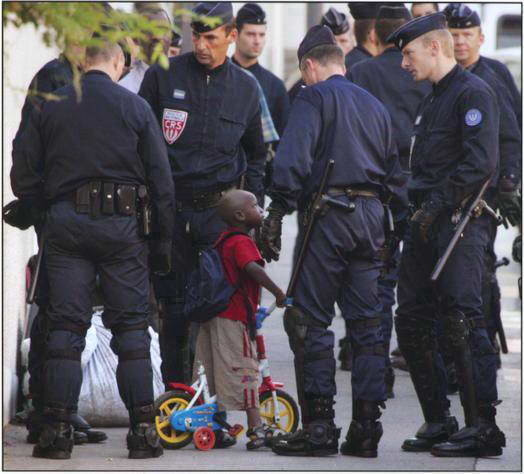 Segolene Royal has been much criticised for warning that the French ‘banlieu’ will riot if Sarkozy, the interior minister who called banlieu inhabitants ‘racaille’ (‘scum’), is elected president. The banlieu is prone to riot anyway. Why?
Well, here are a few personal anecdotes. The stories are 15 years old, so are not directly relevant to Sarkozy, but they explain something of the racist background to France’s social problems.
One: One evening in Paris I was walking with an upper-middle class English friend whose mother is Malaysian. I’m an English Arab, but white-skinned and blue-eyed. Out of nowhere arrived two policemen. With no warning they grabbed my friend, threw him against a wall, then pushed a truncheon against his throat until he was choking and weeping. They took me round the corner and asked why I was walking with him.
Unsustainable Development
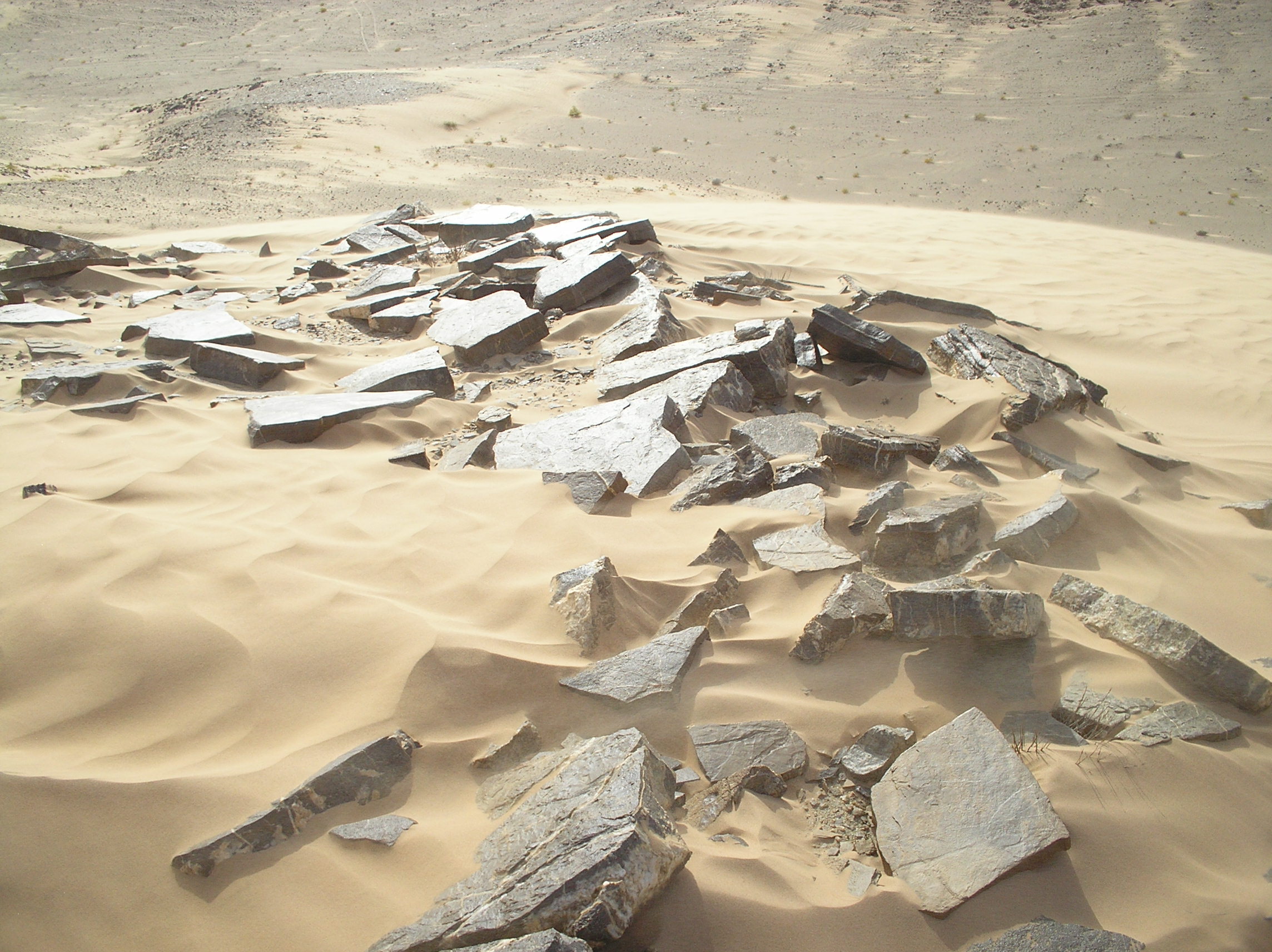 I recently spent a weekend in Oman’s ash-Sharqiyya region – the easternmost part of the Arab world – collecting wind-polished rocks in the desert, sleeping on an isolated beach (a turtle crawled up the sand to bury its eggs before dawn), and passing through small coastal villages.
This area remains – for a short time still – unspoilt. Although the inhabitants of the Sharqiyya enjoy the basic amenities which modernisation can and should provide – sanitation, electricity, health services – the state’s footprint is soft in the sand. I saw no sign of police. Institutional buildings are few and far between. The corporations have not yet arrived. None of the fast food outlets and coffee factories that homogenise the globe from the tropics to the tundra. So the settlements are handsome. The doors of the simplest houses are carved and patterned wood. Recent building may have been done with breeze blocks, but it’s been finished with mud.
The region wobbles on the edge of misnamed ‘development.’ It would be unwise in this water-scarce area to install flush toilets, but there will be worse. Emirati money is buying up the shoreline. Painted rocks mark the outlines of future residential complexes and hotels. I prayed as I passed that these were markers of dreams that would remain unfulfilled.
Gunboat Diplomacy
On January 11th, US occupation forces took five Iranian officials hostage from a diplomatic office in Arbil, Northern Iraq, prompting protests from the Kurdish regional authorities who had invited the Iranians. On February 4th, an Iraqi army unit under direct American command kidnapped an Iranian diplomat in Baghdad. These are incidents we can be sure of.
On February 14th, the anniversary of the bomb which killed Rafiq Hariri and many passersby in Beirut, eleven Iranian Revolutionary Guardsmen died when their bus was bombed by Jundallah, a Sunni fundamentalist and Baluchi separatist group active in southeastern Iran. Iranian authorities accused the US of involvement in the attack, a claim which is backed up by Seymour Hersh and several other analysts who have described American promotion of ethnic and sectarian conflict in Iran, and specifically American cooperation with al-Qa’ida linked anti-Shia groups throughout the region.
Murkier still are rumours that the US administration’s Iran Syria Policy and Operations Group is running a campaign to kidnap Revolutionary Guard commanders. Veteran Guardsman Alireza Askari either defected or was kidnapped during a visit to Istanbul in early February, and the fates of several other officers are unknown.
One of Iran’s top nuclear scientists, Ardeshir Hussainpur, died on January 18th. His death wasn’t announced until a week later, and the cause given then was ‘gas poisoning.’ The US security company Stratfor has said that the Israeli Mossad assassinated Hussainpur.
Meanwhile, there are now two US aircraft carrier batle groups in the Gulf, and Britain’s naval presence has recently been boosted.
This is the context in which 15 British sailors have been arrested by Iranian forces while patrolling the Shatt al-‘arab waterway between Iraq and Iran. Immediately much of the Western media fits the event into the narrative of the American embassy hostage crisis. We are told, without a hint of irony, that the British navy is on the Shatt al-‘arab to ensure that ‘intruders’ will be chased off. The British mission, writes Richard Norton-Taylor in the Guardian, is to ‘protect Iraq’s oil supply’ against ‘pirates, smugglers and terrorists.’ If the Anglo-American invasion and destruction of Iraq is seen against the background of the new oil law hurried through Iraq’s absentee parliament, the words ‘pirates, smugglers and terrorists’ seem apt descriptors of US and British forces. In any case, Western packaging of the story has made very little reference to the recent history of US kidnapping operations against Iranian targets, or to the fact that the Shatt al-‘arab was one front in the disastrous Iran-Iraq war during which Saddam Hussain used Western arms and money to cover Iranian cities in poison gas.
Nobody has wondered what the British reaction would be if Iranian forces were found half a mile outside of British territorial waters (this is the British claim; the Iranians say the sailors had crossed the border). The press, ‘liberal’ and conservative, have remained largely loyal in framing the victim as the aggressor, the aggressor as the victim, once again. Watch this story carefully. It has the potential to escalate into a deliberately-plotted, nation-smashing tragedy. Once again.
America versus America
My children have a Dreamworks animated film called AntZ. I suppose it’s better than the average American children’s film, but still, once you’ve watched 15 minutes you can predict both the conclusion and the moral message that will be rammed violently past your gullet for the next hour and a bit. As in very many Disney films for children or in the Hollywood versions for adults, the message is BE YOURSELF. BE AN INDIVIDUAL. STAND OUT FROM THE CROWD.
It seems contradictory that the country which feeds its children unto obesity with this message is also the country with the most conformist of populations. Americans are more likely than any other people to confuse their national identity with their state machinery, to identify themselves with their leaders and their flag, to believe that their country has a divinely-ordained manifest destiny. The ability of Americans to contemplate alternative perspectives on the world, or even to understand that people in different countries may not want to speak English or eat hamburgers, is severely limited. The declared ideology is individualism, but the reality is rigid conformism.
Bad Signs
Two things. First, Shaikh Yusuf Qaradawi. A ‘moderate conservative’ linked to the Egyptian Muslim Brotherhood, Qaradawi has previously made positive statements about the need for Sunni-Shia unity, particularly in Iraq. At the Doha Inter-Islamic Dialogue Conference a couple of days ago he condemned the cleansing of Sunnis from mixed or Shia areas. “No one can tolerate such unspeakable hatred,” he said. “Sunnis are suffering more in Iraq. I had repeatedly called upon the Shia scholars and leaders in Iraq and Iran to intervene to stop this bloodshed.” He continued, “Iran has influence in Iraq. It can stop this violence and put out the fire that could destroy everything.” Then he went on to complain about Shia attempts to convert Sunnis living in Sunni majority nations.
Qaradawi was right to raise the issue of Shia death squads. He was wrong to keep silent about Salafi/ Baathist/ extremist Sunni terrorism. The Shia of Iraq put up with more than two years of massacres before they began to respond.
Escalation
It seems this broken region, and this broken world, are in for a further escalation of conflict in 2007.
The report of the US Congress-mandated Iraq Study Group recommended that US forces end direct participation in combat operations in Iraq and concentrate on training Iraqi troops instead. It also called for American dialogue with both Iran and Syria for the sake of stabilising Iraq. Although the report failed to recognise the gravity of the problems in Iraq (that there are no ‘Iraqi’ troops, for instance, only militiamen) or to propose serious political solutions, and although its authors still envisaged a long-term American controlling presence in the country, it nevertheless represented an acknowledgment that America is failing in Iraq, and an attempt to limit the damage.
Bush and his people are ignoring the report. Who are Bush’s people? On the one hand, there are traditional right-wing Republicans who are unable to countenance defeat, the kind of people who don’t understand that America was militarily defeated in Vietnam. If it hadn’t been for hippies and weak politicians at home, they think, we’d have smashed the Cong. We won’t be defeated again! And there are neo-con nihilists, believers in ‘creative chaos,’ ideologues often more loyal to Israel’s perceived interests than to America’s. Many commentators have claimed the neo-cons are in decline: I fear not. They have been repositioning, certainly – blaming Bush and Rumsfield for the conduct of the war in Iraq (but not the war itself), making themselves more attractive to the right-wing of the Democratic party. It is very important to remember that as far as large sections of the American ruling class are concerned the Iraq war has not been a failure.
Executing Saddam
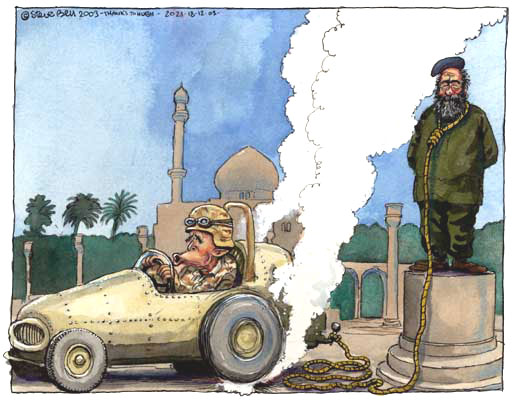 On his excellent ‘In the Axis’ blog (http://www.readingeagle.com/blog/syria/) Brian Anthony complains about the Sunni Arab world and international organisations protesting the execution of Saddam Hussain. Quite rightly, Brian objects to the tendency of many Sunnis to turn a blind eye to Saddam’s crimes. He also suggests that Sunnis may actively support repression of Shia in Iraq.
Saddam was certainly a murderous tyrant. He was helped to power by the CIA first in order to destroy the powerful Iraqi Communist Party, and then funded and armed by the US, Europe and the Gulf regimes to attack revolutionary Iran. He poisoned Iranian cities and Kurdish villages (Iraqi Kurdish militias were in alliance with Iran at the time) with gas. After falling into the American trap and invading Kuwait, he dealt with the 1991 intifada in the south and north of Iraq by annihilating whole clans and villages. This is when the sectarian horror really began to take a grip on Iraq. Tanks painted with the slogan ‘No Shia after Today’ moved into southern cities, and provided ample filling for mass graves. The aunt of one of my friends was driven insane when her sons were tortured to death by Saddam’s mukhabarat: just one story from very many. Saddam didn’t only build the worst secret police state in the Middle East, he actually organised rape squads, and special rape rooms, to destroy Iraqi women and Iraqi family honour. His victims number in the hundreds of thousands, and millions if you include the wars he started.
I still think it is legitimate to oppose his execution for a variety of reasons.
Updike’s Terrorist
John Updike, upon whom I would bestow grand titles such as, possibly, Greatest Living Writer in English (now that Bellow is dead), has written a topical novel called ‘Terrorist.’ The terrorist of the title is eighteen-year-old Ahmad Ashmawy Molloy, the confused and bitter American son of an Irish-American mother and absent Egyptian father.
Ahmad starts the novel as a schoolboy, and then is guided by a malign imam to give up his studies to become a truck driver (ignoring the more wholesome advice of guidance counsellor Jack Levy, a worldly, unbelieving Jew). Before long Ahmad drives his truck into a terrorist plot.
Updike, in his usual present tense, observes acutely and describes intensely. His beautifully rhythmed prose balances psychological analysis and social comment, the internal and the external. His digressions are eloquent and well-placed. Updike criticises in passing the black and white solutions of fundamentalist Christianity and the Black Muslims as well as al-Qa’ida style Islam, and diagnoses as the cause of these fundamentalisms the loss of direction and hollowness of a hedonist, consumerist society. Although Updike doesn’t speak directly. We find his position in the midpoint between his ironising distance from and sympathy for the perspectives of the characters through whom the narrative is focalised. His easy shifts between these perspectives is done professionally. There is a professional’s handling of detail too. For instance, Ahmad feels his beloved Excellency truck is a part of him, and responds badly to the ugly truck he will drive on the day of the ‘operation.’ It looks, like him, dispensable.
Gemayel Assassinated
Now here’s a tricky one. When Rafiq Hariri, the erstwhile ally of Syria but latterly a quiet but effective opponent, was assassinated by a huge car bombing in central Beirut on Valentine’s Day 2005, I was convinced that Syria was not the guilty party. I knew the regime could be brutal and stupid, but I didn’t think it could be quite that stupid. As expected, the assassination of Lebanon’s best-connected multimillionaire (and the man who, as prime minister, had rebuilt Beirut after the civil war and 1982 Israeli invasion) led to massive anti-Syrian protests in Beirut and the withdrawal of Syrian troops from the country.
There were also massive pro-Syrian demonstrations, called by Hizbullah, which were not covered in nearly as much loving detail by the Western media. But in any case, it was a good thing that Syria pulled out. Although the Syrian presence had been one of the factors preventing an Israeli-Phalangist takeover of Lebanon, and although Syria had contributed to ending the civil war and reconciling Lebanon’s warring factions, its clumsy militarism, corruption and police state interference naturally alienated many Lebanese, probably the majority. What was so damaging to both Syria and Lebanon was not that the withdrawal happened but that it happened like this, like a particularly bad-tempered divorce.
Another Massacre
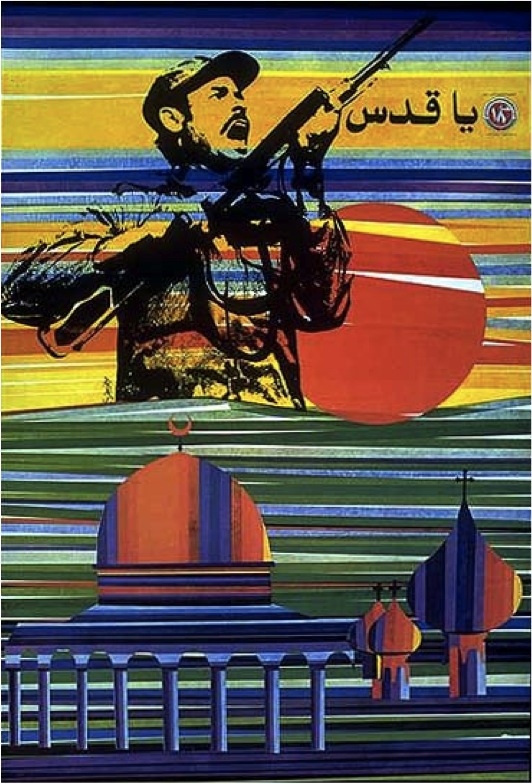 News is coming in that Israeli shells have killed 19 Palestinian civilians, most of them children, as they slept this morning, Wednesday 8th November. This follows a week-long attack on the Gaza town of Beit Hanun in which 60 Palestinians were killed. Many of those were civilians too, but most were young men carrying guns. I must say that I don’t consider young men fighting to liberate their land as equal to occupation troops, who seem to me to be fair military targets. All Beit Hanun men aged between 16 and 45 have been rounded up and taken off to join the Israeli gulag. There are already nearly 10,000 Palestinian prisoners (or hostages – that’s what the Western media would call them if they were Israelis) in Israeli jails.
This week a 700-year-old mosque was destroyed in Beit Hanun. Destruction of Palestinian heritage, of the environment, of sewage and irrigation systems, and of residential buildings, continues unabated. None of this is new to Gaza. Most of the population are refugees from the lands stolen in 1948, from the villages of central Palestine that were ethnically cleansed and bulldozed then. The Gazan refugee camps have witnessed sporadic massacres ever since.


 Qunfuz