Archive for the ‘book review’ Category
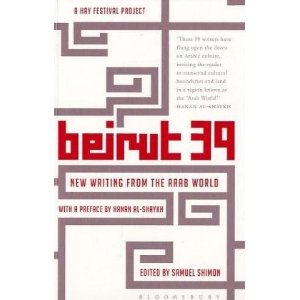
Beirut 39
 This was published at the Guardian.
The Arab world is undergoing seismic transformations, groping its way towards new, as yet unknown forms, throwing up works of art as well as bombs in the process. In the face of vast complexity, however, and in a time of war, our media’s first response is to dumb down.
If the news media simplifies, literature, by offering social and psychological context, broadens and diversifies our understanding of the region, and particularly literature written by Arabs. (When Martin Amis or John Updike write about Arabs, they are of course writing about themselves, their own ideas of how Arabs tick.) The reading public seems to know this. Recent years have seen an increasing demand for Arabic writing in English translation, though Europe still translates far more.
So the publication of “Beirut 39” – 39 extracts by Arab writers under 40 – is a timely and worthwhile initiative. The 39 are winners of a contest organised by Banipal magazine and the Hay Festival of Literature, and the book’s name honours UNESCO’s World Book Capital for 2009. “Beirut 39” contains short stories, novel extracts and a few poems, often brimming with exuberant confidence and sparkling with innovation. The quality of translation ranges from acceptable to excellent.
Myth and Memoricide: Shlomo Sand’s “Invention of the Jewish People”
Denise Buonanno's Le Juif Errant
This review essay was published at The Drouth.
A nation is “a group of persons united by a common error about their ancestry and a common dislike of their neighbours.” Karl Deutsch.
“I don’t think books can change the world, but when the world begins to change, it searches for different books.” Shlomo Sand.
Our Assumptions About Israel
Here is what we in the West, to a varying extent, whether we are religious or not, assume about the Jews and Israel:
The Jews of the world, white, black and brown, are the sons of Abraham, Isaac and Jacob. Moses, after leading the Jews out of Egyptian enslavement, gave them laws. Emerging from the desert, the Jews conquered the promised land of Canaan, which became Judea and Israel, later the mighty kingdom of David and Solomon. In 70CE the Romans destroyed the temple at Jerusalem and drove the Jews from their land. A surviving Jewish remnant was expelled when Muslim-Arab conquerors colonised the country in the 7th Century. And so the Jews wandered the earth, the very embodiment of homelessness. But throughout their long exile, against all odds, the Jews kept themselves a pure, unmixed race. Finally they returned, after the Holocaust, to Palestine, “a land without a people for a people without a land.”
This story has been told again and again in our culture. Today we find bits of it in Mark Twain and Leon Uris, in Hollywood’s output and in church pulpits, and of course in the mainstream news media. American Christian Zionists – devotees of the Scofield Bible – swear by it, and swear to support Israel with all the power of their voting block until the Risen Christ declares the apocalypse.
Clan, State, Islamic Polity
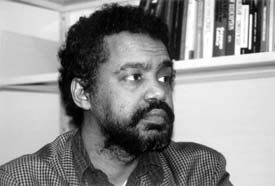
Abdelwahab el-Affendi
Could the root causes of the Arab-Muslim ‘malaise’ be cultural? That’s what journalist Brian Whitaker suggests in his book ‘What’s Really Wrong With the Middle East’. The thesis sounds suspicious, but Whitaker isn’t a cheap Orientalist, and he uses interviews with Arabs as his raw material. The key issues his informants keep pointing to are indeed the issues that, wherever you meet them, young Arabs complain about. These include an undue emphasis on submission and obedience in the education system, at work, and in the home, the social valorisation of conformity, and a corrupt public space.
The personal is the political. The problem in every sphere is one of overbearing authority, and it’s true that this is ultimately family-based, ultimately the result of overly-narrow personal identifications. In fact, I would argue that tribalism, nepotism, sectarianism, even forced marriage and honour killing, are all manifestations of the tyranny of the clan. And the tyranny of the clan is the result of bad governance.
The clan, repeats novelist Rafik Schami, “saved the Arabs from the desert, and at the same time enslaved them.” It saved them by providing economic and social solidarity, a sense of identity, and physical protection. This was necessary because over the years, for most of the time, there has been no safe field of activity other than the clan, no civic life free from the depredations of warlords, sultans and foreign colonialists. Society has had no choice but to turn inward. The traditional Arab town house is an architectural embodiment of the phenomenon. It looks shabby from the outside, just a door in a wall – this to deflect a pillager’s attention. Inside there’s a courtyard with a tree and a pool.
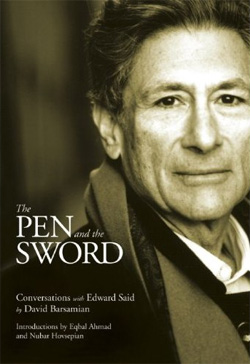
The Pen and the Sword
 This review was originally published in the indispensable Electronic Intifada.
Edward Said was one of the great public intellectuals of the twentieth century – prolific, polymathic, principled, and always concerned to link theory to practice. Perhaps by virtue of his Palestinian identity, he was never an ivory tower intellectual. He never feared dirtying his hands in the messy, unwritten history of the present moment. Neither was he ever a committed member of a particular camp. Rather he offered a discomfiting, provocative, constantly critical voice. And against the postmodern grain of contemporary academia, his perspective was consistently moral, consistently worried about justice.
Said was primarily a historian of ideas. More precisely, he was interested in ‘discourse’, the stories a society tells itself and by which it (mis)understands itself and others. His landmark book “Orientalism” examined the Western narrative of empire in the Islamic Middle East, as constructed by Flaubert and Renan, Bernard Lewis and CNN. Said’s multi-disciplinary approach, his treatment of poetry, news coverage and colonial administration documents as aspects of one cultural continuum, was hugely influential in academia, helping to spawn a host of ‘postcolonial’ studies. Said’s “Culture and Imperialism” expanded the focus to include Western depictions of India, Africa, the Caribbean and Latin America, and the literary and political ‘replies’ of the colonised.
The Madman of Freedom Square
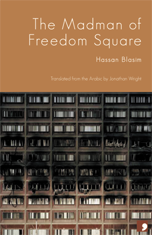 “I see no need to swear an oath in order for you to believe in the strangeness of this world.”
How can imagination respond to a situation like Iraq’s, in which truth is so blatantly stranger and more horrifying than the darkest fiction? Perhaps by simply recording real stories, then sometimes allowing reality to slip a little further in the direction it’s already chosen.
Hassan Blasim, film maker, refugee, and author of the astounding short-story collection “The Madman of Freedom Square,” has a more precise formulation:
“The important thing is to observe at length, like someone contemplating committing suicide from a balcony. The other important thing is to have an imagination which is not melodramatic but malicious and extremely serious, and to have an ascetic spirit that is close to death.”
Except this isn’t a formulation but a voice within a story. In another story there is a man who throws himself from a balcony – a man who clears blood and debris in the aftermath of explosions, then migrates to Holland, renames himself Carlos Fuentes, becomes a Hirsi Ali figure, more Dutch than the Dutch, and suffers nightmares. There’s a man who dreams a number which foretells not a lottery ticket but .. something else. I give away too much.
Blasim slips between first and third person narration, between realism and hyper-realism, fairytale and dream. Better than slip, he weaves, surefooted. The writing is tight, intelligent, urgent. It bears traces of Gogol and Edgar Allen Poe, plus ugly hints of the Brothers Grimm. It’s Gothic but it dispenses with the Gothic mode’s flagged sentiment. Too tough and wise for that.
There is symbolism. There are phantasmagoric tales of people-smuggling, of corpses displayed as public art, of cannibalism. But none of it is fantasy. All of it directly addresses the fate of people tortured by destruction and fire.
Zeitoun
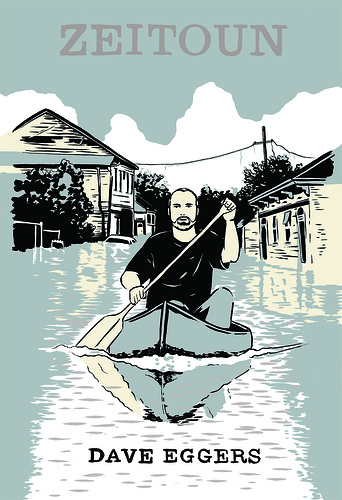
This review was published in the Independent.
Abdulrahman Zeitoun was born in Jebleh, on Syria’s Mediterranean coast. Decades later and thousand of miles away he awakes from dreaming of a fishing expedition out of his childhood home: “Beside him he could hear his wife Kathy breathing, her exhalations not unlike the shushing of water against the hull of a wooden boat.” As so often in Dave Eggers’s latest novel, the docudrama “Zeitoun”, a caught image opens a window on an ocean of memory and a state of mind.
Zeitoun now lives in New Orleans, where he runs a painting and building company and owns several buildings. He’s a dedicated businessman, father, husband, and Muslim. His painter’s van is emblazoned with a rainbow, which Zeitoun soon discovers has gay associations for Americans. But he doesn’t change it. “Anyone who had a problem with rainbows, he said, would surely have trouble with Islam.”
Kathy, practical and strong-willed, was brought up a Baptist in Baton Rouge. Attracted by “the doubt sown into the faith” and “the sense of dignity embodied by the Muslim women she knew,” she converted to Islam after her failed first marriage. Some years later she married the much older Zeitoun. Eggers describes their domestic bustle and warmth, and their personal irritations. For Zeitoun, these include his children’s wastefulness and obsession with pop music, and his alienation in a family of women. Kathy is bothered by Zeitoun’s stubbornness and her own family’s Islamophobic nagging.
A Struggler in Context
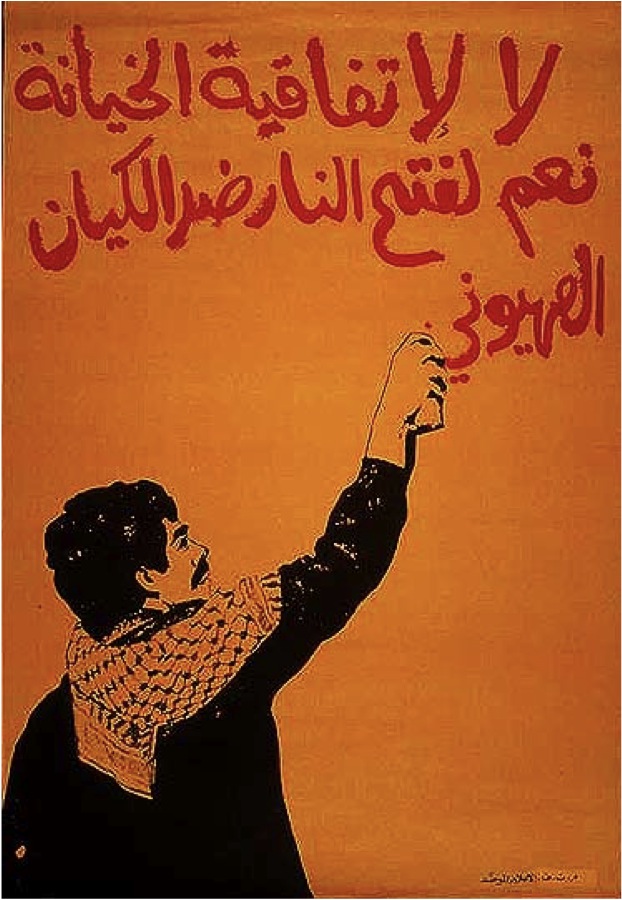 An edited version of this review appeared at the Electronic Intifada.
“From afar,” writes Ramzy Baroud (founder of the indispensable Palestine Chronicle), “Gaza’s reality, like that of all of Palestine, is often presented without cohesion, without proper context; accounts of real life in Gaza are marred with tired assumptions and misrepresentations that deprive the depicted humans of their names, identities and very dignity.”
Baroud’s “My Father was a Freedom Fighter” is an antidote to the media’s decontextualisation and dehumanisation of Palestinians. It’s also an instant classic, one of the very best books to have examined the Palestinian tragedy.
As the title suggests, Baroud relates the life of his father, Mohammed Baroud. Each step in the story is located in a larger familial, social, economic and political context, one distinguished by eyewitness accounts and made concrete by an almost encyclopedic wealth of detail. But neither the book’s detail nor its deep reflection conflict with its compulsive readability. It’s quite an achievement.
The Unnamed
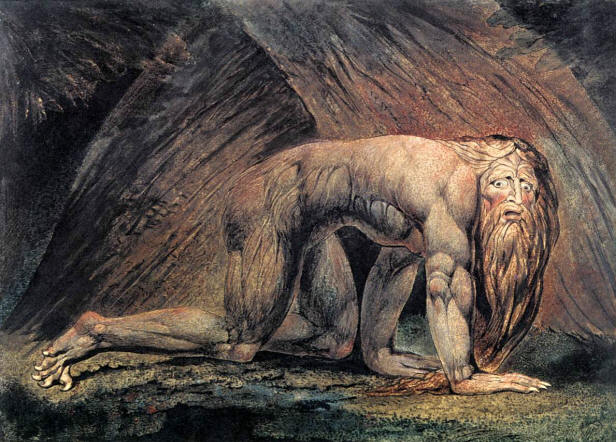
Blake's Nebuchadnezzar
An edited version of this review appeared in the New Statesman.
When death is distant and life is taken for granted our culture forgets God – meaning the God problem – and focuses on bitching instead. This was the focus of Joshua Ferris’s first novel “Then We Came to the End”, an office comedy asking what ultimately is valuable in our bureaucratised existence.
Now Ferris’s eagerly-awaited second novel “The Unnamed” imagines a man forced from a world in which even soap emanates complacency into death’s proximity, where nothing can be taken for granted. God bares his teeth.
Philosopher John Gray describes an experiment which shows, “the electrical impulse that initiates action occurs half a second before we take the conscious decision to act.” The ramifications for our assumptions of agency are unsettling, to say the least. Reading “The Unnamed” is a companion experience.
The Spinning Wheel
 This review was written for the Palestine Chronicle.
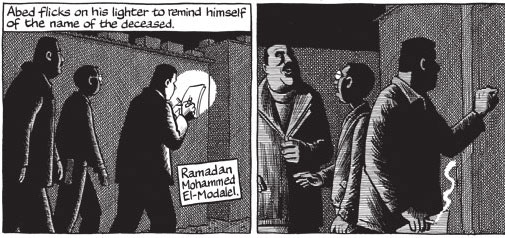
This is not what you expect: an accomplished and self-reflective work of history enclosed within a layer of war reportage – in comic book form. But Joe Sacco’s “Footnotes in Gaza” is just that, an unusually effective treatment of Palestinian history which may appeal to people who would never read a ‘normal book’ on the subject. The writing, however, is at least as good as you’d expect from a high quality prose work. Here, for instance, is page nine: “History can do without its footnotes. Footnotes are inessential at best; at worst they trip up the greater narrative. From time to time, as bolder, more streamlined editions appear, history shakes off some footnotes altogether. And you can see why… History has its hands full. It can’t help producing pages by the hour, by the minute. History chokes on fresh episodes and swallows whatever old ones it can.”
The pictures – aerial shots, action shots, urban still lifes, crafted but realist character studies – work as hard as the words. Sacco depicts fear, humiliation and anger very well indeed, and often achieves far more with one picture than he could in an entire newspaper column. The cranes at work on a Jerusalem skyline are worth a paragraph or two of background. So is the fact that almost every Palestinian male has a cigarette in his mouth. And when dealing with historical process – the changing shape of the camps, for example – the pictures are more than useful.
Mornings in Jenin
 This review was published in today’s Times.
According to the Zionist story, Palestine before the state of Israel was ‘a land without a people awaiting a people without a land.’ Writers from Mark Twain to Leon Uris, as well as Hollywood studios and certain church pulpits, retell the tale. But Palestinians, in the West at least, lack a popular counter-narrative. Palestinians are reported on, met only on the news.
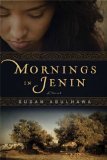
Perhaps this is changing. As the land disappears from under their feet Palestinians have been investing in culture, and an explosion of Palestinian talent is becoming visible in the West, in films, hip-hop, poetry and novels. And now Susan Abulhawa’s “Mornings in Jenin” is the first English language novel to fully express the human dimension of the Palestinian tragedy.
The story begins with the Abulheja family at home in the village of Ein Hod near Haifa, marrying, squabbling, trading, and harvesting the olives. It’s a touching and sometimes funny portrait of rural life with hints of the city (notably the Jerusalem-based Perlsteins, refugees from German anti-Semitism) and the Beduin tribes.
Then comes the Nakba, or Catastrophe, of 1948. Driven from their shelled village, the family suffers loss, separation, and humiliation, ending up in a camp in Jenin where “the refugees rose from their agitation to the realisation that they were slowly being erased from the world.” By now we care very much about the key characters, and through them we experience “that year without end”, the interminably drawn out Nakba which stretches through some of the bloodier signposts of Palestinian history – the Naksa or Disaster of 1967, the Lebanese refugee camp massacres, until the 2002 Jenin massacre.
Five Books on Syria; Batatu on the Peasants
Inspired by the Browser interview concerning my five favourite books on Israel-Palestine, I’ve come up with a list of five on Syria. These are all books available in English, so my selection is inevitably skewed. I’ll name them, then talk at length about the first on the list, the Batatu book.
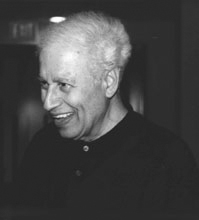
Hanna Batatu
1. Hanna Batatu. “Syria’s Peasantry, the Descendants of its Lesser Rural Notables, and Their Politics.”
2. Patrick Seale. “Asad: The Struggle for the Middle East.”
As essential for understanding power machinations in the US, the USSR, Palestine, Israel and Lebanon as in Syria, this is a biography of Syria’s ruthless, inscrutable, masterful dictator, Hafez al-Asad. Nation builder or gangster, as you will, but surely the most important Syrian of the 20th century.
3. Samuel Lyde. “The Asian Mystery Illustrated in the History, Religion, and Present State of the Ansaireeh or Nusairis of Syria.”
“Israeli Apartheid – A Beginner’s Guide”
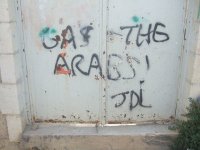
settler graffitti in Hebron/al-Khalil
That there are striking parallels between white rule in apartheid South Africa and Zionist rule in Palestine – an analogy made by such mainstream figures as President Jimmy Carter and Archbishop Desmond Tutu – should no longer be controversial. But calling Israeli apartheid by its name will occasion the usual screams of anti-Semitism and ignorance from Zionist quarters, and for comprehensible reasons: the most politically inept American student knows that apartheid is a bad thing, a crime to be battled, not supported with weapons, vetoes in the Security Council and billions of dollars in ‘aid.’ Therefore the apartheid label must be vigorously resisted by Zionists and their fellow travellers.
Ben White’s “Israeli Apartheid – A Beginner’s Guide” begins by quoting Article II of the International Convention on the Suppression and Punishment of the Crime of Apartheid, UN General Assembly Resolution 3068, which defines the crime as “inhuman acts committed for the purpose of establishing and maintaining domination by one racial group of persons over any other racial group of persons and systematically oppressing them.” The rest of White’s book leaves the reader in no doubt that the Zionist instance of apartheid fits the bill even better than the erstwhile South African version.
A Map of Home
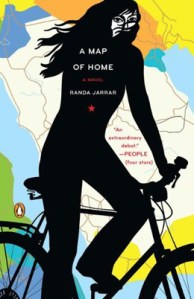 This review was published on the Electronic Intifada.
Randa Jarrar’s “A Map of Home” is a beautifully achieved coming of age novel which follows a clever girl through a war, a domestic battlefield, and repeated forced migrations. For our heroine, these events are aspects of the normal everyday stuff (because everything’s normal when it happens to you), like school, friends, family, and shopping. Despite the geographical and cultural particularities of the story, the themes – of awakening sexually, of learning how to love a parent yet firmly say no, and of struggling for independence and a place in the world – are universal, and the book will appeal to all but the most easily shocked readers.
At the novel’s centre is a family. The father, Waheed, is a Palestinian from Jenin exiled to a string of temporary residences. Resentful of his failure to develop a career as a poet, he projects his ambition onto his daughter, about whom Waheed is convincingly self-conflicted: he wants her to be a famous professor, but doesn’t want her to study away from home.
The Crisis of Islamic Civilisation
A slightly different version of this review was written for Prospect Magazine, where it was available free-of-charge for a while, but no longer.
The contemporary religious revival is a complex business. In the same period that Muslim societies, in their weakness, seem to have re-embraced Islam, America, in its strength, has re-embraced Christianity. Western Europe remains avowedly secular. Despite the contradictions within the West, mainstream Orientalism holds that all cultures are developing towards the universal (or, more specifically, globalised) model of secular modernity and the market. The Muslim world experiences backwardness to the extent that it resists secularisation.
“The Crisis of Islamic Civilisation”, a subtle and erudite book by former Iraqi minister Ali A Allawi, challenges this thesis. Surveying the Muslims’ social, economic and moral failures, and the terror espoused by certain Islamist groups, Allawi suggests the problem might not be too much Islam, but too little.
Syria’s Tolstoy
A book review for the Guardian:
 Syria, more than most, is a land of stories and storytellers. The farmers and shopkeepers describe early Islamic battles or episodes from the Crusades as if they’d attended in person. A gathering of friends is quickly elevated into group performance of jokes, laments, myths, and conspiracies. Even the Syrians’ surnames suggest stories: there are families called The-Milk’s-Boiled, Sip-The-Yoghurt, and Undone-Belt. “The deeper you swim into our stories,” a village rhetorician once told me, “the more you understand that they have no floor.”
Yet Syria is better known for its poets, and its TV dramas, than for its novelists. Egypt, with its unending metropolis, is the home of the Arabic novel, and Egypt produced the Arabs’ master of fiction, Naguib Mahfouz. But a flame equally bright now burns from Damascus, via Germany. Here is the Great Syrian Novel, and its author Rafik Schami.
In “The Dark Side of Love” Schami exploits all the resources of the classic realist novel and then goes a little further, forging a new form out of Syrian orality. His basic unit is not chapter or paragraph, but story; a thousand bejewelled anecdotes and tales are buried here, ready to spring, but each is sculpted with such dazzling surety into the whole that reading the book is always compulsive. In its final, self-exposing passage, Schami compares his method to mosaic work, in which every shiny object is a beauty of itself, yet which in combination, at a distance, reveal a still greater beauty. The novel is even Tolstoyan in its marrying of the personal, social and political spheres, of private with national life.


 Qunfuz