Archive for the ‘Syria’ Category
Syrian Democracy
 An edited version of this piece was published at the National.
You may think Syrians are condemned to an unpleasant binary choice, between Assad – a mass-murdering dictator who at least shaves – and the jihadist with the beard, the dripping knife, the global agenda. Which perhaps makes Assad the lesser evil. Yet the real choice being fought out by Syrians isn’t between the dictator and the jihadists (the two feed each other), but between various forms of violent authoritarianism on the one hand, and grassroots democracy on the other. The democrats deserve our support.
Interviewing activists, fighters and refugees for our book “Burning Country: Syrians in Revolution and War”, we discovered the democratic option is very real, if terribly beleaguered. To the extent that life continues in the ‘liberated’ but brutally bombed areas – areas independent of both Assad and ISIS – it continues because self-organised local councils are supplying services and aid.
For example, Daraya, a suburb west of Damascus now suffering its fourth year under starvation siege, is run by a council. Its 120 members select executives by vote every six months. The council head is chosen by public election. The council runs primary schools, a field hospital, a public kitchen, and manages urban agricultural production. Its military office supervises the Free Syrian Army militias defending the town.
Two Assassinations and a Brexit
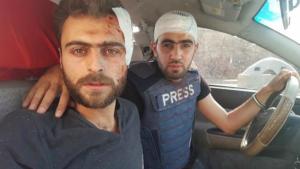
Khaled al-Issa (left) and Hadi Abdulllah, after the air raid, before the controlled explosion
This was published at al-araby al-Jadeed/ The New Arab.
On June 16th Jo Cox, a proponent of EU membership, a compassionate supporter of refugees, and the most articulate voice for revolutionary Syria in the British parliament, was shot, stabbed and kicked by a middle-aged man screaming “Britain First!”
On the same day Syrian citizen journalists Khaled al-Issa and Hadi Abdullah, 48 hours after surviving an air raid, were severely injured in an assassination attempt by controlled explosion.
Jo died in hospital shortly after she was attacked. In a different world, the kind she fought for, she would have been an honoured guest in free Syria. Khaled al-Issa died of his wounds on June 24th. Having survived Assad and ISIS-inspired brushes with death, it was probably Jabhat al-Nusra, Syria’s al-Qaida affiliate, that got him in the end. In a different world Khaled would be reporting on the achievements of post-dictatorship Syria. In this world, however, the very best are being murdered. The very worst are growing in power.
East and west, violent and nativist authoritarianism is on the rise. The British media focused on characterisations of Jo’s murderer, Thomas Mair, as a troubled loner rather than as a terrorist. Had he screamed ‘Allahu Akbar’ rather than ‘Britain First’ as he stabbed and shot, the emphasis would certainly have been different.
Burning Country on the Catskill Review
I was interviewed by the Catskill Review of Books on the Syrian revolution, the war, the roles of outsiders, and media (mis)representations of events.
You can listen to it here.
Syrian Dust: An Overview of Books
 This review of books on Syria, mainly of Francesca Borri’s ‘Syrian Dust’, was published at the National.
“…if you only talk about those who are fighting, any revolution becomes a war.” – Francesca Borri
For a long time very little was published on Syria in English. Patrick Seale’s useful but hagiographic “Assad: the Struggle for Syria” was the best known. Hanna Batatu’s classic “Syria’s Peasantry and their Politics” and Raymond Hinnebusch’s “Revolution from Above” were valuable academic studies of the Hafez-era state.
Over the last five years of revolution and war, several shelf loads of books have appeared. Many are sensationalist, cashing in on the latest terrorism scare. But several are of very high standard. Bente Scheller’s “The Wisdom of Syria’s Waiting Game”, for instance, is an excellent analysis of Assadist pre-revolution foreign policy. Thomas Pierret’s “Religion and State in Syria” is an indispensable resource on the social roles of the Islamic scholars in the same period.
Novelist Samar Yazbek’s “Woman in the Crossfire: Diaries of the Syrian Revolution” is the best account of the revolution’s early months, though “Revolt in Syria” by Stephen Starr, an Irish journalist then resident in Damascus, comes close. Jonathan Littell, author of the remarkable WW2 novel “The Kindly Ones” wrote “Syrian Notebooks” after spending two weeks of 2012 in besieged Homs. Marwa al-Sabouni’s well-received “The Battle for Home” gives a Syrian architect’s perspective on the destruction (and potential rebuilding) of the city.
The Morning They Came For Us
 This review was published at the Guardian.
Reading “The Morning They Came For Us” by veteran war correspondent Janine di Giovanni is at once necessary, difficult, and elating. Giovanni’s reporting from the Syrian revolution and war is clear-eyed and engaged in the best possible sense – engaged in the human realm rather than the abstractly political.
Remembering previous wars too, her account is first-person and deeply personal. She’d once been obsessed with Bosnian crimes; in the introduction we hear warning that Syria may “engulf her”. Giovanni finds herself unable to trim her baby son’s nails for thinking of an Iraqi who’d had his ripped out. Later, accepting a cigarette pack from a student of human rights, she notes the old cigarette burns on his arms.
Her Syrian visits fell between March and December 2012. The first told, from the summer, finds an uneasy silence in central Damascus even as the suburbs burn. Class in this society is a more significant divider than religion, and the bi-national elite are spinning conspiracy theories, sunk into pool parties and denial. In these “last days of a spoilt empire that was about to implode” Giovanni delineates the different kinds of regime ‘believer’: true devotees, or those simply scared of the potential alternatives. 300 frustrated UN monitors are confined to their hotel, and war is “descending with stunning velocity”.
The book thereafter recounts the ramifications on Syrian civilians of Assad’s various scorched earth strategies. An estimated 200,000 people have disappeared into the regime gulag. Most have experienced torture. “I struggle to remember a place where torture has been so widespread and systematic,” a Human Rights Watch official tells Giovanni, who sets about particularising, humanising, some of these lost stories through interview, tales of beatings, burnings, cuttings perpetrated to the torturer’s usual refrain: “You want freedom? Is this the freedom you want?”
Burning Country on Your Call
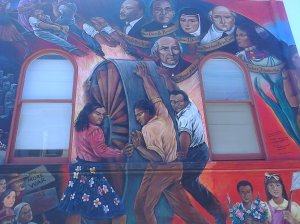 Rose Aguilar interviewed Leila al-Shami and I for ‘Your Call’ on San Francisco radio . We talked about our book, and dealt with a doubting caller. We did the interview from a Chicago studio, but later we visited the beautiful Bay Area. The picture is one of the many Mexican-style murals in the Outer Mission.
Listen to the interview here.
Committees, Councils and Cultural Production
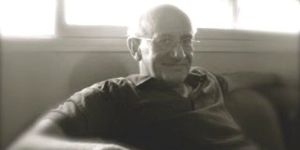
Omar Aziz
In this presentation on Syria – in green Seattle’s public library – Leila talks about Razan Zeitouneh, founder of the Local Coordination Committees, and Omar Aziz, the anarchist who first thought of building local councils. And I talk about the revolution’s cultural and media achievements. Interesting questions from the audience afterwards.
On the Brian Lehrer Show
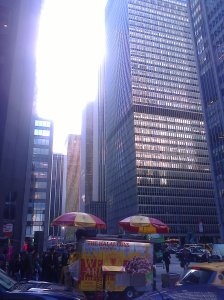 In New York (what an astounding city), Leila and I were interviewed by Brian Lehrer for his show on WNYC. We talked about Syria’s failing ceasefire, the illusory Damascus Spring, Assad’s collaboration with George W Bush, the history of the Baath, and Obama’s deals with Iran and Russia. A couple of listeners called in with questions – one about the sectarian element.
You can listen to the interview here.
Burning Country at the Middle East Institute
Someone in New York sneered and said Washington was a sterile city, but I liked DC a lot during our two-day visit. The centre is full of people from everywhere, lobbying, plotting and misgoverning. The rest of the city has a mainly black population. We stayed with wonderful people, ate good food, and the sun was shining, the trees in bloom. I met my niece, lots of lovely Syrians, and some great Arab thinkers at the Tahrir Institute, most notably Hassan Hassan. The Museum of the American Indian is worth a visit too.
At the Middle East Institute our talk was chaired by the great scholar Charles Lister, author of the indispensable book The Syrian Jihad. Here Leila talks about the aspects of the Syrian revolution rendered invisible by Western commentary, and I talk about what’s stopping us seeing: ideological assumptions, and the fact of war. Q and A afterwards.
Hell, Chicago
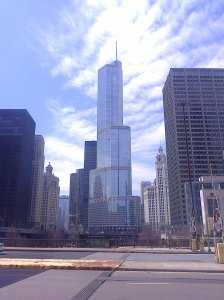 Leila and I were interviewed by phone (we were in Los Angeles) by Chuck Mertz of This is Hell radio, a Chicago-based station. We talked about the Syrian revolution. Because the radio station is in Chicago, and because its name incorporates Hell, here’s a picture of the Trump Tower, or one of them, also in Chicago.
AntidoteZine has published a transcript alongside the audio, here.
Talking About Syria in Chicago
On a pier poking into the icy turquoise of Lake Michigan, looking back at Chicago’s brutal towers, Leila and I were interviewed on Syria by Jerome McDonnell, an engaging host, for WBEZ’s Worldview. We talked about Razan Zaitouneh, revolutionary councils, imperialist intervention, American policy, Islamism, Robert Fisk, and the farmers and dentists who make history. Jerome McDonnell hosted us again that evening at Chicago University’s International House.
With Ian Masters in LA
 On our last morning in sunny, science fiction Los Angeles, Leila and I were interviewed by Ian Masters for his Background Briefing programme on KPFK FM. In the balmy, car-corrupted Californian air we talked about scorched earth, imperialist alignement, and democracy in Syria.
Listen to it here. We come in at about 35 minutes.
On Boston’s Radio Opensource
This was a strange experience. We were told in a long pre-interview that the actual interview would be just us (Leila and I), and would be focused on civil society in Syria. On the day, however, they brought in LRB-contributor Hugh Roberts and American commentator Jeffrey Sachs, so the conversation became enwebbed in a US-centric alternate reality. The host is Chris Lydon. Listen to it here.
How Did Syria Become a Burning Country?
It was good to spend an evening with Ashley Smith in Burlington, Vermont, in the flesh, weeks after he’d interviewed me on skype for Socialist Worker, the US version, thus:
In 2011, the Syrian people joined their sisters and brothers throughout the Middle East in a popular revolution for liberation from dictatorship. They aimed to establish democracy and equality. The regime of Bashar al-Assad responded by bombing its own people and dividing them along ethnic and sectarian lines.
But Assad’s rule-or-ruin tactics could not stop the revolt. It took air strikes and an invasion by Russia, Iran and their allies to shore up the regime in the run-up to current cessation of hostilities and so-called peace talks in Geneva. Robin Yassin-Kassab, the co-author with Leila Al-Shami of Burning Country: Syria in Revolution and War, talked with about the results and prospects of the Syrian struggle. Yassin-Kassab and Al-Shami will be appearing across North America in April on a tour to promote their book.
DURING THE recent cease-fire, Syrian revolutionaries returned to the streets in popular protests. What is the significance of this?
FIRST, I would like to quibble a little bit with the terminology “ceasefire.” What they’ve officially called it is a “cessation of hostilities,” which excludes the Islamic State in Iraq and Syria (ISIS) and al-Qaeda’s Jabhat al-Nusra. So Russia and Assad’s state have actually continued bombing ISIS-controlled territory. And they have used that as a cover to bomb opposition-held territory. For example, they have repeatedly attacked Duma, outside of Damascus, where there’s no presence of either al-Nusra or ISIS.
So it is at best only a partial cessation, in which the average daily death toll has gone down from about 120 a day, as it was a few weeks ago, to about 40 a day now. That’s still awful, but it’s a great improvement.
Syrian revolutionaries have taken advantage of this situation to return to the streets in protest on each Friday since the cessation of hostilities. They are waving the revolutionary flag, not the black flags of various Islamist organizations, and repeating the same chants that we heard in 2011. They are chanting, “The Syrian people are one,” and again demanding freedom and democracy.
So the original urge for liberation that we saw in 2011 is still alive, despite the fact that almost half a million people have been killed, that half the country is now homeless, and that every city in the country except one has been bombed. This is quite inspiring and amazing.
Wayne, New Jersey
Five weeks traveling and talking through the enormous diversity of North America (some of it at least). This was near the start, at William Paterson University, in Wayne, New Jersey. A great pleasure to spend time with Samer Abboud, author of a fine book on Syria, and even more time with Steve Shalom, of long repute, he and his wife our generous hosts.
Watch the video of the event here.


 Qunfuz