Archive for the ‘Syria’ Category
Canadian Radio
I was interviewed on ten different CBC radio programmes this morning (because Canada’s a big place). I was speaking about Syria, more specifically the eastern Ghouta, the ‘ceasefire’ theatre, uncontrolled escalation, and appeasement.
This is one of the interviews. I come in at 2:19:49.
Thanks to Dick Gregory’s obsessive thoroughness, you can also read a transcript of my words at his useful site, News of the Revolution in Syria. (Continuing the run of obsessive thoroughness, someone else – or was it a machine? – has translated Dick’s transcription into Spanish, here.)
The Ghouta Slaughter and Arab Responsibility
This article was first published at the New Arab.
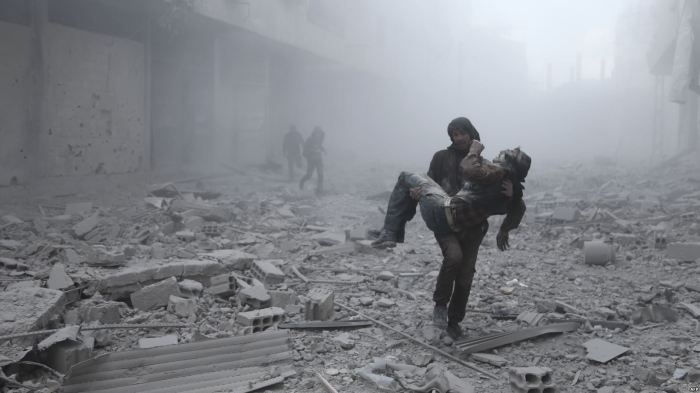 In 2011, people in the eastern Ghouta (and throughout Syria) protested for freedom, dignity and social justice. The Assad regime replied with gunfire, mass arrests, torture and rape. The people formed self-defence militias in response. Then the regime escalated harder, deploying artillery and warplanes against densely-packed neighbourhoods. In August 2013 it choked over a thousand people to death with sarin gas. Since then the area has been besieged so tightly that infants and the elderly die of malnutrition.
Seven years into this process – first counter-revolutionary and now exterminatory – the Ghouta has tumbled to the lowest pit of hell. This didn’t have to happen. Nor was it an accident. Local, regional and global powers created the tragedy, by their acts and their failures to act. And Arab and international public opinion has contributed, by its apathy and relative silence.
Blame must be apportioned first to the regime, and next to its imperialist sponsors. Russia shares the skies with Assad’s bombers, and is an equal partner in war crime after war crime, targeting schools, hospitals, first responders and residential blocks.
Then Iran, which kept Assad afloat by providing both a financial lifeline and a killing machine. Iran’s transnational militias provided 80% of Assad’s troops around Aleppo, and some surround the Ghouta today. Their participation in the strategic cleansing of rebellious (and overwhelmingly Sunni) populations helped boost a Sunni jihadist backlash and will continue to provoke sectarian conflict in the future.
But the blame stretches further. American condemnations of the current slaughter, for instance, ring very hollow in Syrian ears. The Obama administration, focused on achieving a nuclear deal with Iran, ignored Iran’s build-up in Syria. It also ensured the Free Syrian Army was starved of the weapons needed to defend liberated zones. And by signalling his disengagement after the 2013 sarin atrocity, Obama indirectly but clearly invited greater Russian intervention. Since the rise of ISIS, the United States has focused myopically on its ‘war on terror’, bombing terrorists – demolishing cities and killing civilians in the process – but never deploying its vast military might in a concerted manner to protect civilians. Objectively, despite the rhetoric, the US has collaborated with Russia and Iran.
French President Emmanuel Macron, meanwhile, called for a humanitarian truce to allow civilians to evacuate. This sounds humane, and if the fall of Aleppo is any guide, it’s probably the best scenario Ghouta residents can expect. But the proposal’s lack of ambition illustrates the current dysfunction of the global system. Instead of acting to stop the slaughter and siege, European statesmen support mass population expulsion, requesting only that it be done as gently as possible.
Syria’s Opposition Should Support Kurdish Autonomy
This was published first at The New Arab.
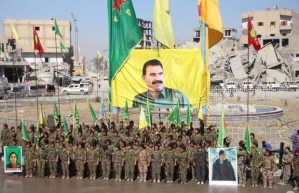
‘There is no life without the leader’. PYD militants raise Abdullah Ocalan’s picture in Raqqa
The Kurdistan Workers’ Party, or PKK, is a Marxist-Leninist turned authoritarian-anarchist (yes, that is an oxymoron) Kurdish separatist party-militia at intermittent war with the Turkish state. The Democratic Union Party, or PYD, is a PKK-offshoot set up while Abdullah Ocalan was hosted in Syria by Hafez al-Assad. Given its focus on the war against Turkey rather than civil rights in Syria, the PYD was usually tolerated by the regime.
As the revolution began liberating territory in 2012, Assad forces withdrew from Kurdish-majority areas without a fight, handing them over to PYD control. Thereafter the PYD monopolised arms and aid money, repressed opposition parties, and shot at protestors.
At the same time, it won an undoubted national victory for the Kurds. After decades of enforced ‘Arabism’, locals finally policed their own neighbourhoods and children were taught in their mother tongue. Through the commune system, the PYD also promoted a measure of local democracy. The allocation of 40% of commune seats to women is evidence of the party’s impressive commitment to gender equality.
As well as the PYD’s avowed secularism, the fact that its territories were not subjected to Assad’s scorched earth inoculated them against penetration by transnational jihadists. The PYD’s political innovations, meanwhile, won the admiration of many leftists and anarchists in the west. Sadly this support was often uncritical, and generally ignored similar democratic self-organisation experiments in the liberated but heavily bombed territories beyond PYD rule.
At first, the PYD governed Syria’s three Kurdish-majority areas, that is the Afrin, Kobani and Jazira cantons. These areas (collectively called Rojava, or Western Kurdistan) are non-contiguous. Kurdish autonomy could work there, but not statehood.
The PYD, however, was able to take advantage of both Russia’s war on the rebels and the American-led coalition’s war against ISIS to join up and expand its territory. In February 2016, in alliance with Russia, the PYD captured Tel Rifaat, Menagh, and surrounding areas close to Afrin. These Arab-majority towns were governed by civilian local councils and defended by non-jihadist rebels. Both people and rebels were driven out by Russian air power (Russian bombs destroyed all three of Tel Rifaat’s health centres during the assault) accompanied by the PYD’s troops on the ground. Next, in July 2016, the PYD captured the Castello Road leading into Aleppo, assisting the Assad regime’s siege on the city and eventually its fall (in December) to Assad’s Iranian-backed militias.
The Common Enemy
This was first published at (the highly recommended) AlJumhuriya.
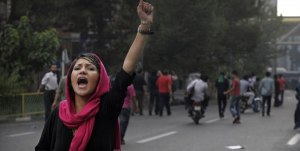 Do revolutions move in circles? The uprisings which shook the Arab world in 2010 and 2011 were in some ways prefigured by Iran’s Green Movement protests of 2009. The years since have been so dominated by counter-revolution and war that many have despaired of forward movement. Yet one year after Iranian proxies crushed the revolution in Syria’s Aleppo, sparks of revolution are flying in Tehran.
These protests differ from those of 2009 in several important respects. The Green Movement was centred in Tehran, it was largely middle class, and it supported the reformist wing of the Islamic Republic against more authoritarian conservatives. The current protests, in contrast, are fiercest in the provinces, are largely working class, and often express rejection of the Islamic Republic itself.
It remains to be seen how far this angrier, more radical opposition movement will undermine or transform Iranian governance. On the one hand, its working-class character cuts at the heart of the regime’s legitimacy. The mustadafin or ‘downtrodden’ are supposed to be the base and prime beneficiaries of the Khomeinist wilayet al-faqih system, and yet they are chanting for the death of the Supreme Leader. On the other hand, this same subaltern fury may play into regime hands by scaring the middle classes. There is, after all, the Syrian example to point to, an image to strike fear into the hearts of rebellious people everywhere. If a regime is pushed too far, look, the result is war, terrorism, social collapse and mass exile.
The Syrian example deployed as a threat may save Iran’s regime. The tragic irony here, of course, is that the Iranian regime has played a crucial role in creating the Syrian example. It is indeed to a large extent responsible for the disaster.
Burning Country in the Guardian
It’s great to find our book selected as one of the best on Syria (in Pushpinder Khaneka’s World Library, here) alongside a couple of contemporary classic novels, In Praise of Hatred and The Dark Side of Love. An excerpt from my introduction to Khaled Khalifa’s In Praise of Hatred is here, and my review of Rafik Schami’s The Dark Side of Love is here.
A Syrianized World
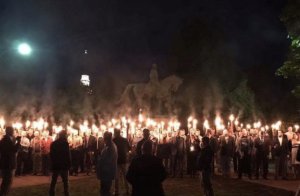 Alongside the chants of ‘Blood and Soil’, ‘You Will Not Replace Us’, ‘White Lives Matter’ and ‘Fuck You Faggots’, some of the privileged fascists rallying at Charlottesville, Virginia gave their opinions on the Syrian issue. “Support the Syrian Arab Army,” they said. “Fight the globalists. Assad did nothing wrong. Replacing Qaddafi was a fucking mistake.”
It’s worth noting that these talking points – support for Assad and the conspiracy theories which absolve him of blame for mass murder and ethnic cleansing, the Islamophobia which underpins these theories, the notion that ‘globalists’ staged the Arab Revolutions, and the idea that the Libyan revolution was entirely a foreign plot – are shared to some extent or other by most of what remains of the left.
In 2011 I expected that Syria’s predominantly working-class uprising against a sadistic regime that is both neo-liberal and fascist would receive the staunch support of leftists around the world. I was wrong. Britain’s Stop the War coalition marched furiously when it seemed America might bomb the regime’s military assets, but ignored America’s bombing of Jihadist groups and Syrian civilians, as well as Assad’s conventional and chemical attacks on defenceless people, and Russian and Iranian war crimes. Key figures in Jeremy Corbyn’s Labour Party followed the StW line. Diane Abbott called the police when Syrians attempted to speak at a StW event. During the final assault on liberated Aleppo last winter, Emily Thornberry suggested to Channel 4 News that Assad protected Christians, that the problem would be solved if ‘jihadists’ left, and that the Assadist occupation of Homs was an example to be emulated – never mind that liberated Aleppo contained democratic councils, that its revolutionaries included people of all religions and sects, or that 80% of Assad’s troops in that battle were foreign Shia jihadists organised by Iran – nor that the vast majority of Homs’s people remain in refugee camps, too terrified to return. John McDonnell gave a speech in Trafalgar Square on May Day under a Stalinist flag and the Baathist flag – that’s the flag of a previous genocide and the flag of a genocide still continuing. It wasn’t him who put the flags up, but he didn’t ask for them to be taken down.
In 2011 I should have known better. Leftists had long made excuses for the Soviet occupation of eastern Europe and the genocidal occupation of Afghanistan. Noam Chomsky, to pick one, made excuses for Pol Pot and Milosevic (today, of course, he rehearses the conspiracy theories which claim Assad’s innocence of sarin gas attacks, and channels like Democracy Now repeatedly offer him and others a platform to do so).
We Crossed A Bridge and it Trembled
This review first appeared at the Guardian. (I would recommend my and Leila’s book Burning Country as the best social, political, historical and cultural contextualiser of the Syrian Revolution, and Yassin al-Haj Saleh’s The Impossible Revolution as the best analysis – and one of the best political books you’ll ever read about any topic – but I would certainly recommend this remarkable book for its method. The entire story is told through the voices of Syrians themselves.)
 Everyone talks about Syrians, but very few are actually talk to them. Perhaps that’s why Syria’s revolution and war have been so badly misunderstood in the West – variously as a US-led regime-change plot, or an ancient Sunni-Shia conflict, or a struggle between secularism and Jihadism.
“We Crossed a Bridge and It Trembled” bucks the trend. Here the story is told entirely through the mouths of Wendy Pearlman’s Syrian interviewees, hundreds of them, from all social backgrounds, Christians and Muslims, Ismailis and Druze, rural and urban, middle-class and poor. These best of all possible informants – the people who made the events, and who suffer the consequences – provide not only gripping eyewitness accounts but erudite analysis and sober reflection.
The introduction, alongside a concise overview of developments from 1970 to the present, describes Pearlman’s method. She interviewed refugees (who are therefore overwhelmingly anti-regime) in locations stretching from Jordan to Germany. And she interviewed in Arabic, enabling “a connection that would have been impossible had I relied on an interpreter.” The result is testament both to Syrian expressive powers and the translation’s high literary standard.
These heart-stopping tales of torment and triumph are perfectly enchained, chronologically and thematically, to reflect the course of the crisis. They begin with life under Hafez al-Assad’s regime, “not a government but a mafia”, when children were trained to lie for their families’ security. “It was a state of terror,” says Ilyas, a dentist. “Every citizen was terrified. The regime was also terrified.”
‘Sectarianization’
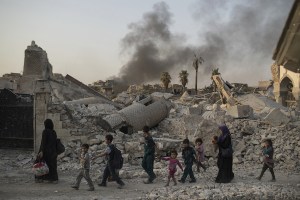
The remains of the Nuri mosque amidst the remains of the ancient city of Mosul, Iraq. photo by Felipe Dana/ AP
An edited version of this article was published in Newsweek.
In his January 20 Inaugural Address, President Trump promised to “unite the civilised world against radical Islamic terrorism which we will eradicate completely from the face of the earth.”
To be fair, he’s only had six months, but already the project is proving a little more complicated than hoped. First, ISIS has been putting up a surprisingly hard fight against its myriad enemies (some of whom are also radical Islamic terrorists). The battle for Mosul, Iraq’s third-largest city, is almost concluded, but at enormous cost to Mosul’s civilians and the Iraqi army. Second, and more importantly, there is no agreement as to what will follow ISIS, particularly in eastern Syria. Here a new Great Game for post-ISIS control is being played out with increasing violence between the United States and Iran. Russia and a Kurdish-led militia are also key actors. If Iran and Russia win out (and at this point they are far more committed than the US), President Bashar al-Assad, whose repression and scorched earth paved the way for the ISIS takeover in the first place, may in the end be handed back the territories he lost, now burnt and depopulated. The Syrian people, who rose in democratic revolution six years ago, are not being consulted.
The battle to drive ISIS from Raqqa – its Syrian stronghold – is underway. The Syrian Democratic Forces (SDF), supported by American advisors, are leading the fight. Civilians, as ever, are paying the price. UN investigators lament a “staggering loss of life” caused by US-led airstrikes on the city.
Though it’s a multi-ethnic force, the SDF is dominated by the armed wing of the Democratic Union Party, or PYD, whose parent organisation is the Kurdistan Workers Party, or PKK. The PKK is listed as a terrorist organisation by the United States (but of the leftist-nationalist rather than Islamist variety), and is currently at war with Turkey, America’s NATO ally. The United States has nevertheless made the SDF its preferred local partner, supplying weapons and providing air cover, much to the chagrin of Turkey’s President Erdogan.
Now add another layer of complexity. Russia also provides air cover to the SDF, not to fight ISIS, but when the mainly Kurdish force is seizing Arab-majority towns from the non-jihadist anti-Assad opposition. The SDF capture of Tel Rifaat and other opposition-held towns in 2016 helped Russia and the Assad regime to impose the final siege on Aleppo.
Eighty per cent of Assad’s ground troops encircling Aleppo last December were not Syrian, but Shia militiamen from Lebanon, Iraq and Afghanistan, all armed, funded and trained by Iran. That put the American-backed SDF and Iran in undeclared alliance.
Hell on Earth
Sebastian Junger has made a film for National Geographic on the Syrian revolution and war. The New Yorker has a review of it here. I gave Sebastian a long interview for the film, and I’m told a lot of it has been used. I haven’t seen the film yet, only the trailer, which contains some unfortunate editing. I say: “In Syria the choice is either Assad or ISIS,” and that’s taken out of context. It’s the opposite of what I believe. Assad boosted ISIS because he wanted people to think the choice is binary. Of course the real alternative to Assad and his creations is democracy, dignity, and social justice.
A friend has seen the film and says “it’s the best documentary available on Syria.” I’m looking forward to it. It seems the clumsy editing of my voice in the trailer is not repeated in the film itself.
The trailer can be seen here.
Critique of Left Readings of Syria
When I still talked about such things, I delivered this critique of the left and how wrong it went over the Syrian revolution. In Oslo last year.
The Raqqa Diaries
 An edited version of this review was published at the Guardian.
In March 2013, Free Syrian Army fighters, alongside the al-Qaida-linked militia Jabhat al-Nusra, liberated Raqqa, a city in Syria’s east. Crowds assaulted the dictator’s statues. Detainees were set free. A hip-hop concert was held. Activists hotly debated the shape of the democracy to come. They set up a local council. Nusra set up a Sharia court.
Then ISIS, or Daesh, an Iraqi-led group, split from Nusra. It was contained for a while, until the Free Army in Raqqa was weakened, battered by airstrikes and “busy fighting the regime elsewhere”.
In January 2014 Daesh captured the city. “Snatching it away from the revolutionaries who had sacrificed everything to liberate it,” the jihadists immediately established rule by fear. Some people fled, some submitted, and some resisted as best they could.
 “The Raqqa Diaries” are as powerful and fast-paced as a thriller, but this is brutal non-fiction, plainly and urgently told. Their author, risking his life to break Daesh’s communications siege, goes by the pseudonym ‘Samer’. His group, al-Sharqiya 24, made contact with the BBC’s Mike Thomson, and a barebones version of the book was read on Radio 4’s Today programme.
Raqqa is a generally conservative but deeply civilised city, its roots stretching to the Babylonian period. Samer describes its people as “humble” and friendly.
Under Assad, Samer’s father was detained for muttering against corruption. The family was forced to exchange its wealth for his freedom.
Dancing in Damascus
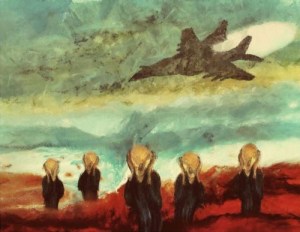
by Wissam al-Jazairy
This review of miriam cooke’s new book was published at the Guardian.
Syria’s revolution triggered a volcano of long-repressed thought and emotion in cultural as well as political form. Independent newspapers and radio stations blossomed alongside popular poetry and street graffiti. This is a story largely untold in the West. Who knew, for instance, of the full houses, despite continuous bombardment, during Aleppo’s December 2013 theatre festival?
“Dancing in Damascus” by Arabist and critic miriam cooke (so she writes her name, uncapitalised) aims to fill the gap, surveying responses in various genres to revolution, repression, war and exile.
Dancing is construed both as metaphor for collective solidarity and debate – as Emma Goldman said, “If I can’t dance, it isn’t my revolution” – and as literal practice. At protests, Levantine dabke was elevated from ‘folklore’ to radical street-level defiance, just as popular songs were transformed into revolutionary anthems.
Cooke’s previous book “Dissident Syria” examined the regime’s pre-2011 attempts to defuse oppositional art while giving the impression of tolerance. The regime would fund films for international screening, for instance, but ban their domestic release.
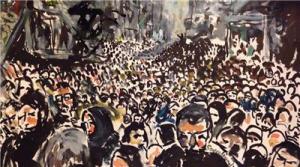
by Souad al-Jundi
“Dancing in Damascus” describes how culture slipped the bounds of co-optation. Increasingly explicit prison novels and memoirs anticipated the uprising. Once the protests erupted, ‘artist-activists’ engaged in a “politics of insult” and irony. Shredding taboos, the Masasit Matte collective’s ‘Top Goon’ puppet shows, Ibrahim Qashoush’s songs and Ali Farzat’s cartoons targeted Bashaar al-Assad specifically. “The ability to laugh at the tyrant and his henchmen,” writes cooke, “helps to repair the brokenness of a fearful people.”
As the repression escalated, Syrians posted atrocity images in the hope they would mobilise solidarity abroad. This failed, but artistic responses to the violence helped transform trauma into “a collective, affective memory responsible to the future”.
Our Fates Are Linked
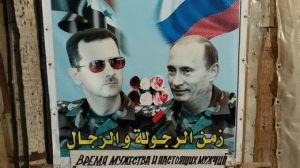
a poster from occupied Syria
Dezeray Lyn interviewed me for the Arab Daily News on the next stage in Syria, propaganda and conspiracy theories, and the connections between Syria and the world. The full article is here.
DL: I think it cheats every revolutionary, pro democracy organizer and all lovers of the land to only discuss Syria only in post counter-revolutionary, post civil war contexts. Can you intimate us with life in Syria and Aleppo before the Arab Spring uprising in terms of organizing/living/arts/love/culture under an oppressive Assad dictatorship?
RYK: Syria was in many ways a lovely country. Foreigners who visited generally loved it, and Syrians were very proud of it. Syria has a fine climate, one of the world’s great cuisines, unparalleled historical riches, and a diverse and friendly population.
It was also, beneath the surface, a tragic country, one which had suffered enforced poverty and dislocation under first Ottoman and then French imperialism, then bitter class oppression, and then sixty years of dictatorship in which a new ruling class of security officers and loyal businessmen coalesced. All forms of government exploited sectarian, ethnic, regional and tribal differences amongst the people, the better to control them. The Baathist dictatorship in particular ruled by violence and fear. About 30,000 people were killed in Hama in 1982, and thousands of dissidents disappeared in the regime’s torture prisons. Civil society was crushed.
Despite the extreme repression, Syrians produced some remarkable poetry, music, drama and films. And dissident thought continued to surface, particularly in the brief and abruptly aborted ‘Damascus Spring’ in 2000, after Bashaar al-Assad inherited the dictatorship from his father Hafez.
Bashaar shut down the political and social opening. Instead, he ‘opened’ the economy. In effect this meant a set of neo-liberal and crony capitalist reforms which enormously enriched his own family and friends while impoverishing large swathes of the population. This was the context for the 2011 uprising.
The Palestinisation of the Syrian People
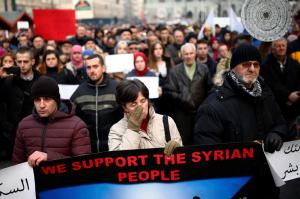
Sarajevo, Bosnia
A slightly edited version of this article was published at al-Jazeera.
In solidarity with Aleppo, the lights on the Eiffel Tower were extinguished. Elsewhere in Paris, and in London, Amsterdam, Oslo and Copenhagen, people demonstrated against the slaughter. Turks rallied outside Russian and Iranian embassies and consulates in Istanbul, Ankara and Erzerum. The people of Sarajevo – who have their own experience of genocide – staged a big protest.
The protests are nothing like as large as they were when the United States bombed Iraq, but they are welcome nonetheless. If this level of support had been apparent over the last six years, it would have made a real difference. Perhaps it is making a difference even now. Public sympathy for the victims may have pressured Vladimir Putin to allow those in the surviving liberated sliver of Aleppo to evacuate rather than face annihilation. At the time of writing, the fate of the deal is in doubt, subject to the whims of the militias on the ground. If it works out and the tens of thousands currently trapped are allowed to leave – the best possible outcome – then we will be witnesses to an internationally brokered forced population transfer. This is both a war crime and a crime against humanity, and a terrible image of the precarious state of the global system. The weight of this event, and its future ramifications, deserve more than just a few demonstrations.
The abandonment of Aleppo is a microcosm of the more general abandonment of Syria’s
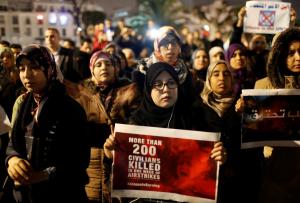
Casablanca, Morocco
democratic revolution. It exposes the failures of the Arab and Muslim worlds, of the West, and of humanity as a whole.
Many Syrians expected the global left would be first to support their cause, but most leftist commentators and publications retreated into conspiracy theories, Islamophobia, and inaccurate geo-political analysis, and swallowed gobbets of Assadist propaganda whole. Soon they were repeating the ‘war on terror’ tropes of the right.
The Obama administration provided a little rhetorical support, and sometimes allowed its allies to send weapons to the Free Army. Crucially, however, Obama vetoed supply of the anti-aircraft weapons the Free Army so desperately needed to counter Assad’s scorched earth. In August 2013, when Assad killed 1500 people with sarin gas in the Damascus suburbs, Obama’s chemical ‘red line’ vanished, and the US more or less publically handed Syria over to Russia and Iran.
Revolutionary Women
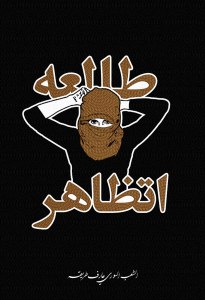 This is the third text I wrote for the Making Light exhibition in Exeter. The first is here, and the second here.
A young woman ties a keffiyeh around her face. The text reads: “I’m coming out to protest.”
From a hole in another girl’s head, butterflies rush out. A girl shot in the head, like so many girls, but the butterflies suggest she’s achieved a kind of freedom – either the freedom that motivated the defiant act that provoked her murder, or simply the freedom of death. The text reads: “Your bullets have only killed the fear within us.”
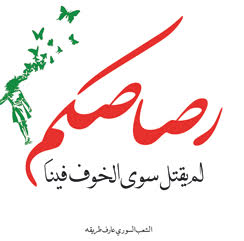 Women have been at the forefront of Syria’s revolutionary struggle.
The two most important grassroots revolutionary coalitions were set up by women: the General Commission of the Syrian Revolution by Suhair Atassi, and the Local Coordination Committees by Razan Zeitouneh.
Suhair Atassi went on to play important roles in the Syrian National Council and the Coalition of Revolutionary and Opposition Forces.
As well as setting up the LCCs, Razan Zeitouneh, a human rights lawyer, helped establish the Violations Documentation Centre to record and publicise the regime’s killings and detentions. After some time living underground, she moved to Douma, a liberated town near Damascus, where she was forthright in her criticism of any authoritarian actor who sought to limit the people’s freedom, whether the regime or any of the militias which had been formed to fight the regime.
In December 2013 Razan was abducted, probably by Jaish al-Islam, an Islamist militia. Three others were taken with her: the activists Samira al-Khalil, Wael Hamada, and Nazem Hammadi. Collectively they are known as the Douma Four. Nothing has been heard of them since.
Before her abduction, Samira Khalil, a former political prisoner, was setting up micro-finance projects and women’s centres in the Douma area. Similar centres operate all over those parts of Syria liberated from both Assad and ISIS.