Archive for the ‘Syria’ Category
Five Year Reflection
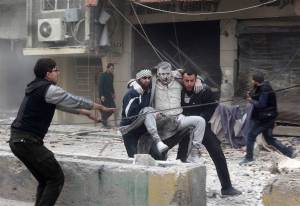
Russian bombing in the eastern Ghouta. picture from Anadolu Agency
The Guardian asked ten Arab writers to reflect on the revolutions five years on (or in). My piece is here below. To read the rest too (including Alaa Abdel Fattah from Egyptian prison, Ahdaf Soueif, and notable others), follow this link.
Five years ago the Guardian asked me to evaluate the effects of the Tunisian uprising on the rest of the Arab world, and specifically Syria. I recognised the country was “by no means exempt from the pan-Arab crisis of unemployment, low wages and the stifling of civil society”, but nevertheless argued that “in the short to medium term, it seems highly unlikely that the Syrian regime will face a Tunisia-style challenge.”
That was published on January 28th. On the same day a Syrian called Hassan Ali Akleh set himself alight in protest against the Assad regime in imitation of Mohamed Bouazizi’s self-immolation in Tunisia. Akleh’s act went largely unremarked, but on February 17th tradesmen at Hareeqa in Damascus responded to police brutality by gathering in their thousands to chant ‘The Syrian People Won’t Be Humiliated’. This was unprecedented. Soon afterwards the Deraa schoolboys were arrested and tortured for writing anti-regime graffiti. When their relatives protested on March 18th, and at least four were killed, the spiralling cycle of funerals, protests and gunfire was unleashed. Syria not only witnessed a revolution, but the most thoroughgoing revolution of all, the one that has created the most promising alternatives, and the one that has been most comprehensively attacked.
Still More Talking
And if you follow this link, and listen from 40 minutes till the end, you’ll hear me talking On BBC Radio 4’s ‘The World Tonight’ about Syria’s revolution and war. I was invited because our book Burning Country has been released. It tells the Syrian people’s stories first and foremost, before examining the global responses and results. We feel this drama has been very badly reported in the main, and we hope the book will fill some important gaps. So please read it.
Talking about the Councils
If you follow this link you’ll hear me talking on BBC World Service radio (‘Newshour’) about Syria’s revolutionary councils, decentralisation, refugees, and the ‘peace process’ illusion.
(I made a mistake here. I said Syrians need at least one or two hundred dollars to escape Syria. Slip of the tongue. I should have said they need one or two thousand.)
Fighting Daesh at the Frontline Club
Alongside BBC correspondent David Lloyn; Richard Spencer, Middle East editor of the Daily and Sunday Telegraph; Shiraz Maher, author of Salafi-Jihadism:The History of an Idea; and Azadeh Moaveni, author of Lipstick Jihad and Honeymoon in Tehran – I was part of this panel discussing Daesh, Nusra, Assad, Saudi-Iran, and the West. (It was also the first time I saw a finished copy of our book Burning Country).
From Deep State to Islamic State
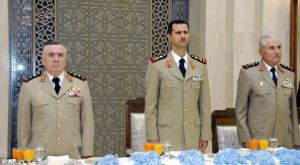 An edited version of this piece was published at Newsweek Middle East edition.
In 2011, according to the ASDA’A Burson-Marsteller Arab Youth Survey, “living in a democracy” was the most important desire for 92% of respondents. A mere four years later, however, 39% of Arab youths believed democracy would never work in the Arab world, and perceived ISIS, not dictatorship, as their most pressing problem.
Powerful states seem to share the perception, bombing ISIS as a short-term gestural response to terrorism, re-embracing ‘security states’ in the name of realism – concentrating on symptoms rather than causes.
How did the bright revolutionary discourse of 2011 turn so fast to a fearful whisper? Jean-Pierre Filiu’s “From Deep State to Islamic State” – a passionate, sometimes polemical, and very timely book – examines “the repressive dynamics designed to crush any hope of democratic change, through the association of any revolutionary experience with the worst collective nightmare.”
For historical analogy, Filiu evokes the Mamluks, Egypt’s pre-Ottoman ruling caste. Descended from slaves, these warriors lived in their own fortified enclaves, and considered the lands and people under their control as personal property. Filiu sees a modern parallel in the neo-colonial elites – militarised elements of the lower and rural classes – who hijacked independence in Algeria, Egypt, and Syria (and, in different ways, in Libya, Iraq, Tunisia and Yemen).
The Syrian Jihad
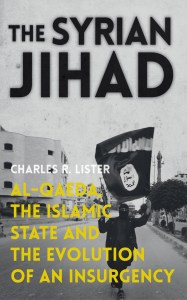 This was published at the National.
Security discourse dominates the international chatter on Syria. Most Syrians see Assad as their chief enemy – he is after all responsible for the overwhelming proportion of dead and displaced. But the Syrian people are not invited to the tables of powerful states, who are in agreement that their most pressing Syrian enemy is ‘terrorism’.
There is disagreement on who exactly the terrorists are. Vladimir Putin shares Assad’s evaluation that everyone in armed opposition is an extremist, and at least 80% of Russian bombs have therefore struck the communities opposing both Assad and ISIS. North of Aleppo, Russia has even struck the rebels while they were batttling ISIS. This wave of the ‘War on Terror’ – now led, with plenty of historical irony, by Russia and Iran – uses anti-terror rhetoric to engineer colonial solutions, just as the last wave did, and ends up promoting terror like never before.
There is no question that the moderate Syrian opposition exists, in the form of hundreds of civilian councils, sometimes directly elected, and at least 70,000 democratic-nationalist fighters. In a recent blog for the Spectator, Charles Lister, one of the very few Syria commentators to deserve the label ‘expert’, explains exactly who they are.
Lister’s book-length study “The Syrian Jihad”, on the other hand, focuses on those militias, from the Syrian Salafist to the transnational Jihadist, which cannot be considered moderate. It clarifies the factors behind the extremists’ rise to such strategic prominence, amongst them the West’s failure to properly engage with the defectors and armed civilians of the Free Syrian Army (FSA) in 2011 and 2012.
The Sound and The Fury
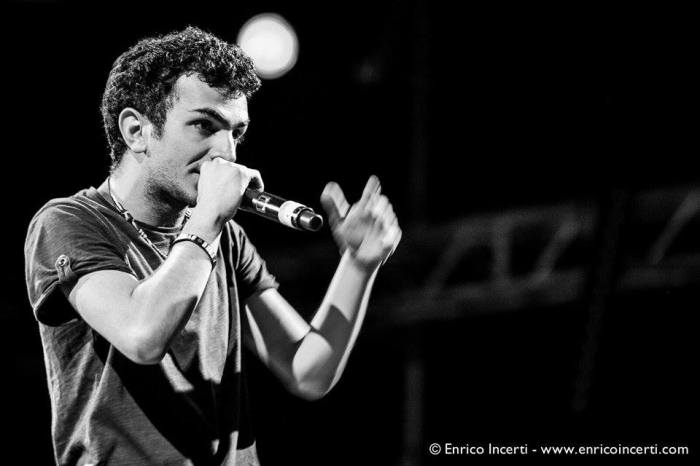 This was first published (with some great links) at the Guardian. Picture is Abu Hajar. More stories about him and many others in our forthcoming book ‘Burning Country: Syrians in Revolution and War’.
In the first heady weeks of the Arab Spring commentators made much of the role played by social media, and certainly Facebook in particular provided an indispensable tool to young revolutionaries throughout the region. But less noticed, and ultimately far more significant, was the carnivalesque explosion of popular culture in revolutionary public spaces.
The protests in Syria against Bashaar al-Assad’s dictatorship were far from grim affairs. Despite the ever-present risk of bullets, Syrians expressed their hopes for dignity and rights through slogans, graffiti, cartoons, dances and songs.
To start with, protestors tried to reach central squares, hoping to emulate the Egyptians who occupied Tahrir Square. Week after week residents of Damascus’s eastern suburbs tried to reach the capital’s Abbasiyeen Square, and were shot down in their dozens. Tens of thousands did manage to occupy the Clock Square in Homs, where they sang and prayed, but in a matter of hours security washed them out with blood.
This April 2011 massacre tolled an early funeral bell for peaceful protest as a realistic strategy. In response to the unbearable repression, the revolution gradually militarised. By the summer of 2012 war was spinning in downward spiral: the regime added sectarian provocation to its ‘scorched earth’ tactics of bombardment and siege; foreign states and transnational jihadists piled in; those refugees who could got out.
Civil revolutionaries did their best to adapt. Alongside self-organising committees and councils, Syrians set up independent news agencies, tens of radio stations and well over 60 newspapers and magazines. Kafranbel, for instance, a rural town become famous for its witty and humane slogans, broadcasts discussion, news and women’s programmes on its own ‘Radio Fresh’ – despite a recent assault by Jabhat al-Nusra fighters. And Enab Baladi (My Country’s Grapes), is a newspaper published by women in Daraya, a besieged, shelled and gassed Damascus suburb. Remarkably, the magazine focuses on unarmed civil resistance.
As a result of both security concerns and communal solidarity, anonymous cooperative endeavours proliferated, amongst them photography collectives such as the Young Syrian Lenses.
The Crossing
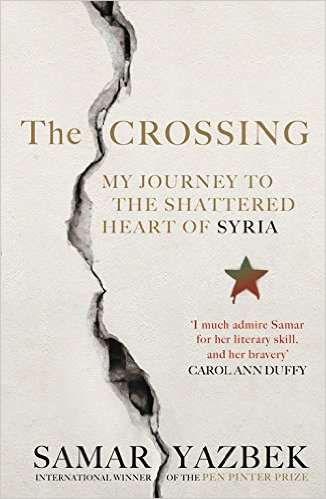 This review of Samar Yazbek’s “The Crossing: My Journey to the Shattered Heart of Syria” was first published at the Daily Beast.
This shocking, searing and beautiful book is an account of three visits to Idlib province in northern Syria, an area liberated from the Assad dictatorship “on the ground but betrayed by the sky.”
In the face of regime repression, Syria’s non-violent protests of 2011 had transformed into an armed uprising in 2012. By August of that year, when the author – exiled Syrian novelist and journalist Samar Yazbek – made her first trip, Assad’s forces had been driven from the rural border zones. From a distance, however, via warplanes and long-range artillery, they implemented a policy of scorched earth and collective punishment. So Yazbek finds her homeland changed to a landscape of burnt fields and cratered market places, with boys picking through collapsed homes in search of things to sell and displaced families sheltering in tombs and caves. Death is ever-present. Gardens and courtyards have become cemeteries. Yazbek never shies away from the horror but builds something worthwhile from it, a record and a reflection, for death is ultimately “the impetus of writing and its source.”
Known today only for war, Syria is heir to an ancient civilisation. Idlib province houses the remains of Ebla, a five-thousand-year-old city, and is dotted with half-intact Byzantine towns and churches. The war’s “ruthless sabotage of history” has damaged these priceless sites. In Maarat al-Numan the statue of 9th Century poet Abu Alaa al-Maari, a native of the town highly respected in his own time despite his unusual atheism, has been decapitated by armed Islamists. And the wonderful mosaic museum at the same location has been bombed by the regime and looted by various militias.
But amid these ruins Yazbek encounters a people giving voice to their aspirations after half a century of enforced silence. In revolutionary towns the walls are “turned into open books and transient art exhibits”. Activists organise “graffiti workshops, cultural newspapers, magazines for children, training workshops, privately-run community schools.” In the context of state collapse these projects are born of necessity, but they also reflect the kind of society the revolutionaries hoped to build – inclusive, democratic, forward-looking – one which they are in fact trying to build, even as extremists fashion their own, much darker versions. Through self-organised committees and councils, Yazbek is told, “each region now has its own administration, and every village looks after itself.” This – Syrians’ willed self-determination, Syrian creativity amid destruction – is the positive story so often missed in the news cycle, and it represents a hope for the future, faint though it is. The activists know they are working against insurmountable odds, but continue anyway. They document atrocities and reach out to international media, an endeavour which has so far failed to bear tangible fruit. When they can, they laugh – it’s “as though they inhaled laughter like an antidote to death.”
Instead of Freedom, Annihilation

‘My Sect is Freedom’. Protest in Zabadani, 2011
This piece was published at the Guardian.
In the last week of its Syrian rampage, ISIS bulldozed the 1500-year-old monastery of Mar Elian in al-Qaryatain and blew up the 2000-year-old temples of Baalshamin and Bel in Palmyra.
Syria’s heritage illustrates civilisational history from the Sumerians to the Ottomans. Its universal significance provoked French archeologist Andre Parrot’s comment, “Every person has two homelands… His own and Syria.” For Syrians themselves, these sites provided a palpable link to the past and, it seemed, to the future too, for they once assumed their distant descendants would also marvel at them. Such monuments were references held in common regardless of sect or politics. Like Stonehenge or Westminster Abbey, they provided a focus for nationalist pride and belonging. Naturally, they would have been central to any future tourism industry. Now they are vanishing.
Very recently the potential future looked very different. The popular revolution of 2011 announced a new age of civic activism and fearless creativity, but the regime’s savage repression led inevitably to the revolution’s militarisation, and then war.
Assad’s scorched earth – artillery barrages, barrel bombs and starvation sieges on residential neighbourhoods – has displaced over half the population. Four million are outside, subsisting in the direst conditions. Traumatisation, the world’s failure to properly arm the Free Army, and the West’s refusal to act when Assad used sarin gas, handed the reins to various Islamists.
Four years in, Syria is prey to division, nihilism, and competing totalitarianisms. A third of the country is split between Kurds, the Free Army and either moderate or extreme Islamic-nationalist groups. The rest is divided between what leftist intellectual Yassin al-Haj Saleh calls ‘bearded’ and ‘necktie’ fascism. Syria’s Sykes-Picot borders were drawn by imperialists to manifest an inherently unjust order; today’s partition scenarios look even worse.
The Dissolution of Past and Present
 An edited version of this piece was published at the National.
Zabadani, a mountain town northwest of Damascus near the Lebanese border, was one of the first Syrian towns to be liberated from the Assad regime (in January 2012) and one of the first to establish a revolutionary council. (The martyred anarchist revolutionary Omar Aziz was involved in setting up this council, as well as the council in Barzeh). Zabadani has been besieged and intermittently shelled since its liberation. And since July 3rd this year it has been subjected to a a full-scale assault by (the Iranian-backed) Lebanese Hizbullah, alongside continuous barrel bombing. Apparently the town’s 800-year-old al-Jisr mosque has been pulverised. Human losses are in the hundreds, and beyond the numbers, incalculable.
In other news, Daesh (or ISIS) has bulldozed the 1500-year-old monastery of Mar Elian in al-Qaryatain and blown up the beautiful 2000-year-old temple of Baalshamin in Palmyra. The temple once mixed Roman, Egyptian and Mesopotamian styles. Today its rubble is further evidence that there will be no resumption of Syrian normality. The people, monuments, even landscapes that Syrians once took for granted, that they assumed their grandchildren would enjoy, are disappearing for ever.
Palmyra – Queen Zenobia’s desert city – is a world heritage site and perhaps Syria’s most precious cultural jewel. Remarkably intact until recently, it provided a tangible link to antiquity and a breathtaking proof of the region’s civilisational wealth. Nationalist Syrians, whether secular or Islamist, feel the importance of such sites for communal pride and identity. Rational Syrians can at least understand their utilitarian benefit to any future tourism industry.
Neither Bashaar al-Assad nor (Daesh ‘caliph’) Abu Bakr al-Baghdadi are nationalists. Al-Baghdadi is explicit about it: “Syria is not for the Syrians,” he says, “and Iraq is not for the Iraqis.” Al-Assad’s rhetoric is still nationalist (and sectarian), but his war effort is managed by a foreign power now pushing towards the nation’s partition. Though not nationalists, both are certainly fascists obsessed with reinforcing their respective totalitarian states and eliminating any independent intellectual influence. Thus, in a flesh-and-blood echo of its slaughter of Palmyran history, Daesh tortured and publically beheaded Palmyra’s head of antiquities, 81-year-old Khaled al-Assa‘ad, perhaps because he’d refused to reveal the location of hidden treasures.
Bitter Almonds
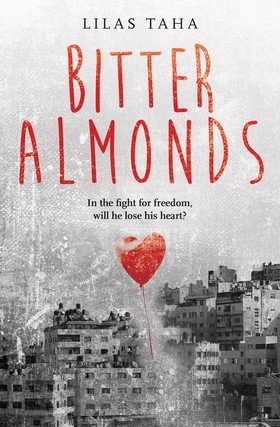 An edited version of this review appeared at the National.
This story starts with a birth and a departure, in Jerusalem in 1948. The birth is Omar Bakry’s, and it orphans him. The departure, alongside three quarters of a million others, is his forced expulsion from Palestine. “We’ll be back in a couple of weeks,” one fatefully quips.
Omar, now in the care of a neighbouring family, relocates to Damascus, where the novel unfolds through the fifties and sixties, both an engaging romance and a convincing period drama.
Lilas Taha writes in American English. My British-English ear found it difficult at first to believe in old-fashioned Arabs saving each others’ asses and getting in each others’ faces. The effect was exacerbated by occasionally clumsy dialogue. Real Palestinian-Syrians would see no need to specify, for example, “the ruling Baath Party” or “the actress Souad Hosni”. Realism is lost at moments such as these when the novel, veering into explanatory overstatement, seems too obviously an act of cultural translation. It might have been better to write a preface, or to add footnotes.
But as the pages turn, slowly but surely, the characters come entirely credibly to life. We learn a great deal about them by observing their negotiations of etiquette and social ritual as they traverse a domestic danger zone marked by deaths, difficult births, precarious marriages, and looming scandals.
The cast is close-knit. Mustafa is a farmer denied his land whose lungs are broken in a wool factory. The book’s title comes from his mouth, and provides a wisdom for the drama: “The bitter almonds make you savour the sweet ones more.” His wife Subhia, their son Shareef and daughters Huda and Nadia, make up Omar’s surrogate family.
Taha depicts them trying to make ends meet, their life in cramped quarters, male and female sleeping areas demarcated by a blanket, and the profound familiarities and festering resentments which grow in such conditions.
Arabs Without God
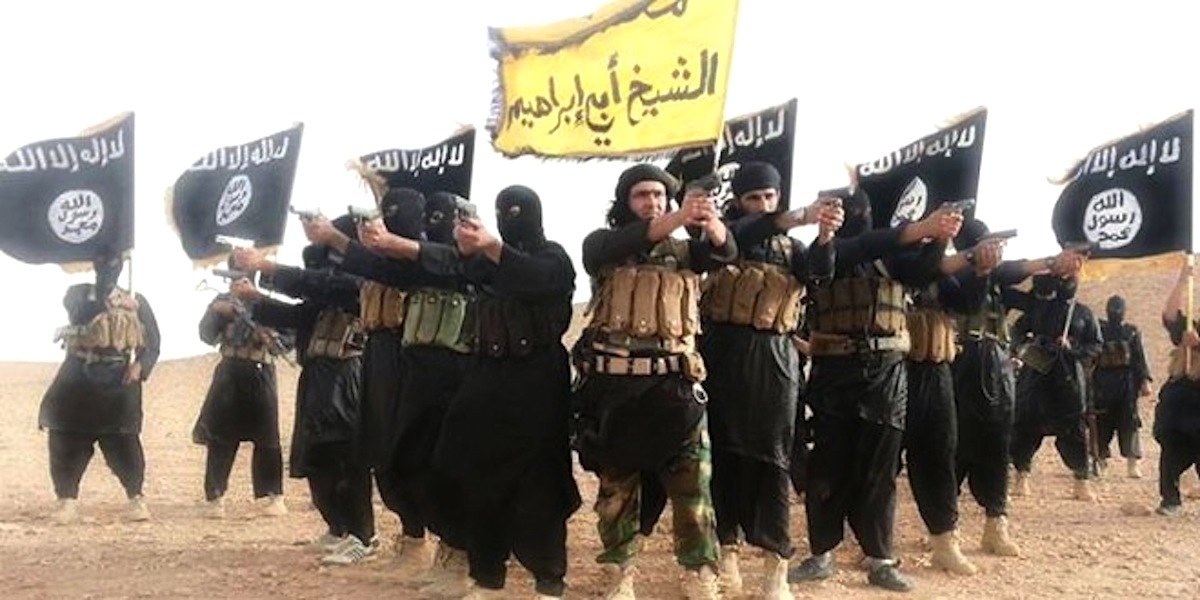 This was first published at NOW.
In the Arab world, the public declaration of religious disbelief is as taboo as the open profession of homosexuality. Publically-declared atheists and agnostics can wave goodbye to social respect, marriage prospects, even legal recognition. Yet a 2012 poll in Saudi Arabia – a state whose legal system equates atheism with terrorism, and which potentially applies the death penalty to apostates – found that 19% described themselves as ‘not religious’ and a further 5% as atheists.
In his new book “Arabs Without God: Atheism and Freedom of Belief in the Middle East” (soon to be translated into Arabic as ‘Arab bala Rab’) journalist Brian Whitaker interviews activist and quietist unbelievers from around the region, and investigates the pressures ranged against them. Most usefully, the book provokes a question – how can a revived Arab secularism (freed from the taint of the so-called ‘secular’ dictatorships) provide a future in which the rights of religious majorities as well as unbelieving or sectarian minorities will be respected and strengthened?
Demands to believe and submit go far beyond religion. Whitaker quotes sociologist Haleem Barakat, who noted that, like God, the Arab head of state and the Arab family patriarch require absolute respect and unquestioning compliance. “They are the shepherds, and the people are the sheep.” (This is why ‘rab’ – which means ‘Lord’ rather than only the monotheist God – is as apt a translation as ‘Allah’ for the book’s Arabic title). So intellectual atheism is perceived as an attack on family and state, and on community solidarity. The contemporary politicisation of religious identity makes unbelief akin to treason in some minds; for this reason minority sects, dissenters and atheists are frequently seen as fifth columnists, agents weakening state and nation on behalf of foreign powers.
Identity politics in the region took on its modern forms with the building of centralised nation states. Nationalism itself was an assertion of a politicised cultural identity, first against the Ottomans, then against the European empires. For the new rulers of post-independence states, a fear of disloyal communities turned to a generalised rage for homogeneity – ‘the good citizen’, depending on where they found themselves, was to be an Arab, or a Muslim, (or a Turk, or a Jew) as imagined by the state. Many states standardised dress, dialect and worship.
An Account Syncopated by Death: Littell’s Syrian Notebooks
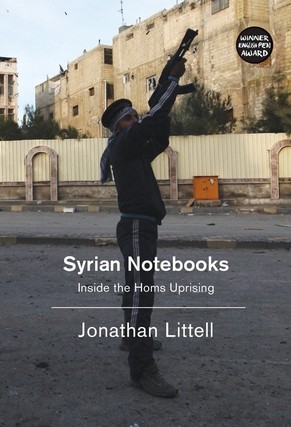 This review was published at the National.
“The Kindly Ones”, one of the 21st Century’s great novels, is an epic inquiry into the intersection of state power and human evil. Its narrator is supremely civilised but also – and somehow without contradiction – an SS officer engaged in industrial-scale murder. The novel is set in the battlefields and death camps of World War Two.
The author, Jonathan Littell, previously worked for humanitarian agency Action Contre La Faim in various war zones including Chechnya, in whose fate he sees Syrian parallels. In 1996 Chechnya won de facto independence. Then collusion between Russian security services and Islamist extremists weakened Chechen nationalists, made the country too dangerous for journalists, and drained international support. This facilitated Russia’s 1999 reinvasion and the total destruction of the capital, Grozny. The Russian strategy is echoed today in what French Foreign Minister Laurent Fabius describes as the “objective complicity” between Assad and ISIS.
There are World War Two parallels too. Aleppo is the most bombed city since that conflict. Syria’s refugee crisis is the greatest since 1945. And the Assad regime, like Hitler’s, produces “thousands of naked bodies tortured and meticulously recorded by an obscenely precise administration.”
Perhaps these commonalities explain why Littell chose to bring his clear sight to bear on Syria’s war. He went in, for 17 days in January 2012, with renowned French photographer Mani. The experience led to a series of reports in Le Monde in February, and now to a book: “Syrian Notebooks: Inside the Homs Uprising.”
Reporting from Syria has been cursed by journalists who embed with the regime’s army or fall prey to regime-planted conspiracy theories. Littell mentions an article penned by Georges Malbrunot for Le Figaro blaming the Free Army for journalist Gilles Jacquier’s death “on the basis of an anonymous source in Paris citing an anonymous source in Homs.” Similar blame-the-victims hoaxes were retailed by Assad’s useful idiots after the Houleh and Ghouta massacres.
ISIS: Hassan/Weiss versus Cockburn
 The review below was published at the Guardian. Unfortunately the heart of the review was cut from the published version. I’ll put it here first of all, because it shows that Patrick Cockburn actually makes stuff up in order to defend Assad and Iran and to slander the Syrian people. Here it is:
“There is no alternative to first-hand reporting,” he nevertheless opines; and “journalists rarely fully admit to themselves … the degree to which they rely on secondary or self-interested sources”. Which brings us to the question of Cockburn’s reliability. In the book he states, in early 2014, “I witnessed [Nusra] forces storm a housing complex … where they proceeded to kill Alawites and Christians.” This alleged massacre was reported by Russian and Syrian state media (Russia is Assad’s imperial sponsor, providing his weapons and defending him at the Security Council); yet international organisations have no record of it. But Cockburn’s original report of the incident, in a January 28, 2014 column for The Independent, states that, rather than witnessing it, he was told the story by “a Syrian soldier, who gave his name as Abu Ali”.
And now here’s the whole thing:
ISIS feeds first on state dysfunction, second on Sunni outrage. In Iraq – where its leadership is local – Sunni Arabs are a minority displaced from their privileged position by America’s invasion. Their revanchism is exacerbated by the sectarian oppression practised by the elected but Iranian-backed government. In Syria – where most ISIS leaders are foreign – Sunnis are an oppresssed majority, the prime targets of a counter-revolutionary tyranny headed by mafias but claiming and exploiting Alawi sectarian identity.
Under other names, ISIS first grew in Iraq as it would later in Syria, by exploiting resistance to occupation, American in one case, that of a delegitimised regime in the other. Drawing on research by the Guardian’s Martin Chulov as well as their own, Michael Weiss and Hassan Hassan show how Syria’s regime collaborated with Iraqi Baathists and Salafist extremists, facilitating the passage of bombers to Iraq who would do more to precipitate civil war than to shake off American occupation. This was a message to America to leave Syria alone.
Popular disgust and the US-backed Awakening movement eventually drove al-Qaida out of Sunni Iraq. The jihadists waited; their moment returned when peaceful Sunni protests were repressed by live fire in 2013. Heading a Baathist-Islamist coalition, ISIS then captured huge swathes of the country and set about its reign of terror.
Weiss and Hassan have produced a detailed and immensely readable book. Their informants include American military officials, American, Jordanian and Iraqi intelligence operatives, defected Syrian spies and diplomats, and – most fascinating of all – Syrians who work for ISIS (these are divided into such categories as politickers, pragmatists, opportunists and fence-sitters). They provide useful insights into ISIS governance – a combination of divide-and-rule, indoctrination and fear – and are well placed for the task. Hassan, an expert on tribal and jihadist dynamics, is from Syria’s east. Weiss reported from liberated al-Bab, outside Aleppo, before ISIS took it over.
Cockburn’s book, on the other hand, is more polemic than analysis. While Weiss and Hassan give a sense of the vital civil movements which coincide with jihadism and Assadism in Syria, Cockburn sees only an opposition which “shoots children in the face for minor blasphemy”. He concedes the first revolutionaries wanted democracy, but still talks of “the uprising of the Sunni in Syria in 2011”. The label doesn’t account for (to take a few examples) the widespread chant ‘The Syrian People are One’, or Alawi actress Fadwa Suleiman leading protests in Sunni Homs, or Communist Christian George Sabra leading the Syrian National Council.
Shock and Awe versus Dentists, Farmers and Students
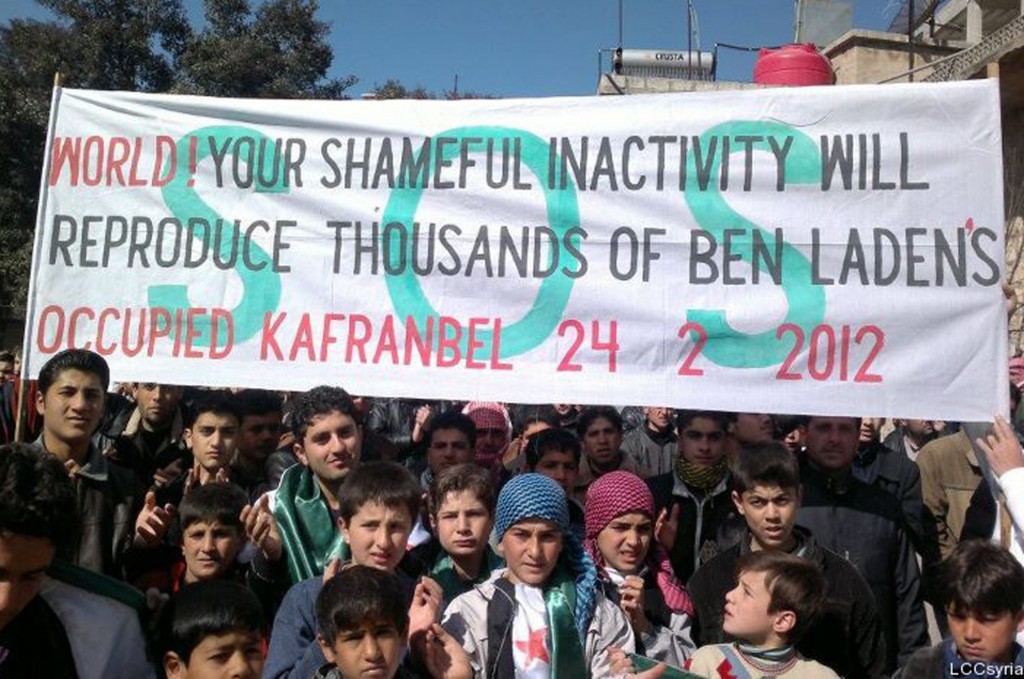 Whatever the hearts-and-minds rhetoric at the United Nations, in Syria the Obama administration is feeding the flames of Sunni extremism, and proving once again the truism that the American state is an enemy of the Syrian people (as it’s an enemy, like all states, of all peoples, including the American).
We expected strikes on ISIS. Some of the strongest strikes (and the strikes are far stronger than in Iraq), however, have been aimed at Jabhat al-Nusra (the Victory Front), the organisation from which ISIS split. Nusra is certainly an extremist Salafist group, and is openly linked to al-Qa’ida. Because its ideology terrifies not only minorities but also huge swathes of the Sunni population, it’s also a strategic obstruction in the way of the Syrian revolution. In August 2013 it participated (with ISIS) in the only documented large-scale massacre of Alawi civilians in the conflict. On the other hand, Nusra (unlike ISIS) was until yesterday actually fighting the regime, not other rebel groups. From January, along with every rebel formation, it’s been fighting ISIS too. And its leadership is entirely Syrian. Many Syrians, not necessarily extremist Salafists themselves, admire Nusra’s victories against their most immediate enemy – the Assadist forces dropping barrel bombs on cities and raping and torturing at checkpoints. A sensible answer to Nusra would be to provide weapons and funds to Free Army forces who would then be in a position to gradually draw men from the organisation, slowly making it irrelevant (most men don’t care about the ideology of their militia’s leadership; they care about food and ammunition). But the Americans are allergic to working with the people on the ground most immediately concerned by the outcome, and bomb from the air instead. Nusra is now abandoning front line positions (in some areas the regime may be able to take immediate advantage). One Nusra leader has already spoken of an alliance with ISIS against the Americans.
Syria’s new daily routine: the Americans and Gulf Arabs bomb the Salafist extremists while Assad bombs the Free Army and Islamic Front (and of course civilians – as usual it isn’t being reported, especially not now the televisual US war is on, but about a hundred are being killed every day). The headline in regime newspaper al-Watan reads “America and its Allies in One Trench with the Syrian Army against Terrorism”. The opposition reads it this way too. Several demonstrations yesterday condemned the American strikes, called for America’s fall, and for solidarity with ISIS and Nusra. A sign at one protest read: “Yes, It’s an International Coalition Against Sunnis.”


 Qunfuz