Archive for the ‘writing’ Category
Writer Talk
Notes for a talk to the Dumfries Writers Group tonight. It’s pretty narcissistic, but narcissism is what I do. I’ll also talk about the practicalities of finding an agent and a publisher, and about blogging.
Where does the urge to write come from?
It comes from the fear of death. From where all human effort beyond eating comes from. Maybe eating too. But the fear of death is only one way to say it. Writing is the attempt to control what can’t be controlled, to impose pattern on confusion, to battle time by recording it, to immortalise thought and sensation, and so to make them sacred. A vain but very human enterprise.
The film director Werner Herzog said, “I believe you can discover a very deep, ecstatic truth by fabricating.” I’m not sure what this means, but I’m sure I agree with it.
Also, for me, fabrication is a channel for passion which might otherwise express itself as anger.
At All Costs
A short story published in Five Dials. It’s only the second short story I’ve written, and I don’t know if I should be proud or ashamed of it. Here’s the link. It includes an interview with Noam Chomsky.
Abdu, masterful and charismatic, was holding forth above a long table which supported a debris of pastes and salads, when he registered, like a disturbance on a radar screen, a burst of cruel hilarity erupting from a couple of the younger guests. Abdu didn’t slow down; instead he increased his volume and amplified the movements of his hands. It was important that as few people as possible noticed the teenagers’ disrespect, and that nobody noticed that he had noticed. To notice it was to grant it value, and that he must not do.
This was his 60th birthday meal. At the climax of his life, after decades of sustained effort, he’d won the right to celebrate birthdays, like Europeans do, and also to be considered a right-living patriot. That is, an embodiment of modern success. No woman at the table wore a headscarf, and neither, of course, was any alcohol served. His young dyed-blonde wife presided quietly at his side. She wore a cream-coloured jacket and trousers from Paris. He wore a new, blue suit. All eyes were upon him. This was essential. If they didn’t recognise him correctly now, he would be ruined in his own eyes.
Egyptian Novels
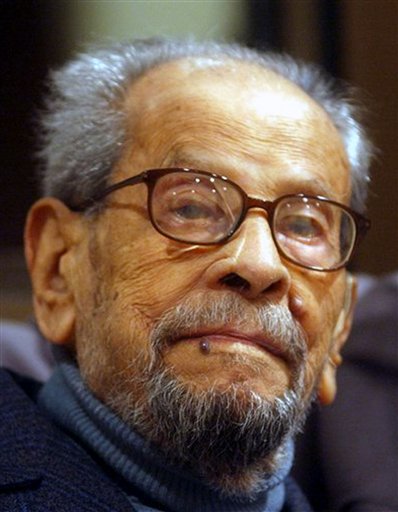
Nobel Laureate Naguib Mahfouz
In the contemporary Arab world, Bilad ash-Sham, or the Levant, surely comes first for poetry. Whether you’re looking for Muhammad Maghout’s bitter satire, anti-romanticism, and defence of the poor and the peasants, or for Mahmoud Darwish’s lyrical nationalism — whether you appreciate the modernist obscurity of Adonis or the powerful simplicity of Nizar Qabbani; you will turn to Syria and Palestine for your verse fix. The Arabs certainly do. For poetry in the Middle East isn’t the elite preoccupation it has become in the West. Taxi drivers and market men will quote you snippets of Qabbani’s love poetry or angry anti-occupation verse according to their temperament and the twist of the conversation. Even the illiterate may know some Qabbani from hearing it quoted in the café or crooned by the Iraqi singer Kazem as-Saher, with orchestral accompaniment. When Arab rappers want to express hardcore identity, they proclaim: “I’m an Arab like Mahmoud Darwish!” (the ‘Dam’ crew from Palestine.) That’s how uncissy Arab poetry is.
But for the Arabic novel, a genre which is only a century old (although there are much earlier precursors), the action is centred in Egypt, unsurprisingly – Egypt with its huge population and its indefinable, unmeasurable metropolis.
The most famous of Egyptian novelists is Naguib Mahfouz. Amongst the Arabs his books are bestsellers in garish covers, and many have been made into classic films. His international reputation was sealed when he became the first Arab to win the Nobel Prize for Literature in 1988. Reflecting changes in 20th century Arab reality, his style developed from heroic through realist to magical realist or romantic symbolist.
“Maps for Lost Lovers” and writerly responsibility
Update 2015: With the passage of time, much of this review embarrasses me. So people and perspectives change. My current view is better summed up by my words at the 2015 Shubbak festival, which Brian Whitaker reports:
There is a beautiful novel called Maps for Lost Lovers by Nadeem Aslam who is Pakistani-British, and I would recommend that everybody reads the novel as a work of literature because it is beautifully, beautifully written and characterised.
It works as a novel, but there is no good Muslim character in it. They are real characters and you can sympathise with them even when they are doing horrible barbaric things. But they are all doing horrible barbaric things from the moment they get up in the morning, and its the kind of horrible barbaric things that British Pakistanis do that you read about in the Sun newspaper.
So of course there is an issue, but we cant tell Nadeem Aslam that he’s a representative British Pakistani writer and therefore he has to write a nice version of British Pakistanis in order to educate the white population that some of them are all right. He’s writing what he wanted to write about and what was real for him, and he did it really well. I think the critique should focus on the social context. It’s not Nadeem Aslam’s fault so much as the Sun newspaper’s fault.
And here’s the thing I originally wrote:
I’ve recently read Nadeem Aslam’s finely-constructed and richly metaphorical novel “Maps for Lost Lovers”, which portrays a British Pakistani community and its rigid boundaries over a year of daily life and crisis. Save for some occasionally unconvincing dialogue, the writing is beautiful and poetic. Unlike, for example, Martin Amis, Aslam respects his characters, who are well-rounded and complex enough to evoke sympathy even when they behave badly. He shows them busy with gossip, work, poetry – and plenty of murder. For example, a book shop owner is murdered for money by his relatives in Pakistan. At the heart of the book, Chanda and Jugnu are murdered by Chanda’s brothers for ‘living in sin.’ Chanda wants to divorce her husband so she can marry her lover, but her husband has disappeared for years, and she doesn’t know where to. Another girl is murdered by a ‘holy man’ during exorcism-beatings. And so on: a litany of crimes motivated by ‘honour’ and superstition.
One subplot revolves around a woman being forced by sharia law to marry another man before returning to a husband who has divorced her once while drunk. The actual regulation is this: if a man divorces his wife THREE times he cannot remarry her unless she has been married to someone else and that marriage has also collapsed. This is generally understood as a warning to husbands not to divorce their wives without considering the consequences. Furthermore, a divorce announced when the husband is angry or intoxicated is not recognised. As for the stranded Chanda, sharia would automatically grant her a divorce if her husband disappeared for a day longer than a year. Fair enough, Aslam is writing about uneducated people’s partial and skewed understanding of their religion, or of their confusion of tradition and religion, but this point will be lost on non-Muslim readers.


 Qunfuz