Qunfuz

Robin Yassin-Kassab

Letter to John Baron MP

leave a comment »

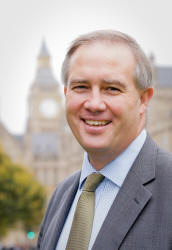
john baronBehind the scenes at Newsnight, John Baron MP said to me, “If you put your emotions aside, for the sake of containment, wouldn’t it be better if Assad won?” I wrote him the following response. As he hasn’t responded, I’m making it public. (To John Baron’s credit, he was one of the few Tories to oppose the invasion of Iraq and the occupation of Afghanistan).

We met at the BBC Newsnight debate on Syria. I think you gave me a card, which I promptly lost. I hope you find this message.

I’m taking the liberty of sending you my latest article concerning sectarian readings of the Syrian situation (my other stuff is on the same blog) as well as something by the secular intellectual Yassin al-Haj Saleh which presents a case better than I could.

As for your question, wouldn’t it be better for containment if Assad were to win? here’s a slightly fuller answer.

Assad can’t win completely, even with continuing solid support from Russia, Iran and Iran’s Iraqi and Lebanese clients, because the opposition has numbers on its side (and secondarily because Saudi weapons will continue to come in). If things go on as they are, a much more likely medium term result is the splintering of the country into zones of destabilisation:

1. a regime/Alawi zone between Damascus and the coast bridged by Homs, which will involve a massive ethnic cleansing of Sunnis from the Homs area (the regime has already burnt the land registry) and probably from the coastal cities too. The blowback from this probable future may well catalyse the sectarian mass slaughter of civilians which hasn’t yet happened from the opposition’s side. As I said in the green room, Assad’s rump state would be in effect Iran’s state (as opposed to Iran’s ally, which Syria was before 2011), beholden to Iran, because it’s Iran and its clients who are directing the regime fightback now. The risk is high that Iran will use Syria as a proxy front for its war with Israel in the same way that Syria once used Lebanon. And while Iran already ‘has’ Lebanon, Hizbullah is forced to deal with other groups in Lebanese politics. Control of a straightforward military/sectarian dictatorship, and a bigger country, is much more of a prize for Iran. I’m no friend of Israel, but America and Britain generally are, so it’s surprising to see all concerned ignoring the emergence of a greater strategic threat to the status quo than Iran’s nuclear programme (if they actually believe their rhetoric of Iran posing a threat to Israel).

Read the rest of this entry »

Written by Robin Yassin-Kassab

August 16, 2013 at 1:39 pm

Posted in Syria, UK

Tagged with

Journey to Kafranbel

leave a comment »

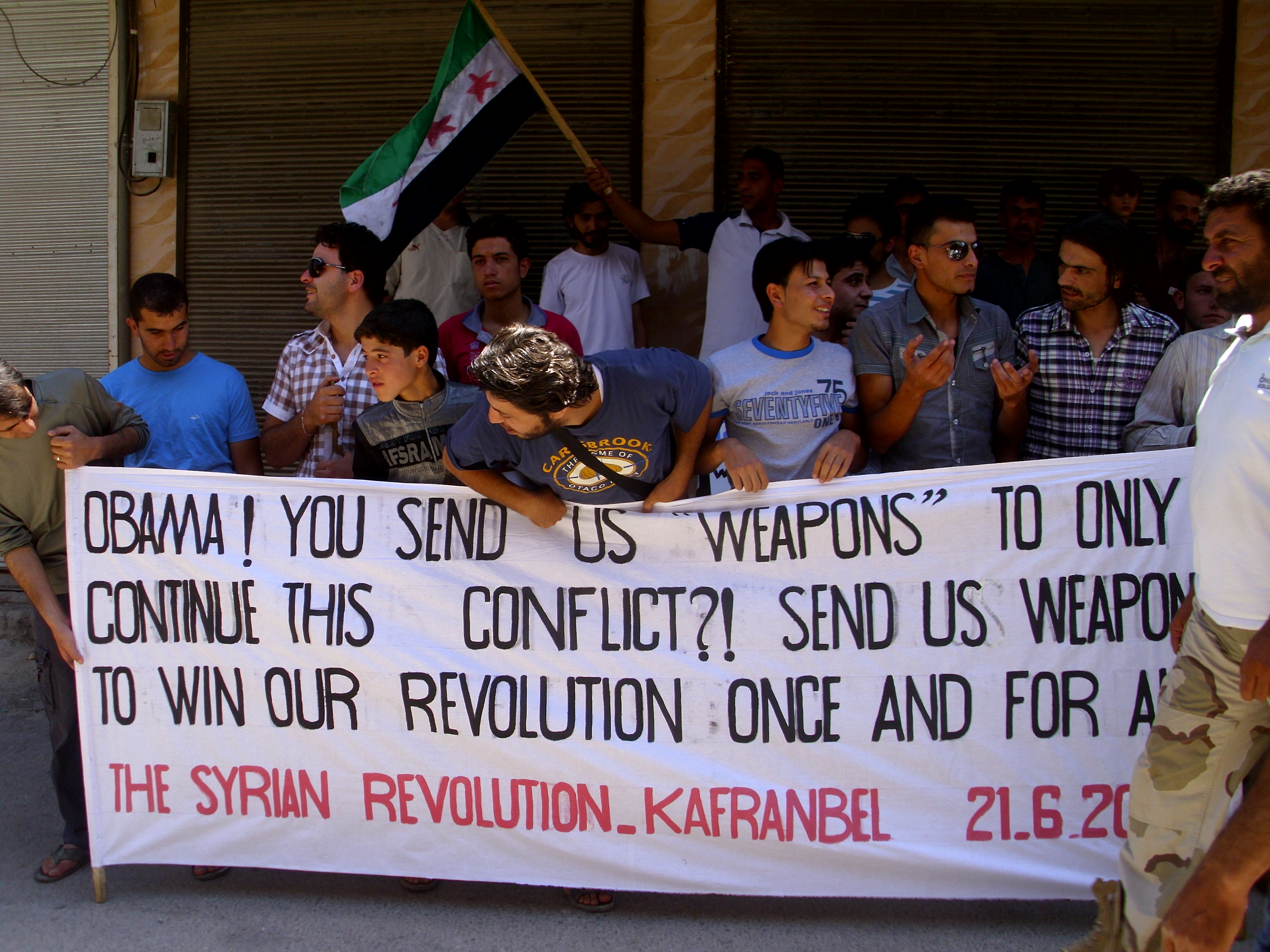
This account of my trip into Syria’s partially liberated Idlib province was published by the Guardian.
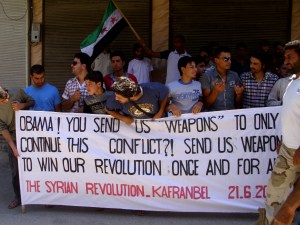
DSCI0172To cross the border I had to climb a wall three times my height. It was the most frightening part of my trip into liberated Syria.

At Atmeh camp (where I’d been working, just inside Syria on the Turkish border) there’s no passport control but only a gap in the barbed wire. On the day of our journey, however, the Free Syrian Army and PKK-linked Kurds were facing off nearby and the Turkish authorities blocked access as a result. This meant we had to go through the official border at Bab al-Hawa. Two of our party possessed Syrian passports, and were waved through. Two of us didn’t, and so were smuggled across by Kurdish teenagers.

We skirted a deserted shack which our escorts pretended was a policeman’s house. One disappeared for a while, pretending to pay an expensive bribe. Our winding path led through a red-soiled olive grove, far away from the border post, but then wound back towards it, and to the wall. I could see the backs of soldiers through the trees, smoking not patrolling.

There were no security cameras. The boys told me they’d taken Chechens across like this.

At wallside a whispered negotiation ensued. We soon haggled a price for their service. The next part was more difficult – They wanted us to scale the wall into what was obviously still the Turkish border post.

I looked at my fellow smugglee. “Do you believe this?” I asked in English.

“I don’t know. Talk to them some more.”

So it went on, until at last Abdullah, one of our hosts inside Syria, phoned to advise me to do as the boys said.

So I climbed too fast for vertigo to strike, scissored my legs over the railings, dropped onto concrete, rolled, picked myself up, then endeavoured to walk across the neatly-trimmed lawn with a nonchalant but entitled and entirely legal air. I strolled through the airconditioned duty free zone and rejoined my companions to wait for the bus through no-man’s-land. (No private cars have been allowed here since a car bombing in February killed thirteen). Sitting in front of me on the bus: a fattish version of Che Guevara, in curls, beard and black beret, but with nogodbutgod printed on the beret.

Read the rest of this entry »
Written by Robin Yassin-Kassab

August 14, 2013 at 11:09 pm

Posted in Syria, Travel

Tagged with ,

Tooth

leave a comment »

The Glasgow Film Theatre asked me and nine other writers based in Scotland to respond to the theme ‘For All.’ My response is part of the novel I’m writing at the moment. The extract  inspired this very brief but strangely wonderful animation by David Galletly:

You can read Tooth here at the GFT’s website..

Written by Robin Yassin-Kassab

July 14, 2013 at 9:49 pm

Translation and Conflict

with 2 comments

Here was me, Dan Gorman and Samia Mehrez talking about translation and conflict for the Literary Translation Centre at the London Book Fair 2013.

Written by Robin Yassin-Kassab

July 14, 2013 at 9:27 pm

Posted in writing

Tagged with

Yassin-Kassab versus Landis

with one comment

Thanks to Joshua Landis for posting (at Syriacomment) this dispute, which originally took place on Sultan Saoud al-Qassimi’s facebook page. I earlier took issue with Syriacomment’s coverage here.

Sultan Sooud: Great read by Joshua Landis on Obama’s three options on Syria. The one, two and three state solutions.

Racan Alhoch: I love orientalist solutions. They are always a modified version of the Sykes-picot. The best solution would be for people like Landis to fuck off.

Joshua Landis: Rocan, I am not sure what is orientalist about these possible outcomes. If Assad hangs on to the south is Syria and the rebels hold the north it will not be because of the west. It will be a Syrian solution. If the rebels are able to conquer Damascus it will probably be thanks to help from the West.
Read the rest of this entry »

Written by Robin Yassin-Kassab

July 11, 2013 at 8:41 pm

Posted in Syria

Tagged with

Newsnight

leave a comment »

Here’s a Youtube recording of a full BBC Newsnight episode on Syria, in which I participated. The debate was about serious help for the resistance. The help isn’t coming.

Written by Robin Yassin-Kassab

July 11, 2013 at 5:44 pm

Posted in Syria

Politics not Theology

with 3 comments

DSCI0206This was published by the National.

I live in Scotland, where I am witness to the continuing legacy of Protestant-Catholic communal hatred, despite the theological indifference and general irreligiosity of the populace.

The hatred is most commonly activated by the Rangers-Celtic football game. (In his great novel “Kieron Smith, Boy”, James Kelman brings it viscerally alive through the mouth of a Glaswegian child.) It is manifest too in Orange Order marches and schoolyard slurs. It intersects with the gang violence of the ‘schemes’. Most of the time, of course, it’s absent, or it emerges as friendly competitiveness rather than actual conflict, but you can bet your last communion wafer that it would blossom into something much fiercer if, in the event of political crisis, a divide-and-rule tyrant were to send Catholic militia in to pacify restive Protestant areas, or vice versa.

Like Scotland’s sectarians, Syria’s Alawis are usually largely secular and ignorant of their own theology (at least they were – a war-driven religious revival is touching them as well as the Sunnis). Over the last four decades Alawi religious scholars have been assassinated or otherwise silenced by the Assad regime as it sought to render the community entirely dependent on the Ba‘athist state. Most Alawis (by no means all) continue to support Assad because they have no other community leadership. Add to this that many have relatives working in the security forces, and so fear a loss of privileges and even violent revenge when the regime falls. Alawis also remember their historical marginalisation by the Sunni majority, and therefore fear majority rule.

As in Iraq, Palestine-Israel, or Northern Ireland, the conflict in Syria is not about theology but about group fears and resentments. Ultimately, it’s about power. Communal tensions are the result not of ancient enmities but of contemporary political machinations. And nothing is fixed in time. Syria’s supposedly ‘Sunni rebellion’ (which contains activists and fighters of all sects) becomes more or less Islamist in response to rapidly-changing political realities. A few months ago, for example, Islamist black flags dominated demonstrations in Raqqa, in the east of the country; now Raqqa’s demonstrations are as likely to protest Jabhat an-Nusra, the extremist militia which nominally controls the city, as the regime. This isn’t an Islamist rebellion but a popular revolution. As in Egypt, if the Islamists oppress the people or fail to deliver, they too will be revolted against.

Read the rest of this entry »

Written by Robin Yassin-Kassab

July 10, 2013 at 5:51 pm

China Radio International

leave a comment »

Follow this link to hear me and Stephen Zunes discussing the situation in Syria on China Radio International. (Due to a timezone confusion, I was asleep until two minutes before this hour-long broadcast, which took place between 3 and 4 in the morning, my time.)

Written by Robin Yassin-Kassab

July 4, 2013 at 7:48 pm

Posted in Syria

Burning the Mosques

with 3 comments

The Umawi mosque in Aleppo has burnt. Its thousand-year-old minaret has fallen. The minaret of Dera‘a’s Omari mosque, built in the seventh Century by Caliph Omar ibn al-Khattab, has been destroyed. And today the Khalid ibn al-Waleed mosque in Homs, built around the mausoleum of the famous Muslim general and companion of the Prophet, was shelled and burnt. These are ancient mosques of enormous significance to Muslims, and they are world heritage. They were. They survived the Mongols, but not Assad.

It’s clear the Western media does not understand the religious, cultural and historical importance of these sites. Assad’s cultural vandalism and civilisational provocations are worse than the Taliban’s assault on the Bamiyan Buddha. Am I wrong to think that an attack by rogue elements of the Syrian resistance on a major Shia shrine would raise a far greater noise?

Many Muslims too are strangely quiet. If the Israelis were to hit a mosque of such vast symbolic resonance, you can bet there’d be furious demonstrations from Casablanca to Jakarta, from London to Lahore.

What’s happening is no secret. The shabeeha write it on the walls: “Al-Assad or We’ll Burn the Country.” The world worries about Islamists, about hypothetical future persecutions, about the chess game between America and Russia, Israel and Iran. Meanwhile the country burns. The people and their history burn. And the flammable poison of sectarian hatred seeps out from Syria, to east and west.

Read the rest of this entry »

Written by Robin Yassin-Kassab

June 29, 2013 at 10:48 pm

Posted in Sectarianism, Syria

Tagged with

Help the Syrian People

leave a comment »

People are asking me how they can help the victims of the genocidal repression in Syria. Those who engage in political debate can struggle against the orientalist, Islamophobic, or statist-ideological misinterpretations of the media which have obscured the reality of the revolution and convinced large swathes of public opinion that the Syrians should be left to face Assad’s war machine unarmed. Those who don’t do politics, or who are honestly confused about the rights and wrongs of the crisis, can donate money.

I have worked with three charities on Syria. I can vouch that all three are honest and efficient, run by intelligent people, and that they do immediate work on the ground in Syria helping displaced people and those holding out in their bombed towns and villages. Syria Relief is UK-based. The Karam Foundation and the Maram Foundation are US-based. I’m sure all three can receive donations from anywhere in the world. Please remember that the Syrian tragedy is unsurpassed in contemporary history, worse than the Iraqi crisis in 2006/2007. The daily death toll is equally high; the numbers of displaced – well over a quarter of the country’s population – are much higher.

Soriyat for Humanity Development is a great project which I saw at work on the ground. It was set up by novelist and revolutionary Samar Yazbek, and is based in Paris. To donate:RIB de la banque LA BANQUE POSTAL. ASSOCIATION SORYAT POUR LE DEVELOPPMENT HUMANITAIRE – NATIONAL 20041-00001-5773792S020-25 – INTERNATIONAL IBAN FR30-2004-1000-0157-7379-2S02-025. CODE BANCK PSSTFRPPPAR

Here’s a short film on the work of Camp Zeitouna, a project of the Karam and Maram Foundations.

Written by Robin Yassin-Kassab

June 28, 2013 at 7:00 pm

On the Fall of Qusair

leave a comment »

I participated in BBC World’s “World Have Your Say” to discuss the fall of Qusair and the spread of sectarian war as Hizbullah invades Syria in force. Sara Assaf, Kenan Rehmani and Elizabeth Tsurkov also contribute.

Written by Robin Yassin-Kassab

June 25, 2013 at 10:31 pm

Posted in Sectarianism, Syria

Tagged with

Pictures from Syria

with one comment

DSCI0105I’ve just returned from a trip to Syria, which I’ll be writing about. In the meantime, please follow this link to see some photographs, with comments.
The Atmeh camp is just inside Syria near the Turkish town of Reyhanli (Reyhaniyeh in Arabic). 22,000 people live in the camp, refugees from the regime’s shelling, aerial bombardment, gunfire, torture and rape. They come mainly from the Idlib, Hama and Aleppo regions. Many are rural people, but there are middle class urban residents too.
This album also contains pictures of a trip to liberated Kafranbel in southern Idlib province.

Written by Robin Yassin-Kassab

June 25, 2013 at 3:19 pm

Posted in Syria

Immediate Responses to Israel’s Attack

leave a comment »

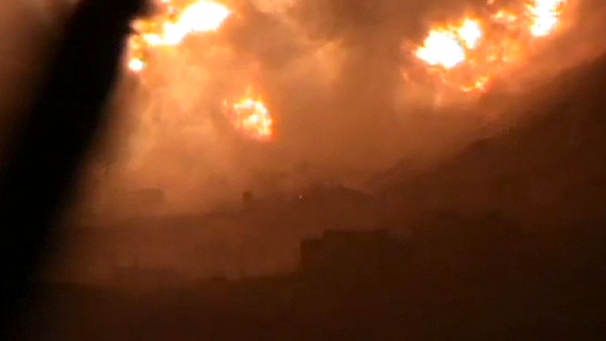
qassioun burningIsrael’s attack on Assad’s military bases on Mount Qassioun above Damascus have provoked mixed feelings amongst Syrians. On the one hand, Syrians have been well aware for over two years that Assad’s army is designed not to confront Zionism but to slaughter the Syrian people. For a year and a half Mount Qassioun has been the launching pad for for artillery and missile attacks on civilian areas of Damascus and its suburbs. On the other hand, hatred and mistrust of Israel rightly runs very deep indeed among the people, far deeper than among the regime which, despite all its rhetoric, has not once (since 1973) responded to Israeli violations of Syrian sovereignty. Syrians know that Israel’s attack is an attempt to exploit the revolutionary situation for Israel’s own ends, that it is part of Israel’s confrontation with Iran – something Syrians want no part of, however much they may hate Iran’s criminal support of the genocidal Assad regime – and that it offers grist to Assad’s propaganda mill.

Here are some immediate responses to Israel’s attack. The Syrian National Coalition released this statement, including this line: “The Coalition holds the Assad regime fully responsible for weakening the Syrian Army by exhausting its forces in a losing battle against the Syrian people.” Many Arabic language Youtube videos show various Free Army and Salafist militias condemning both Israel and Assad’s regime.

I wrote this on Facebook:

Assad responds to the Israeli attack by escalating his sectarian massacres on the coast and his bombardment of Syrian cities, including the Palestinian refugee camp at Yarmouk. Infantile so-called ‘anti-imperialists’ everywhere cheer on Assad’s ‘heroic resistance’.

By ‘sectarian massacres on the coast’ I was referring specifically to the ongoing slaughter of Sunnis in al-Bayda and other areas of Banyas, causing thousands to flee the area.

Read the rest of this entry »

Written by Robin Yassin-Kassab

May 5, 2013 at 6:54 pm

The Wall

leave a comment »

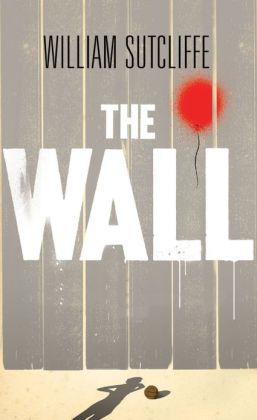
wallThis review was published at the Independent.

Joshua lives in a brand new town called Amarias. He shares his brand new house with his mother who, since his father’s death in battle, has been “like a pane of glass riddled with cracks that was still somehow sitting there in the frame,” and also with tree-killing Liev, the “anti-father” whose cloying unpleasantness is a great pleasure to read.

One day, chasing a lost football and propelled by an overbearing curiosity, Joshua discovers a tunnel which leads under a wall to an entirely different world – one containing both danger and kindness, and a beguiling young girl. As storytellers from CS Lewis to Philip Pullman know, there’s something archetypal about holes in walls opening onto entirely unexpected realms; and tunnels to wonderland have been evoking rebirth since ancient cave painters squeezed through crevices to make their sacred art. William Sutcliffe employs all this rites-of-passage symbolism with a very light touch, and crafts his novel with sustained suspense.

The new world is not named (not until page 80 is it called “the Occupied Zone”; and the words ‘Israel’ and ‘Palestine’ are never mentioned) – in this way the book avoids being self-professedly ‘political’ – yet the place is described with great accuracy and atmospheric precision. An “aftertaste of violence is hanging in the air, like a bad smell.” The houses are close-packed, unpainted, unfinished. The shops spill onto cracked streets which are “both enticingly alive and strangely depressing.” Those who know will recognise “the mournful wail of a solo voice backed by violins” as the Egyptian diva Um Kalthoum, but Joshua doesn’t know. He doesn’t even speak the language, though the inhabitants speak his.

Amarias, on his side of the wall, with its lawns and pools and rows of identical houses, is clean and fresh “as if a magic spell has conjured it up out of thin air.” Once Joshua has tasted forbidden knowledge, the town, and the fact that no-one around Joshua seems to recognise the absurd ephemerality of its situation, become darkly surreal.

Read the rest of this entry »

Written by Robin Yassin-Kassab

April 27, 2013 at 10:31 am

Posted in book review, Palestine

An Opposition Divided

with 2 comments

I was invited to al-Jazeera International’s Inside Syria programme to discuss the political opposition and its divisions with Najib Ghadban of the SNC and Professor Amr al-Azm.

Written by Robin Yassin-Kassab

March 31, 2013 at 11:30 am