An Opposition Divided
I was invited to al-Jazeera International’s Inside Syria programme to discuss the political opposition and its divisions with Najib Ghadban of the SNC and Professor Amr al-Azm.
A Subtle Shift
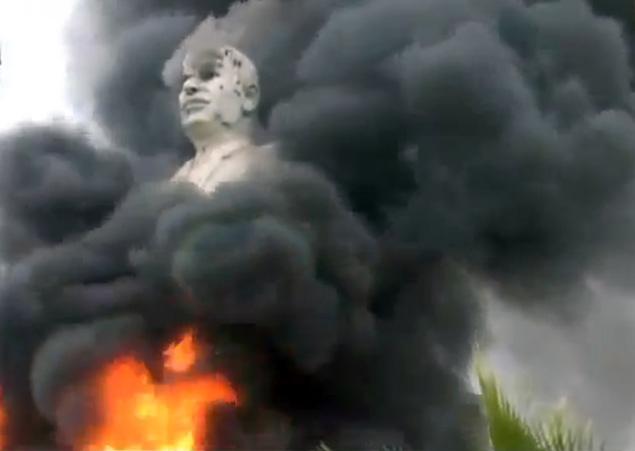
Hafez al-Assad burns in liberated Raqqa. photo by AP.
This was published in the National.
From the very start, some commentators convinced themselves that the Syrian popular revolution was plotted, funded and armed by the West. From Seamus Milne to John Pilger, from Glenn Greenwald to George Galloway, they described the West supplying oppositionist ‘jihadist elements.’ Former leftist icon Tariq Ali spoke on Russia Today of “Russia and China resisting attempts by the West to take Syria over.” Russia is resupplying the Assad regime with the materiel with which to slaughter the Syrian people, making Ali’s performance on Russia’s satellite as unedifying, and as distant from reality, as that of a commentator telling Fox News that Palestinian resistance is simply an Iranian attempt to take over Israel.
These journalists have staked their positions against the evidence. They have done so by forcing Syrian realities, breaking the edges of these jigsaw pieces, to fit their prior geopolitical concerns (their opposition to concurrent Israeli-American and Saudi enmities towards Iran) or ideological stances (that, following Iraqi and Palestinian models, the West must always be the troublemaker in the Arab world).
But Syria is neither Palestine nor Iraq; Syrian events are moved primarily by internal dynamics – namely the violence of the regime and the agency of the rising Syrian people. The conspiratorial leftist perspective misses this, first by vastly overestimating Western influence on current events (a failure to accurately diagnose the historical moment) and, secondly, by misunderstanding how unenthusiastic the West is for any rapid democratic or revolutionary change in Syria.
The Silence and the Roar
 A version of this review was published at the Independent.
“The Silence and the Roar” by Syrian novelist and screenwriter Nihad Sirees was written in 2004, long before the roar of revolutionary crowds, and the countervailing roar of gunfire and warplanes, filled Syrian skies.
The pre-revolutionary roar of the title is that of the (capitalised) Leader speaking, and of the crowd celebrating the Leader speaking, and of those being beaten because they aren’t celebrating loudly enough; a roar relentlessly repeated by radios and televisions throughout the city, accompanying the protagonist almost everywhere he goes.
Counterposed to the roar there are two forms of silence: of imprisonment and of the grave. The first holds an ironic allure, for “the most beautiful thing in the entire universe is the silence that allows us to hear soft and distant sounds.”
The narrator is Fathi Sheen, a writer fallen out of favour with the regime, silenced only to the extent that he doesn’t write any more. He’s very pleasant company, amusing and straightforward, his digressions into Aristotle and Hannah Arendt notwithstanding. Over the course of a day Fathi struggles against the flow of celebrant crowds and regime thugs to visit first his mother and then his lover. He’s been content thus far to continue not to write in return for being left alone, but it becomes clear as the hours pass that the Leader’s friends plan to drive a different sort of bargain. The novella is in part a parable of the artist surviving under dictatorship. How does he make space for creation between silent and roaring states of mind? How does he avoid the regime’s Faustian temptations? More generally, how should one resist?
One answer for Fathi and his lover Lama, as for Winston Smith and his Julia, is through sex, which they find to be “a form of speech, indeed, a form of shouting in the face of the silence.”
The Iraqi Christ
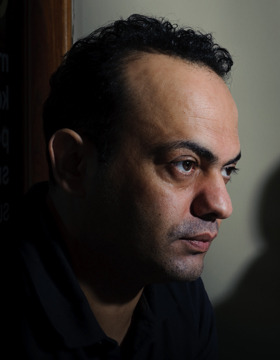
Blasim
A slightly edited version of this review was published at the Guardian.
Hassan Blasim, author of the acclaimed debut collection “The Madman of Freedom Square”, returns with fourteen more stories of profane lyricism, skewed symbolism and macabre romanticism. The qualities which distinguished the “Madman” are all here again in the opening pages of “The Iraqi Christ”: the sly self-referentiality of the frame – a story-telling competition hosted by a Baghdad radio station – the black comedy, the unexpected twists, and the sharp, disturbing images (a man “with no arms and a beard that almost reached his waist… deep in thought, like a decrepit Greek statue.”)
Like the “Madman”, this collection contains tales of war and migration, but these are more abstract, more difficult than the first, if possible stranger still. Treating casual cruelty, rape and murder, and common insanity, these sour cries from a land of generalised trauma don’t make easy bedtime reading. The processing of trauma, or the impossibility of such processing, is the collection’s central theme. Not only are stories dedicated to the dead, they are also narrated by the dead, concerned with death and the echoes of death in the souls of the living.
The subject matter is not exclusively Iraqi. Europe’s forests – with echoes of Grimm – loom as large as Baghdad’s broken streets. The title story, grimly ironic, is about a Christian soldier possessing uncanny powers of prediction who sacrifices himself so his mother may live. An extremist leader marches through with Purge The Earth of Devils tatooed on his forehead. Elsewhere, a narrator falls into a hole alongside a flesh-eating jinn who used to teach poetry in Baghdad. Another helps his brother bury a stranger alive. Characters slip into criminal perversity unwittingly, almost by accident, as spontaneously as the poisonous trees which, in “Sarsara’s Tree”, sprout from a bereaved woman’s gaze.
Blasim’s work is so unusual it’s hard to place. “A Thousand and One Knives”, as the title suggests, owes something to the heritage of the Nights and the ancient fantastic tradition of Arabic writing, now revived by the pains of Arab modernity, particularly in post-invasion Iraq. But “The Iraqi Christ” also seems to belong with the literature of Latin America, likewise struggling with contesting cultures, political violence and overbearing religion. Read the rest of this entry »
Syrian Revolutionary Culture
I and Malu Halasa discussing cultural change in the Syrian Revolution at BBC World TV. I’m looking forward to seeing Khaled Khalifa and other Syrian writers and artists in Copenhagen in a couple of days, at the exhibition organised by Malu.
Negotiations?
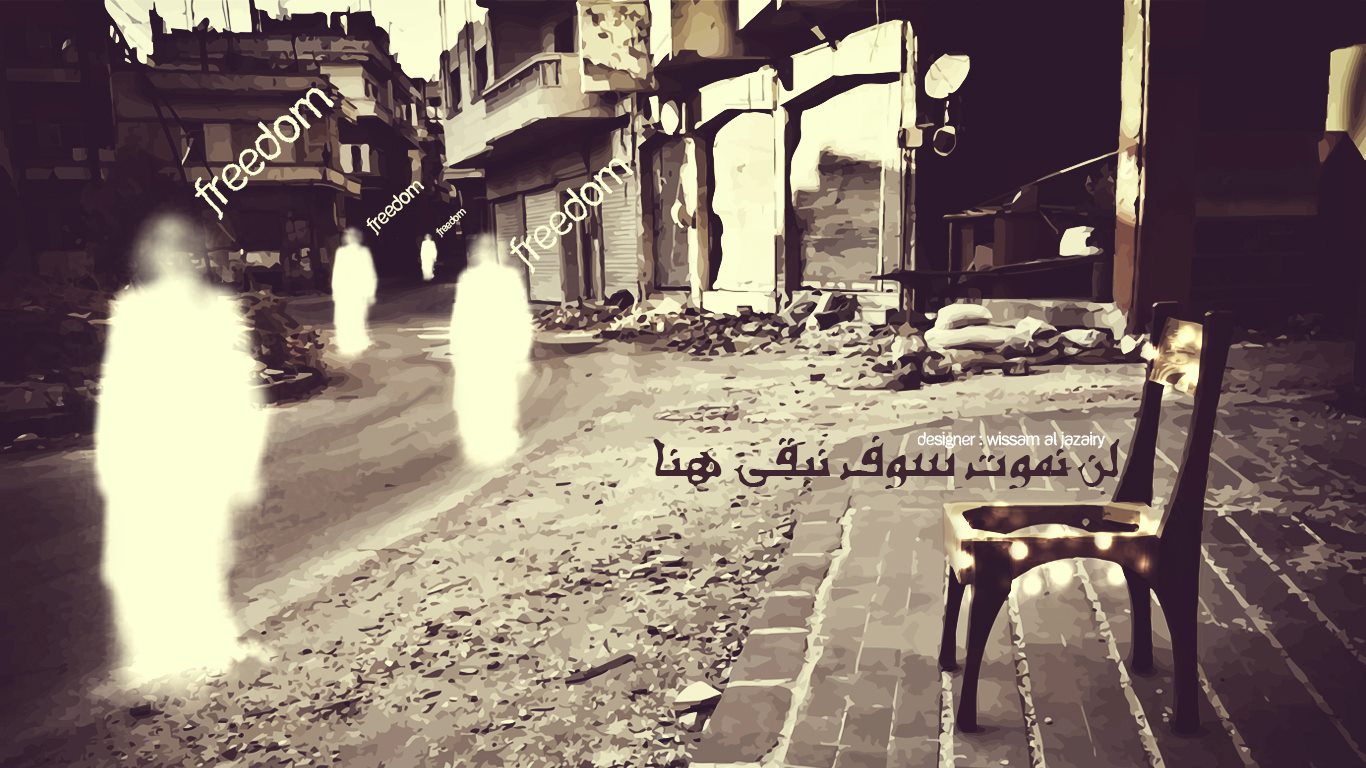
We Won’t Die We Will Remain Here by Wissam al-Jazairy
This was published at The National.
On January19th Syrian foreign minister Walid al-Moallem gave an apparently conciliatory interview to state TV. “I tell the young men who carried arms to change and reform, take part in the dialogue for a new Syria and you will be a partner in building it. Why carry arms?” In the southern and eastern suburbs of Damascus his voice was drowned out by the continuing roar of the regime’s rocket, artillery and air strikes.
The UN and parts of the media have also called for negotiations. Until late January this year, however, the Syrian National Coalition – the widely-recognised opposition umbrella group – opposed the notion absolutely. But then SNC leader Moaz al-Khatib announced that he would talk directly to regime representatives (not Bashaar al-Assad himself) on condition that the regime releases 160, 000 detainees and renews the expired passports of exiled Syrians.
In the context of Moallem’s media offensive (and in the absence of concerted international financial or military support for either the SNC or the revolutionary militias) al-Khatib’s announcement calls the regime’s bluff. It doesn’t, of course, mean that negotiations are about to be launched. For a start, the regime only intends to negotiate with, as it puts it, those “who have not betrayed Syria”. Like successive Israeli regimes, it will only talk with the ‘opposition’ it chooses to recognise. This includes, as well as pro-regime people posing as oppositionists, Haytham Manaa’s National Coordination Committee for Democratic Change, a group which has no influence whatsoever on the revolutionary fighters setting the agenda. The SNC – which does have some influence on the ground, and would have far more if it were sufficiently funded – is definitely not invited.
World Service Twice
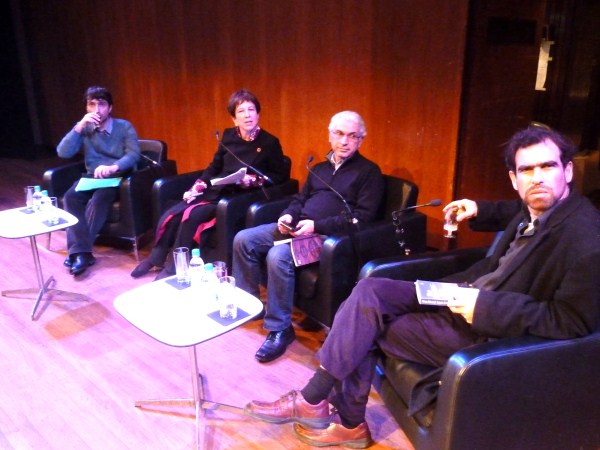
Golan drinks, Lyse looks on, Nihad eyes me suspiciously
Last night I was at London’s Purcell Room, honoured to be in the presence of novelist and screenwriter Nihad Sirees and poet Golan Hajji. The event was chaired by the BBC’s Lyse Doucet. We were talking about writing in the context of the Syrian revolution. Then I participated in the morning edition of the BBC World Service’s World Have Your Say, discussing Syria, and I joined the WHYS in the evening too, discussing Syria and Mali (on which I’m no expert) at greater length.
Here is the morning edition.
And here is the longer evening programme.
The Revolution Armed Itself
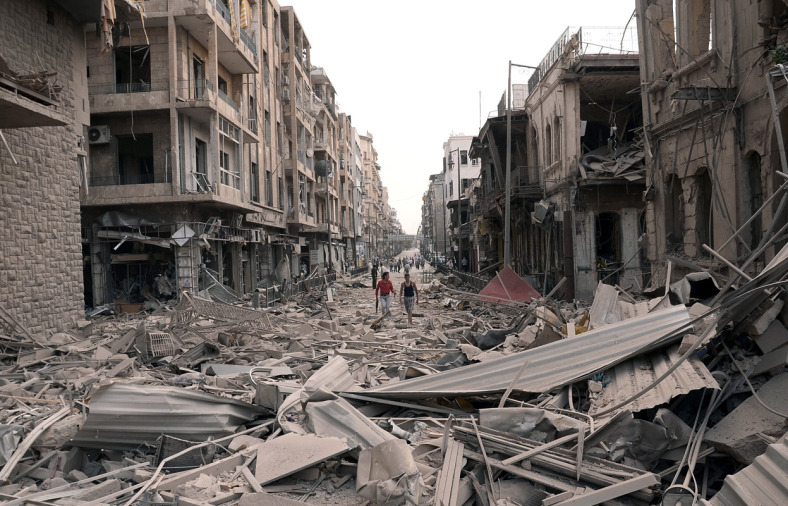 This piece, a rebuttal to Marc Lynch, was published at Foreign Policy under the title Fund Syria’s Moderates.
In response to non-violent protests calling for reform, the Baathist regime in Damascus has brought Syria bloodshed, chaos, and created the conditions in which jihadism thrives. The now partially armed revolution is doing its best to roll back the bloodshed and to eliminate the regime that perpetrates it.
Yet Foreign Policy’s Marc Lynch, one of the more perceptive analysts of the Middle East, argues that after more than 60,000 lives have been lost, “the last year should be a lesson to those who called for arming the rebels.” In a previous article, Lynch noted, “Syrian armed groups are now awash with weapons.”
Anyone laboring under the delusion that pro-revolution foreign powers have flooded Syria with hi-tech weaponry should scroll through the blog of New York Times correspondent C.J. Chivers or peruse the web pages displaying improvised catapult bombs and PlayStation-controlled armored cars. These are hardly the tools of a fighting force that has been armed to the teeth.
While it’s true that some armed groups — particularly the al Qaeda-linked Jabhat al-Nusra — have sometimes found themselves in possession of plenty of weaponry, the resistance remains overwhelmingly dependent on the weapons it can buy, steal, or seize from captured checkpoints and bases.
Simply put, the assumptions of those who called for arming the rebels have not been tested because the rebels have not been armed — except in irrelevant, sporadic and, in Lynch’s words, “poorly coordinated” ways. For instance, an ammunition shortage slowed the original rebel advance in Aleppo to a destructive halt.
Iran Shoots Itself in the Foot
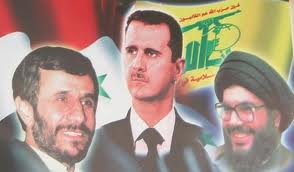 This was written for the excellent Lobelog.
In August 2012 Egyptian President Muhammad Morsi attended a meeting of the Non-Aligned Movement (NAM) in Tehran. His presence at the conference was something of a diplomatic victory for the Iranian leadership, whose relations with Egypt, the pivotal Arab state, had been at the lowest of ebbs since the 1979 revolution.
Egypt’s President Sadat laid on a state funeral for the exiled Iranian shah. A Tehran street was later named after Khalid Islambouli, one of Sadat’s assassins. Like every Arab country except Syria, Egypt backed Iraq against Iran in the First Gulf War. Later, Hosni Mubarak opposed Iranian influence in Iraq, Syria, Lebanon and Palestine, worked with the US and Saudi Arabia against Iran’s nuclear program, and was one of the Arab dictators (alongside the Abdullahs of Jordan and Saudi Arabia) to warn darkly of a rising “Shi’ite cresent”. Not surprisingly, Iran was so overjoyed by the 2011 revolution in Egypt that it portrayed it as a replay of its own Islamic Revolution.
Iran also rhetorically supported the revolutions in Tunisia and Libya, the uprising in Yemen, and, most fervently, the uprising in Shia-majority Bahrain.
In Syria, however, Iran supported the Assad tyranny against a popular revolution even as Assad escalated repression from gunfire and torture to aerial bombardment and missile strikes. Iran provided Assad with a propaganda smokescreen, injections of money to keep regime militias afloat, arms and ammunition, military training, and tactical advice, particularly on neutralising cyber opponents. Many Syrians believe Iranian officers are also fighting on the ground.
Discussing Assad’s Speech at the Opera House
“It was operatic in its otherworldly fantasy, unrelated to realities outside the building,” wrote Rami Khouri of Bashaar al-Assad’s latest speech, delivered as the bombs fell on southern Damascus. I was a guest on the BBC World Service to discuss the speech alongside Patrick Seale (Hafez al-Assad’s biographer), Syria Comment’s Joshua Landis, Faisal Yafai of the National, and Dr Yazan Abdullah. You can listen to the conversation here.
Woman in the Crossfire
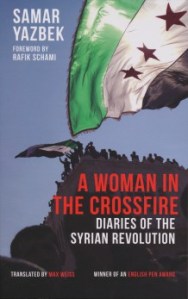 ‘A Woman in the Crossfire: Diaries of the Syrian Revolution’ by novelist Samar Yazbek is part journalism, part personal memoir, and all literature. It’s literature of the instantaneous sort, a staggered snapshot of the first four months of the revolution, a public history of “a country succumbing to the forces of death,” and an interior history too. Yazbek tells us about her headaches, her insomnia and Xanax addiction, her crying fits, her fears for her daughter and herself, her constant panic. How sometimes in the speeded-up context the rush of information precedes all feeling: “The daily news of killing,” she writes, “was more present inside of me than any emotion.”
Samar Yazbek has always been problematic. Having consecrated herself “to the promise of a mysterious freedom in life,” she left home (in Jableh, on the coast) at sixteen, later divorced her husband and lived in Damascus, a single mother, working in journalism and writing sexually controversial novels. When Syria rose up against the Asad regime she publically supported the victims and their cries for freedom. And she’s an Alawi, a member of the president’s largely loyalist sect, of a well-known family. As an unveiled and obviously independent woman, a secularist and daughter of a minority community, her support for the revolution proved the lie of regime propaganda, which characterised the uprising as Salafist from the start.
So leaflets slandering her were distributed in the mountains. She was called a traitor, made recipient of death threats, publically disowned by family and hometown. Naturally she was visited by the mukhabarat and made to experience, vicariously at least, the domestic wing of regime propaganda – for the theatre of blood is as important inside Syria as the projection of civilised moderation used to be abroad – by being walked through a display of meat-hooked and flayed torturees.
Hypocrisy, As Usual
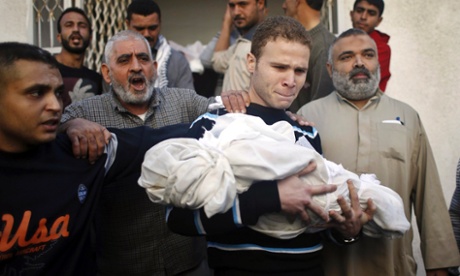
Omar al-Masharawi, son of a BBC cameraman in Gaza, murdered by Zionist bombs.
Israel has launched yet another attack against the Gaza Strip, striking the densely-populated and besieged territory from the air and the sea, and as usual the United States, Canada and Britain have lined up in support of Zionist terrorism.
Speaking from a system poisoned by the Israel lobby, State Department spokesman Mark Toner says: “There is no justification for the violence that Hamas and other terrorist organizations are employing against the people of Israel. We call on those responsible to stop these cowardly acts immediately. We support Israel’s right to defend itself.” Confusing Zionist settlers for ‘the Jewish people’, confusing perpetrator with victim, and then parroting outmoded ‘war on terror’ propaganda, Canadian foreign minister John Baird vomits the following: “Far too often, the Jewish people find themselves on the front lines in the struggle against terrorism, the great struggle of our generation.” Then Britain’s foreign minister William Hague makes the following immoral and illogical comment: “I utterly condemn rocket attacks from Gaza into southern Israel by Hamas and other armed groups. This creates an intolerable situation for Israeli civilians in southern Israel, who have the right to live without fear of attack from Gaza.”
Two things must be said. First, this round of escalation, like the 2008/2009 slaughter, was started by Israel. It is totally mendacious to pretend otherwise. The Hamas government in Gaza refrained from stopping other groups from firing missiles as a result of Israel’s murder of a disabled man and of a twelve-year-old boy in Gaza. Here is a timeline of events. Second, the settlers of southern Israel do not have the right to live without fear of attack while the original inhabitants of ‘southern Israel’ are herded into refugee camps. Eighty percent of people in Gaza are descendants of refugees ethnically cleansed from their villages and towns by Zionist militias in 1947 and 1948.
Finally, Leadership
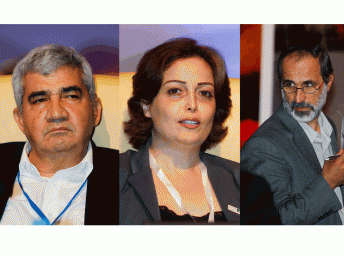
l-r: Saif, Atassi, Khatib (Reuters photo)
Following my previous comment on the astounding failures of Syrian political elites, I must report some optimism. The Syrian National Council has accepted its place within the new Syrian National Coalition (it makes up a third of the new body), and the Coalition has won recognition by the Arab League, France, Japan and others.
The Coalition’s choice of leaders is the most inspiring sign, one which suggests both that the Coalition is no foreign front, and that another, much more positive aspect of Syria is finally coming to the fore.
President Ahmad Muaz al-Khatib is a mosque imam, an engineer and a public intellectual. He is Islamist enough for the Islamists and less extreme Salafists of the armed resistance to give him a hearing, but not Islamist enough to scare secularists and minority groups. He has written books on the importance of minority religious rights and women’s rights in a just Islamic society. His speeches since assuming his position have reached out to minorities and to the soldiers in Asad’s army, who he described as victims of the regime.
Vice President Riyadh Saif is a businessman, former MP, and a liberal democrat.
And Vice President Suheir al-Atassi, daughter of foundational Ba’athist Jamal al-Atassi, is a human rights activist, a secular feminist, a founder of the Syrian Revolution General Commission, and a key activist of the grassroots Local Coordination Committees. She is the sort of person who should have been representing the Revolution at the highest level from the very start.
All three leaders have been active participants in the revolution inside Syria, and all three have suffered imprisonment. All three are known and respected by Syrians inside the country.
Syrian National Mess
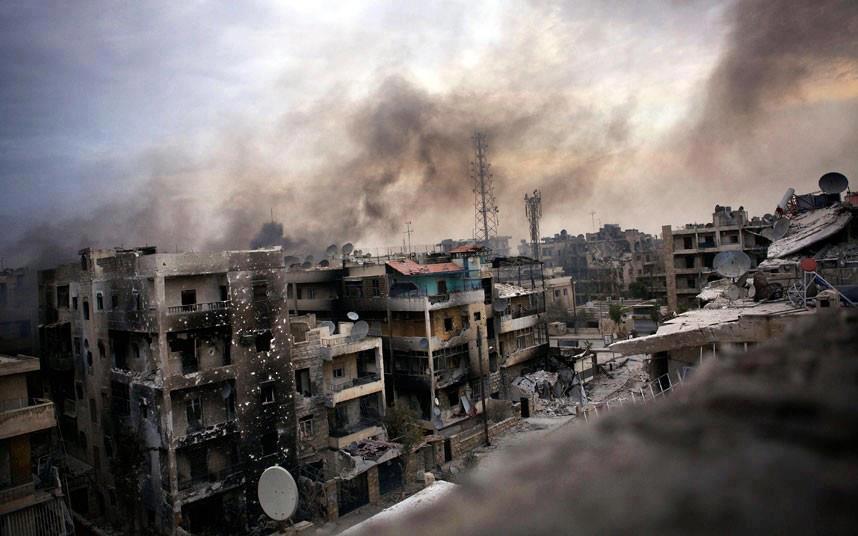 George Sabra has been elected new head of the Syrian National Council. He seems like a good man and his first interviews suggest he’s an effective talker. But his election comes as the SNC loses the last of its relevance. Despite the gravity of its historic responsibility, the Council failed to connect properly with revolutionaries on the ground, it failed to do enough to reassure minorities, or to aid refugees, it put all its eggs in the basket of a foreign military intervention which was never going to happen, it overrepresented the Muslim Brotherhood, it was bedevilled by factional and ego-based conflict, and its self-renewal process ended up with no women in the leadership. Foreign governments have lost interest in it. Crucially the grassroots Local Coordination Committes say the SNC no longer represents them. Other opposition bodies and individuals outside the SNC (some of them doubtless secretly backed by the regime) have added to the sniping and backstabbing.
Today the news is that a new, broader body has been formed to coordinate the fight against Asad, to implement law in liberated areas, and to oversee the post-Asad transition. It’s called the National Coalition of the Syrian Revolutionary Forces and the Opposition, or the Syrian National Coalition. Perhaps this initiative will be more successful than others; we’ll see. Very sadly, it took Qatari and American badgering and perhaps promises of better weaponry (at this late stage with the country in flames and the resistance finally capturing heavy weaponry for itself) to force the ‘opposition’ to coalesce. You’d think Syria’s elite politicians would have been self-motivated to compromise and act by the destruction and mass slaughter in their homeland, by the urgency of the tragedy, by the vacuum allowing nihilists and potential warlords to call shots. But no. While Syria’s grassroots revolutionaries are unparalleled heroes, seemingly capable of endless self-sacrifice, Syrian political elites have failed their people massively.
Nod
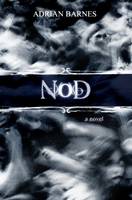 Books which are published by small publishing houses are rarely reviewed by big newspapers, and this is a shame, because small publishing houses often publish excellent work. One example is “The Madman of Freedom Square” by the brilliant Hassan Blasim, published by Comma Press. Another is “Nod”, by Adrian Barnes.
The plot is a grand metaphor worthy of Jose Saramago. For no apparent reason (though people scramble for political and spiritual explanations) people stop sleeping. Only about one in ten thousand people are spared the insomnia plague, and these quickly become victims of an anti-sleeper mass frenzy. The Awakened, as they become known, suffer gradual degeneration through irritability and clumsiness, detachment and madness, to death. Our narrator, a writer of obscure books on obscure words and phrases, is one of the remaining sleepers. Being an expert on words, he reminds us that ‘Nod’ has two somewhat contradictory meanings – both the pleasant sleepy land we send children to, and the land of Nod, the barren desolation to which God sent Cain. The narrator has to watch as his long-term girlfriend and just about everyone else around him degenerate.
If this is science fiction, it’s the literary and philosophical end of the genre, Ray Bradbury or Kafka territory. With a few inversions, Barnes’s nightmare is not so different from this ordinary sleeping world. A former social outcast discovers leadership qualities and his own religion, and sets the people to useless work. Silent children hide in parks. The experience of watching someone you love stop talking to you, stop seeing you, and finally turn into an incomprehensible monster, will be familiar to many people who’ve suffered a relationship breakdown.


 Qunfuz