The Milgram Experiment in Syria
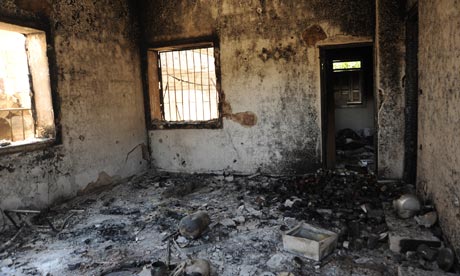
Howleh. picture by Kaveh Kazemi/ Getty Images
It has thrown students out of top-floor windows. It has shelled cities from the land and from the air. It has raped women and men and tortured children to death. Now with the massacres at Howleh and Qubair – in which Alawis from nearby villages, accompanied by the army, shelled, shot and stabbed entire families to death – the Syrian regime has escalated its strategy of sectarian provocation. Here Tony Badran explains very well the sick rationale behind these acts.
To a certain extent the regime’s plan has already worked. Now it seems inevitable that sectarian revenge attacks will intensify. In general, sectarian identification is being fortified in the atmosphere of violence created by the regime and added to by the necessary armed response to the regime. Sectarian hatred will deepen so long as the regime survives to play this card.
The regime wants us to understand the conflict in purely sectarian terms. Many Syrians recognise this and are resisting it. At this impossibly difficult time it’s good to remember the Alawi revolutionaries, who are heroes, and crucial to the revolution, heroic in the way Jewish anti-Zionists are heroic.
What do I mean by heroic? A disproportionate number of Alawis owe their livelihood to the regime. To fight for a post-regime future means to fight for a future in which their community will be, at best, less favoured than at present. This takes moral and political courage. Many Alawis have grown up surrounded not, as most Syrians have, by anti-regime mutterings, but by the happy version. To break with this version requires a psychological transformation, something as big as growing up. More concretely, there are family pressures – and family is so important in Syria. Very many Alawis are employed in the security forces. If your uncle is an officer in the mukhabarat, therefore, you don’t find it easy to publicly oppose the regime. It takes courage to do so, and the kind of confidence in your own judgment which will allow you to discount the arguments of your elders and authorities. Only a few people have such strength. (Of course it takes much more strength to live in a Sunni neighbourhood being beseiged and bombed, but this is a different kind of strength.)
Arm the Guerrillas
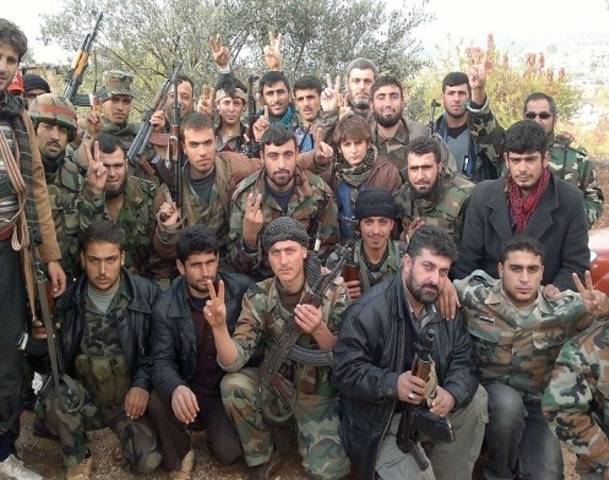
picture by Reuters
This was published at Foreign Policy.
There are some, perhaps many, Syrians who detest their government and are entirely aware of its treasonous nature — yet wish for the demonstrations and the guerrilla actions of the Free Syrian Army (FSA) to stop and for President Bashar al-Assad’s regime to regain control as soon as possible. They take this position out of a profound pessimism: They believe it is impossible to uproot the surveillance-and-torture state and its deep sectarian substructure, that more people will die the longer the unrest continues, that the economy will collapse further, and that nothing will alter the end — Assad’s inevitable victory. Some Syrians go so far as to say that the regime itself, or a branch of it, is surreptitiously encouraging demonstrations so as to have an “excuse” to teach the new generation an unforgettable lesson.
I can’t agree with this defeatist perspective on principle — the principle being my refusal to give in to despair, and my faith in the ability of human beings to change their circumstances. I understand it, however, and I understand that I might share it if I were living in the heart of the horror instead of in Scotland. But apart from principle, I think the assumption underlying the defeatist perspective is mistaken. Yes, the regime is still able to kill, and will continue or even intensify its killing. However, it has lost control of the country and won’t be able to reestablish it.
The much-maligned United Nations observers have confirmed what news reports had already suggested: Large areas of the Syrian countryside and provincial cities are either under FSA control or nobody’s. Regime forces are able to infiltrate and punish areas under the revolutionaries’ sway, but they dare not linger. Sometimes, they are not even able to move in. When the Assad regime recently attempted to retake Rastan, the FSA destroyed a number of armored vehicles and killed 23 soldiers, forcing the military to retreat.
Taliban Poetry
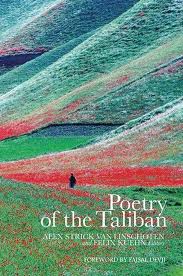 A shaved version of this review appeared in the Guardian.
In the 1980s an artist friend of mine made a poster for Gulbuddin Hekmatyar’s Hizb-e-Islami, a militia later allied with the Taliban. The poster depicted a fully-bearded Afghan mujahid clutching Quran and Kalashnikov and standing atop a slaughtered Russian bear. It was sent as a postcard to British journalists and politicians, without controversy.
In the same period I remember reading stories in the mainstream press about the Mujahideen’s poetic love of flowers and song. After the Russian rout, these Mujahideen committed excesses so extreme that it took Taliban puritanism to re-establish order. Then the Taliban committed their own excesses, of a different sort, and after 9/11 the West waged war on them for metonymic reasons. Nobody now celebrates the gentle, flowery qualities of these men who have burnt schools and lynched television sets.
“Poetry of the Taliban”, therefore, is a brave and very useful project. It offers the reader a perspective on the conflict through the Other’s eyes. It offers the human element, and as such is worth more than a library-full of cold analysis.
There are poems of love, battle, transience, grief, enthusiasm, material deprivation and mystical astonishment. The voices are diverse and often surprising. Faisal Devji’s preface points out that the poetry displayed here is not the official product of the Cultural Committee of the Islamic Emirate, not centrally-organised propaganda, but the efforts of men (and a woman) who fight for a variety of reasons, tribal, ethnic or nationalist, and particularly out of gut resistance to foreign occupiers, wherever they come from.
Ramadan’s Arab Awakening
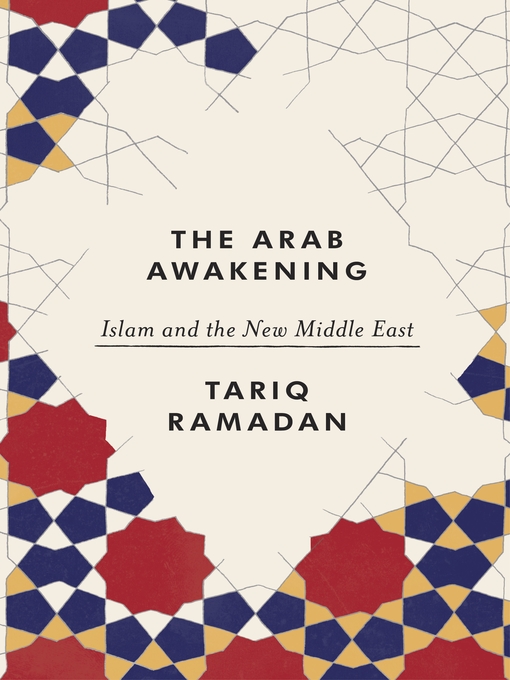 A mangled version of this review appeared in the Independent.
What is happening in the Middle East? Tariq Ramadan, one of the foremost Muslim intellectuals, calls the contemporary events ‘uprisings’, more concrete and permanent in their effect than ‘revolts’ but still short of thoroughgoing ‘revolutions’. So far, Tunisia is the only clear democratising success, and even there it remains unclear if the new dispensation will be fundamentally more just economically than the last.
Half of this slim volume is spent examining whether the uprisings were staged or spontaneous. Ramadan counsels against both the naive view that outside powers are passive observers of events, and the contrary belief that Arab revolutionaries have been mere pawns or useful idiots in the hands of cunning foreign players.
Certainly the US and its allies helped to guide events by collaborating with the military hierarchies which removed presidents in Tunisia and Egypt, and by full-scale intervention in Libya – this for a variety of obvious reasons. An agreement signed by Libya’s NTC in March last year, for instance, guaranteed France 35% of future oil exports.
There’s been Gulf and Western hypocrisy over Bahrain, home to Formula One and the US Fifth Fleet, and al-Jazeera’s coverage has been tailored to reflect its Qatari host’s strategic concerns.
Then, less convincingly, the social media conspiracy: trainees from 37 countries learned non-violent cyberactivism in Serbia. Google, Twitter and Yahoo offered training in the US. Google provided satellite access codes to Egyptian activists so they could evade censorship, but not to their Syrian counterparts.
Not Writing About Syria
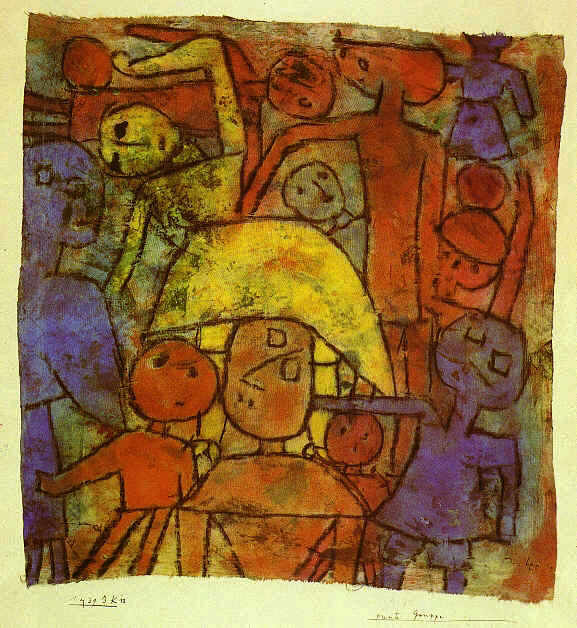
picture by Paul Klee
I haven’t been writing about Syria at my previous pace. The time is not right.
This is a time for Syrian internet activists, those still surviving, to send us their videos. It’s a time for gathering evidence – although no more evidence is needed.
It’s a time for reporters to write, for committed foreign journalists to smuggle themselves inside and tell the tale. (You could call the murdered journalists martyrs, because they chose to go to a place where they knew they might die, and they did so for the sake of the truth.)
People who have specific human stories to tell should tell them. I hear the occasional story, and I might relay some of them; but I am not there. I am observing from Scotland.
This time is the beginning of a long process of creative mulling for those who will eventually produce novels and films concerned with the tragedy.
Most of all it’s a time in which people scream and suffer and die, a time to wait for the next explosion, or the next kick at the door, or for the return of the rapists, or for the next shriek of pain and humiliation from the neighbouring cell. It’s a time for burying children at night, hastily, in silence. And the suffering continues with glacial inevitability. Fate doesn’t seem to plan an end to it, not yet.
Sectarianism and Honesty

the Syrian dictator accompanied by the Sunni mufti
This was published in the excellent Ceasefire magazine.
Ba‘athism began as a conscious attempt to supercede the sectarian and regional divisions which plague the Arab world. That’s why many of its early ideologues were Christians or members of other minority groups. The Ba‘athist slogan umma arabiya wahida zat risala khalida – One Arab Nation Bearing an Eternal Message – employing the word for ‘nation’ which previously designated the international Muslim community, and the word for ‘message’ previously associated with the Prophet Muhammad’s divine message – suggests that this variety of Arabism actually intended to supercede religion itself, or to become a new religion.
In Iraq it all went wrong very quickly. Saddamist Ba‘athism in effect designated ethnic Arabs of the Sunni sect as true Arabs, the Shia majority as quasi-Persian infiltrators, and the Kurds as an enemy nation. Saddam even wrote a characteristic pamphlet called ‘Three Things God Should Not Have Invented – Persians, Jews and Flies’, and so demonstrated the slip from nationalism to fascism.
Syria was somewhat different, somewhat more sophisticated. Despite the fact that the president and his top spies and generals were Alawis from the Lattakkia region, only Sunni Islam and Christianity were taught in the education system (to the chagrin of traditional Alawi shaikhs). When the president prayed in public he prayed in the manner of the majority, Sunni-style. In the last couple of decades the regime sought to broaden its base by coopting Sunni businessmen as well as soldiers from the minority groups. And the majority’s rituals and religious festivals were never banned as they were in Iraq.
Critical Muslim
I’d like to draw your attention to the Critical Muslim, a new quarterly journal which looks like a book. I co-edit the journal with Ziauddin Sardar, who is perhaps Britain’s most prominent ‘critical Muslim’. The CM is concerned with the politics, economics, culture, law and literature of the Muslim world – and of course the Muslim world today includes locations such as London and Lima. Our writers are convinced and sceptical Muslims, religious and cultural Muslims, and non-Muslims. We publish a range of perspectives, usually but not always with a somewhat leftist leaning. And the CM has a sense of humour.
I’m very proud of the arts section. The first issues include a story by the accomplished British-Pakistani writer Aamer Hussein, poetry and prose from upcoming Iraqi writers (one of whom is the very highly-rated Hassan Blasim), a selection of the Arabic poetry (Qabbani and others) which accompanied the Arab uprisings, essays on the Palestine Literature Festival and the Erbil Literature Festival (in Iraqi Kurdistan), a great story of cross-cultural love (and disappointment) by young British writer Suhel Ahmed, poetry from the great Mimi Khalvati, an essay on Muslim jazz, and much more.
Arab Writers at the Book Cafe
I was on BBC Radio Scotland’s Book Cafe talking about writing from the Arab world at this revolutionary time. Here it is:
I mention novelist Manhal al-Sarraj’s immediate response to the repression in Syria, ‘Syrian Scenarios’, which can be read here.
The Karachi Literature Festival
I’ve recently come back from an excellent three weeks in Pakistan visiting universities, farms, shrines and old friends. I started at the Karachi Literature Festival. In the session below, I, Stefan Weidner and Anouar Benmalek discuss the Arab Spring.
Here’s me doing a creative writing class at the festival. Part one. And part two. It’s probably very boring to watch on video except perhaps for the less formal question and answer at the end.
Out Of It
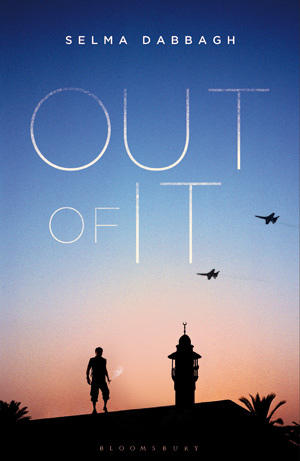 This review appeared in the Guardian.
The Mujaheds, if somewhat more privileged than their neighbours, are a typically itinerant Palestinian family who have learnt to attach sentimental value “only to the small things, the ones that could be thrown into suitcases and scurried away with.” Originally from Jaffa, now returned from Tunis, Beirut and Scandinavia, the novel’s opening finds them living in Gaza in the early years of the second intifada.
One of the many strengths of Selma Dabbagh’s writing is its unerringly precise sense of place. Gaza, imagined from inside with the mental aid of satellite images, is “like dried-out coral, ridged, chambered and sandy.” It contrasts with Israel, “the other side, that side, the place they came from, that had been theirs,” which, studded by solar panels, swimming pools and irrigated fields, looks from above like “an elaborate blanket of modernist design.”
Life in the Mujahed apartment, between the noise of nearby families and the louder noise of warplanes and helicopters, may be like “camping under a flyover”, but it’s better than living in tents as the neighbours – refugees from house demolitions – are forced to do.
The details of dispossession and siege are relentlessly accumulated: the rotting flowers and fruit blocked off from the market by the ‘closure’, the targetted killings, incursions and arbitrary arrests, as well as the increasingly violent internal competition between the religious parties and the corrupt Palestinian Authority whose luminaries are “yearning for cheap suits and desks with name plaques.”
The Liberation of the Golan
Today demonstrators marched against the Syrian regime in Majdal Shams on the occupied Golan Heights. (For believers in the sectarian narrative, most of the people here happen to be Druze, not Sunnis). One of their slogans was ash-sha‘ab yureed tahreer al-jowlan – The People Want the Liberation of the Golan. The Syrian regime, which has slaughtered over 6,000 civilians since the revolution started, hasn’t fired a bullet over the Golan since 1973. In the clip below Asad loyalists confront the protestors, but are outnumbered. The demonstrators shout almowt wala almuzuleh – Death Rather Than Humiliation – and illi yiqtil sha‘abu kha’in – He Who Kills his People is a Traitor.
It’s interesting to note that the Golan was occupied by Zionists in 1967, before most of the demonstrators were born, and illegally annexed in 1982. The very Syrian drama unfolding on these ‘Israeli’ streets proves – if proof were needed – the absurdity of Zionist hopes that Arab national identity on occupied territory will gradually evaporate.
Now The Bombs
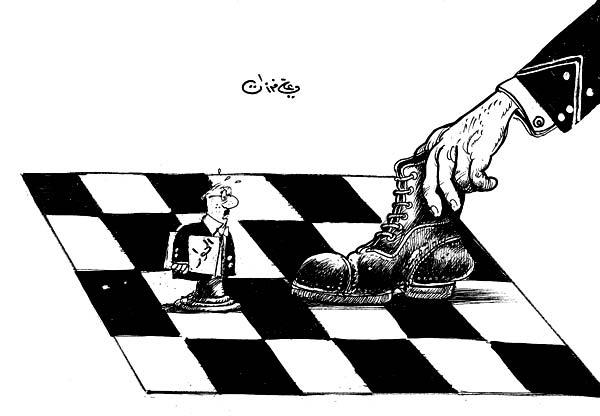
by Ali Farzat
Many Syrians have been awaiting this moment with dread. A further step down into bloody chaos and incipient civil war, a further step into the dark. This morning two car bombs exploded at security installations in Kafar Souseh, Damascus. At least thirty people were killed and over 100 injured.
Who’s to blame? There is no evidence of anyone’s guilt, and there won’t be any credible evidence while the criminal Asad regime remains in power and continues to lie and to block journalists’ access. This means that pro-regime people will follow the regime line and blame al-Qa’ida, and anti-regime people will blame the regime. I make no bones about it: I’m firmly in the anti-regime camp. Those who followed my writing before this year will know that I was once willing to give the regime the benefit of the doubt. Not any longer. This year I’ve been forced to admit that the regime is a lot less intelligent, a lot less sophisticated, than I thought. Back in February it had enough popularity to lead a genuine reform process. It’s entirely possible that Bashaar al-Asad, had he played this revolutionary year right, could have won a real election. But he didn’t play it right. From the start his regime slaughtered peaceful protestors and subjected thousands to torture, including children, even to death. Worst of all, the regime instrumentalised sectarianism in an attempt to divide and rule. After months of attacks by armed Alawi gangs on predominantly Sunni lives and property there are now instances of ‘revenge’ attacks on innocent Alawis, and tit for tat sectarian killings particularly in Homs and its surrounding countryside. All of this could have been predicted months ago. Of course, the mechanics of these killings is as obscure as that behind the bomb attacks in Damascus today. Some revolutionaries believe the regime is behind the killings of Alawis too, because it aims to spark a sectarian war which it thinks it can win. And we must not forget that sectarian war is still – to the credit of the Syrian people – not the dominant strain in the conflict. There are thousands of defected soldiers, many of whom have seen their comrades gunned down. If they had chosen to they could have attacked the minorities in a coordinated fashion. They haven’t. And the Alawi actress Fadwa Sulaiman is still leading demonstrations in the Sunni heart of Homs.
Sarmada

Fadi Azzam
A slightly shorter version of this review appeared in The Independent.
Places have moods, this novel reminds us. Sometimes Sarmada, a mountain village rising from the Hauran plain of southern Syria, is all “oblivion, dust and tedium”; at other times it’s a shimmering delight, each rock, tree, spring, cliff and cave owning rich meanings and histories. Sarmada is also “a Sheherazade”, a generator of tales, so many tales we can’t possibly hear them all. “I thought about telling her the joke about the overweight fortune-teller,” Azzam writes, “but..”
Like the Arabian Nights, “Sarmada” contains stories within a frame story. The frame and trigger is a meeting with Azza Tawfiq, an expert in chaos theory at the Sorbonne who (following the Druze tenet of transmigration) believes she lived in Sarmada in a past life as a murdered girl called Hela Mansour. Bemused, disbelieving, the narrator returns from “chasing dreams in Paris and delusions in Dubai” to excavate the village’s memories, at first on Azza’s behalf.
Aftermath
 The first issue of Critical Muslim, a quarterly magazine in book form co-edited by Ziauddin Sardar and me, will be in the shops in January. More on that at a later date. Today I’m finishing off a long essay on Syria, Iraq and sectarian hatred for Critical Muslim’s third issue. Amongst the books I review in the essay are Fanar Haddad’s indispensable “Sectarianism in Iraq” and Nir Rosen’s “Aftermath: Following the Bloodshed of America’s Wars in the Muslim World,” which is also indispensable, in a different way. As a taster, here’s the section on “Aftermath.”
For a mix of contextual analysis and gripping reportage, the reader will find no better book than Nir Rosen’s magisterial “Aftermath: Following the Bloodshed of America’s wars in the Muslim World”.
Most Western correspondents were flown into Iraq unable to speak Arabic, largely ignorant of the context, to pass their time attending coalition press briefings or embedded with the US military. Their reports were heavy with simplistic labels (‘the Sunni triangle’, for instance) and ignored non-sectarian nationalism and class issues. Rosen’s writing on Iraq is the polar opposite of such parachute journalism. He speaks Arabic for a start, and blends in physically as a result of the “melanin advantage” bequeathed by his Iranian father. More to the point, he is courageous and energetic, going where few outsiders would dare, whatever their skin tone. He’s a reporter of the best kind, capable of locating pattern behind the copious detail. So he doesn’t merely report the mosque sermons he attended, or his encounters with militiamen and their victims, but accurately interprets and reads between the lines. His descriptions of time, place and personality are vivid, with not an ounce of orientalism added. His lack of sentimentality combined with his obvious sympathy for the people of the region make him the perfect candidate to voyage into the sectarian heart of darkness.
Turn It Up
For Syrians it’s an exhilarating experience simply to express honest political opinions out loud in a public place. For decades anti-regime gripes have been expressed in private, in whispers. Many were frightened to speak even in the home, lest the children repeat what they’d heard at school. But now people are screaming and singing against the regime every morning, afternoon and night. The sense of solidarity amongst the revolutionaries – breaking the fear barrier together, facing possible torture and death together – is enormous. These two films demonstrate the sometimes carnivalesque quality of the revolution as well as the Syrian people’s musicality. In the first, filmed in Da’el in the Hawran, a romantic tune is turned into an anti-Asad anthem. In the second, filmed in the Baba Amro neighbourhood of Homs, the authorities cut electricity to a protesting area; the protestors illumine their mobile phone screens and keep on going. Both films should be watched with the volume on maximum.


 Qunfuz