Posts Tagged ‘Anand Gopal’
Syrian Solidarities
This essay was first published at New Lines Magazine. It reviews five recent books on Syria: Rime Allaf’s It Started in Damascus: How the Long Syrian Revolution Reshaped Our World; Noor Ghazal Aswad’s Searching for Solidarity: Revolutionary Dreams and Radical Social Movements; Loubna Mrie’s Defiance: A Memoir of Awakening, Rebellion and Survival in Syria; Anand Gopal’s Days of Love and Rage: A Story of Revolution; and Patrick Haenni and Jerome Drevon’s Transformed by the People: Hayat Tahrir al-Sham’s Road to Power in Syria.
*
One way of approaching politics is to think of it in emotional terms. How do different groups in society, or different nations, bond with and love each other or, on the contrary, demonize and then ignore or fight each other? This question is taken up by the authors of a clutch of new and recent books on Syria that ask how Syrians relate to each other, as well as how the world beyond Syria shows solidarity with, ignores or misrepresents Syrians.
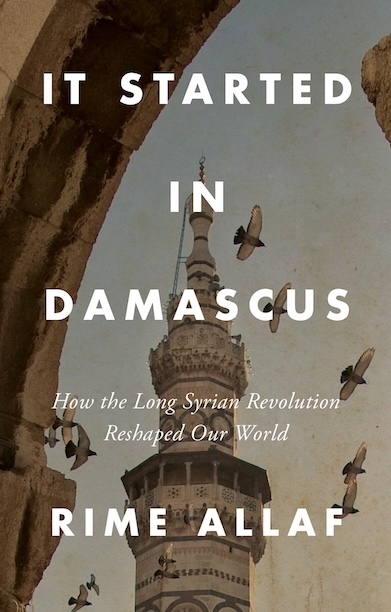
“It Started in Damascus: How the Long Syrian Revolution Reshaped Our World,” by the commentator and former Chatham House Associate Fellow Rime Allaf, explains how, having brought down the old bourgeoisie and landowning class, Hafez al-Assad’s regime elevated a new, loyalist “velvet society,” distinguished above all by its freedom from accountability. Under the rule of Bashar al-Assad — whom Allaf characterizes as arrogant yet indecisive, a ham-fisted politician and “an ill-equipped and temperamental ruler” — the crony elite and their entourages also flaunted outlandish wealth, in contrast to the immiseration of the majority of Syrians. In what became known as the kingdom of silence, most followed the rule of “survival of the quietest.” It was the velvet elite that made all the noise.
The unfeeling arrogance of this elite and their almost colonial attitude to those they considered their subjects is perhaps best illustrated by recently leaked videos of Bashar mocking the inhabitants of the war-wrecked Ghouta suburbs of Damascus before he was overthrown. “They don’t have enough to eat, but they spend money on building mosques,” he said from behind the wheel of his car, giggling as if his role in starving the area had nothing to do with it. “God damn the people of the Ghouta.”
As well as this affective gulf dividing the rulers from the ruled, Assad regime policies cut Syrians off from the rest of the world, from global goods as well as ideas. In the Hafez years, bananas and tissues were expensive luxury items that only appeared in the markets when a regime crony chose to bestow a delivery. Import taxes put almost all foreign items out of reach of ordinary people. Over 5 million Syrians, nearly a quarter of the population, were also banned from traveling abroad as punishment for their presumed disloyalty.
Yet Western scholars, journalists, politicians, diplomats and even “anti-imperialist” activists consistently ignored the conditions and wishes of ordinary Syrians, cutting them off again. Allaf’s book is most successful when she sets her account of disastrous regime failures against the willed misrepresentations of the polity in Western media and scholarly output. She charges these commentators with a failure to see Syrian society behind Orientalist assumptions and geopolitical headlines that often turned out to be wrong. Their reporting was “superficial … laden with clichés, accompanied by simplistic analysis and some outright nonsense.”
Allaf includes among those who knew and cared little for Syrian society the scholar “whose body of work included one of the most flattering and forgiving biographies a tyrant could hope for.” She is diplomatic enough not to name the culprit, but Syria-watchers will recognize Patrick Seale, a British journalist and historian of the Middle East. That biography and a great deal of other commentary gave the impression that Hafez al-Assad was a “fox,” a deft and cunning political operator. Allaf’s analysis depicts someone much clumsier and much more brutal. Hafez lost the Golan Heights to Israel and locked Lebanon into conflict while subjecting Syria to economic stagnation and “national identity theft” as its streets, libraries, schools and lakes were renamed after the tyrant. Worst of all, he exploited and expanded sectarian and ethnic cleavages between Syrians in order to shore up power.
When she covers the revolutionary years, Allaf combines a nuanced exploration of diplomatic responses to the crisis with an insider account of attempts to build a political opposition outside Syria, and she returns to her theme of a Western media that takes no account of ordinary Syrians. Journalists described Bashar as “soft-spoken” and repeatedly pointed out that he was Western-educated, that his wife was British-born, and that he wore a suit, as if these details weighed against the daily war crimes. Western media sought endless “exclusive” interviews with Assad well after it had been proved that he consistently lied; a whole page is given to listing these “exclusives.” The same sort of journalist sometimes sneered — no doubt correctly — at Al Jazeera’s fawning interviews with senior al Qaeda figures. Some journalists embedded with Assad regime forces. Some even interviewed prisoners in Assad’s notorious prisons. In those cases, unsurprisingly, the prisoners “confirmed” that they were not in fact revolutionaries but foreign-backed terrorists. Meanwhile, no serious interviews were conducted with opposition leaders. Revolutionaries were always called “rebels,” a descriptor usually inaccurately prefixed by “U.S.-backed.” The Assad regime was constantly called “secular,” though it was perhaps the most sectarian force in the country, at least until the rise of the Islamic State group. And Western journalists applied a “war on terror” framing to the conflict even before Assad had created the conditions for a regional clash of Sunni and Shiite jihadists.
Allaf’s critique extends to Western oppositionists, Islamophobes and conspiracy theorists, then all the way to the U.N., which spent $82 million at the Four Seasons, a hotel owned by a sanctioned Assad crony, but failed to ameliorate the desperate conditions of Syrians under bombs and in refugee camps. “The Syrian Revolution exposed everyone, everywhere,” Allaf writes.
Read the rest of this entry »