Posts Tagged ‘Hafez al-Assad’
The Tragic Arc of Baathism
An edited version of this essay was published by Unherd.
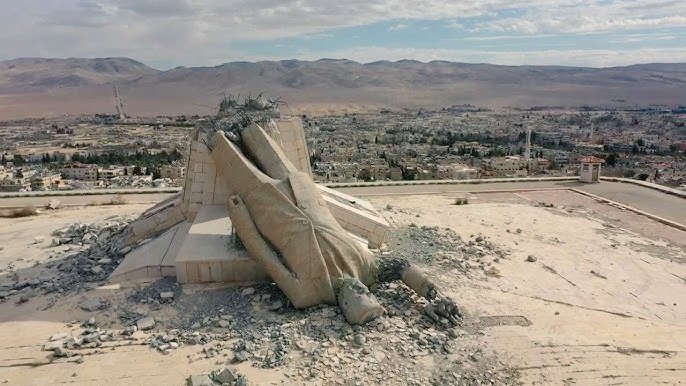
As well as the most persistent, the Syrian Revolution has been the most total of revolutions. Starting in early 2011 and culminating unexpectedly in December of 2024, it – or rather, the Syrian people – managed to oust not only Bashar al-Assad, but also his army, police and security services, his prisons and surveillance system, and his allied warlords, as well as the imperialist states which had kept him in place. The revolutionary victory marked the end of a dictatorship which had lasted 54 years (under Bashar and his father, Hafez), and also the final, belated death of the 77-year-old Baath Party, once the largest institution in both Syria and Iraq.
Founded in Damascus in April 1947, the Arab Socialist Baath Party went through three major stages, each closely related to the vexed political history of the Arab region. The first stage was one of abstract and unrealistic ideals. Baathism was the most enthusiastic iteration of Arab nationalism. Whereas Egyptian president Gamal Abdul Nasser understood the Arab world as a strategic depth for Egypt and a field in which he could exert his own influence, the Baathists had an almost mystical apprehension of the Arabs as a nation transcending historical forces, one which had a “natural right to live in a single state.”
The founding figures were Syrians who had immersed themselves in European philosophy (Bergson, Nietzsche and Marx) while studying at the Sorbonne in Paris. Two of the three founders were members of minority communities, and it’s useful to think of Baathism as a means of constructing an alternative identity to Islam. While Salah al-Din Bitar was a Sunni Muslim, Michel Aflaq was an Orthodox Christian and Zaki Arsuzi was an Alawi who later adopted atheism. The three mixed enlightenment modernism with romantic nationalism. Arsuzi, for instance, believed Arabic, unlike other languages, to be “intuitive” and “natural”. And Aflaq turned the usual understanding of history on its head. He considered Islam to be a manifestation of “Arab genius”, and deemed the ancient pre-Islamic civilizations of the fertile crescent – the Assyrians, Phoenicians, and so on – to be Arab too, though they hadn’t spoken Arabic.
Like other grand political narratives of the 20th Century, Baathism was an attempt to repurpose religious energies for secular ends. The word Baath means “resurrection”. The party slogan was umma arabiya wahida zat risala khalida, or “One Arab Nation Bearing an Eternal Message”, which sounds strangely grandiose even before the realization that umma is the word formerly used to describe the global Islamic community, and that risala is used to refer to the message delivered by the Prophet Muhammad.
The party’s motto – “Unity, Freedom, Socialism” – referred to the desire for a single, unified Arab state from the Atlantic Ocean in the west to the Arabian Gulf in the east, and from Syria in the north to Sudan in the south. The Arab state should be free of foreign control, and should construct a socialist economic system.
This dream was spread by countryside doctors and itinerant intellectuals. In those early days, the leadership consisted disproportionately of schoolteachers and the membership of schoolboys. In 1953, however, the party merged with Akram Hawrani’s peasant-based Arab Socialist Party. This brought it a mass membership for the first time, and it came second in Syria’s 1954 election.
By then, episodes of democracy were becoming more and more rare. Since Colonel Husni al-Zaim’s March 1949 coup – the first in Syria and anywhere in the Arab world – politics was increasingly being determined by men in uniform. The most significant of these soldiers was Nasser, who seized power in Cairo in 1952, then became a pan-Arab hero when he confronted the UK, France and Israel over the Suez canal in 1956.
Read the rest of this entry »Dubious Wisdom
 I wrote this review of Bente Scheller’s book for al-Jazeera.
Syrian poet Rasha Omran once told me that Bashaar al-Assad is “not a dictator, just a gangster boss.” But really he’s not even that. What he is, is what his father looked like in all those statues – one element in the managerial class, a (dysfunctional) functionary. Syria is a dictatorship which lacks an efficient dictator.
Hafez al-Assad – the father – was an entirely different matter. Born in a dirt-floor shack, he clawed his way to the top by brute cunning, deft flexibility, and strategic intelligence. The careful manipulation of sectarian tensions in order to divide and rule was one of his key strategies, yet he was also attentive to building alliances with rural Sunnis and the urban bourgeoisie – both constituencies now alienated by his son. Bashaar’s great innovation was supposedly economic reform. In practice this meant an unpleasant marriage of neoliberalism with crony capitalism. It succeeded in making his cousin Rami Makhlouf the richest man in the country. The poor, meanwhile, became much poorer, the social infrastructure crumbled, and unemployment continued to climb.
The thesis of former German diplomat Bente Scheller’s book “The Wisdom of the Waiting Game” is that the Syrian regime’s approach to its current existential crisis follows a “narrow path consistent with previous experience,” and she focuses on foreign policy to make this point. When the regime found itself isolated on Iraq after the 2003 invasion, for instance, or then on Lebanon in 2005 after the assassination of Rafiq Hariri and the Syrian army’s precipitous withdrawal, it waited, refusing to change its policy, until conditions changed, its opponents were humbled, and it was brought in from the cold. In his book “The Fall of the House of Assad”, David Lesch points out that Bashaar al-Assad felt personally vindicated by these perceived policy victories, and grew in arrogance as a result. Today, with the West handing the Syrian file over to Russia, and seemingly coming round to Bashaar’s argument that Islamism poses a greater threat than his genocidal dictatorship, it looks (for now at least) as if the refusal to budge is again paying off.
The most interesting parts of Scheller’s book are not actually dedicated to foreign policy, but describe – accurately and with balance – the causes of the revolution and the nature of the regime’s response. The most direct link she’s able to posit between domestic and foreign policy is that, in both, the regime’s only abiding interest has been self-preservation. In Scheller’s words, “regime survival … defines what is perceived as a security threat.” This chimes well with the shabeeha graffiti gracing Syrian walls – “Either Assad or we burn the country.” In regime priorities, Assad always stood far above the people, the economy, the infrastructure, and even the integrity of the national territory.



 Qunfuz