Posts Tagged ‘Bashar al-Assad’
Rushed Justice Won’t Bury the Past
I wrote this in response to the unexpected and sudden death sentence delivered to Bashar al-Assad. It was first published at Syria Direct.
On August 11, 2026, Atef Najib was sentenced to death by the Fourth Criminal Court in Damascus. As head of Political Security in Daraa in 2011, Najib was responsible for the torture of a group of schoolboys who had sprayed anti-government graffiti—an event that helped catalyze the Syrian revolution. Some of those schoolboys testified against him in court. Najib also ordered the repression of protests with live ammunition. For the people of Daraa, his presence in court, forced to hear the testimony of his victims, was a long-awaited symbol of justice being done.
Others, however, were sentenced in absentia, without a full accounting of their crimes and without facing any of their victims in court. They included the very top officials of the former regime, foremost among them Bashar al-Assad himself. Syria’s former dictator—and Atef Najib’s cousin—is directly or indirectly responsible for the killings of hundreds of thousands of people. Bashar’s brother Maher, former head of the Fourth Division, which launched sarin and chlorine attacks, enforced starvation sieges and barrel-bombed neighborhoods to oblivion, was also sentenced to death. So too were several others, including former defense minister Fahd al-Freij.

For many people, these verdicts—particularly the one against Bashar—look like justice, and in a very obvious sense they are. The man who ordered the burning of Syria’s cities and the torture to death of its youth is finally being held to account. The man it was forbidden to criticize, on pain of death, now has his own appointment with the noose. Wrongs are being righted and the past is being buried. That is why crowds celebrated the verdicts outside the Palace of Justice in the capital, as well as in Daraa. Some of Syria’s hundreds of thousands of bereaved and tormented mothers will sleep more soundly now.
Other voices, however, are drawing attention to flaws and drawbacks in the process. Amnesty International, for example, called on Syria’s transitional government both to abolish the death penalty on principle and to end trials in absentia. Many Syrian victims of the Assad government will be angered by this, but we should all consider Amnesty’s principle, which may align with the Quranic warning: “He who kills a soul neither in revenge for another, nor to prevent corruption on earth, it is as if he killed the whole of mankind” (Quran 5:32, in Tarif Khalidi’s translation).
The warning has two parts. It does sanction—though it certainly does not prescribe—the death penalty for murder and for “corrupting the earth,” a term referring to crimes that undermine society, which could cover massacres, mass detention and so on. On the other hand, it stresses the gravity of getting it wrong. Nobody sane would dispute Bashar al-Assad’s guilt, but what of all those who may be sentenced to death in the Syria of today and tomorrow? Can it be guaranteed that their trials will always be fair and fully informed?
There’s another question which, in this case, is even more relevant. Could a performative death penalty verdict potentially be used to silence the voices of victims, avoid a full accounting and make an inconvenient problem go away?
Read the rest of this entry »The Tragic Arc of Baathism
An edited version of this essay was published by Unherd.
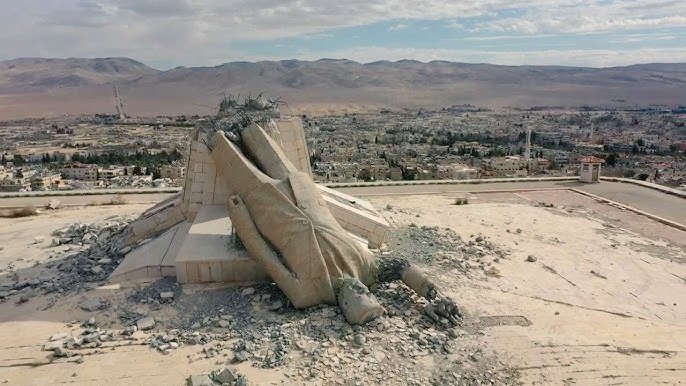
As well as the most persistent, the Syrian Revolution has been the most total of revolutions. Starting in early 2011 and culminating unexpectedly in December of 2024, it – or rather, the Syrian people – managed to oust not only Bashar al-Assad, but also his army, police and security services, his prisons and surveillance system, and his allied warlords, as well as the imperialist states which had kept him in place. The revolutionary victory marked the end of a dictatorship which had lasted 54 years (under Bashar and his father, Hafez), and also the final, belated death of the 77-year-old Baath Party, once the largest institution in both Syria and Iraq.
Founded in Damascus in April 1947, the Arab Socialist Baath Party went through three major stages, each closely related to the vexed political history of the Arab region. The first stage was one of abstract and unrealistic ideals. Baathism was the most enthusiastic iteration of Arab nationalism. Whereas Egyptian president Gamal Abdul Nasser understood the Arab world as a strategic depth for Egypt and a field in which he could exert his own influence, the Baathists had an almost mystical apprehension of the Arabs as a nation transcending historical forces, one which had a “natural right to live in a single state.”
The founding figures were Syrians who had immersed themselves in European philosophy (Bergson, Nietzsche and Marx) while studying at the Sorbonne in Paris. Two of the three founders were members of minority communities, and it’s useful to think of Baathism as a means of constructing an alternative identity to Islam. While Salah al-Din Bitar was a Sunni Muslim, Michel Aflaq was an Orthodox Christian and Zaki Arsuzi was an Alawi who later adopted atheism. The three mixed enlightenment modernism with romantic nationalism. Arsuzi, for instance, believed Arabic, unlike other languages, to be “intuitive” and “natural”. And Aflaq turned the usual understanding of history on its head. He considered Islam to be a manifestation of “Arab genius”, and deemed the ancient pre-Islamic civilizations of the fertile crescent – the Assyrians, Phoenicians, and so on – to be Arab too, though they hadn’t spoken Arabic.
Like other grand political narratives of the 20th Century, Baathism was an attempt to repurpose religious energies for secular ends. The word Baath means “resurrection”. The party slogan was umma arabiya wahida zat risala khalida, or “One Arab Nation Bearing an Eternal Message”, which sounds strangely grandiose even before the realization that umma is the word formerly used to describe the global Islamic community, and that risala is used to refer to the message delivered by the Prophet Muhammad.
The party’s motto – “Unity, Freedom, Socialism” – referred to the desire for a single, unified Arab state from the Atlantic Ocean in the west to the Arabian Gulf in the east, and from Syria in the north to Sudan in the south. The Arab state should be free of foreign control, and should construct a socialist economic system.
This dream was spread by countryside doctors and itinerant intellectuals. In those early days, the leadership consisted disproportionately of schoolteachers and the membership of schoolboys. In 1953, however, the party merged with Akram Hawrani’s peasant-based Arab Socialist Party. This brought it a mass membership for the first time, and it came second in Syria’s 1954 election.
By then, episodes of democracy were becoming more and more rare. Since Colonel Husni al-Zaim’s March 1949 coup – the first in Syria and anywhere in the Arab world – politics was increasingly being determined by men in uniform. The most significant of these soldiers was Nasser, who seized power in Cairo in 1952, then became a pan-Arab hero when he confronted the UK, France and Israel over the Suez canal in 1956.
Read the rest of this entry »