Author Archive
Action
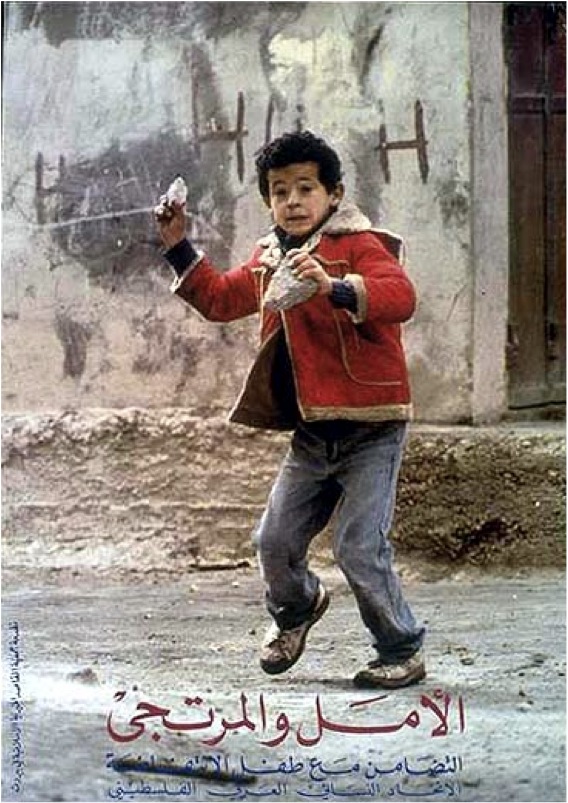 I haven’t used this blog for activism before, and I may not again. But for now, there is information below on how to demonstrate, donate, and write letters. The Zionist propaganda machine has won as usual in the West: Hamas are portrayed as the aggressors; western governments justify the slaughter; nobody talks about the root of the problem: Zionist apartheid and ethnic cleansing. Can you do anything except work up to a heart attack? See below. Please send this information on to others.
Besieged
 This morning’s assault on Gaza and the massacre of 205 Palestinians (so far) was easy to foresee. First came the official lapse of the six-month ceasefire between Israel and Hamas. Then an Israeli incursion, and the Gazan response: firing dozens of home-made Qassam missiles at southern Israel. A little bit of damage was done to property as a result. Meanwhile, Hamas leaders said they’d be pleased to work out a renewed ceasefire deal. According to Haaretz, Shin Bet chief Yuval Diskin understood this clearly enough: “Make no mistake, Hamas is interested in continuing the truce, but wants to improve its terms. It wants us to lift the siege, stop (IDF) attacks, and extend the truce to include Judea and Samaria (the West Bank),” he said.
Extending the truce, and letting the Gazans live, seem not to be on Israel’s agenda. It’s election time, and the mood for stamping out resistance has taken Israel in its arms.
In other circumstances it might seem strange that a population on the Mediterranean coast is being besieged and starved without a murmur from the rest of the world. But this is Gaza, Palestine, and the victims suffer alone. Reports say Mubarak had given his assent to a ‘limited blow’ before today’s blood; he’s been keeping the Egyptian border with Gaza sealed, keeping the ugly oppressed in their cage very effectively since they briefly broke out last January. Tony Blair – who should be in prison but is instead poncing about in Ramallah and Jerusalem – has been winking to Israeli journalists about necessary change in Gaza. No response to today’s crime is likely in Lebanon, or Jordan, or Egypt. The peoples of Europe and America are, by and large, silent.
Shoes and Bullets
George Bush has had shoes thrown at him in Baghdad. As he threw the first, Muntadar az-Zaidi shouted, “This is a goodbye kiss from the Iraqi people, dog.” As he threw the second, he added, “This is for the widows and orphans and all those killed in Iraq.” It was gratifying to see the Iraqi journalist’s human response to one of the destroyers of his country, even if it was woefully inadequate. In a just world, Bush would be imprisoned for the rest of his life (I oppose capital punishment even in the most deserving of cases).
Meanwhile the empire’s top criminals continue to spout self-justifying vomit. What do you say about a Condoleezza Rice? In an interview with the Wall Street Journal she says her regime removed the Taliban, but doesn’t say that America helped bring the Taliban to power in the first place, nor that the new Taliban is now winning against the occupation and its warlord/ druglord Afghan allies. She doesn’t say that Pakistan’s previously peaceful borderlands are controlled by the Pakistani Taliban, that hundreds of thousands have been displaced from these areas, that there are regular bomb attacks in Pakistan’s major cities, or that Pakistan faces the real possibility of collapse.
At The Empire’s Edge
Here’s a piece I wrote for the National about Arabs on Hadrian’s Wall.
 Beyond the fleeting days of summer, Hadrian’s Wall in the north of England is a cold place to be. I stood on a high ridge looking down the line of the Wall at black cloud building over the ruins of Housesteads fort. I was fully exposed to the wind, which carried small seeds of rain, and the mud covering my clothes seeped slowly towards my heart. For a moment I dreamt myself into the skin of an ancient soldier, one come here from warmer climes to serve his empire, and I shivered to my frozen toes. Then my son grinned, turned towards the fort, and with a delighted scream charged downwards, slaying imagined barbarians as he went.
We had set out early in the brisk morning from our home in south west Scotland, over bridges and past floods in low-lying fields. Streams gurgled in roadside ditches; pond-sized puddles occupied town centres. There’s enough water here to produce the illusion of hopping island to island through a vast archipelago.
At All Costs
A short story published in Five Dials. It’s only the second short story I’ve written, and I don’t know if I should be proud or ashamed of it. Here’s the link. It includes an interview with Noam Chomsky.
Abdu, masterful and charismatic, was holding forth above a long table which supported a debris of pastes and salads, when he registered, like a disturbance on a radar screen, a burst of cruel hilarity erupting from a couple of the younger guests. Abdu didn’t slow down; instead he increased his volume and amplified the movements of his hands. It was important that as few people as possible noticed the teenagers’ disrespect, and that nobody noticed that he had noticed. To notice it was to grant it value, and that he must not do.
This was his 60th birthday meal. At the climax of his life, after decades of sustained effort, he’d won the right to celebrate birthdays, like Europeans do, and also to be considered a right-living patriot. That is, an embodiment of modern success. No woman at the table wore a headscarf, and neither, of course, was any alcohol served. His young dyed-blonde wife presided quietly at his side. She wore a cream-coloured jacket and trousers from Paris. He wore a new, blue suit. All eyes were upon him. This was essential. If they didn’t recognise him correctly now, he would be ruined in his own eyes.
Hair for the Observer
Here is an unedited version of an article published in the Observer Woman magazine.
 When I first saw my wife she was seated in the middle of a crowded room, she had her eyes fixed on me, and she had a luxuriously unruly cascade of hair. We started talking, and from then on her hair’s startling blackness seemed emblematic of the force of her character.
I enjoyed seeing her hair fanned out around her moonsliver face. I enjoyed touching it, either its natural curliness or its hair-dryered straightness. In a city where half the women covered their hair in public, and just because she had such beautiful hair, Rana’s hair became for me her sign, the feature by which I’d pick her out at a distance, my symbol for understanding her and what she meant to me.
So when, five years into our marriage, Rana decided to cover her hair, I was somewhat bothered. In the meantime we’d moved from Syria via Morocco to Saudi Arabia, we’d had children, and Rana had worked as a teacher and TV presenter. She’d always been an elegantly modest dresser, but here, amid the compulsory dress codes of Saudi Arabia – which annoyed both of us – she’d decided to introduce something new. I grasped for a response.
Bomb in Damascus
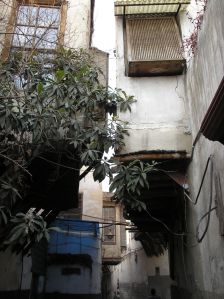 This morning a car bomb exploded in Mahlak street, Damascus, at a junction with the airport road and not far from Sitt Zainab. Seventeen are dead and 14 injured. That sounds like a powerful bomb, killing more than it maims.
In 1997 I found myself walking over what appeared to be blood and oil stains in the Victoria area of the city. There were soldiers gathering shards of glass and hosing the street down. Bystanders were subdued, not meeting your eye. I asked someone what had happened and he mumbled something about a gas leak. In fact a bus had been blown up minutes after leaving the old station at Baramkeh, and nine people had been killed. Afterwards there were whispers about Lebanese Maronites (the Lebanese Sunnis still supported Syria) being behind it, and of course Israel was a suspect. But the whole thing was kept as quiet as possible. The deal the regime has made with the people is: allow us corruption and thuggishness if we give you in return a foreign policy which doesn’t shame you and, most fundamentally, a guarantee of security. Exploding buses are a message from whoever sends them to the Syrian people, and the literal translation of the message is: the regime can’t protect you.
Remembering Chab Hasni
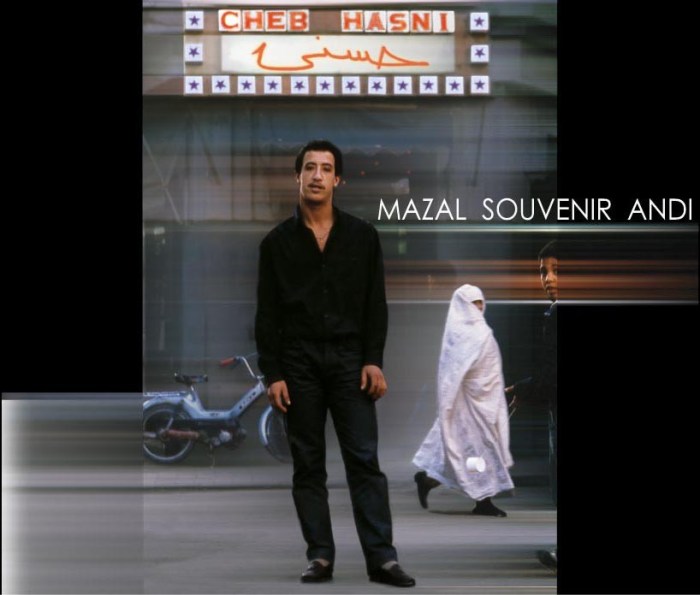 This was written for the National.
Disturbing a sleeping box of old cassettes the other day, my hand brushed an album by Chab Hasni, and memories rushed in as fluent as music, of the Algerians I’d known in Paris in the early nineties, particularly my friends Qader and Kamel.
In Algeria these two had been ‘hittistes’. That’s a real Algerian word: a French ending tacked onto the Arabic ‘hayit’ meaning ‘wall’. The hittistes were the youths who spent their time leaning against walls, bored, angry, and stoned. They had no jobs and no housing – those young men who did have jobs often slept in their workplaces. They spent their time dodging the fearsome police force.
Life as ‘clandestin’ illegal immigrants in France was not much easier. There too they had to negotiate checkpoints. I remember Kamel spending a fortnight in prison for being stopped ‘without papers’. When at liberty, they peddled hashish on Pigalle and sold the cassettes they lifted from shops. (Still, there was honour amongst thieves. Qader once knocked down a fellow Algerian for stealing from an old man on the metro. “So what if he’s French?” he growled. “He could be your grandfather!”)
Two Reviews
Two reviews, one harsh and critical, one brief and bright.
I met Nadeem Aslam in Southampton, and spent an evening and a morning having wonderful conversations with him. When I told him I’d written a bad review of his latest book (half of it is bad) for the National (in Abu Dhabi) he was not in the least bitter, not even for a moment. I am not such a successful human being. I would have been convulsed with rage and venom for at least three hours, and then ill with it for weeks. He just wanted to know why I didn’t like the book. Well, it’s partly the politics, and quite a lot to do with characterisation. Then my review may be fierce precisely because I think he’s a major writer, and therefore fair game. (But I don’t think he’s fair game after meeting him, such a lovely man he is; I hang my head in shame). The negativity of the review may also have something to do with me responding to my own perceived failures as a writer.
And damn, they pay you to squeeze out an opinion, so opinionate is what you do.
The problem with writing a book review after you’ve had a book published is that it seems as if you’re suggesting you could outwrite the writer you’re criticising. Ironically, now that I should be more qualified to write about novels, I feel less qualified. Or at least worried that I’m setting myself up. Anyway.
My Absence, and a Sad Marriage
I apologise from my absence. I’ve been very busy. I’ll be back soon, but for now I’ll post something from Conflicts Forum. I’ll post it because it clarifies the already clear truth that Salafism, whether the Salafis know it or not, has an inherent opposition to genuine resistance in the Arab and Muslim worlds. Below you’ll read about the marriage of Wahhabi nihilism and Arab fascism, and how its purpose is to deepen the Empire’s control by encouraging the people to hate each other. And there is further clarification of how very unlike this twisting, thrusting couple (Mr. Salafi and Mr. Fascist – it’s a same-sex partnership) are organisations like Hizbullah and Hamas.
The honeymoon after the wedding was remarkable for its dog-gnawed corpses, and for the smiles on the faces of fat businessmen and kings.
(I recommend Conflicts Forum’s intelligent and detailed articles. The three-part report on how Hizbullah defeated Israel in 2006 is fascinating.)
Fracturing Authority
I had great sympathy for Chechnya when it was twice destroyed by Russian forces. The Chechens have been fighting for their independence for more than a hundred and fifty years. But Prime Minister Gordon Brown had no sympathy for Chechnya because, he says, Chechnya is officially part of Russia. The Chechen issue is a matter of Russian ‘territorial integrity.’ I admit that Brown’s position here makes sense. However brutal Russia’s treatment of Chechnya, it isn’t Britain’s business. (It may be the business of concerned British people, but that’s something else).
I don’t have much sympathy for Georgia, however, and none at all for the bleatings of the US, Britain and Germany, including Brown’s ridiculous bleatings in the Guardian. When the Soviet Union collapsed, Russia relinquished its control of eastern Europe and allowed independence to Caucasian and Central Asian nations. But instead of independence several of these countries became absorbed into the American empire. The fear that some of them had of their huge neighbour was understandable and deeply rooted (though not in Georgia, which had participated in Soviet rule from the Georgian Stalin to the Georgian Shevardnadze). The real fault was the West’s, to so stupidly exploit this fear, and to extend, by hubris, NATO membership and American missiles right to Russia’s borders. Russia in 1991 was too weak to do anything but let power slip, but its tolerance of Western expansion also showed a naivety, an overly-optimistic trust in Western capitalism. The very memory of that naivety is a humiliation to Russians.
Dawkins or McIntosh
I am increasingly infuriated by religious claims to certainty and by religious attempts to close down free thought (I’m not talking about high profile attacks on writers or cartoonists here, which have more to do with power politics than theology, but simply the resort to ‘it’s true because God says so’). Although some leftist and anti-imperialist Islamist groups have achieved great things, I find the current fashion for religious politics in the Arab world to be a dead end. Simple-minded slogans like ‘Islam is the solution’ are no solution. An analysis of contemporary disasters based primarily on class and state and corporation could conceivably provide grounds for unity and solidarity; political action based on Sunni or Shia myths will ultimately only help the empire to divide and rule; it will also empower rulers and institutions hiding behind religious cover. It is sad to watch the Muslims becoming more and more religious as they gallop further into social, economic and environmental catastrophe.
The rise of ugly modernist forms of religion is not confined to the Muslim world. Everywhere, the death of traditional religion has spawned a million poor substitutes. Under the pressure of traumatic social change, and almost always of war, traditional forms of Judaism, Christianity, Islam, Hinduism and Buddhism have morphed into Zionism, neo-conservatism, Bible-belt evangelical-nationalism, fascism, Stalinism, Ba’athism, Wahhabi-nihilism, state-Hindu chauvinism and Maoism. And fundamentalist atheism.
Edinburgh
I read at the Edinburgh Book Festival on August 12th. It was a double event, shared between me and Mohammed Hanif, author of the Booker-longlisted novel “A Case of Exploding Mangoes.” Mohammed’s book is a tragi-comic detective story which references Marquez’s “Chronicle of a Death Foretold”; and the murderee is General Zia ul-Haqq. (General Musharraf quivers between impeachment and exile as I type). It was great to meet Mohammed, not least because he knows several of the journalists I used to work with in Pakistan. One evening he cooked me a chilli-rich meal. I hope we meet again.
The death that has hung heaviest over the last week is not Zia’s but Palestinian poet Mahmoud Darwish’s. It was even a death foretold: the Palestine National Theatre was at Edinburgh performing a play based on the Darwish poem “Jiddariyya”, which concerns mortality and the extinction of identity, and which he wrote after heart surgery. It was a new bout of heart surgery which killed him. Such are the Edinburgh crowds that I failed to see the play. I did see Sabry Hafez give a talk on Darwish, and how the extinction of identity is for Palestinians an immediately concrete threat beyond the universal problem of physical death: Darwish was from a family of ‘mutaselaleen’, Palestinians who crept back across the border into ethnically-cleansed Israel in the months following their expulsion in 1948, and as a result his name could not appear on school registers. I wish I’d seen the play. Also sold out was a film on three screens by Iranian director Abbas Kiastorami. It showed, apparently, a Shia passion play, a taaziyeh for the martyrdom of Hussain, performed in an Iranian village.
Complex Origins
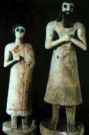
Sumerians at prayer
From a Muslim perspective, I’m used to seeing Judaism, Christianity and Islam as episodes within the same religion (which is not to deny their differences) – a series of revelations emanating from the same cultural locus. But since so many of the Abrahamic stories are inherited from earlier civilisations, even from the very first to write down stories, it may be that my definition of one religion, or at least one civilisation, should expand to include the earliest myths. Stories so early that we can reasonably guess their roots reach deep into our pre-civilised hunter-gatherer past.
Myth doesn’t mean untruth any more than a great novel does. Myth is heightened truth. A myth is perhaps more ‘true’ than reality because reality unfiltered is unstructured and unexplained. The fact that God uses human myths to talk to humans need not perturb the religious. “wa tilka al-amthal nadribuha lil-nas la’alahum yatafakiroon,” says the Qur’an. “We rehearse these parables to people in order that they may think.” From a religious perspective, the rehearsal of myths in sacred text is proof of God’s understanding of human minds. And where do the myths arise from anyway? From unforgotten events, and from us, from our shared Godstuff.


 Qunfuz