Archive for the ‘Syria’ Category
The Thinking Muslim
I was very happy to be interviewed about Syria by Muhammad Jalal for his Thinking Muslim podcast.
Free Syria’s First Days: Good, Bad and Ugly
This was published at the New Arab (link here)
We feared the regime’s end would be accompanied by a bloodbath. Thank God, that hasn’t happened. In the end the regime collapsed without a fight, even in its supposed heartland on the coast.
There has been some looting in Damascus, which has been somewhat more chaotic than the northern cities, perhaps because there has been a smaller rebel presence. Otherwise, the news coming from liberated Syria has been surprisingly good.
On the social level, Syrians are talking the language of reconciliation. One typical video shows a bearded rebel admonishing surrendered regime fighters for standing with the side that slaughtered women and children. Then he tells them, “Go! You are free!” The rebels have issued a general amnesty for military personnel. This does not extend to those guilty of war crimes and crimes against humanity. The intention is to hold those people to account.
Meanwhile, Muhammad al-Bashir, who was the prime minister in Idlib’s Salvation Government, has been appointed to form a Transitional Government in Damascus. The Salvation Government ruled in HTS territory, but was civilian, largely technocratic, and fairly independent. It looks as if a similar logic is going to apply to the Transitional Government.
Having shed his nom de guerre, Abu Muhammad al-Jolani is now known by his real name, Ahmad al-Sharaa. Instead of ‘leader of HTS’, he has been rebranded as ‘commander of military operations’. He wants to be seen as a national figure rather than a Sunni jihadist. Some fear that he will change direction as soon as western states stop branding him a terrorist, but for now at least his direction is tolerant and democratic. Rebels have been told not to interfere in women’s clothing choices, for instance. And prominent opposition figures say that UN Resolution 2254 will be implemented. This will involve drafting a new constitution and holding free and fair elections under UN supervision.
So far so good. All of it inspires confidence in Syrians at home as well as the millions who were driven from their homes. Huge streams of people are leaving the tented camps on the country’s borders, and returning from Turkey and Lebanon, where so often they were subjected to racist abuse and violence. The result is thousands of emotional reunions between siblings, or between parents and children, who in many cases haven’t seen each other in over a decade. This is a blessing that nobody expected a fortnight ago, and it culminates a drama that has lasted almost 14 years. In 2011, millions of Syrians screamed Irhal! – Get out! – at Assad. His response was to drive them out instead. But today, at last, the Assad family are the refugees.
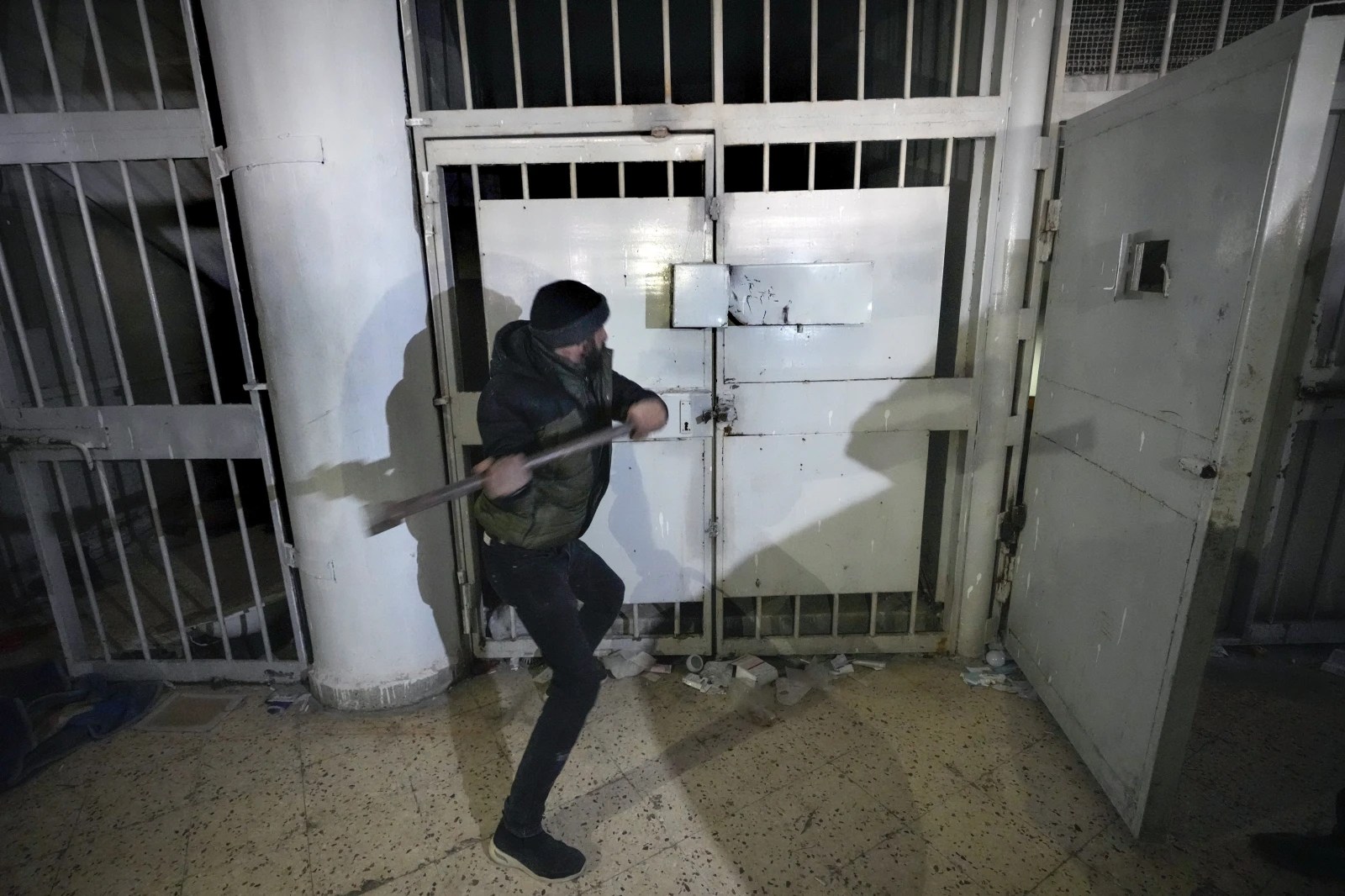
It’s also very good that tens of thousands of prisoners have been liberated from Assad’s dungeons. But it’s bad – profoundly depressing, in fact – that so many are in such a bad state. Lots of women and children have been found behind bars. The children were either arrested by the regime along with their parents, or were born in these dungeons to mothers who had been raped.
Read the rest of this entry »Liberation
The Syrian Revolution: the most thoroughgoing, diverse, persistent and resilient revolution in all human history.
The revolutionary Syrian people: a people that risked everything, lost everything, and then won. A people that was helped only by God.

I remember Syrians chanting “Ya Allah, Malna Ghairak Ya Allah” – O God, We Have Nobody but You, O God – and this was largely true. Syrians were slaughtered by Iranians and their Lebanese, Iraqi, Afghan and Pakistani militias; and by imperialist Russia’s air force; and by the Baathist-al-Qaida amalgam ISIS. The US, and the Turkish-Kurdish PKK, and Zionists worked against them. The Egyptian dictator, the Saud family, and in particular the filthy UAE regime conspired to keep them in chains. Syrians were slandered by conspiracy theorists, authoritarian campist ‘leftists’ and pro-PKK ‘anarchists’. The media saw them only as a security problem. In Turkey and Lebanon refugees were attacked by racist mobs. The EU’s border guards shot at them. The EU did what it could to normalise Assad and to send refugees back to be murdered.
The revolution’s three greatest military enemies – once it had broken the back of the fascist regime – were ISIS, Iran, and Russia. Though at first Assad, Iran, Turkey and other allowed it to grow, ISIS was in the end defeated by America, and many other actors, at the cost of the destruction of several cities. Iran’s militia system had its bluff called, and was smashed (for other reasons) by Israel. Russia has exhausted itself with its criminal invasion of Ukraine. But the key factor in this blessed ten days of revolutionary culmination has been the maturity, courage, and intelligence of Syrian revolutionaries, and first amongst them HTS under the leadership of Ahmad al-Sharaa, or Abu Muhammad al-Jolani.
Aleppo was crucial. Inhabitants of the west of the city – which had never before slipped regime control – and in particular members of religious minorities, were very frightened on the first day of the takeover. But their fear was quickly dissipated. One rebel hick pushed over a Christmas tree, and was arrested and disciplined, and the tree restored. The people of Aleppo were assured that they could worship as they wished and wear what they liked. Even better, Jolani announced: “The city of Aleppo will be managed by a local authority, and all military forces, including those of HTS, will fully withdraw from the city in the coming weeks.” The military coalition of which HTS is the largest actor has forbidden any fighter from entering any home without permission from the leadership, and has forbidden setting up military bases in civilian neighbourhoods.
Public buildings are under guard. There has been no looting so far, nor any revenge attacks. More impressive than the treatment of Aleppo’s Christians has been the treatment of Shia civilians – a community which, like the Alawis, has been closely associated with the criminal regime and its criminal foreign (Iranian) backers. But there has been no looting or revenge attacks by the rebels on Nubl and Zahra, Shia towns in Aleppo province which hosted murderous sectarian militias. The militias ran away and left the civilians to their fate – and their fate has been to be reassured, and to have food and water distributed to them. The rebel discipline, tolerance and magnanimity here is an enormously positive sign.
Read the rest of this entry »Assad’s Prison State
Much of the media is reporting the collapse of the Assad regime as ‘scary jihadis’ rather than as the liberation – the huge advance in human freedom – it actually is. I’ve written this text for the ISIS Prisons Museum (where I am chief English editor) giving background on Assad’s detention and torture state, and the history of the regime’s massacres against the Syrian people, to show what’s at stake for Syrians. Please read, and share. And please pay attention to the IPM website and project. We’re planning to document and reconstruct crime scenes from Assad prisons as we have from ISIS prisons.
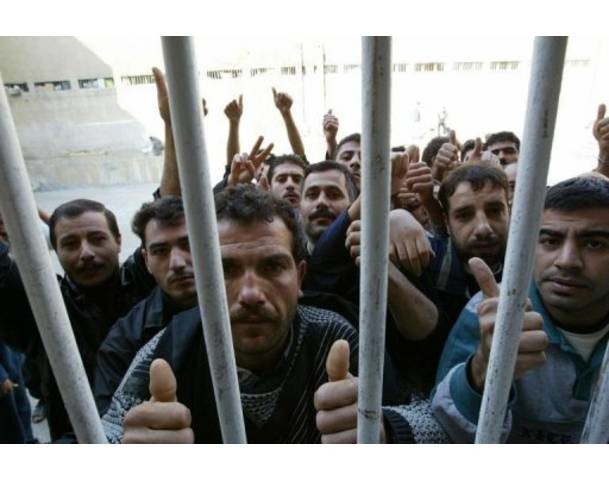
Quotes from the text:
“The prominent dissident Michel Kilo described meeting a young child in prison. The child’s mother had been raped in prison. Her child was born in prison nine months later. When Kilo met the boy he told him a story about a bird…”
“This was not the first time the Syrian regime had directed large scale violence against the population in the streets … It had sent the army to suppress urban uprisings in 1963, 1964, 1965, 1967, 1973, and 1980. But the 1982 Hama massacre was on a totally new scale…”
“The purpose of such abuse is not to extract information from prisoners – otherwise, why would it continue for months and years after arrest, when any information a prisoner may have had would have become obsolete. Instead it is designed to demonstrate the regime’s absolute power, and to project terror onto the society beyond the prison, to paralyze society from action.”
Anti-Campist Anger
I was on Luton’s Inspire FM trying to summarise the dramatic and blessed events in Syria. I’m really trying not to deal with the idiotic and inhumane campist propaganda that ignores the agency of the Syrian people in favour of ridiculous and ignorant grand geo-political narratives. There’s so much more important stuff going on than that chattering…. but here some was thrown at me, and I responded. Watch/ listen here.
History Made on the Ground
You know the multiverse theory, that there are many parallel universes, and that they may contain alternate versions of ourselves and our conditions in this universe…. Well, the last couple of days feel like we’ve jumped from one existence into a parallel universe, one in which a lot more is possible. This universe is a flexible, more cheerful place, in which the Syrian Revolution may even be resolved. (As it happens, we went the day before yesterday on a trip to Edinburgh to see my son. He bought us tickets to the Museum of Illusions. We walked through an arrangement of swirling lights called The Vortex, and we lost our balance. Was that when it happened? When we got home we heard the news that Aleppo city had been liberated.)
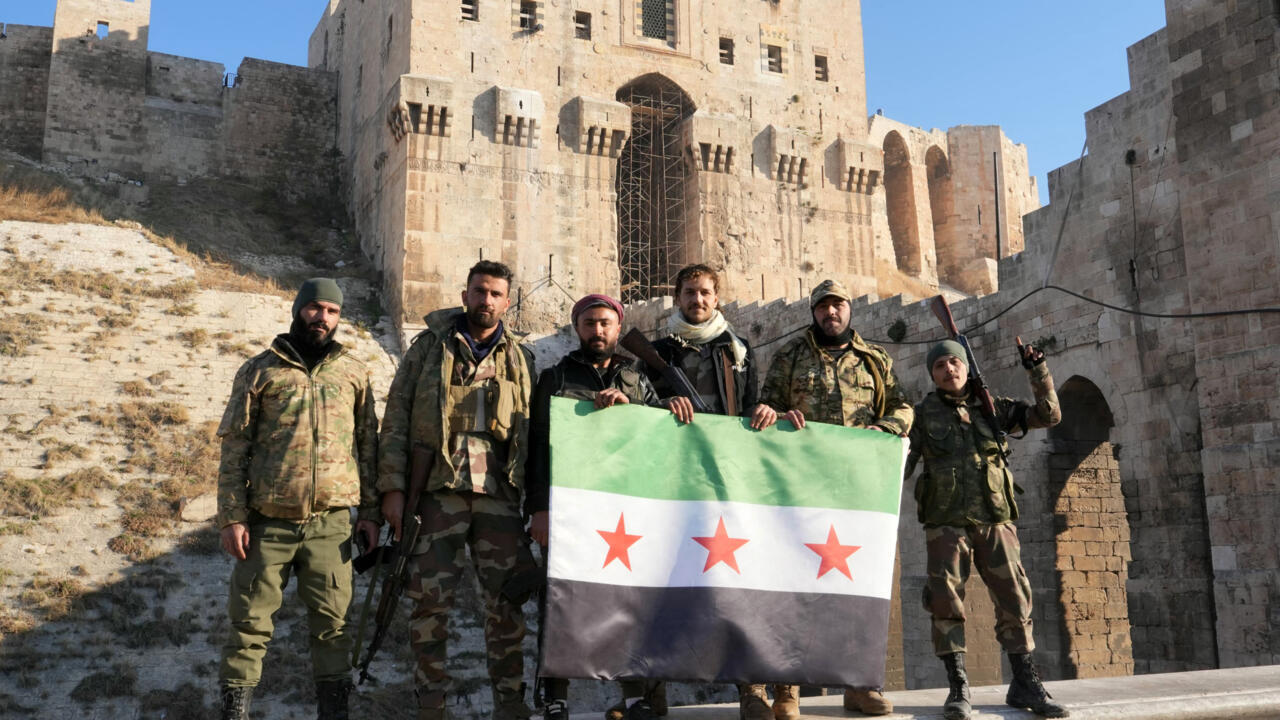
The rebels advanced out of the narrow strip of Idlib in which they and millions of Syrians from around the country had been crammed for over four years. ‘The rebels’ here means a military alliance under the umbrella of Hayat Tahrir al-Sham – the greatly moderated and better organised reincarnation of Jabhat al-Nusra. It’s still an authoritarian Islamist militia, but it’s not at all ‘like ISIS’ as the uninformed are saying. It broke definitively from the ISIS stream in 2014. It has a much more positive policy towards sectarian and ethnic minorities than ISIS. It allows far greater space for pluralism, disagreement and consultation than ISIS did (though it still arrests and detains some political opponents, and tortures them). Unlike ISIS, it doesn’t field a Hisba Diwan (or morality police) to interfere in people’s daily lives. Its focus is Syrian rather than transnational. It doesn’t threaten the west.
Its ‘Fath al-Mubeen’ military alliance also incorporates lots of members of other less authoritarian groups that were displaced to Idlib and then gobbled up by HTS. HTS has not been popular among people in Idlib – they’ve been demonstrating against it for months – but its offensive is wildly popular, because the people want to be rid of Assad and his foreign backers, and to return to their homes.
I didn’t expect the offensive, at least not on this scale. Nobody did. At first it looked to me like a controlled operation to restore the agreed Astana lines – that is, the division of north west Syria agreed upon at Astana by Russia, Iran and Turkey. Russia had pushed Turkey to normalise and negotiate with Assad, and Turkey had tried hard to do so. Assad had refused to budge from his maximalist positions, the Russians don’t want to alienate Turkey (given their difficult position attacking Ukraine), and Turkey needs more Syrian territory to which to send Syrian refugees. So perhaps the Turks and Russians were scaring Assad into negotiating by taking a few towns in the Aleppo countryside.
But the offensive went much further than that, far beyond the Astana lines. News came, meanwhile, that the Turks had prevented the Syrian National Army – comprised of former Free Army militias now under Turkish control – from moving towards eastern Aleppo. This allowed the PKK-dominated SDF to take areas in Aleppo abandoned by collapsing Assad forces – surely the opposite of what Turkey wanted. Turkey was not, therefore, in control of events. Turkey clearly didn’t know what was going on.
Read the rest of this entry »Selective Outrage
There’s a link here to a two-part podcast of me talking about the genocide in Gaza, the genocide in Syria, and universal anti-fascism. Thanks to Andy Heintz for the opportunity.
Genocide justifying itself by genocide
The most repulsive thing I saw yesterday was a Zionist justifying the genocide of Palestinians by reference to the genocide of Syrians. Three points.
One: One genocide doesn’t make another OK. Obviously.
Two: Israel was a major reason why the US stopped serious weapons reaching the Free Army. Other than a few rhetorical comments, the US worked with Iran (doing a deal) and Russia (welcoming it into Syria to ‘solve the chemical weapons problem’, which of course it didn’t) to save Assad. This, according to what American officials told Syrians lobbying for weapons, was because Israel was worried about ‘instability’, especially about Syrians having anti-aircraft missiles and heavy weapons. So hundreds of thousands of Syrians were murdered, millions expelled, and the country utterly destroyed, for the sake of the apartheid state’s ‘stability’.
Three: Israel is doing exactly the same to Gaza as what Assad/Iran/Russia did to Homs, Aleppo, the Ghouta, etc: it is destroying the civilian infrastructure, imposing starvation sieges, hitting schools, hospitals, residential blocks, bakeries. Its aim is the same – to remove or annihilate the civilian population. Its genocidal rhetoric is the same, but it seems to be far more deeply spread amongst Israeli Jews than it is amongst Assad’s ‘loyal’ Alawi community. The difference in method is that Israel does the killing faster and more efficiently, with more advanced western (American and German) weapons.
So Israel does the same as Assad/Iran/Russia, only faster, and Israel contributed to the disaster in Syria anyway, and you can’t justify your fascist genocide in the south of bilad ash-sham by pointing to the fascist genocide in the north. You are all fascists, and the people of the region in their overwhelming majority despise you both. There will be no peace until both of your ideologies and murderous power systems are dismantled.
Read the rest of this entry »Syrian Gulag
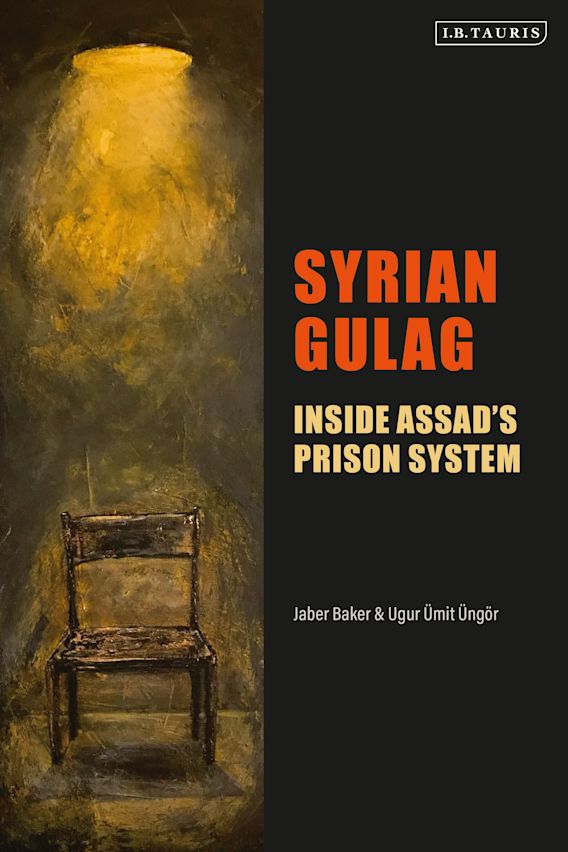
I’ve written a long essay for a future issue (the Halal issue) of the Critical Muslim which reviews three necessary books on the politics of the Middle East. Two are Alex Rowell’s “We Are Your Soldiers” and Azmi Bishara’s “Syria 2011 – 2013”. Here I’m showing you a few paragraphs on the third book – Syrian Gulag: Inside Assad’s Prison System – because it’s such an essential addition to the Syrian bookshelf that I feel the need to publicise it. Nobody should pontificate about Syria before making themselves familiar with this material.
To better understand the history of the strong man, or the taghout, in Syria, let’s return to the country’s torture chambers, which became more numerous and more politically salient in the days of the UAR. Some years later, Hafez al-Assad further expanded the detention and torture network, to the point that the entire Syrian society was governed, and smothered, by the fear of detention and torture. The misrule of the supreme strong man was underpinned by hundreds of little strong men abusing people in prisons.
The US incarcerates 629 people per 100,000 of the population. This is generally considered to be the worst rate in the world. Russia incarcerates 445 per 100,000. In Syria, however, 1,200 per 100,000 are incarcerated. That’s a conservative estimate. And many of those who are taken “behind the sun”, as Syrians say, never return.
I’ve taken those figures from Syrian Gulag: Inside Assad’s Prison System by Jaber Baker and Ugur Umit Ungor. This is an immense work, based on over 100 interviews with survivors, some interviews with defected perpetrators, leaks – including the ‘Caesar’ photos of at least 6,786 people murdered in detention – as well as reports by international organizations, a vast archive of torture accounts held by a Dutch immigration lawyer, and published and unpublished prison memoirs. Prison literature (adab as-sijoon) is Syria’s most developed genre, very unfortunately.
Syrian Gulag is encyclopedic, organizing information on the different types of prisons, the various branches and their histories, and the officers who built the system. In so doing, sadly, it gives a history of the last sixty years in Syria. What’s surprising here is the petty sadism of the top-level, household-name officers, their willingness to get their hands dirty. The people in charge are thugs, quite literally. And what is wearily familiar here is the taghout’s tactic of turning meaning on its head. The “Palestine Branch” sounds like it does exciting espionage on Israel, but is in fact a torture camp for the abuse of Palestinians and Syrians.
The torture methods described are numerous and heart-shattering. They include “the German Chair”, “the Dynamo”, tying the penis, sleep deprivation, electrocution, “the Magic Carpet”, “the Ladder”, burning with charcoal, burning with hot water, fingernail extraction, drowning, “the Parachute”, “the Pyramid Pose”, cutting with knives, and rape. Remember, these horrors are not freak occurrences. Almost every Syrian family has encountered them.
Read the rest of this entry »Khaled’s Death is Hard Work
A slightly different version was published at The Markaz Review.
I remember Khaled in a beer garden in Bristol. He was sitting at a table performing the English language: “So so so,” he sang. “And and and, but and but! and so… but! so… but!” Khaled inhabiting his stocky body, his warm, brimming smile, his big head of fluffy white hair.
Of course he knew far more words than those. He somehow managed to communicate very well in English without speaking it very fluently. In Arabic he talked and talked, like the tide. Sometimes he broke into song. His writing was brilliant, the kind that will last for many generations. A poet, screenwriter, novelist — he was endlessly playful with words. And he was gentle with life, and with people. He took them very seriously.

I was with him at the BBC one evening in June 2014. ISIS had captured Mosul, and using the money looted from the city’s banks, and the American weapons captured from the fleeing Iraqi army, the organization had rapidly seized vast swathes of eastern Syria, areas which had been previously liberated from the Assad regime. The radio presenter asked Khaled what he thought of it all. His answer — “It’s important to pay attention to the role of Iran” — may have confused non-experts at the time, but was absolutely apt.
He was politically acute, although he wasn’t primarily a political person. He was a humanist, an artist, and a Syrian who cared deeply about Syrians. Once, as we toured England to introduce the Syria Speaks anthology, Khaled met refugees from villages near his own in the Aleppo countryside. “They asked me about the olive trees and the seasons,” he grinned afterwards. “I love these people.”
He liked the concrete, material detail of life, and was aware of the dense social webs connecting people. This comes through in his writing, in its sensuousness and physicality as well as in its careful intricacies of plot and character. His novels are beautiful and rewarding, but not always easy reading. The stories often proceed in narrative swirls and mosaics rather than in linear fashion. This form manifests a kind of realism, because in real human life everywhere, not only in Syria, characters are woven from stories, and stories link to further stories …
Read the rest of this entry »Revolutionary Resurgence in Syria
Just a couple of points:
Twelve and a half years on, days after the tenth anniversary of the sarin slaughter in the Ghouta, that is a decade after Syrians lost all reason to hope…
As in the first years of the Syrian Revolution, people of all sects and social backgrounds are coming together to demand freedom and dignity. Over a decade of fierce sectarian counter-revolutionary violence hasn’t changed the basic demands of the Syrian people.
Protests are rising throughout southern Syria, in Daraa and Sweida provinces. As if this were 2011 reborn, there are massive popular demonstrations in regime-controlled territory. They’ve been met by solidarity demonstrations in eastern Syria: in Deir ez-Zor, and in Raqqa in PKK/PYD/SDF territory; as well as in the liberated areas of the north. The chants and lyrics of greeting and solidarity exchanged between the various regions of the country feel like a fresh breeze after the years of engineered sectarian and ethnic breakdown.

Syrians have been disappointed so many times before that it seems foolish to continue hoping. And yet, there are two new elements to the situation today. First, the entire Druze community – centred on Sweida – appears to be rejecting Assad entirely.
Individuals from minority communities have opposed Assad previously, but not a minority community en masse. The Druze of Sweida tolerated Assad so long as his forces kept their distance, and so long as young Druze conscripts served in the province rather than went to fight other Syrians. And the community sheltered defectors and others on the run from Assad’s killers. But it didn’t stage mass protests, nor an armed uprising, even as the Sunnis in neighbouring Deraa province were tortured, shot, and bombed. Assad’s main strategy has been to slaughter, rape, torture and expel Sunnis in particular, and to scare minority groups to sell them the lie that only Assad can protect them from the Sunnis. So mass protests of Druze are particularly difficult for Assad to deal with.
It looks like these protests won’t be stopped without massive violence. But massive violence against a minority sect ruins the pretext of the regime being a ‘protector of minorities’. It emphasises the unity of the Syrian people. Assad can’t survive a meeting with a unified Syrian people. Hence the slogan once again rising: One, One, One, the Syrian People are One.
Second,
Read the rest of this entry »Lesson from Iraq and Syria
Everybody’s asking what lessons can be learned from Iraq twenty years after the invasion and occupation. But more can be learned by looking back further, to 1991.

I’ve just listened to the two episodes on the The Rest is Politics podcast in which Rory Stewart grills Alastair Campbell on the 2003 invasion. It’s a fascinating discussion which I recommend listening to, but there are some glaring omissions. First, there’s lots of talk about British military casualties and the effects on western politics in the years since (and good they mention the Iraq hangover’s role in the west’s criminal inaction in Syria), but not much talk on the hundreds of thousands of dead Iraqi civilians. Next, and most importantly, there is no mention of the American decision in 1991, after driving Iraqi forces from Kuwait, to not only leave Saddam in office but to give him permission to use helicopter gunships to put down the uprising in the mainly Shia Iraqi south.
That was the time to remove Saddam from power, not as a remotely decided regime change, but in support of a population that was already rising against the tyrant. At that key moment, America (and its allies) decided to NOT protect the Iraqi population. America had soldiers right there in southern Iraq watching as Saddam’s forces massacred civilians and filled mass graves. The reason for this was probably fear that Iran would take advantage – but if this terrified decision makers then into such immoral behaviour, why in 2003 did British and American decision makers not bother even considering how Iran would take advantage of their invasion? Of course the end result of the 2003 invasion was the takeover of Iraqi institutions by Iranian-run militias. This was the key factor in the rise of ISIS and then the consequent war to destroy the so-called ‘caliphate’.
So in 1991, after destroying the Iraqi army and liberating Kuwait, the US chose to allow Saddam to slaughter the southern Shia. Then it imposed ruinous sanctions which destroyed the Iraqi middle class. Sectarianism became much worse as Saddam used loyal Sunni troops to massacre Shia, and as he turned to sectarian rhetoric to shore up his damaged rule. By 2003, when the US and Britain decided to invade for their own reasons, on their own timetable, it wasn’t surprising that the place soon collapsed in civil war.
Read the rest of this entry »Palestinian Assadists
There’s nothing more ridiculous than a Palestinian Assadist. For western Assadists, the Arab world is a blank on which to project ideological fantasies. But the Palestinians are part of this world. So what makes some repeat inhuman and absurd Assadist propaganda?

How has the Assad regime under father and son won such loyalty? Is it because in 1967 Hafez al-Assad, then defence minister, ordered the Syrian army to retreat from the Golan before any Israeli soldiers had turned up? So the Golan was handed to Israel, which then annexed it. Or is it because in 1973 Hafez al-Assad, now in absolute control, lost another war (not surprising given his endless purges and rabid sectarianization of the army) but spun the defeat as a historic victory and proof of his nationalist genius? Perhaps it’s because early in the Lebanese civil war, the Assad regime, which had loudly proclaimed its support for the Palestinian/Muslim/leftist alliance, intervened, but on the side of the pro-Israel Maronite Falangists to defeat the Palestinian/Muslim/Leftist alliance? Or could it be because throughout the 1980s the Assad regime slaughtered tens of thousands of Palestinian civilians in camps in Lebanon, most notably at Tel Za’atar? Perhaps it’s because the regime under Bashar utterly destroyed Yarmouk camp, until then Syria’s most important centre of Palestinian culture. Or because the regime tortured and starved so many Palestinians to death during the Syrian Revolution. Or maybe Assadist Palestinians love the regime because its reign has seen all of Syria parceled out to foreign powers – Russia, Iran, the United States, Turkey, the Turkish-Kurdish PKK, as well as the part it had already handed to Israel. Perhaps they believe the destruction of Syria’s cities, the murder of a million Syrians, and the expulsion of millions more, will in the end hasten the liberation of Palestine.
I should say that most Palestinians sympathise with the revolutionary Syrian people and not with the regime (and its allies) killing them. The more working class and more religious the Palestinian, the more this is the case (in my experience). And among liberal middle class activists there are many decent people who have shown solidarity with Syrians. Here’s a great statement by some of them from 2016. But some of the signatories were ostracised by other Palestinians for signing. Amongst the West Bank middle classes, including not a few faux-intellectuals, there’s plenty of Assadism. There’s also, for God’s sake, the statue of Saddam Hussein at Bir Zeit.
Why is it that this kind of Palestinian, the very kind who in previous decades we might have considered as being at the forefront of radical politics in the Arab world, has become enmeshed in such backward and inhumane modes of thought? It might be because the Palestinians haven’t experienced the revolutionary wave of the Arab Spring. This isn’t really their fault. They are stuck with the old nationalist narratives because they are stuck with a foreign occupation. Whereas their neighbours have moved on to postcolonial struggles. The foreign occupations have gone (or had gone, before Assad brought them back), so the struggle now is against those gangsters who seized control of the weakened countries the colonialists left behind.
Read the rest of this entry »‘It can’t get any worse.’ And then the earthquake…
(A lightly edited version of this piece was published by Dawn Mena. At the bottom of this page there is information on who to donate to.)
Syrians wanted to be known for their contributions to civilization, as they were in ancient times. Syria is part of the Fertile Crescent where agriculture began, where the first cities were built, where the first states developed. The first alphabet (Ugaritic) was thought up in Syria. The country produced Roman emperors and, under the Umayyad dynasty, became the first centre of a new ‘Islamic world’. When Syrians achieved independence in the mid 20th Century, they hoped their modern accomplishments would echo the old. As a diverse, cultured, hardworking people who valued education, and who tended to excel in business when abroad, they had good reason to hope this would be the case.
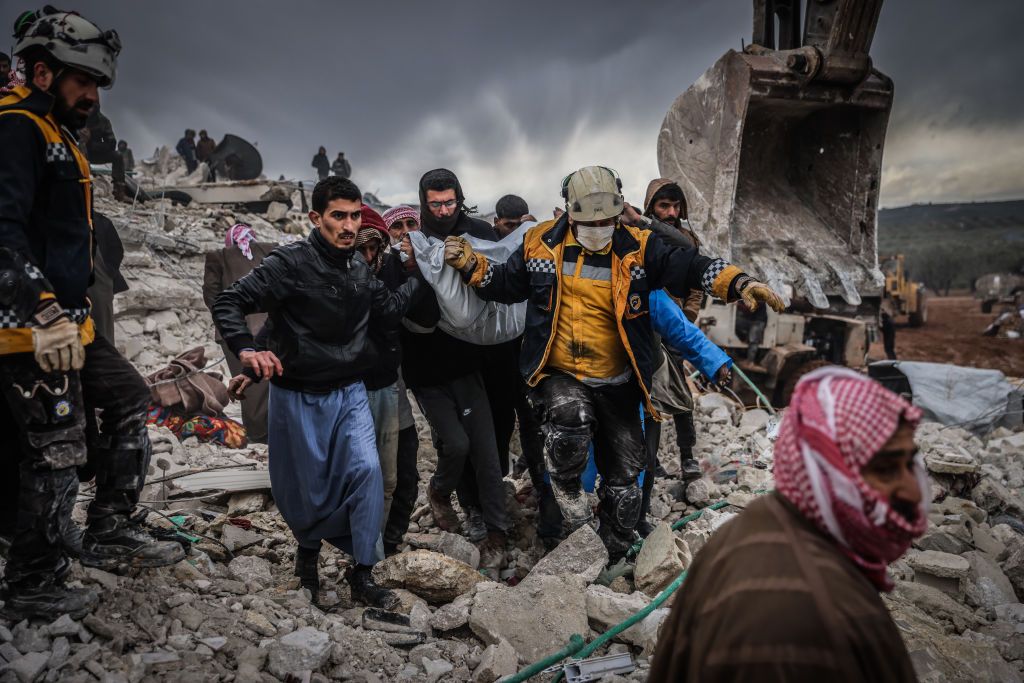
But like so many post-colonial states lacking strong institutions, modern Syria soon fell into a cycle of military coup and counter-coup, ending with the Baathist dictatorship which has tortured and plundered the country and its people since 1963 – and under the Assad family since 1970. In 2011 Syrians rose in revolution against the Assad regime, and would have liked then to be recognized for their revolution’s successes. For years they resisted the most extreme oppression, and even under the bombs managed to build hundreds of democratic local councils. They also managed to avoid falling into sectarian civil war, despite the provocations. Sunni and Alawi villages didn’t attack each other. The sectarian massacres had to be organized from on high, first by the regime, then by ISIS, the regime’s dark protégé.
But the Assad regime was rescued by Russian and Iranian imperialists, and by the West’s appeasement of these imperialists. The democratic Syrian Revolution was defeated by force of arms. Worse, it was ‘orphaned’, to use Ziad Majed’s term. Beyond Syria it was ignored or misrepresented, particularly in the West, by the Kremlin’s leftist and rightist useful idiots and a wider public prepared to believe the worst of a mainly Arab and mainly Muslim people.
So now Syrians have become known internationally not for their history, nor their modern success, but for the extremity of their suffering. Their pains under dictatorship were bad enough, culminating in the 1982 Hama massacre when at least 20,000 were murdered, but multiplied after 2011 when the full force of local, regional and international counter-revolution was deployed against them.
Read the rest of this entry »Ukraine, Syria, Russia and ‘anti-imperialism’
My good friend Mira Krampera interviewed me at length in Czech on Russian imperialism in Syria and Ukraine, and western and global responses to the crisis. Here’s the interview in Czech. And here is an English translation. And now… here it is in Polish. And now in English in Antidote Zine.


 Qunfuz