Posts Tagged ‘genocide’
Your Presence is a Danger to Your Life
My review of Samar Yazbek’s latest book – this one documenting horrors imposed on Palestinians rather than Syrians – was first published at The New Arab.
There are sentences in this remarkable, painful book that imply an entire universe of horror. Like this: “We brought my daughter’s leg and buried it next to her brother and sister.” Or this: “A boy was blowing air into a dismembered woman’s corpse, trying to bring her back to life – she was his mother.”
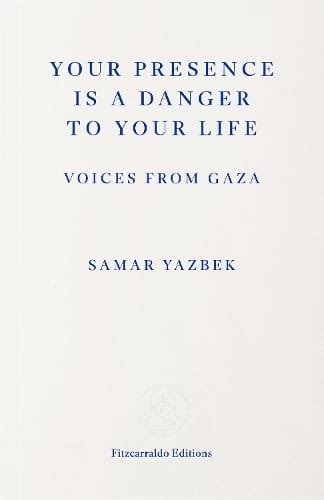
“Your Presence is a Danger to Your Life” – the title is taken from the flyers dropped by the Israelis minutes before they bombed civilian targets – documents the Gaza genocide, or at least the genocide as experienced by twenty-six men, women and children interviewed at length throughout 2024 while they were receiving medical treatment in Qatar. The interviewer, editor and shaper of these narratives is the Syrian novelist and non-fiction writer Samar Yazbek.
Yazbek has already produced three documentary texts from the Syrian Revolution and war – “Woman in the Crossfire” and others. In the introduction she explains how the destruction of Gaza reenacted for her the destruction of Syria. She hints at the continuum of experience between the two disasters, and describes her work as “testament to a dream of justice for those living beneath the grindstone of this violent era.” But there are key differences, terrifying “novel details” involving the technological sophistication of the Israeli genocidaires and their “algorithms of murder”.
Many of the witnesses are householders hit at home in the midst of family life. A child asks for a sandwich and then, in a flash, life is irretrievably broken. “My brain couldn’t interpret what had happened” is a phrase repeated by several. “It seemed as though we had entered hell” is another.
Some witnesses are doctors, nurses, or those who volunteered to help in hospitals. They recount Israeli soldiers bombing maternity wards, storming the intensive care department, methodically destroying the medical equipment. One doctor is forced into the role of human shield. Several witnesses remember Israeli soldiers torturing the maimed and dying in their beds.
There are descriptions of dismemberment, of heads spit open, of cats red-faced from human meals. Someone recalls “a grandmother as gentle as the breeze … innocent children, splendid as roses, evaporated in an instant;” others talk of children who bleed to death alone, or children who lose their entire families: parents, grandparents, siblings, cousins, aunts and uncles. For the survivors, or semi-survivors, there is endless pain, vomiting after drinking poisoned water, the stink of sewage, of infected, maggot-filled wounds, of corpses rotting under the rubble. There is the shame of being unable to stop screaming in a room full of strangers
Yazbek preserves the creative uses of Palestinian war idiom in the witness accounts. For instance, the popular word for a vacuum bomb is ‘shafat’ – meaning ‘suction’ – an idea which is then animated: “It took no more than two seconds to suck up twenty-five souls.”
One of the accounts ends with the words, “And then there are all the things that cannot be spoken.” This silence contains both general and specific meanings. In general, as Yazbek writes in her introduction, “humans are capable of brutalizing each other in ways that challenge language’s very capacity of expression.” More specifically, women witnesses would describe to Yazbek rapes and sexual abuse perpetrated on other women, but never on themselves.
None of this can be described as easy reading. The accounts provoke a visceral response, and sometimes the reader feels a near compulsion to put the book aside, go for a walk, and observe the emotional tumult it has unleashed. Horror, grief and rage are natural responses to the reality expressed here. And yet there is a contrary compulsion to keep reading, to know the worst of it, to bear witness alongside Yazbek. Each distinct Palestinian voice, full of character, leads us through the maelstrom.
Read the rest of this entry »Genocide justifying itself by genocide
The most repulsive thing I saw yesterday was a Zionist justifying the genocide of Palestinians by reference to the genocide of Syrians. Three points.
One: One genocide doesn’t make another OK. Obviously.
Two: Israel was a major reason why the US stopped serious weapons reaching the Free Army. Other than a few rhetorical comments, the US worked with Iran (doing a deal) and Russia (welcoming it into Syria to ‘solve the chemical weapons problem’, which of course it didn’t) to save Assad. This, according to what American officials told Syrians lobbying for weapons, was because Israel was worried about ‘instability’, especially about Syrians having anti-aircraft missiles and heavy weapons. So hundreds of thousands of Syrians were murdered, millions expelled, and the country utterly destroyed, for the sake of the apartheid state’s ‘stability’.
Three: Israel is doing exactly the same to Gaza as what Assad/Iran/Russia did to Homs, Aleppo, the Ghouta, etc: it is destroying the civilian infrastructure, imposing starvation sieges, hitting schools, hospitals, residential blocks, bakeries. Its aim is the same – to remove or annihilate the civilian population. Its genocidal rhetoric is the same, but it seems to be far more deeply spread amongst Israeli Jews than it is amongst Assad’s ‘loyal’ Alawi community. The difference in method is that Israel does the killing faster and more efficiently, with more advanced western (American and German) weapons.
So Israel does the same as Assad/Iran/Russia, only faster, and Israel contributed to the disaster in Syria anyway, and you can’t justify your fascist genocide in the south of bilad ash-sham by pointing to the fascist genocide in the north. You are all fascists, and the people of the region in their overwhelming majority despise you both. There will be no peace until both of your ideologies and murderous power systems are dismantled.
Read the rest of this entry »