Posts Tagged ‘middle-east’
A Nobel Prize for Syria?
This article was first published at New Lines Magazine.
On Aug. 25, Mazloum Abdi, the commander in chief of the Syrian Democratic Forces (SDF), a Kurdish-led militia that had ruled swaths of northern and eastern Syria for over a decade, announced the group’s dissolution. This marked the end of the process of integrating SDF fighters into the Syrian Ministry of Defense. Three all-Kurdish brigades of the national army now serve in Hasakah and Qamishli, with a fourth in Kobani. That means Kurdish-majority areas are policed and guarded from external threats by local Kurds rather than by outsiders. Abdi has been appointed as an adviser to the Syrian presidency.
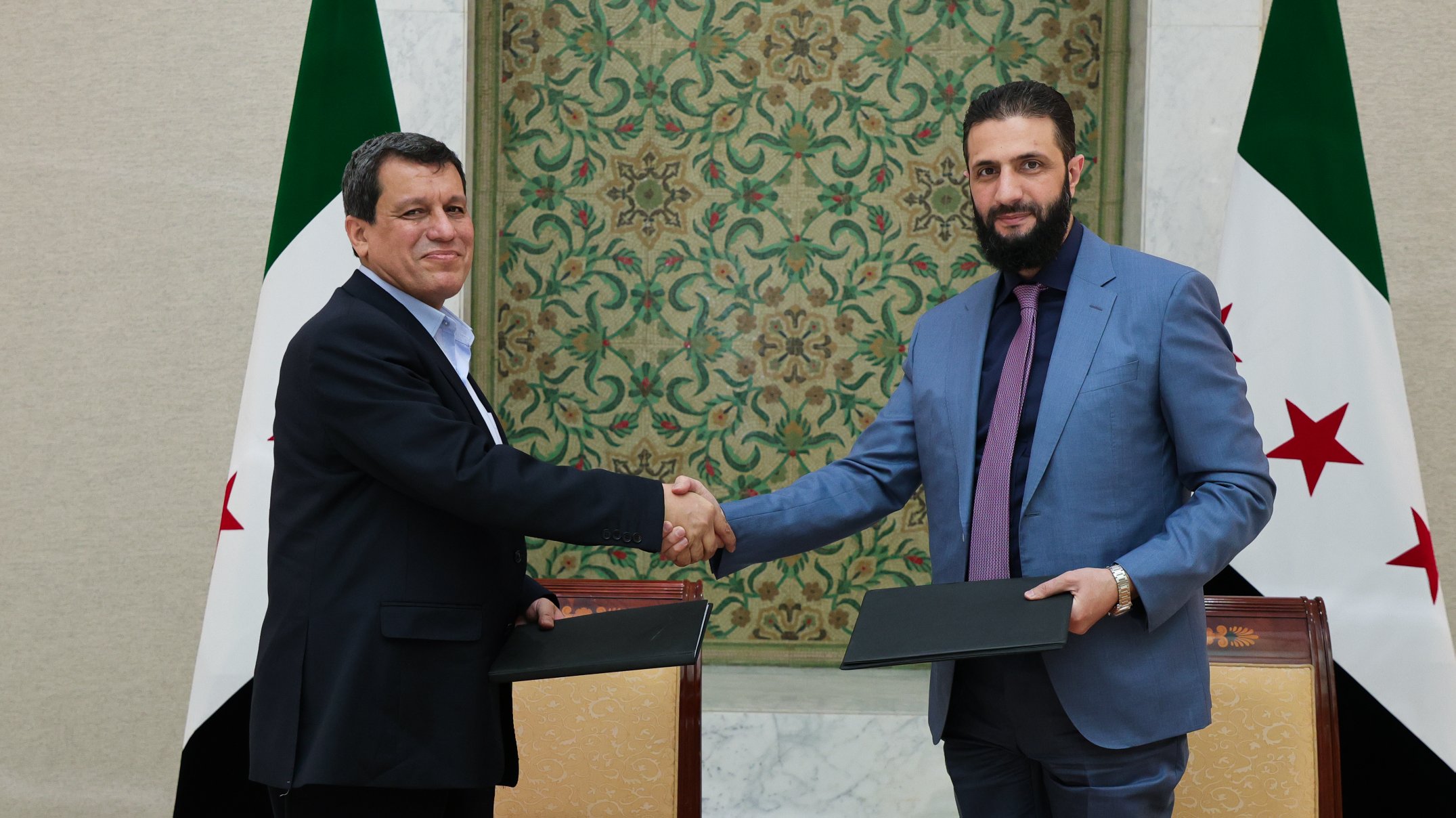
The integration process is a compromise for both sides. The dissolution of the SDF comes in concert with the winding up of the Autonomous Administration of North and East Syria (AANES) and the “Rojava” (or “Western Kurdistan”) experiment. This is experienced as liberation for many Arabs and others in northeastern Syria, who found SDF rule oppressive, but it also represents the end of Kurdish autonomy, leaving many Kurds wounded and worried about the future. For their part, many Syrian Arabs are discomfited that parts of their country are still managed by people who until recently ran their own state project, and who don’t necessarily believe in a unified and sovereign Syria.
But still, the process has more or less worked, and the northeast is no longer at war. A Syrian solution has been arrived at, rather than an international conflict. It could have all happened very differently, and Abdi and Syria’s transitional President Ahmad al-Sharaa should be credited with avoiding much worse scenarios.
In late November and early December 2024, while al-Sharaa’s Hayat Tahrir al-Sham (HTS) rebels were seizing Syria’s western cities from the collapsing regime of Bashar al-Assad, from Aleppo in the north via Homs to Damascus in the south, the Turkish-aligned militias of the so-called Syrian National Army (SNA) advanced eastward into SDF-controlled territory. Backed by the Turkish air force, the SNA took Tel Rifaat and Manbij from SDF control. In Manbij, according to a Kurdish resident I interviewed for my recent book on post-Assad Syria, SNA fighters and Arab residents together drove Kurds from their homes, which they then looted.
Motivated by homesickness as well as revenge, the SNA fighters wanted to continue. Many of them had been pushed out of their home areas in eastern Syria by the Islamic State group, then prevented from returning by the SDF. There were clear signs, too, that the Arab population of northern and eastern Syria would welcome a larger battle. As HTS arrived in Damascus, armed civilians attacked checkpoints in the city of Deir ez-Zor, and Arab fighters in the SDF defected. The city had liberated itself by Dec. 11, 2024, three days after Assad’s flight to Moscow.
The encouragements for war were plentiful. Both sides would have found powerful state backers: Turkey sponsoring Damascus, and Israel the SDF. The SDF had no wish to compromise with its archenemies. For their part, the SNA fighters were raring to go.
But al-Sharaa restrained them. Instead, he and Abdi signed the March 10, 2025, agreement to reintegrate the northeast into the Syrian state. This statement of intent was supported by the United States but opposed by hard-liners on both sides. The procedural nitty-gritty was consigned to committees. Each side understood the terms of the agreement differently. Often, the process seemed destined to fail.
Yet al-Sharaa and Abdi persevered, reining in both their respective hard-liners and cadres on the ground. For this reason, I’ve heard one Syrian journalist suggesting, and only partly tongue in cheek, that the two men deserve the Nobel Peace Prize.
Perhaps they do — even Henry Kissinger won the Nobel once, so it’s not a high bar — but if they do, it’s for their intelligent reading of reality rather than for any inherently pacific orientation. Both men have risen by accurately evaluating the potentials and risks presented by their changing environments. Both have survived the vicissitudes of the long Syrian conflict by understanding that war, like politics, is the art of the possible. When fighting is likely to achieve their aims, they fight. When it’s more likely to lead to disaster, they usually refrain. Unlike Assad or Israel’s Prime Minister Benjamin Netanyahu, their judgment has only rarely been clouded by hubris.
Read the rest of this entry »Liberation
The Syrian Revolution: the most thoroughgoing, diverse, persistent and resilient revolution in all human history.
The revolutionary Syrian people: a people that risked everything, lost everything, and then won. A people that was helped only by God.

I remember Syrians chanting “Ya Allah, Malna Ghairak Ya Allah” – O God, We Have Nobody but You, O God – and this was largely true. Syrians were slaughtered by Iranians and their Lebanese, Iraqi, Afghan and Pakistani militias; and by imperialist Russia’s air force; and by the Baathist-al-Qaida amalgam ISIS. The US, and the Turkish-Kurdish PKK, and Zionists worked against them. The Egyptian dictator, the Saud family, and in particular the filthy UAE regime conspired to keep them in chains. Syrians were slandered by conspiracy theorists, authoritarian campist ‘leftists’ and pro-PKK ‘anarchists’. The media saw them only as a security problem. In Turkey and Lebanon refugees were attacked by racist mobs. The EU’s border guards shot at them. The EU did what it could to normalise Assad and to send refugees back to be murdered.
The revolution’s three greatest military enemies – once it had broken the back of the fascist regime – were ISIS, Iran, and Russia. Though at first Assad, Iran, Turkey and other allowed it to grow, ISIS was in the end defeated by America, and many other actors, at the cost of the destruction of several cities. Iran’s militia system had its bluff called, and was smashed (for other reasons) by Israel. Russia has exhausted itself with its criminal invasion of Ukraine. But the key factor in this blessed ten days of revolutionary culmination has been the maturity, courage, and intelligence of Syrian revolutionaries, and first amongst them HTS under the leadership of Ahmad al-Sharaa, or Abu Muhammad al-Jolani.
Aleppo was crucial. Inhabitants of the west of the city – which had never before slipped regime control – and in particular members of religious minorities, were very frightened on the first day of the takeover. But their fear was quickly dissipated. One rebel hick pushed over a Christmas tree, and was arrested and disciplined, and the tree restored. The people of Aleppo were assured that they could worship as they wished and wear what they liked. Even better, Jolani announced: “The city of Aleppo will be managed by a local authority, and all military forces, including those of HTS, will fully withdraw from the city in the coming weeks.” The military coalition of which HTS is the largest actor has forbidden any fighter from entering any home without permission from the leadership, and has forbidden setting up military bases in civilian neighbourhoods.
Public buildings are under guard. There has been no looting so far, nor any revenge attacks. More impressive than the treatment of Aleppo’s Christians has been the treatment of Shia civilians – a community which, like the Alawis, has been closely associated with the criminal regime and its criminal foreign (Iranian) backers. But there has been no looting or revenge attacks by the rebels on Nubl and Zahra, Shia towns in Aleppo province which hosted murderous sectarian militias. The militias ran away and left the civilians to their fate – and their fate has been to be reassured, and to have food and water distributed to them. The rebel discipline, tolerance and magnanimity here is an enormously positive sign.
Read the rest of this entry »To Aleppo and Beyond
An edited version of this article was published at the New Statesman.
Today, for the first time in years, millions of Syrians can dare to hope. In only three days, rebel forces swept out of the north western corner of the country in which they had been crammed, into Aleppo city and beyond.
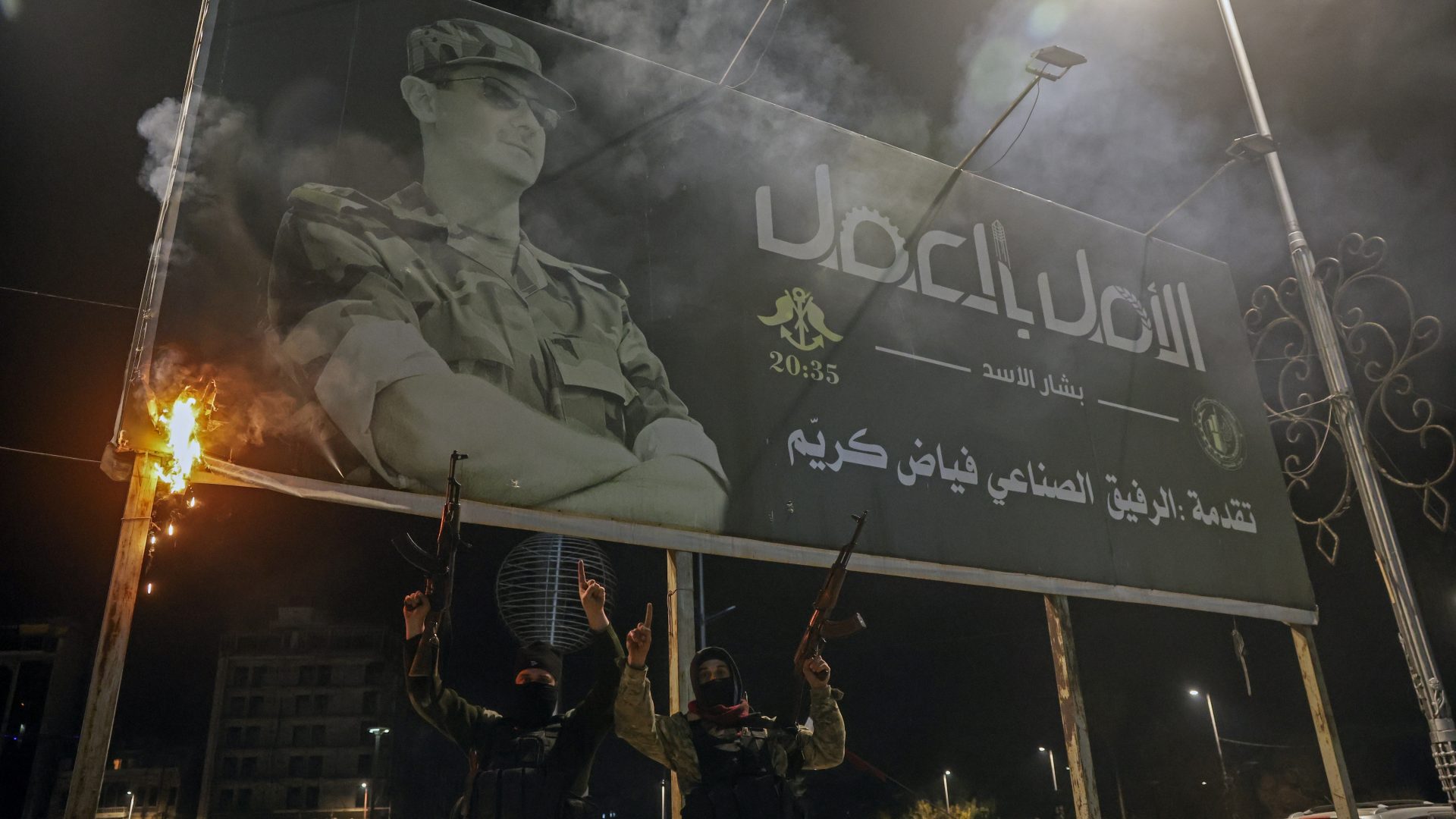
The dominant power in the rebel coalition is Hayat Tahrir al-Sham, a militia which began in 2011 as an offshoot of al-Qaida, but which has since purged its most extreme elements and greatly moderated. It’s still an authoritarian Islamist organisation, but is not at all ‘like ISIS’, as some are claiming. It doesn’t field a ‘religious police’ to interfere in people’s private lives, and it has a far more tolerant approach to religious minorities and dissent than ISIS. It isn’t popular with the people it rules – at least it wasn’t until four days ago when the offensive was launched. People have protested against its authoritarianism for months. Unlike the Assad regime, HTS has largely tolerated these protests. But even if people don’t like HTS, they do support the offensive. That’s because they wish to return to their homes from which Assad and his allies expelled them.
At first the offensive looked like a limited operation, perhaps agreed between Turkey and Russia to force Assad to negotiate. But as the regime lines collapsed and the rebels entered Aleppo, pushing Iran’s militias out and liberating prisoners from Assad’s dungeons, it soon became clear that events had slipped foreign control. This is primarily a Syrian drama, reflecting both rebel success and regime failure.
The rebel coalition contains unified military forces operating much more efficiently and professionally than ever before. Even more impressive than the military improvements on show is the obvious social progress. Rebel messaging to the multicultural inhabitants of Aleppo has stressed respect for the rights and lifestyles of all religions and sects, and so far this has been backed up in practice. Unveiled women walk the streets without harassment, and services are held in the churches. There have been no credible reports of violations whatsoever. The rebels have even set up a phone line through which citizens can report violations. It is important civil revolutionaries continue to hold the rebels to the high standards they seem to have set for themselves. It was a mistake, a decade ago, to turn a blind eye to the growing criminality of the armed men, which did so much damage to the revolutionary cause.
For now, very unusually, electricity is on in the whole city. Public buildings are guarded from looters. The rebels already look something like a government, in stark contrast to the regime – a narco-mafia (look up its Captagon trade) underpinned by local warlords and foreign imperialists.
Read the rest of this entry »History Made on the Ground
You know the multiverse theory, that there are many parallel universes, and that they may contain alternate versions of ourselves and our conditions in this universe…. Well, the last couple of days feel like we’ve jumped from one existence into a parallel universe, one in which a lot more is possible. This universe is a flexible, more cheerful place, in which the Syrian Revolution may even be resolved. (As it happens, we went the day before yesterday on a trip to Edinburgh to see my son. He bought us tickets to the Museum of Illusions. We walked through an arrangement of swirling lights called The Vortex, and we lost our balance. Was that when it happened? When we got home we heard the news that Aleppo city had been liberated.)
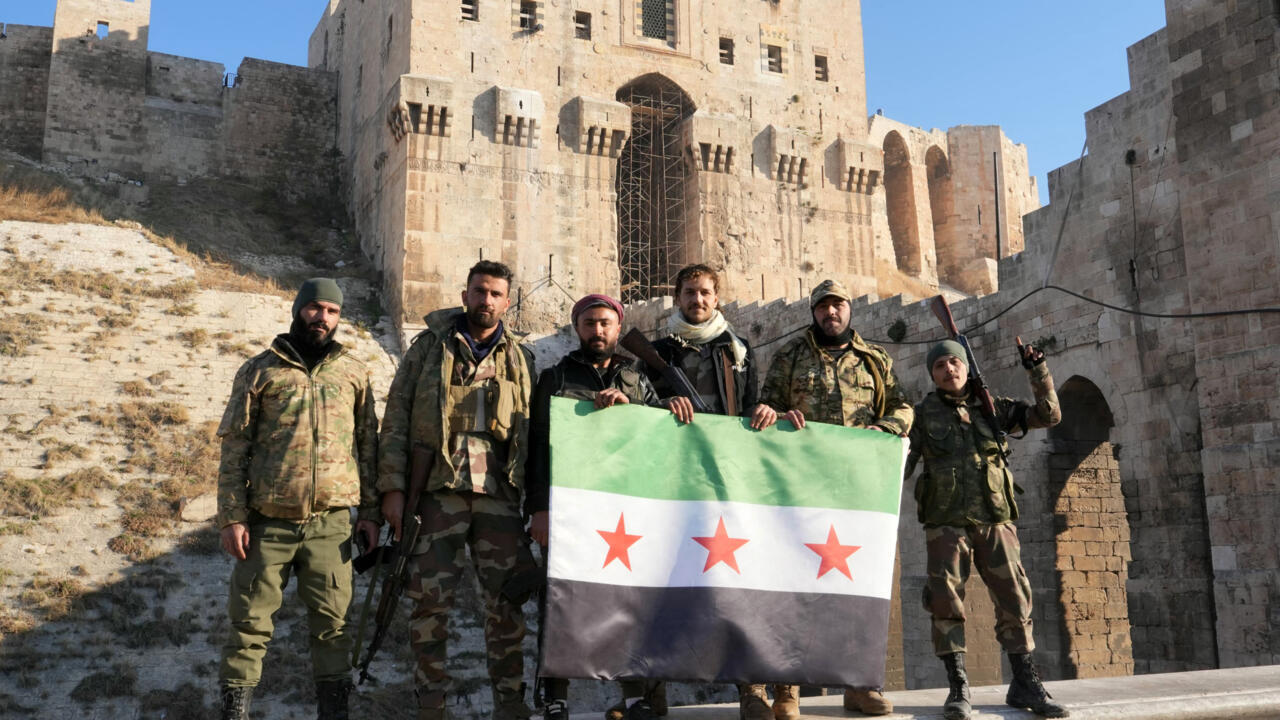
The rebels advanced out of the narrow strip of Idlib in which they and millions of Syrians from around the country had been crammed for over four years. ‘The rebels’ here means a military alliance under the umbrella of Hayat Tahrir al-Sham – the greatly moderated and better organised reincarnation of Jabhat al-Nusra. It’s still an authoritarian Islamist militia, but it’s not at all ‘like ISIS’ as the uninformed are saying. It broke definitively from the ISIS stream in 2014. It has a much more positive policy towards sectarian and ethnic minorities than ISIS. It allows far greater space for pluralism, disagreement and consultation than ISIS did (though it still arrests and detains some political opponents, and tortures them). Unlike ISIS, it doesn’t field a Hisba Diwan (or morality police) to interfere in people’s daily lives. Its focus is Syrian rather than transnational. It doesn’t threaten the west.
Its ‘Fath al-Mubeen’ military alliance also incorporates lots of members of other less authoritarian groups that were displaced to Idlib and then gobbled up by HTS. HTS has not been popular among people in Idlib – they’ve been demonstrating against it for months – but its offensive is wildly popular, because the people want to be rid of Assad and his foreign backers, and to return to their homes.
I didn’t expect the offensive, at least not on this scale. Nobody did. At first it looked to me like a controlled operation to restore the agreed Astana lines – that is, the division of north west Syria agreed upon at Astana by Russia, Iran and Turkey. Russia had pushed Turkey to normalise and negotiate with Assad, and Turkey had tried hard to do so. Assad had refused to budge from his maximalist positions, the Russians don’t want to alienate Turkey (given their difficult position attacking Ukraine), and Turkey needs more Syrian territory to which to send Syrian refugees. So perhaps the Turks and Russians were scaring Assad into negotiating by taking a few towns in the Aleppo countryside.
But the offensive went much further than that, far beyond the Astana lines. News came, meanwhile, that the Turks had prevented the Syrian National Army – comprised of former Free Army militias now under Turkish control – from moving towards eastern Aleppo. This allowed the PKK-dominated SDF to take areas in Aleppo abandoned by collapsing Assad forces – surely the opposite of what Turkey wanted. Turkey was not, therefore, in control of events. Turkey clearly didn’t know what was going on.
Read the rest of this entry »