Posts Tagged ‘Mahmoud Darwish’
The Green Still Resists
 In one of the most contentious sections of his thoroughly contentious Cairo speech, Obama declared:
Palestinians must abandon violence. Resistance through violence and killing is wrong and does not succeed. For centuries, black people in America suffered the lash of the whip as slaves and the humiliation of segregation. But it was not violence that won full and equal rights. It was a peaceful and determined insistence upon the ideals at the center of America’s founding. This same story can be told by people from South Africa to South Asia; from Eastern Europe to Indonesia. It’s a story with a simple truth: that violence is a dead end. It is a sign of neither courage nor power to shoot rockets at sleeping children, or to blow up old women on a bus. That is not how moral authority is claimed; that is how it is surrendered.”
It’s difficult to know where to start with this. Perhaps by registering just how insulting it is for the representative of the imperial killing machine – responsible directly and indirectly for millions of deaths in Iraq, Afghanistan, Pakistan, Lebanon, Somalia – to lecture the dispossessed and massacred Palestinians on their occasional attempts to strike back. We can be sure that the sleeping children Obama is concerned with here are the Israeli children who live on the stolen land of Palestine, not the unsleeping, traumatised children of Gaza, several hundred of whom were burnt and dismembered six months ago. Then it’s worth remarking how the erudition and intelligence shown in Obama’s pre-presidential book ‘Dreams from my Father’ have been immediately crushed on his assumption of the presidency. How otherwise could his historical vision be so partial and simplistic? There was certainly a key non-violent aspect to the struggle for civil rights in the United States, but pretending that violence played no role in the process makes it necessary to ignore the American Civil War (half a million dead), Nat Turner, Malcolm X, the Black Panthers and rioting Chicago. Violence, or the threat of violence, was important in South Africa and India too, and certainly in Obama’s ancestral Kenya, and was the dominant anti-imperial strategy in Vietnam and Algeria.
Edinburgh
I read at the Edinburgh Book Festival on August 12th. It was a double event, shared between me and Mohammed Hanif, author of the Booker-longlisted novel “A Case of Exploding Mangoes.” Mohammed’s book is a tragi-comic detective story which references Marquez’s “Chronicle of a Death Foretold”; and the murderee is General Zia ul-Haqq. (General Musharraf quivers between impeachment and exile as I type). It was great to meet Mohammed, not least because he knows several of the journalists I used to work with in Pakistan. One evening he cooked me a chilli-rich meal. I hope we meet again.
The death that has hung heaviest over the last week is not Zia’s but Palestinian poet Mahmoud Darwish’s. It was even a death foretold: the Palestine National Theatre was at Edinburgh performing a play based on the Darwish poem “Jiddariyya”, which concerns mortality and the extinction of identity, and which he wrote after heart surgery. It was a new bout of heart surgery which killed him. Such are the Edinburgh crowds that I failed to see the play. I did see Sabry Hafez give a talk on Darwish, and how the extinction of identity is for Palestinians an immediately concrete threat beyond the universal problem of physical death: Darwish was from a family of ‘mutaselaleen’, Palestinians who crept back across the border into ethnically-cleansed Israel in the months following their expulsion in 1948, and as a result his name could not appear on school registers. I wish I’d seen the play. Also sold out was a film on three screens by Iranian director Abbas Kiastorami. It showed, apparently, a Shia passion play, a taaziyeh for the martyrdom of Hussain, performed in an Iranian village.
Egyptian Novels
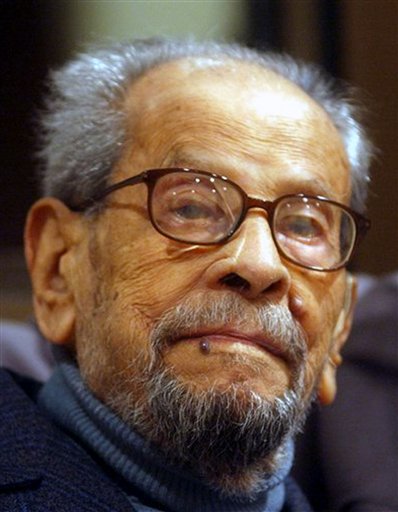
Nobel Laureate Naguib Mahfouz
In the contemporary Arab world, Bilad ash-Sham, or the Levant, surely comes first for poetry. Whether you’re looking for Muhammad Maghout’s bitter satire, anti-romanticism, and defence of the poor and the peasants, or for Mahmoud Darwish’s lyrical nationalism — whether you appreciate the modernist obscurity of Adonis or the powerful simplicity of Nizar Qabbani; you will turn to Syria and Palestine for your verse fix. The Arabs certainly do. For poetry in the Middle East isn’t the elite preoccupation it has become in the West. Taxi drivers and market men will quote you snippets of Qabbani’s love poetry or angry anti-occupation verse according to their temperament and the twist of the conversation. Even the illiterate may know some Qabbani from hearing it quoted in the café or crooned by the Iraqi singer Kazem as-Saher, with orchestral accompaniment. When Arab rappers want to express hardcore identity, they proclaim: “I’m an Arab like Mahmoud Darwish!” (the ‘Dam’ crew from Palestine.) That’s how uncissy Arab poetry is.
But for the Arabic novel, a genre which is only a century old (although there are much earlier precursors), the action is centred in Egypt, unsurprisingly – Egypt with its huge population and its indefinable, unmeasurable metropolis.
The most famous of Egyptian novelists is Naguib Mahfouz. Amongst the Arabs his books are bestsellers in garish covers, and many have been made into classic films. His international reputation was sealed when he became the first Arab to win the Nobel Prize for Literature in 1988. Reflecting changes in 20th century Arab reality, his style developed from heroic through realist to magical realist or romantic symbolist.


 Qunfuz