Remembering and Forgetting: The Bosnian Genocide
I visited Bosnia in September 2024 to write the following essay for the Genocide issue of the Critical Muslim. I discovered that the genocide of the Bosniaks by Serb fascists in the 1990s was only the latest of a cycle of genocides.
*
In the enthusiasm of arrival, I nearly forget what has brought me here.

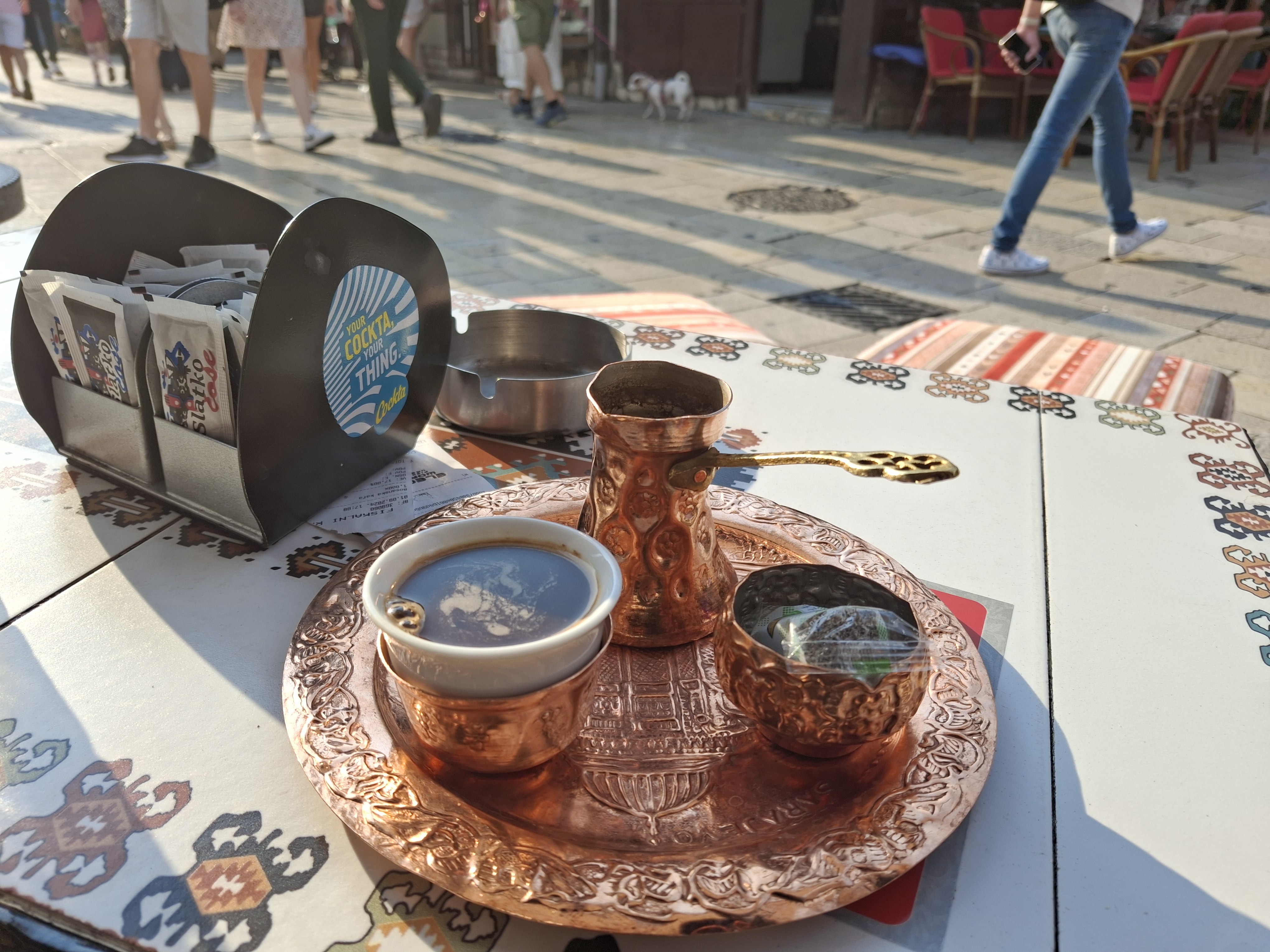
Sarajevo is a city in a low valley between tree-clad mountain slopes. The architecture is a mix of Ottoman and Austro-Hungarian, and a series of elegant bridges arch over a central river. It’s a city, therefore, lying somewhere between Prague and Isfahan, connecting those distant cultures. It has a café scene, based around the distinctive Bosnian coffee, which betrays a Middle Eastern approach to time. Its cuisine merges Turkish, Slavic, and central European influences.
It looks like a multicultural success story. A few steps from my hotel room there are several mosques, a Catholic church, an Orthodox church, and a synagogue. And a few steps from the nearest mosque is a café serving alcohol. Some of the Muslims leave the mosque after prayer and greet their friends who are sitting drinking beer. Between a quarter and a third of the women wear some kind or other of hijab. Sometimes the religiously-dressed women are accompanied by men in shorts and T-shirt. That’s a scene that can be seen anywhere in the Muslim world. But there are also religious-looking men, long-bearded, in sober, spacious dress, accompanied by women in shorts and T-shirt. You could say that a “secular” sort of Islam is practised here, if you were to use only one, positive signification of that troublesome word. Better, perhaps, to say that there’s an easy interplay of the secular and religious. A variety of beliefs and levels of belief, of different ways of living, jostle against each other not just politely but brightly and warmly. So it seems.
There are Turkish and Arab tourists, and Muslim visitors from Germany, England and France, no doubt feeling safer, more respected, and more comfortable here than they would in most European destinations.
I am visiting in the eleventh month of the full-scale Zionist genocide of Palestinians. The banners in support of Palestine are ubiquitous – in shop windows, car windscreens, or draped from the bridges. Not just flags, but the remembered dates of specific massacres. But beyond that, when you bring up “Syria”, the Bosniaks don’t immediately regurgitate conspiracy theories, nor squint in confusion, but demonstrate political understanding and Muslim and human solidarity. This provides another good reason for me to feel at home, or at least among friends. I remember the large protest demonstration in Sarajevo in 2016 when Aleppo was being destroyed by Assad, Russia and the Iranian militias. Other capitals ignored the disaster, but Sarajevo knows fascism when it sees it. It understands genocide.
This line of thought brings me back to my purpose. If it hadn’t, I’d have been reminded by the bullet holes and larger shell damage still visible on many of the walls. So now I recall an earlier mental image of the city, one formed by news reports in the early 1990s. It shunts my sunny euphoria to the side, imposing itself over my vision. This older version of Sarajevo is grey, snow-cursed, painted with pain-scarred faces, puddles of blood, and smouldering tower blocks. This is what has brought me here. My purpose is to write about the genocide of the Bosniaks.
And that makes everything look and feel different. Even the beautiful, green mountain sides, from which Serb big guns and snipers once terrorized the city below. When I walk out of town to the Kozija ćuprija bridge, then upwards on a path towards Mount Trebević, I find a different flag displayed. Nobody stops me to ask for my passport, but I am now, very suddenly, in the territory of a different administration – the Republika Srpska. The officials of this entity don’t recognize that a genocide of Bosniaks took place, or if they do, they believe it was necessary. They believe the Serbs, the genocidaires, were the real victims of the war, and are today the victims of the peace. Which makes the peace merely temporary. Nothing here has been resolved, only frozen. Inconvenient facts have been forgotten, while genocidal narratives have been carefully remembered. Sarajevo is surrounded, locally and globally, by immensely powerful interests that don’t believe in the happy jostling together of different ways of life. The city is besieged by forces of history currently paralyzed from motion but ready to fall, like axes or hammers, as soon as the spell of peace passes.
How then did this multicultural Muslim society in the Balkans come to be, and why is it so dangerously surrounded?
A mountainous land rising from the Adriatic Sea up into and beyond the Dinaric Alps, Bosnia and Herzegovina (or BiH for short – Herzegovina is the drier, warmer southern third) was known as Illyria before the slow Roman conquest. Slavic tribes settled in the sixth and seventh centuries, amongst them a tribe called Croat and another called Serb. But the area between today’s Croatian and Serbian states has had its own distinct political identity at least since the medieval Banate of Bosnia and the Bosnian kingdom that followed. Ottoman forces first arrived in 1414. It took them the next 150 years to absorb the entire country into the empire. Then the Bosniaks gradually converted to Islam. By the early seventeenth century, Muslims formed a majority of the population.
Why did so many of the Bosniaks convert? Why them, as opposed to other communities under Ottoman rule in the Balkan peninsula, such as Serbs, Croats or Greeks? The answer surely has something to do with Bosnia’s position in the borderlands between western (Catholic) and eastern (Orthodox) Christianity. Most Bosniaks rejected both. In the early medieval period they had their own Bosnian Church, and were charged with heresy by the larger churches as a result. The two related theories presented by historians to explain the Islamic conversion are both connected to medieval Bosnia’s alienation from official Christendom. The first theory is that membership in the Bosnian Church – a less hierarchical version of Christianity – facilitated the passage to anti-hierarchical Sunni Islam. The second is that most medieval Bosniaks still lived in mountain hamlets and thus had no strong connection to any organized form of religion before the arrival of Islam. By this reading, the Bosnian Church was an elite affair, known to only a tiny minority.
It is certainly the case that complex urban society in Bosnia developed for the first time under Ottoman control. Centers like Sarajevo, Mostar and Travnik were endowed with mosques, madrasas, baths, and markets, and their populations rapidly grew. Bosnia was no longer an independent state, but it retained its identity as an Ottoman administrative unit, an eyalet.
There was opposition to the empire in Bosnia as there was elsewhere. Muslims as well as Christians staged uprisings and tax rebellions. The most significant was the Great Bosnian Uprising of 1831-2, led by Husein Gradaščević, a figure later shaped by the Bosniak imagination into a folk hero and national symbol. This history had to be forgotten by Serb and Croat nationalists so that the myth of the Bosniaks as traitor Slavs and Ottoman agents could be constructed.
Later in the nineteenth century, as nationalism spread from western Europe, ethnic differences in BiH became more clearly defined and more politically salient. The distinctions between the peoples were religious first, but were cemented by competing state ideas. Orthodox Christianity was identified with Serb nationalism, which defined itself in opposition to the Ottomans and “Turks”. Catholicism was identified with the Austro-Hungarian empire, and the more “western” Croat identity. ‘The Bosniaks,’ on the other hand, as Ahmet Alibašić, professor of Islamic Studies, told me in his Sarajevo Old City office, ‘didn’t build up their national identity at that time because, as Sunni Muslims, they were members of the empire’s majority community. It was the other religious groups that formed “millets”. But today we live in a world of national groups, not of religions.’
In the nationalist convulsions which ended Ottoman rule throughout the Balkans, Muslims were usually marked as those who didn’t fit. Almost all the native Muslims of Serbia were exterminated or expelled, and their mosques destroyed, in the decades after the First Serbian Uprising of 1813. Then in the aftermath of the Ottoman defeat in the 1877-8 Russo-Turkish War, up to 300,000 more Muslims were exterminated in Serbia and Bulgaria, and another million expelled. A cycle of targeting and killing Muslims had set in. Other groups would soon be added to the target list.
In 1878, the Austro-Hungarian empire inherited BiH from the Ottomans, adding a new architectural layer to the cities. The nobles accepted the new rulers, while both the Muslim and Serb peasants resisted. But the western empire didn’t last long. Famously, Archduke Franz Ferdinand was assassinated by Bosnian Serb student Gavrilo Princip while leaving Sarajevo’s City Hall. That was the spark that lit an already very flammable interstate rivalry, catalysing the First World War. ‘The twentieth century began in Sarajevo,’ wrote Susan Sontag in 1993 as the city burned. ‘The twenty-first century has begun in Sarajevo too.’
The World War ended with BiH’s incorporation into the Kingdom of Yugoslavia – land of the southern Slavs – dominated by its Serb king. Land reforms of this period made the Bosniak community poorer. According to Jasmin Mujanović, ‘both upper and lower class Bosniaks were targeted for socioeconomic marginalization by a policy that was clearly ethno-national rather than economic in its intention and character.’
The Yugoslav kingdom lasted until the outbreak of World War Two. Then a new round of genocide rolled over a new generation of victims. The Jewish community – descendants of Sephardim expelled from al-Andalus by Christian supremacists – was largely wiped out by the Croat Ustashe as well as Serb Chetniks, both Nazi-aligned. The Ustashe also committed genocidal violence against Serbs, and the Chetniks slaughtered Croats. In some cases, Bosniak Muslims participated in these crimes. In more cases, Bosniaks were slaughtered, especially by Chetniks. In particular, there was a “cleansing” of Muslims from eastern Bosnia.
At a certain point in the course of the fighting, most of the Chetniks gave up their alliance with Germany and joined Marshal Tito’s anti-Nazi partisans. So as not to disrupt the new multiethnic resistance, their previous atrocities were carefully forgotten.
Following victory over the Germans, Tito set up the only Communist state in Europe independent of Russian control. Economically, it did a lot better than the rest of the Communist bloc. Ahmet Alibašić remembers wide-eyed visitors from neighbouring states amazed by the quantity and quality of goods in Bosnian shops. The urban working class, he tells me, enjoyed free housing and a reasonably good standard of living. Class differences were slight.
As for ethno-sectarian diversity, the state ideology was “brotherhood and unity”. This required an officially-directed forgetting of religious and cultural specificity. Ahmet explains: ‘For 45 years we obliterated difference. We all went to the same schools. We all did the same military service. There was no separation between the communities. There was intermarriage. And it didn’t work. In the 1990s, the narratives that had been submerged re-emerged. There is a lesson here for those who oppose multiculturalism. Here we tried assimilation, and the erasure of difference, and it didn’t work at all.’
Nevertheless, signs of “Yugonostalgia” abound. In a park in Travnik, a statue of Tito still stands, and the leader’s face decorates T-shirts and fridge magnets sold in the Sarajevo tourist markets. I mention this to the activist and researcher Azra Imamović, who gives me a few more examples of the phenomenon, then comments: ‘Sometimes we idealise the Communist period because we knew nothing else, and because when it ended the war began, and then everything we knew crumbled.’
‘But in those days, Islam was not valued, structurally. It was described as backward and reactionary, associated with the backward Ottomans. My grandfather was an imam. Of course, he wasn’t paid. My grandmother was veiled until Communists forced her to take it off, in the name of emancipation. And the Bosniak identity was not recognized.’
Waqf endowments were seized by the state, madrasas were closed, mosques destroyed. In 1969, however, Muslims were recognized as one of the constituent Yugoslav “nations”. This represented a kind of progress; at least there was now formal acceptance that the Muslim community existed. But it was a questionable progress. If the state portrayed Islam as backward and reactionary, then the Muslims implicitly carried the same labels. Hasan Nuhanović, a survivor of the Srebrenica slaughter, tells me, ‘It is unfair and illogical to refer to an ethnic group by religion.’ But there was a logic to it. Describing the people as Muslim meant they weren’t described as Bosniak, which meant the connection between the people and their land could be forgotten. For Jasmin Mujanović that connection is essential: ‘BiH is the Bosniak community’s only homeland; they perceive themselves as its indigenous people, and it is the source of their identity as a community.’
A Bosniak isn’t inevitably a Muslim, though most are. The minority of Serbs and Croats who believe in BiH might also identify as Bosniak. A couple of centuries ago they were more than a minority, before the ethno-nationalisms swelled.
When Tito died and Communism collapsed, such exclusionary nationalisms took their place. The strongest and most extreme version was Greater Serb nationalism, and this was fattened on propaganda – though propaganda may be too narrow a term for the cultural work underpinning the murderous ideology. The crimes against Serbs during World War Two were carefully remembered, while the memory of Serb crimes against others was suppressed. But the remembering went much further back, far enough to cast a sense of eternity over the conflict. In particular, the 1389 Battle of Kosovo, an indecisive clash between the Ottomans and a Christian coalition led by a Serb prince, was remembered with so much care that a myth was constructed from the paltry historical facts. A tale of sacrifice and treason had been made of it at least since the development of Serb nationalism in the nineteenth century. The Mountain Wreath, an epic poem of that period which portrays Slavic Muslims as Christ-killers and calls for their extermination, was a standard school text in Yugoslavia.
In this endlessly repeated poem, and in the speeches of Serbian president Slobodan Milošević, among others, Serbs cast themselves as eternal victims. Victimhood is often assumed to grant its holders a moral immunity, and thus recasts “retaliatory” or even “pre-emptive” violence as self-defence. This – the powerful imagining themselves to be weak – is one of the key elements of fascism. Every case of genocidal violence is preceded by a narrative of victimhood.
Alongside tropes of victimhood and “blood and soil”, Serb propaganda relied on the Islamophobic scare stories that have become more widespread since, conjuring Bosniak Muslims who wished to build a purist Islamic state stretching from the Great Wall of China to the Adriatic. In reality, the Bosniaks were the only ones in ex-Yugoslavia appealing to pluralism. While Serb and Croat nationalists sought to build states that would defend and exalt their respective ethnicities, the Bosnian referendum question was as follows: ‘Do you vote for a sovereign and independent Bosnia and Herzegovina, a state of equal citizens and peoples of Bosnia and Herzegovina – Muslims, Serbs, Croats, and of other peoples living in it?’
Demographics as well as principle favoured a pluralist system, for the country had no clear majority community. The Muslim proportion of the population had fallen since the Ottoman heyday – a result of Ottoman forced conscription as well as of Christian oppression. By 1992, when the referendum was held (on 29 February and 1 March, to be precise), 43 percent of the population was Bosniak, 33 percent Serb, 17 percent Croat, and 7 percent other. The “other” category comprised those of mixed heritage who self-defined as “Yugoslavs”, as well as Jews, Roma, and Albanians.
Many Bosnian Serbs boycotted the referendum, following the directives of their nationalist leaders, but of the 63.7% of the population that did vote, 99.7% supported the independence of Bosnia and Herzegovina (BiH) as a ‘state of equal citizens’. ‘This means,’ says Satko Mujagić, a lawyer and a survivor of the Omarska concentration camp, ‘that the new, independent Bosnian state was conceived as multicultural. But it wasn’t a new idea, because that’s the way it always was. Bosnian society was the first multicultural society in Europe.’
‘The first after al-Andalus,’ I add in my mind, drawing some connections. Andalus: another European and Islamic society which had practised convivencia – a multicultural flourishing, even if it wasn’t always truly convivial – and which had been ended by Crusader genocidaires.
Did people see the trouble coming? Why didn’t they prepare for it better?
I remember a conversation on this subject many years ago in London with a woman called Natasha, who had recently married my friend Mick. Natasha was the product of a marriage between a Muslim mother and a Croat father – which made her “other” or “Yugoslav” according to the census. She was only 16 when the war erupted, and she left almost immediately, first to Belgrade, then to London. She told me she’d had no idea before the war who of her neighbours were Muslim, Catholic or Orthodox. She remembered the men of the neighbourhood drinking vodka together on the Catholic and Orthodox Christmases, as well as at the Eids. All the men drank vodka – that was their defining identity as far as she was concerned. Then one night her father was driving the family home from a restaurant when the car was stopped by angry militiamen. But these men pushing the nose of a gun through the car window were the kids who until that day had played football at the bottom of the building, who had usually been friendly. Now someone had handed out guns and armbands, and all of a sudden they were defined as Serbs. The next day Natasha went with her parents, her sister, and tens of thousands of others to demonstrate for peace in central Sarajevo. Serb snipers shot and killed people in the crowd, and the unexpected war was underway.
Hasan Nuhanović had a very different experience. He was older than Natasha and, more to the point, came not from the capital but from rural eastern Bosnia. However much “brotherhood and unity” discourse he’d heard growing up, the reality was that Serbs and Muslims lived in different villages, or at least in different quarters of town. ‘We knew who was who,’ he says. ‘We knew by geography, and by people’s names.’
Azra Imamović knew too, but still, she says, it was hard to imagine the differences between communities resulting in actual violence. ‘Yes,’ she says, ‘we could see it coming. There’d already been a war between Serbia and Croatia. But even then, there was a lot of denial that it could happen here. And that denial continued even when snipers were taking positions on the roofs. It continued, in fact, even after people had been killed.’
Long before the snipers, there were more than enough warning signs. Serb nationalists themselves warned of the damage they would soon do. ‘Don’t believe you won’t lead Bosnia and Herzegovina to hell, and possibly the Muslim people to extinction,’ raged Bosnian Serb leader Radovan Karadžić to the BiH parliament in October 1991, ‘because the Muslim people cannot defend themselves if war breaks out here.’
But many didn’t take the threats seriously. Because people were always threatening things which never happened. Because it was mere political rhetoric, even if there’d been a war in Croatia. Because it was only a joke.
Haris Hindić was living in Norway when the war started. He was working as an interpreter for the Norwegian immigration service, which meant he heard many stories from those who had fled. One was told by a Bosniak who had been a policeman in a rural area. This Bosniak officer had been on night shift with two colleagues, one Serb and one Croat. It was a quiet night, so the three men were relaxing together in the station, talking and laughing, drinking coffee. And then the Serb abruptly changed his expression, pulled out his gun, and ordered the others to disarm. At first the Bosniak and the Croat continued laughing, assuming their friend was performing a practical joke. But there was nothing funny about it. Their colleague threatened to kill them if they didn’t hand over their weapons. So they did, and just a few minutes later they heard buses and trucks on the road, and then smelled the smoke as houses began to burn. The buses were intended to transport surviving non-Serbs out of town.
As Bosnian Serbs disarmed Bosniaks and Croats, arms were distributed to Bosnian Serb paramilitaries. The war began, therefore, with the Serbs bearing the most weapons and the Muslims the least. When the UN imposed an arms embargo on the former Yugoslavia, the (always ill-named) “international community” locked the Bosniak disadvantage in place. Serbia inherited the former Yugoslav army and its stocks. Croatia by now had achieved independent statehood, and possessed a long coastline, which made it easier to smuggle or deal for weapons. But the Muslims had to manufacture weapons from whatever they could find, or buy them from their enemies.
Well-armed and well-prepared, combined Serb forces seized over 60 percent of the country in the first six weeks. But they couldn’t seize the capital.
Activists of the Serb Democratic Party barricaded the approaches to Sarajevo in early April 1992. The minority of Serbs and Croats who remained loyal to the idea of a multicultural BiH remained in the city, organizing themselves into the Serb Citizens Council and the Croat Citizens Council respectively. But most left. And so began the siege, which lasted for 44 months, or 1,425 days. Families huddled in basements, in the dark, and starved. They burned their books to keep warm. Upstairs, in the streets, there were massacres. An average of 329 shells a day hit the city, ripping apart schools, hospitals, markets, and residential blocks. 11,541 people were killed, including 1,601 children. At least 50,000 were injured.
That was the period that provided my early idea of Sarajevo. I had pictures in my mind because there was media coverage. But I had no pictures from rural eastern Bosnia – not until Srebrenica in 1995 – because there was no TV coverage of the events there.
After a few days in Sarajevo, I hire a driver to take me to Srebrenica. Just outside the capital, the flags change from the Bosnian lilies to the red, white and blue stripes, and the mosques become much fewer. The Cyrillic alphabet accompanies or replaces the Latin on the street signs. Once again, I’ve entered the Republika Srpska.
The driver, Afan, points out a village in which one resident – a woman whose husband was murdered by Serbs – recently won a long-running court case. Apparently the locals had built an Orthodox church in her garden. Right on her land, right up against her window. Not so much a place of worship in this case as a symbol of ethno-sectarian triumph, and a further urging – following the first, which was the murder of her husband – for her to vacate the property.
But this was a mere echo of the war in the early nineties, if “war” is what it was. That may not be the most appropriate word, given that the main targets of the violence – as in Palestine today, as in most genocides – didn’t have a strong, unitary, functioning state to defend them. The violence was very one-sided, and its point was genocide.
Bosnian Serb militias under Serbian state control, reinforced by the old Yugoslav army, burnt whole families in their homes. Sometimes they crucified men before burning them. They shot parents in front of their children, and children in front of their parents.
We descend from the hills, past a sign advertising a not-yet-built ski resort, and then down to the plain where Vlasenica lies. This town once had a Muslim majority, but no longer.
I read in Edina Bećirević’s book that in this municipality boys as young as 12 were mobilized, ‘armed not only with machine guns but also with fear,’ because they’d been told the Muslims wished to kill them.
Ordered to hand over their weapons, the Bosniaks of Vlasenica complied. They believed compliance would calm their neighbours’ passions. Instead, in the town and the surrounding villages, the neighbours summarily executed men, women and children. The murderers were known to the victims. Some survivors managed to flee into the forests, and some joined the Bosniak resistance. Others were gathered in concentration camps, such as the Sušica camp, which consisted of a warehouse and a hangar, which held 8,000 people between May and October 1992. The majority of women and girls in the camp were raped.
An estimated 50,000 people were raped during the genocide, most of them Bosniak women and girls. Some camps were entirely dedicated to the purpose. This means a harvest of many tens of thousands of thoroughly traumatized lives, and of lives born into trauma. There is testimony by Alen Muhić displayed in Mostar’s Museum of Genocide titled ‘My biological father raped my biological mother.’ Edina Bećirević quotes the man who raped Bakira Hasečić, who told her as he was raping her (in Višegrad, in 1992) that the rape was not personal but systematic, so that Bosniak women would be ‘inseminated by the Serb seed.’
Rape is an element common to almost all genocides, with the curious exception of the Nazi Holocaust, when taboos on intercourse with racial inferiors, as well perhaps as the abstracted, “scientific” justifications for the slaughter, worked against such messiness. But other than in the Nazi case, organized rape is as ubiquitously connected to genocide as patriarchy is to most human cultures. This arises from the conception of women as property. Spoiling the enemy’s property is a war aim. To make his property ours.
In Sarajevo’s Galerija 11/07/95, there is a photograph of a woman pushed across a frontline east of Travnik. Bosniak fighters are kneeling to her level, asking gentle questions, and she is sitting on the grass, her dress torn, hair matted, face horror-shocked. According to the text accompanying the photograph, she is mute. Those traveling with her reported she’d been held in a Serb-run detention camp.
The car rolls onward. If it weren’t for memory, eastern Bosnia would be bucolic. Steep-roofed wooden-plank houses stand between stands of corn, piles of firewood, and beehive haystacks. There are actual beehives too, and home-made honey on sale at the roadsides. Cattle stroll the road, bells around their necks. Afan says there are wolves and bears in the hills. We see an eagle.
Afan offers me a cigarette. ‘I gave up three years ago,’ I say. ‘That was a big mistake,’ he says, very seriously. ‘If you can control yourself, you can smoke only one pack a day, and that is good.’
We’re driving alongside a river now. It’s sinuous, emerald clear, foaming over rapids, and banked by elegant green. I remark on its beauty. ‘These rivers are full of bodies,’ says Afan, in the same serious tone he uses for discussing cigarettes.
Edina Bećirević’s book is called Genocide on the Drina River. That’s the next river to the east, and the natural frontier with Serbia. Serbs who wished to erase the frontier aimed to eliminate all Bosniaks from the towns and villages on the river banks. So in mid April 1992 a Bosniak woman watched through her window in Višegrad as Serbs shot people at the bridge over the Drina unceasingly for 36 hours. The corpses that fell into the water clogged up the culverts of the dam serving the hydroelectric plant downstream.
So there are bodies in the river beds. The grains of river silt consist of corpse dust. The fish of these rivers have bred on corpses over many generations. ‘The bodies are not just from the 90s,’ Afan frowns. ‘But from every war, from all of them.’
The same quiet, slightly sour seriousness settles on all his words throughout the day. He was a boy when the last genocide was perpetrated. He comes from the Krajina region in the north, also part of the Republika Srpska today, and cleansed of most of its Bosniak natives. He lives in Sarajevo, near his father, who has not been the same since the 90s. ‘He is angry,’ Afan says. ‘He isn’t able to be happy.’
For a while I stop asking questions. The day is balmy. A warm September. There are one or two mosques between the churches, the fields, the patches of forest, but these mosques are newly built.
‘It is not just one genocide,’ Afan says. ‘It is one after another. The Serbs don’t give up their aim.’
From the Bećirević book I learn the story of Hasan Tufekčić: In 1943, Chetniks killed his wife and ten children on the Višegrad bridge. He married again, and had five more children. In 1992, Chetniks killed three of these children, who were named after their brothers killed fifty years earlier.
But now the car pulls in at the Potočari memorial, just a mile or two out of Srebrenica. The memorial is opposite the old battery factory, where Dutch UNPROFOR troops were once barracked, where – when Serbs captured Srebrenica – Bosniak families once rushed for help, and where the Dutch UN troops handed the Bosniaks to the Serbs, who murdered 8,000 of them.
I’ve seen pictures of this memorial, the engraved names and serried headstones officially inaugurated by President Bill Clinton, all very somberly institutional, suggesting the formal recognition of the crimes committed, a degree of restitution, and closure. What I hadn’t realized before I came – what, in fact, makes very little sense to me now – is that this memorial is under the control of a regime of official forgetfulness. It’s in the territory held by the genocidaires.
When I mention Potočari to my Bosnian friend and correspondent Adnan Delalić, he responds with indignation. ‘The sheer absurdity of it,’ he writes. ‘Imagine if the Nazi state were allowed to continue existing, with Auschwitz in its territory. And everyone “remembers” it and declares “never again”, but barely anyone mentions the fact that the political project that committed the genocide still controls the territory. Which means the conflict is not really resolved. In some ways, the genocide continues. This is what official/international Srebrenica discourse feels like. Detached from the material reality and the facts of how it came to be. Sentimental, if not kitsch.’
The memorial in this context is almost an insult. At the same time, it’s necessary, and meaningful. But I don’t quite know what to do with the meaning. How does one commemorate a genocide? How does one recognize, or do something positive with, the objectification of a group of humans, and their consequent slaughter? How to make meaning of the fact that their lives were considered by their murderers to have no meaning at all? How to acknowledge, and comprehend, and make amends for, the enormity of the pain and fear felt by the 8,000 murdered here, the 100,000 killed throughout BiH, and all their surviving relatives and friends?
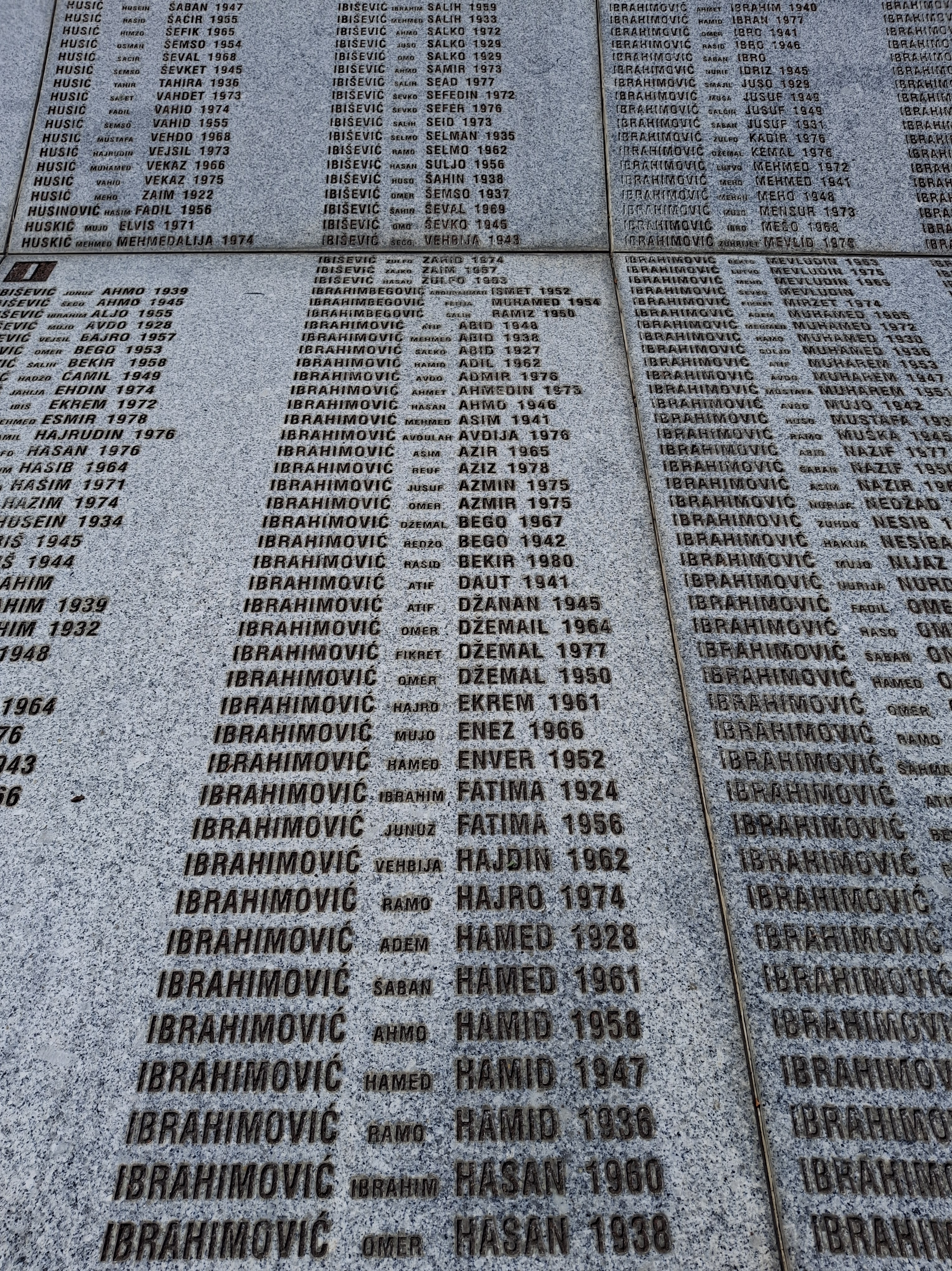
I take a photograph of one section of the stone installation. Dozens of names from the same family: Ibrahimović. I send the photograph to my son, whose name is Ibrahim. Two old ladies, meanwhile, have picked their way to a certain spot among the gravestones and are reading the fatiha. During the genocide they would have been in early middle age. Mothers, sisters, daughters. I read the fatiha too. What else can one do? I read the fatiha several times at different locations in the cemetery. Conscious as I read that I am overlooked by the partisans of Republika Srpska. Conscious too of the bereaved Syrians eking out an existence in this same moment in the tent cities of Idlib. Conscious of the carpet bombing of Gaza, and of the abandoned Rohingya drowning at sea, and the Tigrayans and Ukrainians, the Uyghurs and Yazidis, everyone who has had a turn, the same evil turning again and again and again. Not sure what use there is in reading the fatiha, but anyway reading it. What else to do?
I walk across to the battery factory, which is now a museum. The factory itself – its cavernous inhuman halls – is a testament to man’s tendency to alienate himself, to act against his own interests. It’s a shadowy place, cold even on a hot day. The exhibits seem small in its holding. There are the piled shoes of dead people. There is racist, sexist graffiti left by the Dutch, mocking the people they were about to send out to die. There are maps and plaques recounting the details of what happened.
Srebrenica had been under siege for months before the Serbs moved in. The locals were starving alongside tens of thousands of refugees from the “cleansed” villages of the Drina valley. When the town fell, thousands of men and boys tried to march to free territory. They were strafed by artillery, picked off by snipers, and they starved even thinner. Many died; many others eventually arrived in safety, having seen their relatives die.
Of those who sought and were denied shelter with UNPROFOR, most women and young children were deported – though many of those too were killed. But the Serbs demanded access to the men and older boys, claiming they wished to filtrate them, to check if they had committed crimes. And the Dutch UN soldiers handed these men and boys over, though the Serbs until that point had respected the battery factory boundaries. Hasan Nuhanović, who I met in Sarajevo, was an interpreter for the soldiers who handed the rest of his family to the Serbs, who then murdered them – his father, mother, younger brother – ‘before my eyes’. Dutch officers continued to send Bosniaks to their deaths despite the pleas of people like Hasan, and even after reliable information came back that men were being murdered.
Years later, Hasan took the Dutch state to court in the Netherlands, and won. In 2013, the Dutch Supreme Court found the state liable for the killing of three Bosniak men, including Hasan’s father and brother. Liable only for those three, not for the rest. So Hasan’s was a partial victory – like the official recognition of the Srebrenica slaughter as a genocide, but not the slaughter of Bosniaks in general; and like the trial and conviction of Serb military leaders at the Hague, but not the punishment of the foot soldiers. Partial, symbolic, but a victory nevertheless. Another of my Bosniak interlocutors referred to Hasan Nuhanović as ‘an institution’.
Another human institution, at least in Srebrenica, is Ahmed Hrustanović, the imam of a rebuilt mosque. I met him in a Srebrenica café over coffee and crepes.
His father and uncles were murdered when the Dutch troops handed them to the Serbs. Ahmed’s last sight of them was from the back of the truck which carried him and his mother into internal exile. He grew up in this exile, and studied Islam, and then came home to the scene of the crime.
‘I’ve spent 11 years back here,’ he tells me. ‘And these have been the best years of my life. This land, these streets, this is where my memories with my father are. It’s like a treasure.’
But is it easy living here? ‘No,’ he says, ‘It’s not easy at all. Our neighbors are those who committed crimes against us. We suffer constant discrimination. All the official jobs go to Serbs. In schools, the children are taught what they call the “Serb” language, and Serb versions of history and geography.’
‘So why did you come back?’ I push him further.
‘Living here again,’ he says, ‘is treatment for my trauma. That’s the main reason I came. To fight with my trauma.’
There were 13,000 Muslims native to the area before the genocide. Now there are 2,000, people like Ahmed who decided to return. ‘But the conditions are uncomfortable. And the young go to the west in search of jobs. There are many empty houses. But despite that, there is a community again. Before, everything was destroyed, the mosques and the houses. Now there are five mosques in Srebrenica.’
Not a single mosque in eastern Bosnia was left undamaged by the Serbs. ‘This is a clear difference,’ says Ahmed. ‘The churches in Sarajevo survived. In Srebrenica, the Serbs destroyed all the mosques, every sign of Islam, even our graves, in a couple of days. They bulldozed everything and then buried the rubble. They made mass graves for the mosques.’
But first they made mass graves for the people. And when investigators arrived in the years following, they dug up and reburied the evidence. They moved the remains from site to site, trying to cover their tracks. This means that Ahmed has buried his father’s bones several times. ‘In 2012 we buried 40 percent of his bones. They were identified by DNA testing. In 2021 we buried another 40 percent. So 20 percent are still missing.’
Beside me Afan frowns into his coffee cup. I remember something else he told me in the car: ‘There is a type of butterfly that is attracted to calcium. This was a clue for those searching for mass graves. The butterflies like the calcium in the bones.’
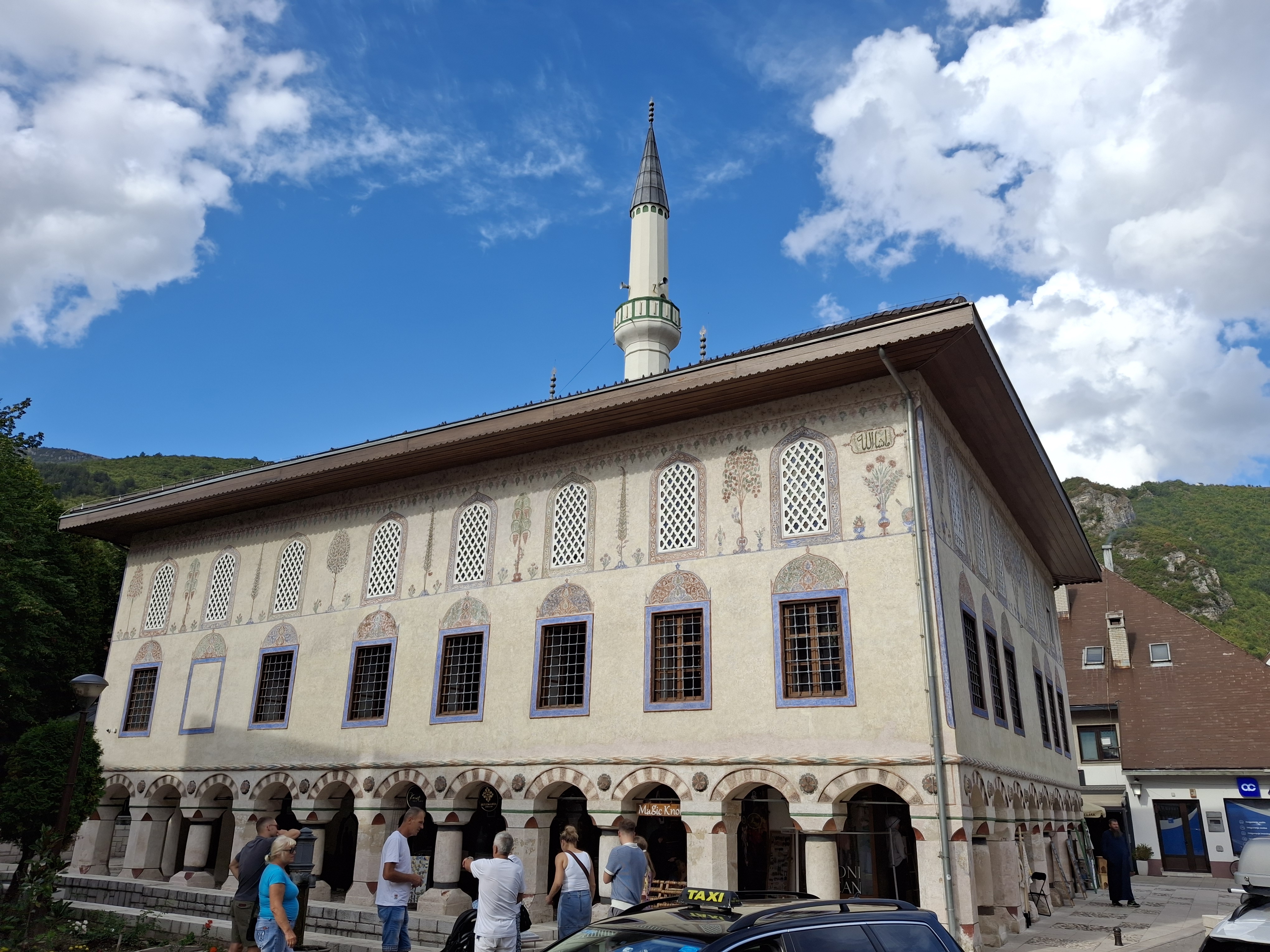
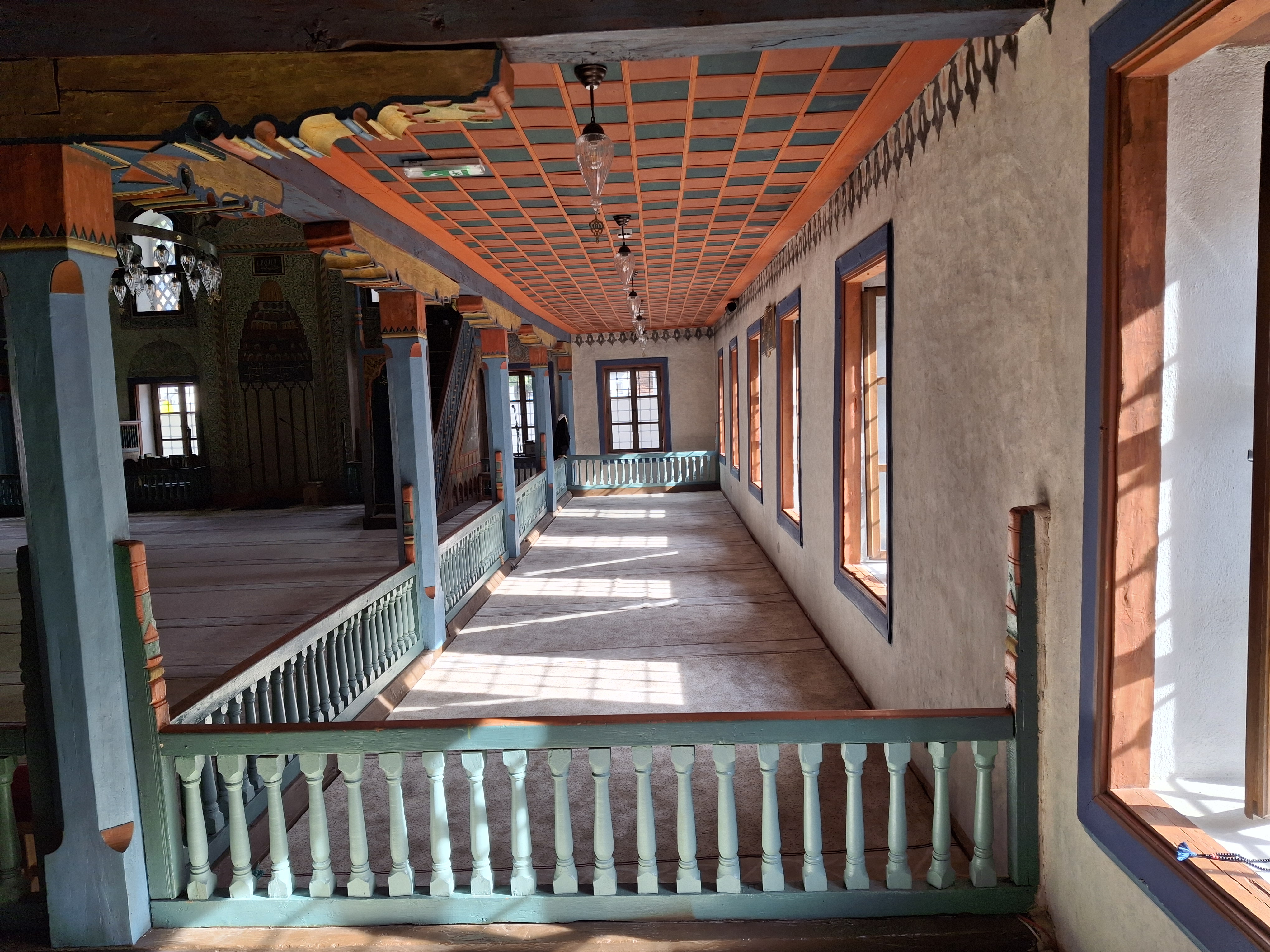
We return to Sarajevo, and the next day I take a bus to Travnik, an alpine town in central Bosnia which served as the Ottoman Empire’s first Bosnian capital. Once called “the European Istanbul” and still packed with historical buildings, it feels to me like a psychic relief. I notice the relief before reading why: this part of central Bosnia never slipped Bosniak control. There was some fighting with Croat militias, and the town hosted refugees from elsewhere, but there was no siege here, no genocide. The Sulemanija Mosque – wooden, lushly painted, with floral decoration reminiscent of the Umayad Mosque in Damascus – is one of the most beautiful I’ve seen anywhere. The wonders of the architecture suggest how much has been lost elsewhere. The place, in any case, feels much less interrupted than the war-damaged locations I visit. The people, like the buildings, feel somehow more intact. I’d like to return with my hiking boots, for the mountains, and with time to enjoy more grilled trout at the spring-side restaurants.
Then I take a bus to Mostar, which is in the southern, Herzegovina part of the country. The route passes through remarkable scenery, jagged blue peaks, and Jablanica Lake, which justifies another potential visit…
Mostar is built in a valley between hills, like Sarajevo, but the hills here are drier and the valley is still steeper than Sarajevo’s, so even more at the mercy of those who control the heights. In the early days of the war, Serb forces came from the east, “cleansing” the villages of Muslims, then setting up their big guns on the summits to blast the buildings below. ‘You could call it urbacide,’ Haris Hindić says, using a term invented specially for the Bosnian war. Homes and civilian infrastructure were incinerated, roads were cratered, food sources cut off. And Haris’s mother was killed in the shelling.
I meet him and his friend Jasmin Maksumić for evening coffee in a Mostar hotel – because coffee seems to regulate every meeting here, at every time of day.
They run through the history for me. The Serbs were attacking Croats as well as Muslims, and at first the two targeted communities made natural allies. They fought shoulder to shoulder against the aggressors. ‘But the politics of the Croatian state were different,’ says Haris. ‘Blaz Kraljević was an honest Croat, a local. He wanted to deepen the cooperation between us. But the Croat leaders killed him.’ This was because Croatian president Franjo Tuđman had made a deal with Serbian president Slobodan Milošević to divide BiH between Croatia and Serbia, leaving nothing for the Bosniaks. In Mostar, therefore, the Bosniaks were soon hemmed in between the Serbs on the eastern heights and the Croats to the west. Once again, neighbours turned on neighbours. Croat forces took the Muslims they captured to the stadium in Mostar, and from there distributed them to their own network of concentration camps. ‘It is difficult to understand,’ says Haris sadly. ‘We were allies first. Before that, we were neighbors. But anyway, they couldn’t finish us off here. Their plan didn’t work. There was resistance.’
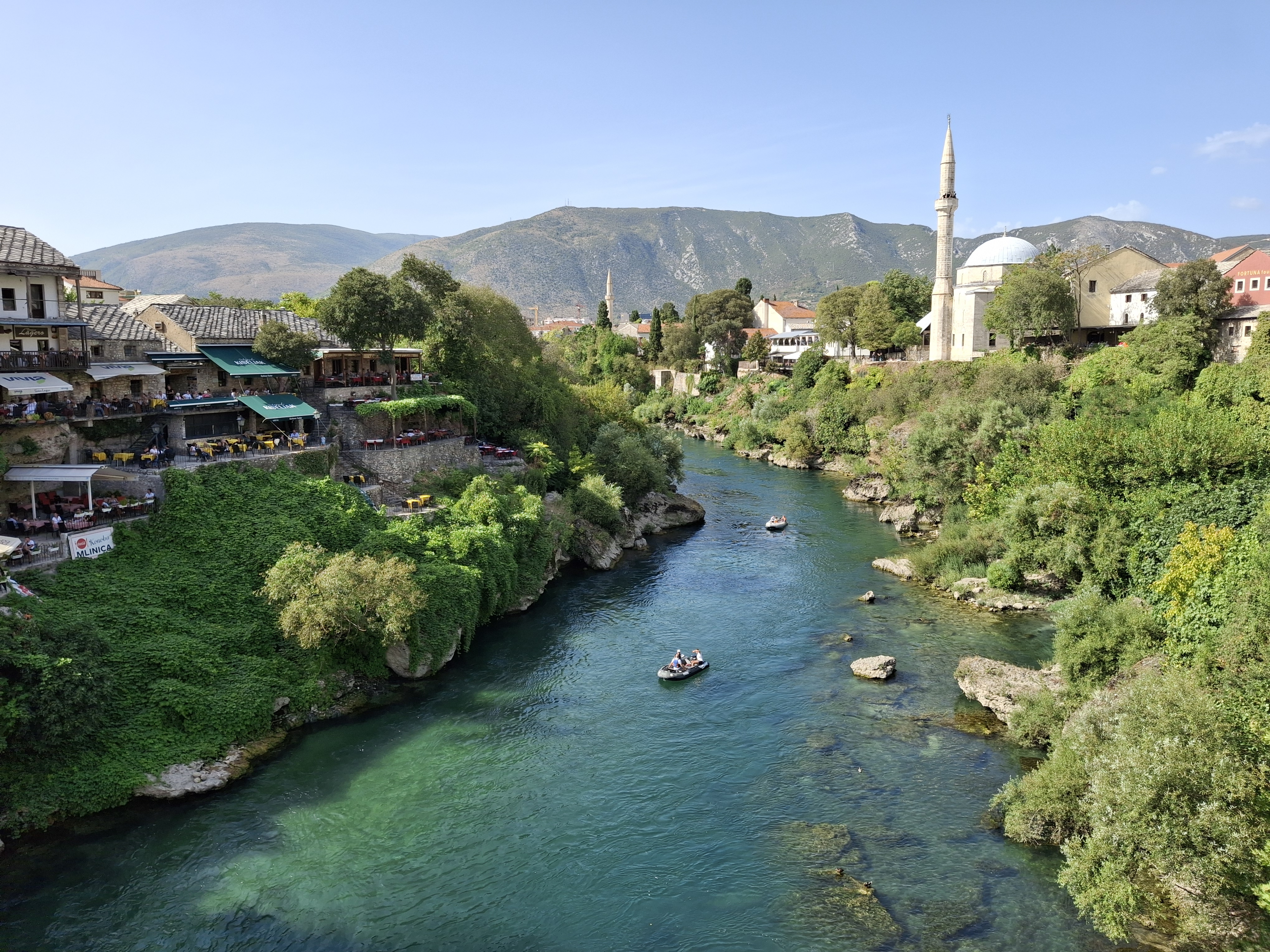
The resistance was fierce, and in some cases epic. The Croats held almost all the west of the city, where their community was in the majority. They soon destroyed all the bridges across the River Neretva, including the old Ottoman bridge, the high-arched Stari Most. As well as a tactical loss, this was a blow to Bosniak morale. The bridges had given Mostar its name – the men who guarded the bridges in medieval times were called mostari, or bridge keepers – and the Stari Most served as a Bosnian national symbol. But despite its destruction, a Bosniak presence remained on the west bank. Two small neighbourhoods, Donje Mahala and Cernica, were held throughout the 11-month battle by only “eight or nine men” and the surviving Muslim families who shared their meager food supplies. These eight or nine “kept shifting positions, one place to the next, so the Croats thought there were hundreds of defenders.”
The Croats, though better armed and benefiting materially and politically from the support of an independent state, were not ultimately helped by their reliance on Zagreb. Young troops belonging to the Croatian state’s army were sent to fight in a city they’d never seen before, in a land which only belonged to them according to a recently-forged ideology . So the advantage remained with local Bosniak defenders.
Jasmin Maksumić was one of them. He tells me about the battle of 15 July 1993, when non-Bosnian Croats arrived from the south, planning to cut the road between Mostar and Blagaj. The Bosniaks were able to surround the Croat advance force, and to kill the commander. When they found the commander’s Motorola phone, they shouted ‘retreat! retreat!’ into the receiver, which caused confusion in the Croat ranks. ‘Our soldiers killed many of them. Their panic that day saved Mostar.’
The east bank of the city was almost entirely destroyed. The west bank, in general, was not. Pictures in Mostar’s Genocide Museum prove that the impressive, stone-walled, tourist-crammed Old Town is not actually old but has been recently reconstructed. Today the tourist throngs are the only physical obstacle to moving from one side of town to the other, but Mostar is still socially divided. A huge cross has been mounted atop the hill on the west bank on exactly the spot where Croat artillery once sat. I ask Haris what he thinks of it. ‘It’s not just that one,’ he says. ‘They put up crosses on any land they claim. They are marking their territory, just as dogs do.’
After years of international inaction, a few days of NATO bombing brought the slaughter to a halt. At the same moment, the US intervened to prevent Bosniak forces retaking the northern city of Banja Luka. In the same spirit, the agreement made at Dayton, Ohio allowed the initiators of the war, the worst criminals, to mark almost half of BiH as their territory. 49 percent of the country fell under the administration of the Republika Srpska. In the words of my correspondent Adnan Delalić, ‘the genocide was institutionalized.’
Nothing was resolved. The conflict was frozen. But ice is better than murder. ‘The fact that we haven’t had a war for 29 years is a good thing,’ says Hasan Nuhanović. He directs a similar glass-half-full rhetoric at the attempts towards accountability: ‘There are thousands of war criminals living in our neighborhood, but their entire political leadership was tried at the Hague.’
He’s referring to the International Criminal Tribunal for the Former Yugoslavia (ICTY), which sent dozens of men to prison. It was the first time that top officials had been held accountable for the crime of genocide. This gave legal and some emotional validation to the survivors, and seemed to go some way towards ensuring their future safety. ‘Had there been no ICTY,’ Azra Imamović asks rhetorically, ‘can you imagine this place today?’
An estimated 19,500 men participated in the massacre at Srebrenica – soldiers, police, drivers, and various other facilitators. Throughout BiH, very few Serbs actively protected their Bosniak neighbours. This is not because they are Serbs, but because they are human. Very few Germans actively protected their Jewish neighbours. Dissenters in matters of blood are always very few. Almost the entire Serb population was complicit in the genocide, even if only by averting their eyes at key moments. These people were not put on trial. Neither – at the other end of the scale – was the most powerful perpetrator of all. The February 2007 verdict of the International Court of Justice (ICJ) in the case of the BiH state against the Serbian state held Serbia accountable for failing to prevent genocide, but not for perpetrating it. BiH had asked the court to consider the minutes of the Serbian Supreme Defense Council, which would have showed the state’s intentions and its behind-the-scenes acts, but the court refused to do so. This let the Serbian state off the hook, and eased the way for denialist narratives.
Milorad Dodik, the current Bosnian Serb leader, calls the genocide ‘the greatest myth of the twentieth century.’
I ask Ahmad Hrustanović if he ever discusses the past with his Serb neighbors. The answer is no. ‘They don’t want to speak, certainly not to apologise. They are proud of what they did.’
Ahmet Alibasić agrees. ‘The problem isn’t so much denialism,’ he says, ‘as triumphalism.’
And Hasan Nuhanović confirms it. ‘Beyond certain outspoken activists – who are usually Serbs from Serbia, not Bosnian Serbs – they all deny the genocide, including representatives sitting in the Sarajevo parliament. The Banja Luka [Republika Srpska] parliament has actually passed legislation to deny it.’
When I ask Azra Imamović if this level of denial means that the genocide could happen again, she responds, immediately and energetically: ‘Yes! Certainly it could happen again, and many people feel it. Some keep their suitcases packed. The outbreak of war in Ukraine made us afraid. Gaza too. We are waiting.’
If it does happen again, who will the Bosniaks be able to rely on? My interlocutors cultivated no illusions.
‘Without America,’ says Hasan Nuhanović, ‘the Europeans would have tolerated the genocide even longer.’ This seems to be a fact as much as an opinion. Comments made by Bill Clinton support it, as reported by his confidant Taylor Branch. Clinton told Branch that, ‘privately, key allies objected that an independent Bosnia would be “unnatural” as the only Muslim nation in Europe. He said they favored the [arms] embargo precisely because it locked in Bosnia’s disadvantage … President Mitterand of France had been especially blunt in saying that Bosnia did not belong, and British officials also spoke of a painful but realistic restoration of Christian Europe.’
But America is no more reliable a guarantor of Muslim safety than Europe, as the current bloodbath in Palestine and Lebanon proves. The provision of arms, funds and propaganda for the slaughter shows how little Muslim blood matters when weighed against Israel’s “painful but realistic” maximalist aims. As the west distances itself from its previous interest in law and human rights, western Muslims even beyond BiH find no reason at all to feel secure. In the UK, those demonstrating against the genocide of Palestinians – surely the segment of society that currently cares most about law and rights – are called “hate marchers” by those in power. In this climate, riots broke out in northern English towns a few weeks before I left for Bosnia. Provoked by big-name disinformants on social media, the mobs attacked a mosque, a hotel housing refugees, and random brown and black people in the streets. In the following weeks (reversing the ICTY pattern), the often lumpenproletarian foot-soldiers were rapidly tried and sentenced, but the upper-class rabble-rousers were left free to disinform another day.
Rabble-rousers, propagandists, the powerful nursing a sense of victimhood. When such types dominate the media, in a time of uncertainty, whether in a fractured post-Communist state or in an internet-drenched late-capitalist state, then deadly trouble follows. Then the demons of the past return with a vengeance.
There is a problem with the ownership of the media, most certainly, and particularly in societies whose media have replaced or smothered their cultures. There is a culture war, in the truest sense.
So what can we do? – I mean, those of us who don’t own media platforms. We can read the fatiha. And against forced forgetfulness, we can place our own efforts to remember.
This is what the Bosniaks do. They try to remember, and to remind everybody else. Museums in the cities remember the sieges, the war crimes, the genocide. Wall plaques at massacre sites throughout Sarajevo remember the names of the victims, and flowers remember their hearts. In Saarajevo pavements, at intervals, the impact holes from the heaviest shells are filled with the memory of blood-red paint.
Genocide is always an attack on culture, because a people’s existence is carried in their culture as much as it is in their bodies. Hence the destruction of all the mosques, shrines, madrasas and graves. And hence, in reply, the Sarajevo film festival, begun in the siege and still continuing today. Hence the burning of the National Library’s 1.5 million volumes, and hence the performance of Mozart’s Requiem in the ruins. For every act of erasure, a corresponding act of inscribing. This is most steadily apparent in the lived business of everyday culture. All my interlocutors, secular and religious, stressed how the genocide had solidified Bosniak and Muslim identity.
I walk again through Sarajevo’s Galerija 11/07/95 (the title remembers the date of the Srebrenica massacre) – and stop at Tom Stoddart’s famous photograph of Meliha Varesanović. It remembers a moment in 1993 as this Bosniak woman was moving through the besieged capital. She’s wearing high heels, and a flowery dress showing off her shape, and pearls, and on each wrist a bracelet, her chin high, her dark eyes energetically engaged with the eyes of the viewer. To her left is a soldier’s body and gun, and the cigarette burning in his fingers. Sandbags are piled high behind her.
The picture channels her defiance. And the beauty of the body – the spirit of the body – while all around men are obliterating bodies, reducing them to chunks of raw matter.
Citations
The Bećirević book is highly recommended. As well as being a detailed study of the Bosnian genocide, it contains ideas and information relevant to genocide in general.
Edina Bećirević, Genocide on the River Drina, Yale University Press, New Haven and London, 2014
I came across Taylor Branch in the Bećirević book. The full version of his notes on the Clinton presidency is here:
Taylor Branch, The Clinton Tapes: Wrestling History with the President, New York, Simon and Schuster, 2009.
Jasmin Mujanović, The Bosniaks: Nationhood After Genocide, Hurst and Company, London, 2023
Telibećirović and Colaković, The Siege of Sarajevo 1992-1996, Vrijeme, Zenica, 2019
Marko Attila Hoare’s histories of the region are also highly recommended.


Leave a Reply