Archive for September 2026
‘Holy Land’ Ideology
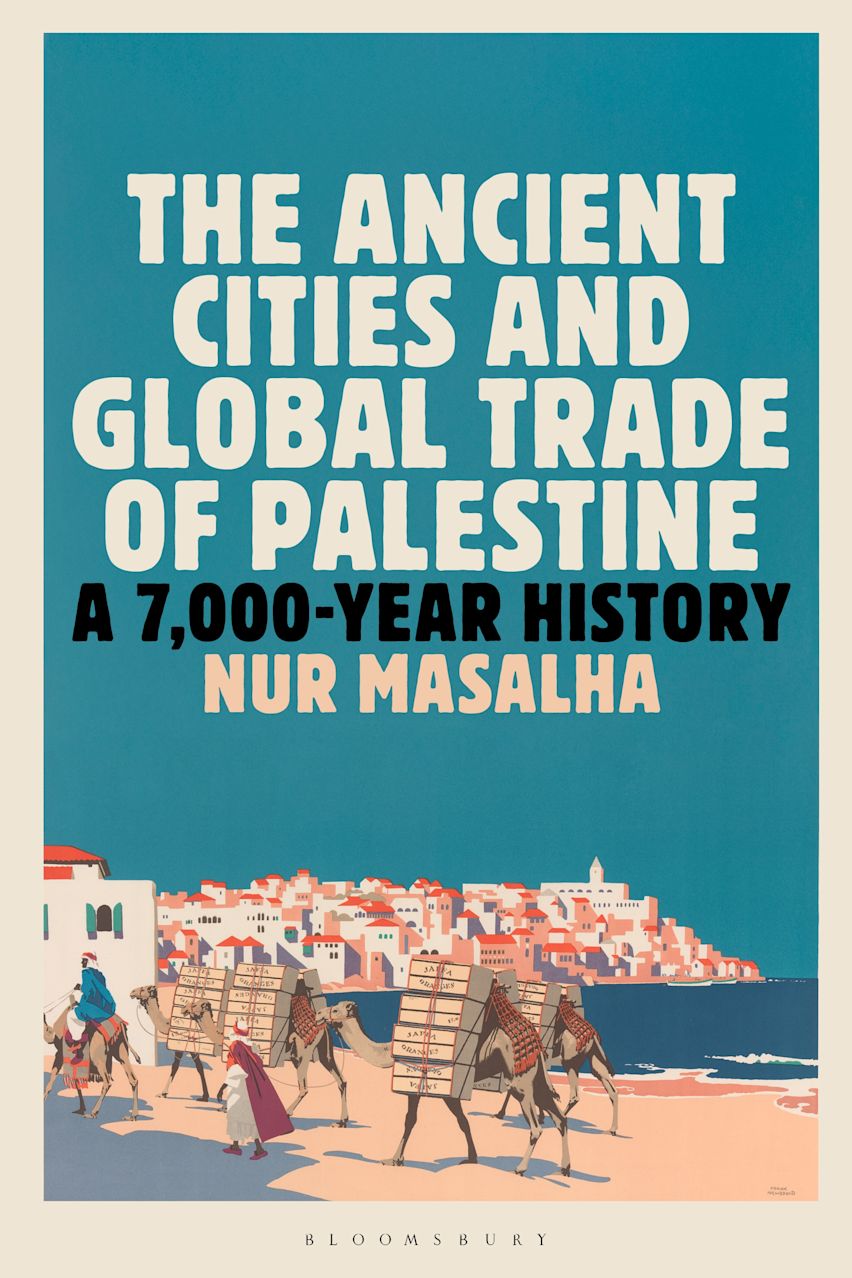
This essay – and review of Nour Masalha’s account of Palestine through the millenia – was published at New Lines Magazine.
On 30 October 2024, in the run-up to the presidential election pitting Kamala Harris against Donald Trump, Bill Clinton addressed voters in Michigan, a state with a significant Arab-American population. Democrat strategists were worried that Arab-Americans, along with many students and progressives, would punish their party at the polls for its participation in Israel’s genocide in Gaza. That’s presumably why they brought out Clinton — a former president with star quality — to boost their chances. But Clinton was so lost in his own story that he surely made things worse. His words also revealed the extent to which even elite Americans understand the Middle East through a mythical rather than historical framework.
“I understand why young Palestinians and Arab Americans here in Michigan think too many people have died. I get that,” Clinton started, before exonerating the genocidaires of blame. Hamas, he explained, “force you to kill civilians if you want to defend yourself.” Then his discourse degenerated further. “I got news for them,” he said, meaning Hamas. “They [the Israelis] were there first, before their faith existed.”
Clinton seems to have meant that the Israelis were “there first” because Judaism is an older religion than Islam, but Judaism is not the Israelis and Islam is not the Palestinians. This strange category error emerges from the same myth complex that renders many Americans unable to distinguish between the Land of Israel imagined in Sunday school and the State of Israel established by conquest and mass ethnic cleansing a few years after World War II. Likewise, they fail to distinguish the ancient Israelites from the contemporary Jewish peoples.
The former president would have been better informed had he read some books on the topic other than the Old Testament — books like Nour Masalha’s meticulous and lavishly referenced “The Ancient Cities and Global Trade of Palestine: A 7,000-Year History.” This is the latest in a string of books Masalha has written examining the country’s ancient past.
It’s interesting that Clinton, in American terms a secular liberal, arrives at similar conclusions to America’s Christian Zionists, who read Genesis 12:3 — “And I will bless them that bless thee, and curse him that curseth thee” — as an exhortation to support the Israeli state. The confusion of the ancient and the contemporary when considering the Middle East is a very common confusion throughout the Western world, not just the U.S., and one that has been carefully exploited to ease the dispossession of the indigenous people of what is now Israel and the occupied Palestinian territories.
The usual story goes that Palestine was inhabited mainly by Jews until they were expelled en masse by the Romans. But the Romans are not as convenient an enemy for contemporary Western audiences as the Muslim Arabs, so some are shifting focus — Benjamin Netanyahu, for instance.
“For roughly 2,000 years,” Netanyahu said, unchallenged, on Jordan Peterson’s podcast, “we were conquered by the Romans, we were conquered by the Byzantines. They did a lot of bad things to us, but they didn’t really exile us, contrary to what people think. The loss of our land actually occurred when the Arab conquest took place in the seventh century. The Arabs burst out from Arabia, and they did something that no other conqueror — not the Romans, not the Byzantines, not the Greeks before them, not Alexander the Great, nobody — did before. They actually started taking over the land of the Jewish farmer.”
No doubt Netanyahu knows that this is revisionist history designed to serve very contemporary political purposes. But if he actually believes what he says, he would be well-advised to read the Israeli writer Shlomo Sand’s 2008 book “The Invention of the Jewish People.” In that work, like others before him, Sand dispatches the myth of the Roman mass expulsion (so he agrees to that extent with Netanyahu); premodern states had neither the capacity nor the desire to perpetrate mass expulsions. Instead, the Romans destroyed the Jewish political class when they destroyed the temple. But even before that, Sand shows, there was never a Jewish monoculture in Palestine. The Torah was written in the fifth and sixth centuries BCE by an urban elite that claimed mythical ancestry elsewhere (Mesopotamia, via the patriarch Abraham, and Egypt, via Moses). The majority of the population during the Jewish period were pagans, more likely to worship Baal or Astarte than Jahweh.
Judaism was a proselytizing creed at least until the adoption of Christianity as the Roman state religion (and later than that in Yemen). According to Sand, there were already more Jews outside Palestine than inside when the temple was destroyed. Many converts were won in ancient Rome. The notion that the Jews were a single “race” separate from others, initially seen in the late Middle Ages, gained ground in 19th-century Europe in concert with the rise of racial theory, the various post-Napoleonic nationalisms and modern forms of antisemitism.
Elements of Sand’s argument have been disputed, but its core makes perfect sense. The Jews are as plural and diverse as anyone else. The idea that Jews originating in Yemen, Ethiopia, Iraq and Poland form one unified people clearly distinguished from others is a construction. The Jews are as “invented” as all peoples are, including the Syrians, the British and African Americans. Nations, as Benedict Anderson formulated it, are always “imagined communities.” This doesn’t mean they are not “real”; if people experience themselves as a nation, then they are a nation. (Even more pertinently, Sand quotes Karl Deutsch: “A nation … is a group of persons united by a common error about their ancestry and a common dislike of their neighbours.”) But it does point to the absurdity of pretending that a contemporary nation was “there first” thousands of years ago, and of expelling or annihilating the natives on that basis.
The “there first” justification for ethnic cleansing is particularly absurd — and ironic — in Palestine. Sand argues that the closest descendants of the ancient inhabitants of Judea are actually the Palestinians, most of whom gradually converted first to Christianity, and then to Islam. Sand’s book was a controversial bestseller in Israel, but it wasn’t the first to posit that the Palestinians had descended from Jewish farmers. “Eretz Israel in the Past and Present,” a 1918 book written by Itzhak Ben-Zvi and Israel’s first prime minister, David Ben Gurion, did just that. But the idea was soon forgotten as Palestinian resistance to Zionist settlement intensified. The Palestinians were increasingly cast as nomads unattached to any specific bit of land. Their generic “Arabness” was emphasized; the minority who escaped expulsion from the new Jewish state were labeled “Arab Israelis” as if they were recent immigrants from Kuwait — or less recent invaders from Mecca.
Read the rest of this entry »Your Presence is a Danger to Your Life
My review of Samar Yazbek’s latest book – this one documenting horrors imposed on Palestinians rather than Syrians – was first published at The New Arab.
There are sentences in this remarkable, painful book that imply an entire universe of horror. Like this: “We brought my daughter’s leg and buried it next to her brother and sister.” Or this: “A boy was blowing air into a dismembered woman’s corpse, trying to bring her back to life – she was his mother.”

“Your Presence is a Danger to Your Life” – the title is taken from the flyers dropped by the Israelis minutes before they bombed civilian targets – documents the Gaza genocide, or at least the genocide as experienced by twenty-six men, women and children interviewed at length throughout 2024 while they were receiving medical treatment in Qatar. The interviewer, editor and shaper of these narratives is the Syrian novelist and non-fiction writer Samar Yazbek.
Yazbek has already produced three documentary texts from the Syrian Revolution and war – “Woman in the Crossfire” and others. In the introduction she explains how the destruction of Gaza reenacted for her the destruction of Syria. She hints at the continuum of experience between the two disasters, and describes her work as “testament to a dream of justice for those living beneath the grindstone of this violent era.” But there are key differences, terrifying “novel details” involving the technological sophistication of the Israeli genocidaires and their “algorithms of murder”.
Many of the witnesses are householders hit at home in the midst of family life. A child asks for a sandwich and then, in a flash, life is irretrievably broken. “My brain couldn’t interpret what had happened” is a phrase repeated by several. “It seemed as though we had entered hell” is another.
Some witnesses are doctors, nurses, or those who volunteered to help in hospitals. They recount Israeli soldiers bombing maternity wards, storming the intensive care department, methodically destroying the medical equipment. One doctor is forced into the role of human shield. Several witnesses remember Israeli soldiers torturing the maimed and dying in their beds.
There are descriptions of dismemberment, of heads spit open, of cats red-faced from human meals. Someone recalls “a grandmother as gentle as the breeze … innocent children, splendid as roses, evaporated in an instant;” others talk of children who bleed to death alone, or children who lose their entire families: parents, grandparents, siblings, cousins, aunts and uncles. For the survivors, or semi-survivors, there is endless pain, vomiting after drinking poisoned water, the stink of sewage, of infected, maggot-filled wounds, of corpses rotting under the rubble. There is the shame of being unable to stop screaming in a room full of strangers
Yazbek preserves the creative uses of Palestinian war idiom in the witness accounts. For instance, the popular word for a vacuum bomb is ‘shafat’ – meaning ‘suction’ – an idea which is then animated: “It took no more than two seconds to suck up twenty-five souls.”
One of the accounts ends with the words, “And then there are all the things that cannot be spoken.” This silence contains both general and specific meanings. In general, as Yazbek writes in her introduction, “humans are capable of brutalizing each other in ways that challenge language’s very capacity of expression.” More specifically, women witnesses would describe to Yazbek rapes and sexual abuse perpetrated on other women, but never on themselves.
None of this can be described as easy reading. The accounts provoke a visceral response, and sometimes the reader feels a near compulsion to put the book aside, go for a walk, and observe the emotional tumult it has unleashed. Horror, grief and rage are natural responses to the reality expressed here. And yet there is a contrary compulsion to keep reading, to know the worst of it, to bear witness alongside Yazbek. Each distinct Palestinian voice, full of character, leads us through the maelstrom.
Read the rest of this entry »A Nobel Prize for Syria?
This article was first published at New Lines Magazine.
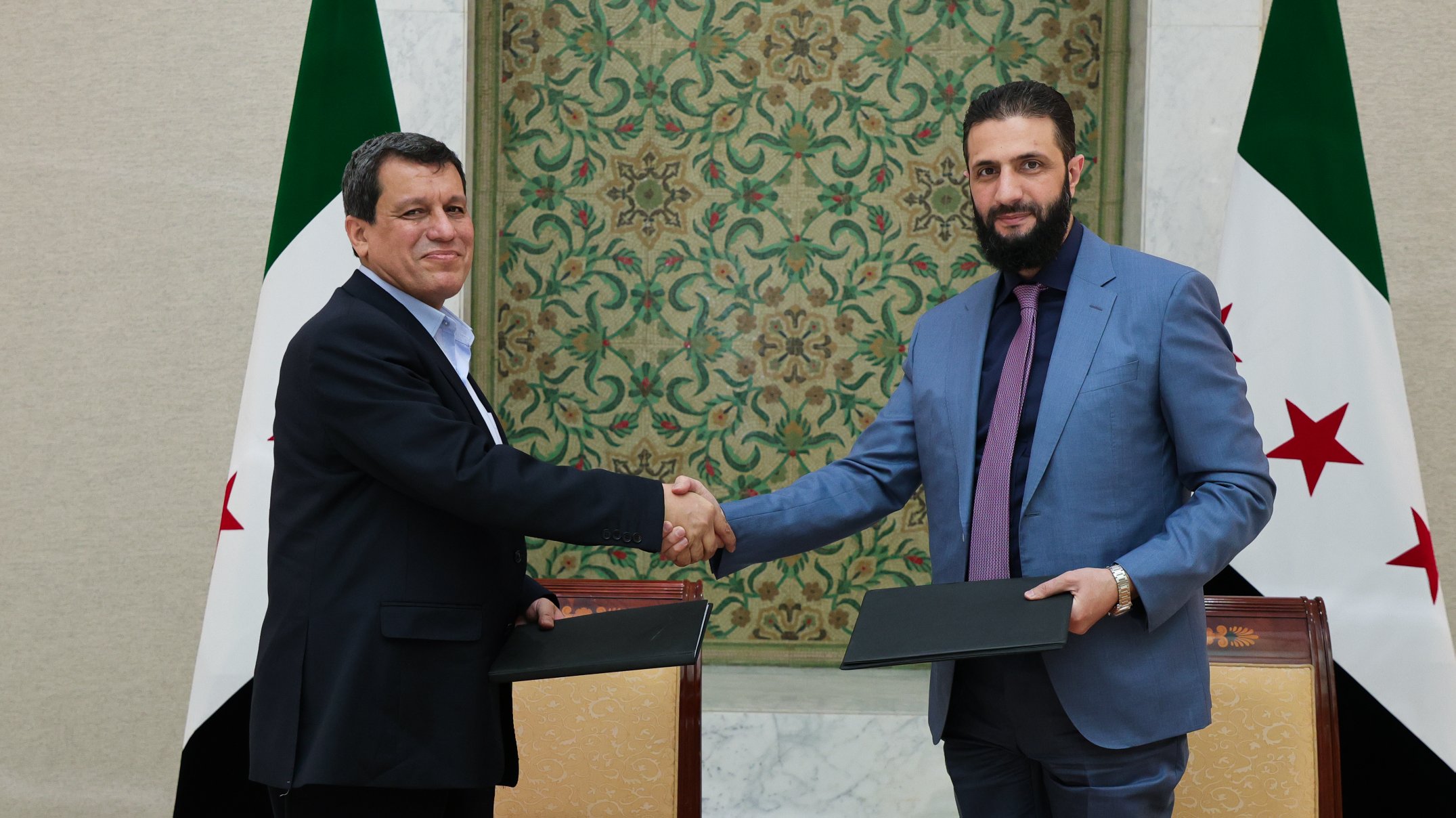
On Aug. 25, Mazloum Abdi, the commander in chief of the Syrian Democratic Forces (SDF), a Kurdish-led militia that had ruled swaths of northern and eastern Syria for over a decade, announced the group’s dissolution. This marked the end of the process of integrating SDF fighters into the Syrian Ministry of Defense. Three all-Kurdish brigades of the national army now serve in Hasakah and Qamishli, with a fourth in Kobani. That means Kurdish-majority areas are policed and guarded from external threats by local Kurds rather than by outsiders. Abdi has been appointed as an adviser to the Syrian presidency.
The integration process is a compromise for both sides. The dissolution of the SDF comes in concert with the winding up of the Autonomous Administration of North and East Syria (AANES) and the “Rojava” (or “Western Kurdistan”) experiment. This is experienced as liberation for many Arabs and others in northeastern Syria, who found SDF rule oppressive, but it also represents the end of Kurdish autonomy, leaving many Kurds wounded and worried about the future. For their part, many Syrian Arabs are discomfited that parts of their country are still managed by people who until recently ran their own state project, and who don’t necessarily believe in a unified and sovereign Syria.
But still, the process has more or less worked, and the northeast is no longer at war. A Syrian solution has been arrived at, rather than an international conflict. It could have all happened very differently, and Abdi and Syria’s transitional President Ahmad al-Sharaa should be credited with avoiding much worse scenarios.
In late November and early December 2024, while al-Sharaa’s Hayat Tahrir al-Sham (HTS) rebels were seizing Syria’s western cities from the collapsing regime of Bashar al-Assad, from Aleppo in the north via Homs to Damascus in the south, the Turkish-aligned militias of the so-called Syrian National Army (SNA) advanced eastward into SDF-controlled territory. Backed by the Turkish air force, the SNA took Tel Rifaat and Manbij from SDF control. In Manbij, according to a Kurdish resident I interviewed for my recent book on post-Assad Syria, SNA fighters and Arab residents together drove Kurds from their homes, which they then looted.
Motivated by homesickness as well as revenge, the SNA fighters wanted to continue. Many of them had been pushed out of their home areas in eastern Syria by the Islamic State group, then prevented from returning by the SDF. There were clear signs, too, that the Arab population of northern and eastern Syria would welcome a larger battle. As HTS arrived in Damascus, armed civilians attacked checkpoints in the city of Deir ez-Zor, and Arab fighters in the SDF defected. The city had liberated itself by Dec. 11, 2024, three days after Assad’s flight to Moscow.
The encouragements for war were plentiful. Both sides would have found powerful state backers: Turkey sponsoring Damascus, and Israel the SDF. The SDF had no wish to compromise with its archenemies. For their part, the SNA fighters were raring to go.
But al-Sharaa restrained them. Instead, he and Abdi signed the March 10, 2025, agreement to reintegrate the northeast into the Syrian state. This statement of intent was supported by the United States but opposed by hard-liners on both sides. The procedural nitty-gritty was consigned to committees. Each side understood the terms of the agreement differently. Often, the process seemed destined to fail.
Yet al-Sharaa and Abdi persevered, reining in both their respective hard-liners and cadres on the ground. For this reason, I’ve heard one Syrian journalist suggesting, and only partly tongue in cheek, that the two men deserve the Nobel Peace Prize.
Perhaps they do — even Henry Kissinger won the Nobel once, so it’s not a high bar — but if they do, it’s for their intelligent reading of reality rather than for any inherently pacific orientation. Both men have risen by accurately evaluating the potentials and risks presented by their changing environments. Both have survived the vicissitudes of the long Syrian conflict by understanding that war, like politics, is the art of the possible. When fighting is likely to achieve their aims, they fight. When it’s more likely to lead to disaster, they usually refrain. Unlike Assad or Israel’s Prime Minister Benjamin Netanyahu, their judgment has only rarely been clouded by hubris.
Read the rest of this entry »The Book of Damascus
This review was published at the New Arab.
One of the functions of literature is to capture historical moments from the inside, to describe their social and experiential reality rather than merely listing the external facts. That function is admirably performed by The Book of Damascus – the latest in Comma Press’s excellent Reading the City series.
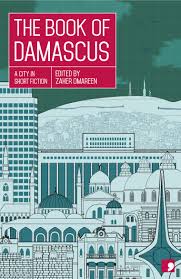
Khaled Khalifa, the greatest Syrian novelist of his generation, and a fixture of Damascus literary life, wrote the Preface: “It is true we live in a forsaken land, afraid of the future and the past, afraid of being arrested and ‘disappeared’, afraid of all forms of annihilation.”
Khaled wrote those words – and the contributors wrote their stories – before the collapse of the Assad regime after 14 years of war and more than half a century of tyranny. His point about annihilation and disappearance still holds, given that sectarian massacres and detentions without due process continue to characterize Syrian political life, albeit on a smaller scale than before. It’s also still true that Damascus is “a city that lives on invisible layers of endless sorrow.” But it’s no longer true that “What exists today is merely a remnant of a country waiting to breathe its last so it can be buried.” That country no longer exists. It was buried on 8 December 2024 when Islamist militiamen trained in Idlib arrived in the capital, when the prison gates opened, and statues of Assad were toppled.
Khaled Khalifa also no longer exists. He died, aged only 59, on 30 September 2023, in the city he loved and refused to leave, whatever horrors it produced. He missed the liberation, the death of the old and the birth of a violently contested new world, with new winners and new victims, a new type of identity politics and a new authoritarianism, and new enthusiasms and possibilities too.
The stories here study that strange extended period when the Assad regime had already died but – its corpse propped up by foreign powers – refused to lie down. They record the city during that long limbo, expressing how it felt to walk its streets and to suffocate in its crushing fear. Damascus in this battered but not quite defeated state is seen through a range of perspectives and filtered through a variety of genres.
Read the rest of this entry »The Blood Between Us at the Lighthouse Bookshop
The good people at the Lighthouse Bookshop in Edinburgh invited me to talk about my new book (and therefore, recent events in Syria) as part of their Book Fringe Festival. There was a great little audience, including the Palestinian writer Raja Shehadeh and the Scottish writer on the Middle East Alex Rowell. You can watch the talk below. Apologies in advance: for the first few minutes the microphone is nowhere near my mouth. Even after I’ve been told to speak into it, I sometimes forget.