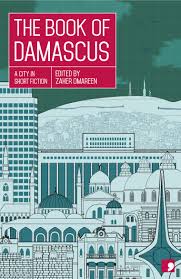
The Book of Damascus
This review was published at the New Arab.
One of the functions of literature is to capture historical moments from the inside, to describe their social and experiential reality rather than merely listing the external facts. That function is admirably performed by The Book of Damascus – the latest in Comma Press’s excellent Reading the City series.
Khaled Khalifa, the greatest Syrian novelist of his generation, and a fixture of Damascus literary life, wrote the Preface: “It is true we live in a forsaken land, afraid of the future and the past, afraid of being arrested and ‘disappeared’, afraid of all forms of annihilation.”
Khaled wrote those words – and the contributors wrote their stories – before the collapse of the Assad regime after 14 years of war and more than half a century of tyranny. His point about annihilation and disappearance still holds, given that sectarian massacres and detentions without due process continue to characterize Syrian political life, albeit on a smaller scale than before. It’s also still true that Damascus is “a city that lives on invisible layers of endless sorrow.” But it’s no longer true that “What exists today is merely a remnant of a country waiting to breathe its last so it can be buried.” That country no longer exists. It was buried on 8 December 2024 when Islamist militiamen trained in Idlib arrived in the capital, when the prison gates opened, and statues of Assad were toppled.
Khaled Khalifa also no longer exists. He died, aged only 59, on 30 September 2023, in the city he loved and refused to leave, whatever horrors it produced. He missed the liberation, the death of the old and the birth of a violently contested new world, with new winners and new victims, a new type of identity politics and a new authoritarianism, and new enthusiasms and possibilities too.
The stories here study that strange extended period when the Assad regime had already died but – its corpse propped up by foreign powers – refused to lie down. They record the city during that long limbo, expressing how it felt to walk its streets and to suffocate in its crushing fear. Damascus in this battered but not quite defeated state is seen through a range of perspectives and filtered through a variety of genres.
Haseeb al-Zainy’s The Blacklist is a Kafkaesque story from the depths of the counter-revolutionary war, when the city was characterized by “the sounds of military helicopters overhead, and patriotic songs glorifying the leader blasting” on “a breeze mingled with the smell of car exhausts, gunpowder and burnt corpses.” The narrator does his best to deal with a grotesquely lecherous intelligence officer, but the nightmarishly surreal situation refuses to be so easily dealt with.
In a very different way, The Seven-Gated Girl-Lady by Rasha Abbas recounts nightmares on the way to the shrine of Ruqqayah, stopping at each of the city’s seven gates, each one associated with a planet.
Omar al-Jbaai’s brief, sad story In the First Hour of Traffic describes the end of a Damascene type, Mr. Kaleh (Kaleh means ‘faded’) whose worn grey suit was purchased with a government voucher, and who won a prize in the 1980s for being “the most productive worker in the public sector.”
Odai al-Zoubi’s Bitter Hymns is narrated by related characters enmeshed in adultery, deception and sectarian prejudice. Fares al-Zahaby’s The Curse of Eid Eve, set in Rukn ed-Din, is a tale of haram money and generalized corruption.
Salwa Zakzak’s Butterflies in the Sky of Damascus captures the war-ravaged, cannibalized city as experienced by some of its weakest, most overlooked inhabitants: those “silent, terrified girls, searching through rubbish for anything that can be sold or traded, or put to personal use, like childish joy.” There’s no room for romanticism in this tale with its simultaneously grim and prosaic ending. Nor in Rawaa Sonbol’s A Storyteller for Our Times, whose hero’s attempt to supplement his income by reviving a Damascene tradition ends in humiliation and in a deadening and dangerous rather than creative and entertaining form of story-telling.
Some of the stories portray the city from a greater distance, as seen by provincials. Zaher Omareen’s What Only the Chickens and the Donkey Know, for instance, is the story of a conscript from “the open cemetery” of Hama who is first obliged to attend military camp at Dumayr, and then goes looking for debauched delights in Merjeh Square. The undying tragedy of the 1982 Hama massacre overhangs this otherwise comic tale. (As well as a contributor, Omareen is the editor of this collection.)
The eponymous Abu Hajal of Abu Hajal and the Magic Lamp is from Deir ez-Zor, but is residing in the capital’s Adra Prison on a drugs charge. Abu Hajal’s brother Khalil, a poet, visits the city’s literary hang-outs, like the Rawda and Havana cafés, when he isn’t visiting lawyers and intermediaries on his brother’s behalf. (Aboud Saeed, the author of this compact but wide-ranging story, became renowned for his irreverent, tragi-comic Facebook updates during the revolution. His book The Smartest Guy on Facebook is highly recommended.)
The city is seen from the distance of exile too, as so many have been forced to see it. Alaa Rashidi’s Marvellous Musical Memory offers the distanced Damascene a nostalgic tour of the city’s musical spots, from the nightclubs of Rabweh to classical performances in Khan Asa’d Pasha, from Sufi chanting at Kaftarou’s mosque to the protest songs of Abdul Baset Sarout, not forgetting the Hawasli pirated cassette shop on Sharia al-Hamra. The narrator once composed his own “Ultimate Song of Romance and Social Justice”, he tells us, his own “Grand Unification of World Scales”, and his own “Definitive Spirituality-Sensuality Mix”. He wished to “reconcile” his “completely contradictory tastes in music” but – and this becomes a refrain – “I was displaced,” and so “I lost all of my recordings.” There’s a powerful metaphor at work here.
In general, there’s a lot of power packed into the slim volume of The Book of Damascus, a worthy addition to Comma Press’s excellent series that includes The Book of Cairo, The Book of Khartoum, and The Book of Gaza, among many others. My only complaint is the absence of stories set in the suburbs, in places like Harasta, Muadamiya and Jaramana that have either been reduced to rubble or crammed full of people displaced from elsewhere. But this is less a criticism than a call for another collection of stories – “The Book of the Damascus Countryside”, perhaps.
.


Leave a comment