Your Presence is a Danger to Your Life
My review of Samar Yazbek’s latest book – this one documenting horrors imposed on Palestinians rather than Syrians – was first published at The New Arab.
There are sentences in this remarkable, painful book that imply an entire universe of horror. Like this: “We brought my daughter’s leg and buried it next to her brother and sister.” Or this: “A boy was blowing air into a dismembered woman’s corpse, trying to bring her back to life – she was his mother.”
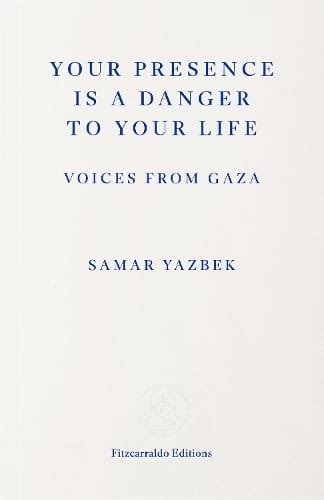
“Your Presence is a Danger to Your Life” – the title is taken from the flyers dropped by the Israelis minutes before they bombed civilian targets – documents the Gaza genocide, or at least the genocide as experienced by twenty-six men, women and children interviewed at length throughout 2024 while they were receiving medical treatment in Qatar. The interviewer, editor and shaper of these narratives is the Syrian novelist and non-fiction writer Samar Yazbek.
Yazbek has already produced three documentary texts from the Syrian Revolution and war – “Woman in the Crossfire” and others. In the introduction she explains how the destruction of Gaza reenacted for her the destruction of Syria. She hints at the continuum of experience between the two disasters, and describes her work as “testament to a dream of justice for those living beneath the grindstone of this violent era.” But there are key differences, terrifying “novel details” involving the technological sophistication of the Israeli genocidaires and their “algorithms of murder”.
Many of the witnesses are householders hit at home in the midst of family life. A child asks for a sandwich and then, in a flash, life is irretrievably broken. “My brain couldn’t interpret what had happened” is a phrase repeated by several. “It seemed as though we had entered hell” is another.
Some witnesses are doctors, nurses, or those who volunteered to help in hospitals. They recount Israeli soldiers bombing maternity wards, storming the intensive care department, methodically destroying the medical equipment. One doctor is forced into the role of human shield. Several witnesses remember Israeli soldiers torturing the maimed and dying in their beds.
There are descriptions of dismemberment, of heads spit open, of cats red-faced from human meals. Someone recalls “a grandmother as gentle as the breeze … innocent children, splendid as roses, evaporated in an instant;” others talk of children who bleed to death alone, or children who lose their entire families: parents, grandparents, siblings, cousins, aunts and uncles. For the survivors, or semi-survivors, there is endless pain, vomiting after drinking poisoned water, the stink of sewage, of infected, maggot-filled wounds, of corpses rotting under the rubble. There is the shame of being unable to stop screaming in a room full of strangers
Yazbek preserves the creative uses of Palestinian war idiom in the witness accounts. For instance, the popular word for a vacuum bomb is ‘shafat’ – meaning ‘suction’ – an idea which is then animated: “It took no more than two seconds to suck up twenty-five souls.”
One of the accounts ends with the words, “And then there are all the things that cannot be spoken.” This silence contains both general and specific meanings. In general, as Yazbek writes in her introduction, “humans are capable of brutalizing each other in ways that challenge language’s very capacity of expression.” More specifically, women witnesses would describe to Yazbek rapes and sexual abuse perpetrated on other women, but never on themselves.
None of this can be described as easy reading. The accounts provoke a visceral response, and sometimes the reader feels a near compulsion to put the book aside, go for a walk, and observe the emotional tumult it has unleashed. Horror, grief and rage are natural responses to the reality expressed here. And yet there is a contrary compulsion to keep reading, to know the worst of it, to bear witness alongside Yazbek. Each distinct Palestinian voice, full of character, leads us through the maelstrom.
Yazbek understands genocide as an erasure: “the erasure of dismembered bodies; the erasure of our ability to see clearly; the erasure of the profound act of bearing witness to the agony of others; the erasure of language.” This book, then, no less than the writing of Primo Levi and other survivors of the Holocaust, seeks to transform erasure into narrative. The effort to do so is particularly valuable given the welter of Zionist propaganda erasing the past and present existence of Palestinians. To render them invisible and inaudible, Israel has prevented international journalists from entering Gaza, and has assassinated at least 267 Palestinian journalists since 7 October 2023 (according to the International Federation of Journalists).
The attempted erasure of Palestinians and their rights reaches back through the repeated military assaults and the quarter-century-long siege of Gaza, back through the decades of massacre and dispossession, all the way to the erasure of hundreds of villages and towns that marked the birth of the Zionist state.
In this book, unlike in her documentations of Syrian suffering, Yazbek largely erases her own presence in favour of the Palestinians she so carefully listens to. She notices the most pertinent details of their narratives and closely reproduces the idiomatic style and substance of their voices. What emerges is the eloquence of ordinary people under extraordinary pressure, a testament to Palestinian resilience, and a record of one of the greatest crimes of the age.
Unlike the crimes in Ukraine, Syria or Sudan, this one has been funded and armed by the United States and rhetorically supported by most Western governments and media outlets. In other words, the states that until recently claimed to promote universal human rights and international law have abandoned that pretence in order to stand with Zionist barbarism. This has obvious implications for us all, not just Palestinians.
The genocide is still underway today, though more slowly, and will continue until we finally move to stop it. “For over seventy years,” says Abu Yahya, father of two murdered and two maimed children, “everyone has abandoned us.”


Leave a comment