Posts Tagged ‘Comma Press’
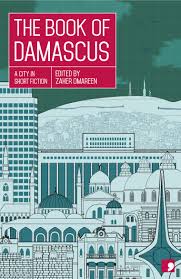
The Book of Damascus
This review was published at the New Arab.
One of the functions of literature is to capture historical moments from the inside, to describe their social and experiential reality rather than merely listing the external facts. That function is admirably performed by The Book of Damascus – the latest in Comma Press’s excellent Reading the City series.
Khaled Khalifa, the greatest Syrian novelist of his generation, and a fixture of Damascus literary life, wrote the Preface: “It is true we live in a forsaken land, afraid of the future and the past, afraid of being arrested and ‘disappeared’, afraid of all forms of annihilation.”
Khaled wrote those words – and the contributors wrote their stories – before the collapse of the Assad regime after 14 years of war and more than half a century of tyranny. His point about annihilation and disappearance still holds, given that sectarian massacres and detentions without due process continue to characterize Syrian political life, albeit on a smaller scale than before. It’s also still true that Damascus is “a city that lives on invisible layers of endless sorrow.” But it’s no longer true that “What exists today is merely a remnant of a country waiting to breathe its last so it can be buried.” That country no longer exists. It was buried on 8 December 2024 when Islamist militiamen trained in Idlib arrived in the capital, when the prison gates opened, and statues of Assad were toppled.
Khaled Khalifa also no longer exists. He died, aged only 59, on 30 September 2023, in the city he loved and refused to leave, whatever horrors it produced. He missed the liberation, the death of the old and the birth of a violently contested new world, with new winners and new victims, a new type of identity politics and a new authoritarianism, and new enthusiasms and possibilities too.
The stories here study that strange extended period when the Assad regime had already died but – its corpse propped up by foreign powers – refused to lie down. They record the city during that long limbo, expressing how it felt to walk its streets and to suffocate in its crushing fear. Damascus in this battered but not quite defeated state is seen through a range of perspectives and filtered through a variety of genres.
Read the rest of this entry »The Drone Eats With Me
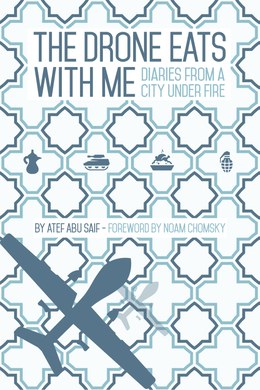 This appeared first at The National.
Plenty of news flows out from Gaza, but very little human information. This emotional blackout bothered Ra Page, founder of Comma Press, a Manchester-based publisher producing groundbreaking short story collections. It was Comma that gave the astounding Iraqi surrealist writer Hassan Blasim his first break. Comma has published a high-quality series of literary responses to scientific innovations as well as several collections based around cities such as Tokyo, Istanbul and Liverpool. Why not Gaza too?
“My rather naive idea with The Book of Gaza,” writes Page, “was to try to inch the city ever so slightly closer to a state of familiarity, to establish it as a place and not just a name, through the simple details that a city’s literature brings with it – the referencing of street names, the name-dropping of landmarks and districts.”
The book was by no means the first literary project to aim in some way to normalise Palestinian life. Since 2008 the Palestinian Festival of Literature (Palfest), brainchild of novelist Ahdaf Soueif, has tried to reaffirm, in Edward Said’s phrase, “the power of culture over the culture of power”. In practical terms, this means transforming a literature festival into a roadshow – Jerusalem one night, Bethlehem another, Ramallah on a third… Though these places are only a few miles apart, checkpoints prevent Palestinians from travelling between them. So the guest writers travel to their audience, and at the same time learn something of Palestine’s enormous creativity. This stateless nation has boasted many great literary talents, most notably Mahmoud Darwish and Mourid Barghouti in poetry and Ghassan Kanafani in prose. Meanwhile there are burgeoning film and music (especially hip hop) scenes.
For decades writers had to smuggle their manuscripts out of Gaza to presses in Jerusalem, Cairo or Beirut. The shorter the text, the more likely it was to be published. As a result, the Strip became an “exporter of oranges and short stories.” Edited by novelist and journalist Atef Abu Saif, The Book of Gaza contains stories from three generations. It achieves both the sense of place that Page hoped for and ‘familiarity’ through its treatment of universal themes. The stories are as likely to deal with women “besieged by preconceptions” (in Najlaa Ataallah’s words) as the seige imposed by Israel. The project succeeded in ‘depoliticising’ Gaza, at least to some extent.
But then, immediately after publication, Israel launched Operation Protective Edge. Story contributors were directly affected by the assault. Writer Asmaa al-Ghoul, for instance, lost nine members of her extended family. Page was driven to this bleak conclusion: “There is no stability in Gaza on which to build a reader-familiarity.”


 Qunfuz