Olivier Roy’s ‘Jihad and Death’
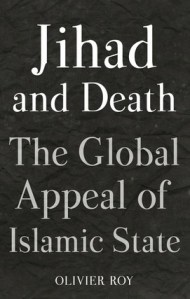 This review was first published at the National.
What motivates Westerners to become jihadists? What comes first, radicalism or religious text?
Olivier Roy, a French analyst of ‘globalised Islam’, begins “Jihad and Death: The Global Appeal of Islamic State” with empirical research on about 100 people involved in Jihadist terrorism in France and Belgium. Converts account for a staggering 25% of this sample. The rest tend to be lapsed Muslims, and return to strict religious practice, if at all, only months before they commit violence.
They are as likely to come from prosperous as poor families. They show a frequent history of delinquency, and very often of domestic violence. Crucially for Roy’s argument, they tend to be immersed in global youth culture: action movies, computer games, hip-hop and streetwear. “Combat sports clubs are more important than mosques in Jihadi socialisation.”
Terrorists don’t come from what the French right-wing calls ‘Salafised spaces’. Roy points out the irony of the ISIL-linked Abdeslam brothers running “a bar in a neighbourhood described as Salafised,” and usefully emphasises the distinction between Salafism and ISIL-style radicalism. The latter, unlike the former, permits punishment by fire and suicide attacks, for instance, and rejects parental and clerical authority.
“Jihadis do not descend into violence after poring over the sacred texts,” Roy writes. A self-serving, inconsistent and decontextualised manipulation of scripture is central to ISIL propaganda, but largely irrelevant, he argues, to the European radicals. These are not believers programmed for terror by religion, but “rebels who choose radicalism and then fit it into an Islamic paradigm.”
Strange Horizons
 Gautam Bhatia, for the sci-fi magazine Strange Horizons, hosted critic Marcia Lynx Qualey, writers Anoud and Ali Bader, and me, for a fascinating discussion on Arab sci-fi and other genre experiment. This was prompted by the short story collection “Iraq + 100”. You can read the discussion here.
The President’s Gardens
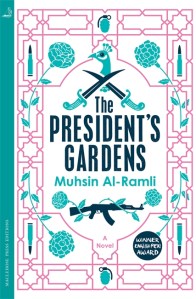 This review was published first at the Guardian.
Since 1980, Iraq has suffered almost continuous war, as well as uprisings, repressions, sanctions, and war-related cancers. “The President’s Gardens” by Muhsin al-Ramli –published in Arabic in 2012 and now masterfully translated by Luke Leafgren – at last provides us with an epic account of this experience from an Iraqi, and deeply human, perspective.
“If every victim had a book, Iraq in its entirety would become a huge library, impossible ever to catalogue.” This book must belong to Ibrahim, nicknamed ‘the Fated’, the discovery of whose head (in a banana crate) opens and closes the novel in 2006, and whose life until that decapitation is narrated in the most detail. Yet Ibrahim’s friends since childhood, Tariq ‘the Befuddled’ and Abdullah ‘Kafka’, are essential to the story.
Tariq is a schoolteacher, a perfumed, snappy dresser, and a grinning, earthy imam. As such he is spared military service, and prospers in the village, making necessary accomodations to the ruling system.
Abdullah, the “prince of pessimists” who describes contemporary events as “ancient, lost, dead history”, is already alienated by his illegitimacy when he is called up in 1988 for the war against Iran, captured, and incarcerated as a POW for the next 19 years, with almost 100,000 others. In Iran he is paraded, tortured, starved, and lectured on Khomeinism. Prisoners are separated by religious affiliation, but those ‘penitents’ who adopt the Islamic Republic’s ideology are raised up to rule over the unconverted.
There is no sectarianism at all in the narration. The main characters, from north of Baghdad, are probably Sunnis, but the reader must bring knowledge from beyond the text to make this assumption. Their travels through the country’s beautiful landscapes and terrible warscapes convey a clear sense of Iraqi nationhood alongside a sustained disdain for exclusionary and propagandistic nationalism. “When I look at the flag of any country,” says Abdullah on his release, “I see nothing more than a scrap of cloth devoid of any colour or meaning.”
If Abdullah’s chief mode is principled nihilism, Ibrahim’s is gentle resignation. “Everything is fate and decree” is his catchphrase, and he names his daughter Qisma, ‘fate’. Made sterile by poison gas in the Iran war, lamed during the invasion of Kuwait, he finds a job in the paradisal gardens of the title, secret expanses within Baghdad studded by Saddam Hussain’s palaces, where the fountain water is mixed with perfume, camels graze between rose beds, and crocodiles swim in the pools. Naturally, horrors lurk beneath this surface.
Exit West
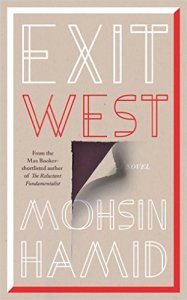 This review was first published at the National.
Saeed works in an advertising agency, lives with his parents, and prays irregularly “as a gesture of love for what had gone and would go and could be loved in no other way.” Nadia, against the wishes of her family, chooses to live alone. She rides a motorbike and wears black robes to ward off predatory men. They meet at an evening class on corporate identity and product branding. They soon become friends, then something more.
Both are trying to build their lives in increasingly precarious circumstances. Saeed’s father is a university lecturer in a country which hasn’t done well by its professional class. He blames himself for not providing for his son: “The far more decent thing would have been to pursue wealth at all costs.”
They inhabit a city “teetering on the abyss”, filling up with refugees and prone to random violence. This could almost be Lahore, where Mohsin Hamid, the novel’s author, was born. But the war, when it arrives, feels like a tale from the Arab counter-revolutions. The encroaching militants behave like Daesh, outlawing music and staging public executions.
So Nadia and Saeed’s hometown could be many places, and this is part of the novel’s point. “Exit West” is formally adventurous despite the initial impression of realism. Set in the near future, or in an alternative and intensified present, the tale twists between magical realism and gentle science fiction.
At its centre is a magical image. Naturally, the war changes people’s relationship to windows, “the border through which death was possibly most likely to come”. But their relationship to doors changes too. Rumours spread of doors closely guarded in secret locations, infinitely dark doors which open onto random distant lands.
The Way of the Strangers
 A slightly edited version of this review was published at the National.
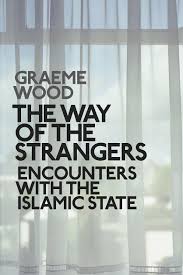
In “The Way of the Strangers: Encounters With The Islamic State”, journalist Graeme Wood aligns himself with the orientalist tradition of Bernard Lewis, who warned liberal students against projecting secular frameworks on contemporary Muslim politics. Lewis believed religion, not secular grievance, was the prime motivator of this politics.
This may or may not be true. In any case, the argument has limited explanatory power. It doesn’t explain why Islamism is more in vogue today than in the 1960s, for instance, or why contemporary extremists are destroying the ancient temples which previous generations left unharmed.
Does scripture account for ISIL’s crimes? It’s a fact that the Prophet’s Companions took slaves as war booty. The overwhelming majority of contemporary scholars, considering custom (’urf) and public interest (maslaha) as well as learned precedent, nevertheless see slavery as obsolete, no more relevant to modern warfare than bows and arrows. But ISIL, ignoring these considerations, has proudly revived the practice.
Wood rightly expresses exasperation with Muslim scholars who claim that ISIL’s behaviour has ‘nothing to do with Islam’. It would be equally wrong to claim that American slavery had nothing to do with Christianity (see, for example, 1 Peter 2:18: “Slaves, submit yourselves to your masters with all respect, not only to the good and gentle but also to the cruel.”) “It is the interpretation,” Wood writes, “not the historical fact itself, that is up for debate.”
His account lacks political (or ‘secular’) context, but still, with hard-boiled humour, it provides a sometimes fascinating journey through some varieties of Islamic interpretation, from hate preaching to gentle quietism.
The Raqqa Diaries
 An edited version of this review was published at the Guardian.
In March 2013, Free Syrian Army fighters, alongside the al-Qaida-linked militia Jabhat al-Nusra, liberated Raqqa, a city in Syria’s east. Crowds assaulted the dictator’s statues. Detainees were set free. A hip-hop concert was held. Activists hotly debated the shape of the democracy to come. They set up a local council. Nusra set up a Sharia court.
Then ISIS, or Daesh, an Iraqi-led group, split from Nusra. It was contained for a while, until the Free Army in Raqqa was weakened, battered by airstrikes and “busy fighting the regime elsewhere”.
In January 2014 Daesh captured the city. “Snatching it away from the revolutionaries who had sacrificed everything to liberate it,” the jihadists immediately established rule by fear. Some people fled, some submitted, and some resisted as best they could.
 “The Raqqa Diaries” are as powerful and fast-paced as a thriller, but this is brutal non-fiction, plainly and urgently told. Their author, risking his life to break Daesh’s communications siege, goes by the pseudonym ‘Samer’. His group, al-Sharqiya 24, made contact with the BBC’s Mike Thomson, and a barebones version of the book was read on Radio 4’s Today programme.
Raqqa is a generally conservative but deeply civilised city, its roots stretching to the Babylonian period. Samer describes its people as “humble” and friendly.
Under Assad, Samer’s father was detained for muttering against corruption. The family was forced to exchange its wealth for his freedom.
Dancing in Damascus
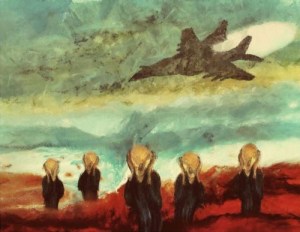
by Wissam al-Jazairy
This review of miriam cooke’s new book was published at the Guardian.
Syria’s revolution triggered a volcano of long-repressed thought and emotion in cultural as well as political form. Independent newspapers and radio stations blossomed alongside popular poetry and street graffiti. This is a story largely untold in the West. Who knew, for instance, of the full houses, despite continuous bombardment, during Aleppo’s December 2013 theatre festival?
“Dancing in Damascus” by Arabist and critic miriam cooke (so she writes her name, uncapitalised) aims to fill the gap, surveying responses in various genres to revolution, repression, war and exile.
Dancing is construed both as metaphor for collective solidarity and debate – as Emma Goldman said, “If I can’t dance, it isn’t my revolution” – and as literal practice. At protests, Levantine dabke was elevated from ‘folklore’ to radical street-level defiance, just as popular songs were transformed into revolutionary anthems.
Cooke’s previous book “Dissident Syria” examined the regime’s pre-2011 attempts to defuse oppositional art while giving the impression of tolerance. The regime would fund films for international screening, for instance, but ban their domestic release.
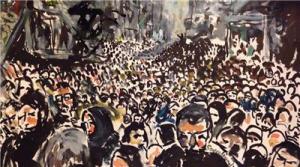
by Souad al-Jundi
“Dancing in Damascus” describes how culture slipped the bounds of co-optation. Increasingly explicit prison novels and memoirs anticipated the uprising. Once the protests erupted, ‘artist-activists’ engaged in a “politics of insult” and irony. Shredding taboos, the Masasit Matte collective’s ‘Top Goon’ puppet shows, Ibrahim Qashoush’s songs and Ali Farzat’s cartoons targeted Bashaar al-Assad specifically. “The ability to laugh at the tyrant and his henchmen,” writes cooke, “helps to repair the brokenness of a fearful people.”
As the repression escalated, Syrians posted atrocity images in the hope they would mobilise solidarity abroad. This failed, but artistic responses to the violence helped transform trauma into “a collective, affective memory responsible to the future”.
2084: The Recurring Liberal Apocalypse
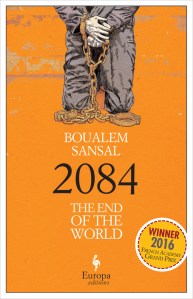 This was first published at the National.
The true subject of science fiction is always the present. Its imagined futures are mirrors to today’s hopes and fears. George Orwell’s “1984” simply shifted the numbers of the year in which he wrote the book – 1948 – and made a metaphor of that time’s dark politics. Likewise “2084”, the latest from Algerian novelist Boualem Sansal, is addressed to, and in some way is part of, very contemporary woes.
Sansal lays out a fantastically detailed dystopia in complex and often elegant prose. After the Great Holy War killed hundreds of millions, an absolutist theocracy has been founded by Abi the Delegate, servant of the god Yolah. Abi’s rule is secured by such institutions as the Apparatus and the Ministry of Moral Health, and displayed by frequent mass slaughters of heretics in stadia built for the purpose. The nine daily prayers are compulsory. Women must cloak themselves in thick ‘burniqabs’.
Dissent, individuality, and progress have been abolished. The future must be a strict replica of the past. All languages are banned save the state-invented ‘Abilang’.
Ati, the story’s vague hero, is sent to a sanatorium in the mountains to cure his tuberculosis. Here he hears rumours of a nearby border, a limit to Abi’s reign. The notion “that the world might be divided, divisible, and humankind might be multiple” sparks a crisis of doubt in him, and then a journey of discovery.
At times “2084” suffers from science fiction’s most common pitfall: an unwieldy listing of technical or political information describing the imagined world outweighs and obscures the necessary human information. Sansal’s characters are somewhat two-dimensional, and the plot can seem almost accidental.
It is best, therefore, not to read this as a conventional novel but as a mix of satire, fable, and polemic.
The ‘Hakawati’ as Artist and Activist
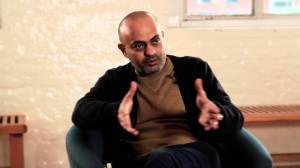 I interviewed my friend Hassan Blasim, a brilliant writer and a wonderful human being, for the National.
Hassan Blasim is an Iraqi-born writer and film-maker, now a Finnish citizen. He is the author of the acclaimed story collections “The Madman of Freedom Square” and “The Iraqi Christ” (the latter won the Independent Foreign Fiction prize), and editor and contributor to the science fiction collection “Iraq +100”. His play “The Digital Hat Game” was recently performed in Tampere, Finland.
Because it’s so groundbreaking, his work is hard to categorise. It deals with the traumas of repression, war and migration, weaving perspectives and genres with intelligence and a brutal wit.
Why do you write?
To be frank, I would have killed myself without writing.
If you read novels and intellectual works since your childhood, your head is filled with the big questions. Why am I here? What’s the meaning of life? You apply this questioning to the mess of the world around you – why is America bombing Iraq? why are we suffering civil wars? – and you realise the enormous contradiction between your lived reality and the ideal world of knowledge. On the one hand, peace, freedom, and our common human destiny, and on the other, borders, capitalism and wars.
Writing for me began as a hobby, or a way of dreaming. And then when I witnessed the disasters that befell Iraq, it became a personal salvation. It wouldn’t be possible to accept this world without writing.
Maybe writing is a psychological treatment, or an escapism. It’s certainly a dream. But it’s also to confront the world, and to challenge all the books that have been written before. And it’s a process of discovery. It’s all of these things.
Our Fates Are Linked
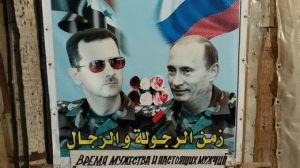
a poster from occupied Syria
Dezeray Lyn interviewed me for the Arab Daily News on the next stage in Syria, propaganda and conspiracy theories, and the connections between Syria and the world. The full article is here.
DL: I think it cheats every revolutionary, pro democracy organizer and all lovers of the land to only discuss Syria only in post counter-revolutionary, post civil war contexts. Can you intimate us with life in Syria and Aleppo before the Arab Spring uprising in terms of organizing/living/arts/love/culture under an oppressive Assad dictatorship?
RYK: Syria was in many ways a lovely country. Foreigners who visited generally loved it, and Syrians were very proud of it. Syria has a fine climate, one of the world’s great cuisines, unparalleled historical riches, and a diverse and friendly population.
It was also, beneath the surface, a tragic country, one which had suffered enforced poverty and dislocation under first Ottoman and then French imperialism, then bitter class oppression, and then sixty years of dictatorship in which a new ruling class of security officers and loyal businessmen coalesced. All forms of government exploited sectarian, ethnic, regional and tribal differences amongst the people, the better to control them. The Baathist dictatorship in particular ruled by violence and fear. About 30,000 people were killed in Hama in 1982, and thousands of dissidents disappeared in the regime’s torture prisons. Civil society was crushed.
Despite the extreme repression, Syrians produced some remarkable poetry, music, drama and films. And dissident thought continued to surface, particularly in the brief and abruptly aborted ‘Damascus Spring’ in 2000, after Bashaar al-Assad inherited the dictatorship from his father Hafez.
Bashaar shut down the political and social opening. Instead, he ‘opened’ the economy. In effect this meant a set of neo-liberal and crony capitalist reforms which enormously enriched his own family and friends while impoverishing large swathes of the population. This was the context for the 2011 uprising.
The Palestinisation of the Syrian People
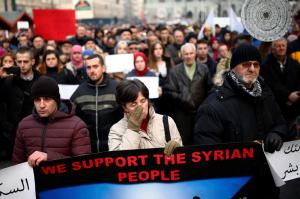
Sarajevo, Bosnia
A slightly edited version of this article was published at al-Jazeera.
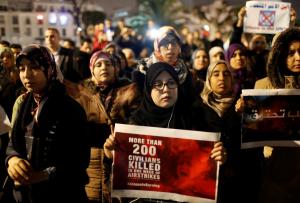
In solidarity with Aleppo, the lights on the Eiffel Tower were extinguished. Elsewhere in Paris, and in London, Amsterdam, Oslo and Copenhagen, people demonstrated against the slaughter. Turks rallied outside Russian and Iranian embassies and consulates in Istanbul, Ankara and Erzerum. The people of Sarajevo – who have their own experience of genocide – staged a big protest.
The protests are nothing like as large as they were when the United States bombed Iraq, but they are welcome nonetheless. If this level of support had been apparent over the last six years, it would have made a real difference. Perhaps it is making a difference even now. Public sympathy for the victims may have pressured Vladimir Putin to allow those in the surviving liberated sliver of Aleppo to evacuate rather than face annihilation. At the time of writing, the fate of the deal is in doubt, subject to the whims of the militias on the ground. If it works out and the tens of thousands currently trapped are allowed to leave – the best possible outcome – then we will be witnesses to an internationally brokered forced population transfer. This is both a war crime and a crime against humanity, and a terrible image of the precarious state of the global system. The weight of this event, and its future ramifications, deserve more than just a few demonstrations.
The abandonment of Aleppo is a microcosm of the more general abandonment of Syria’s
Casablanca, Morocco
democratic revolution. It exposes the failures of the Arab and Muslim worlds, of the West, and of humanity as a whole.
Many Syrians expected the global left would be first to support their cause, but most leftist commentators and publications retreated into conspiracy theories, Islamophobia, and inaccurate geo-political analysis, and swallowed gobbets of Assadist propaganda whole. Soon they were repeating the ‘war on terror’ tropes of the right.
The Obama administration provided a little rhetorical support, and sometimes allowed its allies to send weapons to the Free Army. Crucially, however, Obama vetoed supply of the anti-aircraft weapons the Free Army so desperately needed to counter Assad’s scorched earth. In August 2013, when Assad killed 1500 people with sarin gas in the Damascus suburbs, Obama’s chemical ‘red line’ vanished, and the US more or less publically handed Syria over to Russia and Iran.
Revolutionary Women
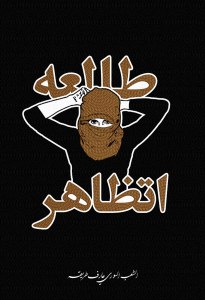 This is the third text I wrote for the Making Light exhibition in Exeter. The first is here, and the second here.
A young woman ties a keffiyeh around her face. The text reads: “I’m coming out to protest.”
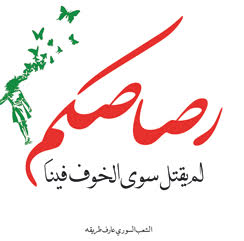
From a hole in another girl’s head, butterflies rush out. A girl shot in the head, like so many girls, but the butterflies suggest she’s achieved a kind of freedom – either the freedom that motivated the defiant act that provoked her murder, or simply the freedom of death. The text reads: “Your bullets have only killed the fear within us.”
 Women have been at the forefront of Syria’s revolutionary struggle.
The two most important grassroots revolutionary coalitions were set up by women: the General Commission of the Syrian Revolution by Suhair Atassi, and the Local Coordination Committees by Razan Zeitouneh.
Suhair Atassi went on to play important roles in the Syrian National Council and the Coalition of Revolutionary and Opposition Forces.
As well as setting up the LCCs, Razan Zeitouneh, a human rights lawyer, helped establish the Violations Documentation Centre to record and publicise the regime’s killings and detentions. After some time living underground, she moved to Douma, a liberated town near Damascus, where she was forthright in her criticism of any authoritarian actor who sought to limit the people’s freedom, whether the regime or any of the militias which had been formed to fight the regime.
In December 2013 Razan was abducted, probably by Jaish al-Islam, an Islamist militia. Three others were taken with her: the activists Samira al-Khalil, Wael Hamada, and Nazem Hammadi. Collectively they are known as the Douma Four. Nothing has been heard of them since.
Before her abduction, Samira Khalil, a former political prisoner, was setting up micro-finance projects and women’s centres in the Douma area. Similar centres operate all over those parts of Syria liberated from both Assad and ISIS.
Victory is Guaranteed
This old man has habitually kind eyes
but now he’s in a rage
arms flap cheeks bunch hands wave
If you burn the earth under us
we will not leave
If you kill us all
we will not leave
If you bury us
we will not leave
The victory of a man on the floor of a cell
or hung from the ceiling
who does not count
who no longer feels the blows
The victory of a woman
who knows her rapist’s honour is wrecked
of a child
who draws a picture of a different city
Read the rest of this entry »
Addressing the Oireachtas (Me and Hassoun)
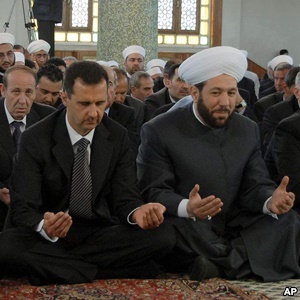
Hassoun and Assad
I was happy to have a chance to adress the Joint Committee on Foreign Affairs and Trade in the Irish Parliament. I spoke about the crushing of the Syrian revolution and the Russian and Iranian occupation of Syria. You can read my address below.
Before me, the committee was addressed by a delegation of the Syrian regime, headed by the state Mufti, Ahmad Badreddine Hassoun. Hassoun has previously threatened Europe and America with an army of suicide bombers, and has specifically called for the civilians of liberated Aleppo to be bombed. It’s incredible that such a man can get a visa to a European country (unlike millions of desperate Syrians who are not terrorists), let alone address a parliament. Hassoun was also invited to Trinity College, and (most ironic of all) to sign some declaration ‘against extremism’.
Some argue that Hassoun should be heard in the interests of balance and free speech. I say that all Syrian perspectives should be heard, and that I would have no problem with a delegation of pro-Assad civilians making their case. My problem is with this official regime propaganda exercise, at a time when the regime and its backers are slaughtering and expelling civilians en masse. And of course the people who talk about balance and free speech in this case don’t apply the principle in all cases. I don’t see official representatives of ISIS being invited to make their case in these settings. And ISIS, monstrous as it is, has killed, raped, and tortured far, far fewer people than the Assad regime.
Thanks to the work of the wonderful people in the Irish Syria Solidarity Movement, the Irish people were alerted to Hassoun’s nature. This report was on the RTE news. In the Arab media, Asharq Al-Awsat, al-Quds al-Arabi and the New Arab have also covered Hassoun’s visit.
Here is the filmed record of the sessions, first Hassoun’s group, then me. And here is my address:
It Will Not Happen Again
This is the second text I wrote for the Making Light exhibition in Exeter (the first is here).
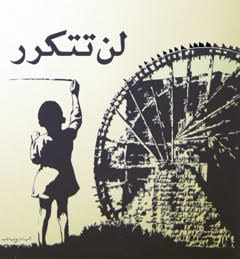
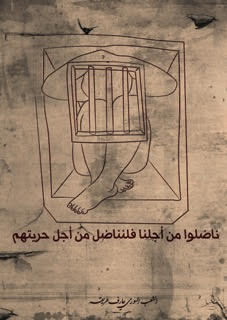 Two posters juxtaposed.
A man impossibly crammed in a cage. “They struggled for our freedom,” reads the text, “so let’s struggle for theirs.”
Beside a noria, one of the ancient water-wheels of the ancient city of Hama, a child writes on a wall: “It will not happen again.” The phrase combines bitter irony and fierce defiance, for even as we read it we know that it has happened again, it is happening, and ten or a hundred times worse.
In 1982 there was a massacre in Hama. Its memory haunted and silenced Syrians until 2011. The massacre was a success for the regime, and therefore a model for its current policy.
 An anti-regime movement began to organise in 1978. It wasn’t a mass movement of the scale and breadth of the 2011 revoution, but it included leftists, nationalists and democrats as well as Islamists. The regime responded with a dual policy of extreme repression and radicalisation of their opponents, murdering, torturing and imprisoning them en masse. By 1982 not much was left of the movement other than the radicalised armed wing of the Muslim Brotherhood which, mixing stupidity with desperation, took over Hama by force of arms.
The regime welcomed the confrontation as an opportunity to teach the country an unforgettable lesson. Making no distinction between civilians and insurgents, its army levelled the city’s historical districts with tank, artillery and aerial bombardment. With churches, mosques and markets burning, its soldiers went house to house, riddling whole families with bullets. Estimates of the dead range from ten to forty thousand. Many thousands more were killed elsewhere in the country.
Thousands of political prisoners were thrown into the country’s dungeons. Hundreds were hanged, shot, or otherwise murdered inside. The rest languished for decades without sufficient food, medical care, any comfort or hope. Their relatives feared to ask after them.


 Qunfuz