Dancing in Damascus
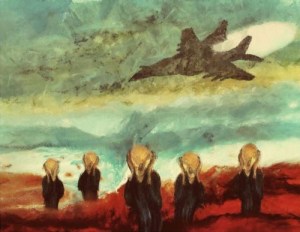
by Wissam al-Jazairy
This review of miriam cooke’s new book was published at the Guardian.
Syria’s revolution triggered a volcano of long-repressed thought and emotion in cultural as well as political form. Independent newspapers and radio stations blossomed alongside popular poetry and street graffiti. This is a story largely untold in the West. Who knew, for instance, of the full houses, despite continuous bombardment, during Aleppo’s December 2013 theatre festival?
“Dancing in Damascus” by Arabist and critic miriam cooke (so she writes her name, uncapitalised) aims to fill the gap, surveying responses in various genres to revolution, repression, war and exile.
Dancing is construed both as metaphor for collective solidarity and debate – as Emma Goldman said, “If I can’t dance, it isn’t my revolution” – and as literal practice. At protests, Levantine dabke was elevated from ‘folklore’ to radical street-level defiance, just as popular songs were transformed into revolutionary anthems.
Cooke’s previous book “Dissident Syria” examined the regime’s pre-2011 attempts to defuse oppositional art while giving the impression of tolerance. The regime would fund films for international screening, for instance, but ban their domestic release.
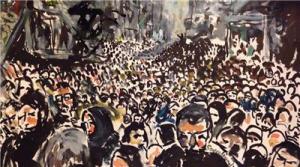
by Souad al-Jundi
“Dancing in Damascus” describes how culture slipped the bounds of co-optation. Increasingly explicit prison novels and memoirs anticipated the uprising. Once the protests erupted, ‘artist-activists’ engaged in a “politics of insult” and irony. Shredding taboos, the Masasit Matte collective’s ‘Top Goon’ puppet shows, Ibrahim Qashoush’s songs and Ali Farzat’s cartoons targeted Bashaar al-Assad specifically. “The ability to laugh at the tyrant and his henchmen,” writes cooke, “helps to repair the brokenness of a fearful people.”
As the repression escalated, Syrians posted atrocity images in the hope they would mobilise solidarity abroad. This failed, but artistic responses to the violence helped transform trauma into “a collective, affective memory responsible to the future”.
2084: The Recurring Liberal Apocalypse
 This was first published at the National.
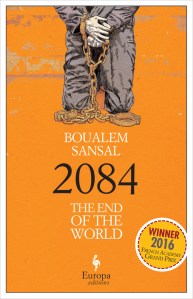
The true subject of science fiction is always the present. Its imagined futures are mirrors to today’s hopes and fears. George Orwell’s “1984” simply shifted the numbers of the year in which he wrote the book – 1948 – and made a metaphor of that time’s dark politics. Likewise “2084”, the latest from Algerian novelist Boualem Sansal, is addressed to, and in some way is part of, very contemporary woes.
Sansal lays out a fantastically detailed dystopia in complex and often elegant prose. After the Great Holy War killed hundreds of millions, an absolutist theocracy has been founded by Abi the Delegate, servant of the god Yolah. Abi’s rule is secured by such institutions as the Apparatus and the Ministry of Moral Health, and displayed by frequent mass slaughters of heretics in stadia built for the purpose. The nine daily prayers are compulsory. Women must cloak themselves in thick ‘burniqabs’.
Dissent, individuality, and progress have been abolished. The future must be a strict replica of the past. All languages are banned save the state-invented ‘Abilang’.
Ati, the story’s vague hero, is sent to a sanatorium in the mountains to cure his tuberculosis. Here he hears rumours of a nearby border, a limit to Abi’s reign. The notion “that the world might be divided, divisible, and humankind might be multiple” sparks a crisis of doubt in him, and then a journey of discovery.
At times “2084” suffers from science fiction’s most common pitfall: an unwieldy listing of technical or political information describing the imagined world outweighs and obscures the necessary human information. Sansal’s characters are somewhat two-dimensional, and the plot can seem almost accidental.
It is best, therefore, not to read this as a conventional novel but as a mix of satire, fable, and polemic.
The ‘Hakawati’ as Artist and Activist
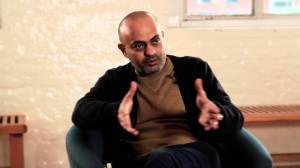 I interviewed my friend Hassan Blasim, a brilliant writer and a wonderful human being, for the National.
Hassan Blasim is an Iraqi-born writer and film-maker, now a Finnish citizen. He is the author of the acclaimed story collections “The Madman of Freedom Square” and “The Iraqi Christ” (the latter won the Independent Foreign Fiction prize), and editor and contributor to the science fiction collection “Iraq +100”. His play “The Digital Hat Game” was recently performed in Tampere, Finland.
Because it’s so groundbreaking, his work is hard to categorise. It deals with the traumas of repression, war and migration, weaving perspectives and genres with intelligence and a brutal wit.
Why do you write?
To be frank, I would have killed myself without writing.
If you read novels and intellectual works since your childhood, your head is filled with the big questions. Why am I here? What’s the meaning of life? You apply this questioning to the mess of the world around you – why is America bombing Iraq? why are we suffering civil wars? – and you realise the enormous contradiction between your lived reality and the ideal world of knowledge. On the one hand, peace, freedom, and our common human destiny, and on the other, borders, capitalism and wars.
Writing for me began as a hobby, or a way of dreaming. And then when I witnessed the disasters that befell Iraq, it became a personal salvation. It wouldn’t be possible to accept this world without writing.
Maybe writing is a psychological treatment, or an escapism. It’s certainly a dream. But it’s also to confront the world, and to challenge all the books that have been written before. And it’s a process of discovery. It’s all of these things.
Our Fates Are Linked
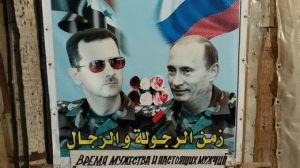
a poster from occupied Syria
Dezeray Lyn interviewed me for the Arab Daily News on the next stage in Syria, propaganda and conspiracy theories, and the connections between Syria and the world. The full article is here.
DL: I think it cheats every revolutionary, pro democracy organizer and all lovers of the land to only discuss Syria only in post counter-revolutionary, post civil war contexts. Can you intimate us with life in Syria and Aleppo before the Arab Spring uprising in terms of organizing/living/arts/love/culture under an oppressive Assad dictatorship?
RYK: Syria was in many ways a lovely country. Foreigners who visited generally loved it, and Syrians were very proud of it. Syria has a fine climate, one of the world’s great cuisines, unparalleled historical riches, and a diverse and friendly population.
It was also, beneath the surface, a tragic country, one which had suffered enforced poverty and dislocation under first Ottoman and then French imperialism, then bitter class oppression, and then sixty years of dictatorship in which a new ruling class of security officers and loyal businessmen coalesced. All forms of government exploited sectarian, ethnic, regional and tribal differences amongst the people, the better to control them. The Baathist dictatorship in particular ruled by violence and fear. About 30,000 people were killed in Hama in 1982, and thousands of dissidents disappeared in the regime’s torture prisons. Civil society was crushed.
Despite the extreme repression, Syrians produced some remarkable poetry, music, drama and films. And dissident thought continued to surface, particularly in the brief and abruptly aborted ‘Damascus Spring’ in 2000, after Bashaar al-Assad inherited the dictatorship from his father Hafez.
Bashaar shut down the political and social opening. Instead, he ‘opened’ the economy. In effect this meant a set of neo-liberal and crony capitalist reforms which enormously enriched his own family and friends while impoverishing large swathes of the population. This was the context for the 2011 uprising.
The Palestinisation of the Syrian People
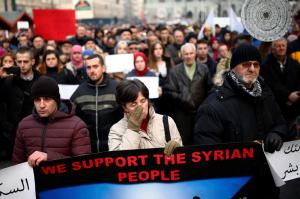
Sarajevo, Bosnia
A slightly edited version of this article was published at al-Jazeera.
In solidarity with Aleppo, the lights on the Eiffel Tower were extinguished. Elsewhere in Paris, and in London, Amsterdam, Oslo and Copenhagen, people demonstrated against the slaughter. Turks rallied outside Russian and Iranian embassies and consulates in Istanbul, Ankara and Erzerum. The people of Sarajevo – who have their own experience of genocide – staged a big protest.
The protests are nothing like as large as they were when the United States bombed Iraq, but they are welcome nonetheless. If this level of support had been apparent over the last six years, it would have made a real difference. Perhaps it is making a difference even now. Public sympathy for the victims may have pressured Vladimir Putin to allow those in the surviving liberated sliver of Aleppo to evacuate rather than face annihilation. At the time of writing, the fate of the deal is in doubt, subject to the whims of the militias on the ground. If it works out and the tens of thousands currently trapped are allowed to leave – the best possible outcome – then we will be witnesses to an internationally brokered forced population transfer. This is both a war crime and a crime against humanity, and a terrible image of the precarious state of the global system. The weight of this event, and its future ramifications, deserve more than just a few demonstrations.
The abandonment of Aleppo is a microcosm of the more general abandonment of Syria’s
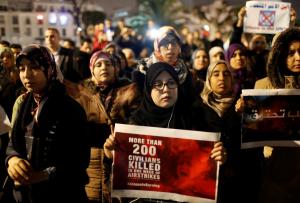
Casablanca, Morocco
democratic revolution. It exposes the failures of the Arab and Muslim worlds, of the West, and of humanity as a whole.
Many Syrians expected the global left would be first to support their cause, but most leftist commentators and publications retreated into conspiracy theories, Islamophobia, and inaccurate geo-political analysis, and swallowed gobbets of Assadist propaganda whole. Soon they were repeating the ‘war on terror’ tropes of the right.
The Obama administration provided a little rhetorical support, and sometimes allowed its allies to send weapons to the Free Army. Crucially, however, Obama vetoed supply of the anti-aircraft weapons the Free Army so desperately needed to counter Assad’s scorched earth. In August 2013, when Assad killed 1500 people with sarin gas in the Damascus suburbs, Obama’s chemical ‘red line’ vanished, and the US more or less publically handed Syria over to Russia and Iran.
Revolutionary Women
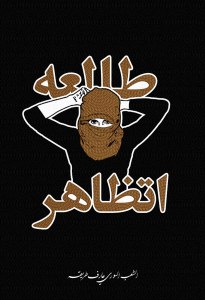 This is the third text I wrote for the Making Light exhibition in Exeter. The first is here, and the second here.
A young woman ties a keffiyeh around her face. The text reads: “I’m coming out to protest.”
From a hole in another girl’s head, butterflies rush out. A girl shot in the head, like so many girls, but the butterflies suggest she’s achieved a kind of freedom – either the freedom that motivated the defiant act that provoked her murder, or simply the freedom of death. The text reads: “Your bullets have only killed the fear within us.”
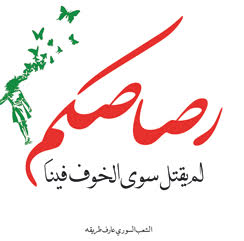 Women have been at the forefront of Syria’s revolutionary struggle.
The two most important grassroots revolutionary coalitions were set up by women: the General Commission of the Syrian Revolution by Suhair Atassi, and the Local Coordination Committees by Razan Zeitouneh.
Suhair Atassi went on to play important roles in the Syrian National Council and the Coalition of Revolutionary and Opposition Forces.
As well as setting up the LCCs, Razan Zeitouneh, a human rights lawyer, helped establish the Violations Documentation Centre to record and publicise the regime’s killings and detentions. After some time living underground, she moved to Douma, a liberated town near Damascus, where she was forthright in her criticism of any authoritarian actor who sought to limit the people’s freedom, whether the regime or any of the militias which had been formed to fight the regime.
In December 2013 Razan was abducted, probably by Jaish al-Islam, an Islamist militia. Three others were taken with her: the activists Samira al-Khalil, Wael Hamada, and Nazem Hammadi. Collectively they are known as the Douma Four. Nothing has been heard of them since.
Before her abduction, Samira Khalil, a former political prisoner, was setting up micro-finance projects and women’s centres in the Douma area. Similar centres operate all over those parts of Syria liberated from both Assad and ISIS.
Victory is Guaranteed
This old man has habitually kind eyes
but now he’s in a rage
arms flap cheeks bunch hands wave
If you burn the earth under us
we will not leave
If you kill us all
we will not leave
If you bury us
we will not leave
The victory of a man on the floor of a cell
or hung from the ceiling
who does not count
who no longer feels the blows
The victory of a woman
who knows her rapist’s honour is wrecked
of a child
who draws a picture of a different city
Read the rest of this entry »
Addressing the Oireachtas (Me and Hassoun)
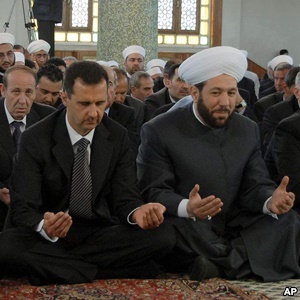
Hassoun and Assad
I was happy to have a chance to adress the Joint Committee on Foreign Affairs and Trade in the Irish Parliament. I spoke about the crushing of the Syrian revolution and the Russian and Iranian occupation of Syria. You can read my address below.
Before me, the committee was addressed by a delegation of the Syrian regime, headed by the state Mufti, Ahmad Badreddine Hassoun. Hassoun has previously threatened Europe and America with an army of suicide bombers, and has specifically called for the civilians of liberated Aleppo to be bombed. It’s incredible that such a man can get a visa to a European country (unlike millions of desperate Syrians who are not terrorists), let alone address a parliament. Hassoun was also invited to Trinity College, and (most ironic of all) to sign some declaration ‘against extremism’.
Some argue that Hassoun should be heard in the interests of balance and free speech. I say that all Syrian perspectives should be heard, and that I would have no problem with a delegation of pro-Assad civilians making their case. My problem is with this official regime propaganda exercise, at a time when the regime and its backers are slaughtering and expelling civilians en masse. And of course the people who talk about balance and free speech in this case don’t apply the principle in all cases. I don’t see official representatives of ISIS being invited to make their case in these settings. And ISIS, monstrous as it is, has killed, raped, and tortured far, far fewer people than the Assad regime.
Thanks to the work of the wonderful people in the Irish Syria Solidarity Movement, the Irish people were alerted to Hassoun’s nature. This report was on the RTE news. In the Arab media, Asharq Al-Awsat, al-Quds al-Arabi and the New Arab have also covered Hassoun’s visit.
Here is the filmed record of the sessions, first Hassoun’s group, then me. And here is my address:
It Will Not Happen Again
This is the second text I wrote for the Making Light exhibition in Exeter (the first is here).
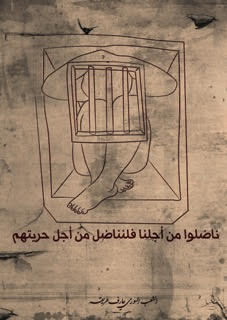 Two posters juxtaposed.
A man impossibly crammed in a cage. “They struggled for our freedom,” reads the text, “so let’s struggle for theirs.”
Beside a noria, one of the ancient water-wheels of the ancient city of Hama, a child writes on a wall: “It will not happen again.” The phrase combines bitter irony and fierce defiance, for even as we read it we know that it has happened again, it is happening, and ten or a hundred times worse.
In 1982 there was a massacre in Hama. Its memory haunted and silenced Syrians until 2011. The massacre was a success for the regime, and therefore a model for its current policy.
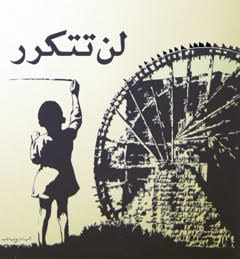 An anti-regime movement began to organise in 1978. It wasn’t a mass movement of the scale and breadth of the 2011 revoution, but it included leftists, nationalists and democrats as well as Islamists. The regime responded with a dual policy of extreme repression and radicalisation of their opponents, murdering, torturing and imprisoning them en masse. By 1982 not much was left of the movement other than the radicalised armed wing of the Muslim Brotherhood which, mixing stupidity with desperation, took over Hama by force of arms.
The regime welcomed the confrontation as an opportunity to teach the country an unforgettable lesson. Making no distinction between civilians and insurgents, its army levelled the city’s historical districts with tank, artillery and aerial bombardment. With churches, mosques and markets burning, its soldiers went house to house, riddling whole families with bullets. Estimates of the dead range from ten to forty thousand. Many thousands more were killed elsewhere in the country.
Thousands of political prisoners were thrown into the country’s dungeons. Hundreds were hanged, shot, or otherwise murdered inside. The rest languished for decades without sufficient food, medical care, any comfort or hope. Their relatives feared to ask after them.
Salafi-Jihadism and Interpretive Gymnastics
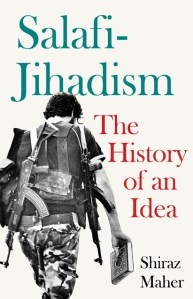 This review of Shiraz Maher’s book was first published at the National.
Currently under military pressure in Iraq and Syria, and still terrorising civilians far beyond those lands, ISIS has horrified and bewildered Muslims and non-Muslims alike. Its carefully studied barbarism and cinematic savagery seem to owe as much to Hollywood action movies and computer combat games as to classical Islamic jurisprudence. The furiously destructive passions of its adherents often appear insane.
ISIS is certainly immoral, but not entirely irrational. Its actions are rooted in specific political contexts and based on a greatly contested analysis of ancient and contemporary Islamic texts. Shiraz Maher’s magisterial “Salafi-Jihadism: The History of an Idea” provides an “explanatory backstory” to this and other manifestations of what could be called in shorthand the al-Qaida tradition.
Salafists preach “progression through regression”, specifically a return to the practice of the first three generations of Muslims known as the salaf al-salih, or the ‘righteous predecessors’.
Although its antecedents go back at least to the medieval theologian Ibn Taymiyya, Salafism is a modern phenomenon – a traumatised response to modernity – developed in the last 150 years. There are ‘quietist’ and ‘activist’ strains, but Maher’s book focuses on the ‘violent-rejectionists’ who have risen to prominence even more recently. Their ascent since the early 1990s coincided with a decline in those varieties of political Islam which hoped to achieve power through reformist or democratic means. By this period, the Syrian and Egyptian wings of the Muslim Brotherhood had been crushed, Tunisia’s Ennahda movement suffered a harsh crackdown, the leaders of Saudi Arabia’s Sahwa movement were imprisoned, and elections won by Islamists in Algeria were cancelled.
Maher quotes Trotsky’s dictum that “War is the locomotive of history”. The war sparked by the suspension of Algerian democracy, the anti-Soviet war in Afghanistan, the wars in Iraq, and today’s conflict in Syria, constitute stations in the development of Salafi-Jihadism, a movement which is at once revolutionary and deeply reactionary.
Civil Disobedience
Anyone near Exeter should make sure to visit Making Light’s exhibition Stories from Syria (and visit the website). I wrote three small texts to accompany some of the art work. Here’s the first:
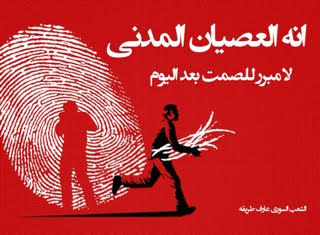 Two posters made in early 2011.
One reads: “It’s civil disobedience. No excuse for silence after today.”
A figure grabs lines from a thumb print, and runs. The thumb print evokes ID cards and the whole machinery of state. The figure is fleeing surveillance, therefore, and defining his own identity as he does so. Have those lines transformed into sticks in his arms? Is he about to light a fire?
The figure in the second poster is trapped inside a ‘no entry’ road sign, either dismantling it, and by implication the political prohibitions in Syrian society, or saying ‘no’ himself, refusing orders.
The words in this one read: “Civil disobedience. I don’t obey the law of an illegitimate 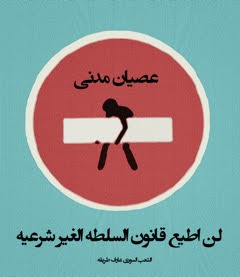 authority.” The sentence is a response to a regime poster campaign of the period. One of those official slogans read: “I obey the law.”
The revolutionary poster aims to force a dialogue where before there was only monologue. It answers back.
Before 2011, nobody answered back, at least not in public. Back then, veteran dissident (and long-term political prisoner) Riad al-Turk was entirely just when he called Syria a “kingdom of silence”.
Syrians were terrified to speak openly and honestly about domestic politics. Those who did either had to leave the country or were imprisoned for decades in the most brutal conditions. The state had ears and eyes everywhere, spies in every workplace, school and café. It owned all the tongues in the country, every newspaper, every radio and TV station. It decided which books were published and which films were shot. It dominated trades unions and universities and every last inch of the public space, even the graffiti on the walls.
In 2000, Bashaar al-Assad inherited power from his father Hafez. The new president’s neo-liberal (and crony-capitalist) economic reforms impoverished the countryside and city suburbs while excessively enriching a tiny elite. Rami Makhlouf, for instance, the president’s tycoon cousin, was estimated to control 60% of the national economy by 2011.
In the spring of 2011, Syrians refound their voices. Enmired in increasing poverty, rejecting the humiliations of unending dictatorship, lashing out against corruption, and encouraged by the Arab Spring uprisings nearby, they took to the streets.
What’s at Stake in Aleppo?
Leila and I spoke at SOAS in London on the revolution in Aleppo, the committees and councils there, the women’s centres, free newspapers and education projects, the military leaders, as well as the Russian and Iranian occupations and their crimes.
It certainly isn’t the most coherent or time-organised talk we’ve done, but the event went very well (a great, engaged, diverse audience). You can listen to it here.
Anarchism
I came across anarchism too late in life to start calling myself an anarchist. At earlier stages I’d enjoyed attaching labels to myself, like ‘leftist’, or ‘Arab’, or ‘Muslim’. I was never a great believer in any of them, but I tried.
When the Arab revolutions made politics real for me, I became suspicious of adopting any labels, given as they referred to me, and politics wasn’t about me any more, not about my fantasies of myself, my need to see myself as on the right side, or my ‘identity’. When the revolutions broke out, and then the counter-revolutions and wars, I understood that real politics concerns the actual struggles of real people in the real world. (I also understood that all identity politics is ultimately a distraction, and one most often used by those in power – or those who aim to achieve power – to divide and rule their subjects). I became suspicious of all grand narratives and all ideological frameworks which assumed there was a perfect solution to human problems as well as a clear path towards it.
So I’m not going to call myself an anarchist. And even if I wanted to, I probably couldn’t, because I am ultimately undecided on the question of whether people could do better without states and hierarchical authority. I’d like to believe that we could run complex modern societies on a horizontal basis more successfully than we do at present, but then I don’t know if I have that much faith in humanity. Perhaps we do need hierarchy of some sort to organise ourselves and to control our anti-social urges, and the best we can hope to do is reform and restrain the hierarchy. I don’t know. I need to read much more and think much more – and even when I do, if I decide I know for sure one way or the other, please ask me to check my arrogance. I’m not capable of knowing. None of us are.
I’ve written a book about Syria with someone who describes herself as an anarchist, and I agree with her on nearly everything. Plus I’ve found anarchists much less likely than leftists to be snagged by allegiance to some state or other. Their conversation on Syria is therefore likely to be much more interesting. At those book events we’ve done which were liberally salted by anarchists, in Seattle, for instance, or Toronto, the discussion was intelligent, nuanced, informed. Compassionate too. I admired the anarchists I met in Spain for several reasons. Most of them at least.
But then Noam Chomsky has been described as an anarchist. Here’s where I get confused, because Chomsky doesn’t usually (or ever?) adhere to what I think are anarchist principles.
Guapa
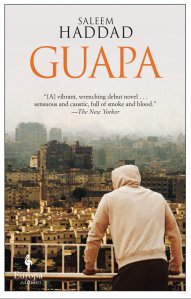 This review was first published, slightly edited, at the Guardian.
“There is everything that ever happened, and then there is this morning.”
Rasa’s grandmother – Teta – has discovered him in bed with his boyfriend Taymour. It’s a potential disaster for Taymour, who tries to “play by the rules, one foot in and one foot out”, and for Rasa it precipitates a crisis of eib, or shame, the fear of what people will say and the necessity of lying it imposes.
Since boyhood he has obsessed with finding a word to define him: louti – sodomite, or khawal – effeminate, or gay, first heard on TV when George Michael came out, or even shaath – “queer, deviant, abject”.
But Teta’s spying and screaming is only one of Rasa’s problems.
His friend Maj has been arrested. Rasa isn’t sure if it’s because of his human rights work or on account of his sexuality. In a hidden nightclub called Guapa – the “pocket of hope” which gives Saleem Haddad’s wonderful debut its title – Maj often belly dances in full niqab and a print of Marilyn Monroe’s face. He calls this “war-on-terror neo-Orientalist gender-fucking”. “We are all performing,” Maj declares, referring back to eib, and to the demands of survival in a prying dictatorship.
The president’s gaze, no less than Teta’s, “unpacks your existence bit by bit until you are naked and helpless, your most secret thoughts out in the open for all to see.”
Rasa lives in a unnamed, composite Arab city clogged with traffic, policemen, cynical cab drivers, and new and old waves of refugees. People clutch cigarettes and Turkish coffee in their well-chewed fingers. The air smells of jasmine. The walls are adorned with posters of the president in various costumes.
‘Criminals Kill While Idiots Talk’
 The Pluto blog has published an extract from our book. Here it is:
‘Burning Country’, written by Robin Yassin-Kassab and Leila Al-Shami, explores the horrific and complicated reality of life in present-day Syria with unprecedented detail and sophistication, drawing on new first-hand testimonies from opposition fighters, exiles lost in an archipelago of refugee camps, and courageous human rights activists among many others. These stories are expertly interwoven with a trenchant analysis of the brutalisation of the conflict and the militarisation of the uprising, of the rise of the Islamists and sectarian warfare, and the role of governments in Syria and elsewhere in exacerbating those violent processes. In this extract taken from the book, Robin Yassin – Kassab and Leila Al-Shami dissect the 2014 seizure of Mosul and impact it had in Iraq and Syria and on international opinion.
In June 2014, ISIS led an offensive which took huge swathes of northern and western Iraq out of government hands. Most significantly, the city of Mosul, Iraq’s second largest, fell to ISIS on 10 June  after only four days of battle. General Mahdi al-Gharawi – a proven torturer who had run secret prisons but was nevertheless appointed by Prime Minister Maliki as governor of Nineveh province – fled, and his troops, who greatly outnumbered the ISIS attackers, deserted. This meant that the US-allied Iraqi army, on which the US had spent billions of dollars, was less able to take on ISIS than Syria’s ‘farmers and dentists’. Many Syrians saw a conspiracy in the Iraqi collapse, a play by Malki to win still more weapons from America, and by Iran to increase its regional importance as a counterbalance to Sunni jihadism. It’s more likely that the fall of Mosul was an inevitable result of the Iraqi state’s sectarian dysfunction. Shia soldiers felt themselves to be in foreign territory, and weren’t prepared to die in other people’s disputes. Many Sunni soldiers defected to ISIS.
ISIS’s control of the Iraq–Syria border, and especially of Mosul, was a game changer. The organisation collected the arms left behind by the Iraqi army, much of it high-quality weaponry inherited from the American occupation. Perhaps more importantly, it cleaned out Mosul’s banks. Then it returned to Syria in force, using the new weapons to beat back the starved FSA and the new money to buy loyalties.
The FSA and Islamic Front in Deir al-Zor, besieged by both Assad and ISIS for months, begged the United States for ammunition, warning the city was about to fall. Their plea was ignored, and the revolutionary forces (plus Jabhat al-Nusra) pulled out in July, leaving the province’s oil fields, and the Iraqi border area, in ISIS’s hands. ISIS reinforced itself in Raqqa and surged back into the Aleppo countryside and the central desert. Suddenly it dominated a third of Iraq and a third of Syria. In a tragic parody of the old Arab nationalist dream, it made good propaganda of erasing the Sykes–Picot border; in a tragic parody of Islamic history, it declared itself a Caliphate at the end of June.