Myth-Making
 We often project our current political concerns backwards in time in order to justify ourselves. I say ‘we’ because everyone does it. Nazi Germany invented a mythical blonde Aryan people who had always been kept down by lesser breeds. The Hindu nationalists in India imagine that Hinduism has always been a centralised doctrine rather than a conglomerate of texts and local traditions, and describe Muslim, Buddhist, Christian, Sikh, Jain and animist influences on Indian history as foreign intrusions. Black nationalists in the Americas depict ancient Africa as a continent not of hunter-gatherers and subsistence farmers but as a wonderland of kings and queens, gold and silk, science and monumental architecture. To our current cost, Zionists and the neo-cons have been able to reactivate old Orientalist myths in the West, myths in which the entirety of Arab and Islamic history has involved the slaughter and oppression of Christians, Jews, Hindus, women, gays, intellectuals .. and so on.
Such retrospective mythmaking frequently goes to the most absurd extremes in young nations conscious of their weakness or of a need for redefinition (America may be one of these). Probably for that reason it is particularly evident in the Middle East.
Mornings in Jenin
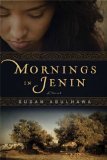 This review was published in today’s Times.
According to the Zionist story, Palestine before the state of Israel was ‘a land without a people awaiting a people without a land.’ Writers from Mark Twain to Leon Uris, as well as Hollywood studios and certain church pulpits, retell the tale. But Palestinians, in the West at least, lack a popular counter-narrative. Palestinians are reported on, met only on the news.
Perhaps this is changing. As the land disappears from under their feet Palestinians have been investing in culture, and an explosion of Palestinian talent is becoming visible in the West, in films, hip-hop, poetry and novels. And now Susan Abulhawa’s “Mornings in Jenin” is the first English language novel to fully express the human dimension of the Palestinian tragedy.
The story begins with the Abulheja family at home in the village of Ein Hod near Haifa, marrying, squabbling, trading, and harvesting the olives. It’s a touching and sometimes funny portrait of rural life with hints of the city (notably the Jerusalem-based Perlsteins, refugees from German anti-Semitism) and the Beduin tribes.
Then comes the Nakba, or Catastrophe, of 1948. Driven from their shelled village, the family suffers loss, separation, and humiliation, ending up in a camp in Jenin where “the refugees rose from their agitation to the realisation that they were slowly being erased from the world.” By now we care very much about the key characters, and through them we experience “that year without end”, the interminably drawn out Nakba which stretches through some of the bloodier signposts of Palestinian history – the Naksa or Disaster of 1967, the Lebanese refugee camp massacres, until the 2002 Jenin massacre.
Criminal and Accomplice
 I didn’t watch Blair’s performance at the Chilcot inquiry, for health reasons, but I did read that he mentioned Iran 30 times, as in ‘the same good case for war applies to Iran’. This comes in the context of America concentrating ships and missiles in the Gulf. It is unlikely that the US will attack Iran directly, but increasingly likely that Israel will provoke a conflict. Blair may be preparing the ground for this.
Blair felt ‘responsibility but no regret’ over the destruction of Iraq which has killed over a million, created at least four million refugees, and turned a fertile land into a diseased desert. He focused on Saddam Hussain’s monstrosity, but refrained from explaining how Saddam’s most monstrous crimes were supported by his Western backers. He was allowed to refrain. He didn’t entertain the possibility that Hussain could have been deposed in other ways. He blamed Iran and al-Qa’ida, neither of which had a presence in the country before its collapse, for Iraq’s problems, and again his illogic was not questioned.
This Evening
 It was a relationship abrasive and intimate, based on love. So a good relationship. To his children he barked commands, swore, adopted strict military monotones, or ignored them, ordered them out. Underneath it was love. Usually his anger was feigned. He didn’t know how else to control his thoughts when children were screaming. He wasn’t a multitasker. So it wasn’t so much a matter of controlling the children as of organising himself, except on certain planned occasions. The children understood this.
For a while he lay in the bed with the girl to read her from a book of prehistory. He read a page she read a page. It was volcanoes and evolution versus creation myths. Then he called the boy to come and join them. Come and read the good book, he said. His mother had read him the Bible when he was young although she wasn’t a Christian, or it must have been selections, but he remembered the dark shock of Noah drunk and naked cursing his son to enslavement, and Lot’s daughters spicing their father’s drink just right to get him drunk, but not too drunk to fuck, and Abraham pimping his wife, twice, and God rewarding him for it, and the passion and strangeness of it all. He was grateful to his mother for showing him this stuff and was passing the favour to his own children. Except he sent the girl out of the room for the aforementioned parts. She was only seven after all. Both children enjoyed it, just the Book of Genesis so far.
What Comes Next
This is the extended version of a piece published in today’s Sunday Herald.
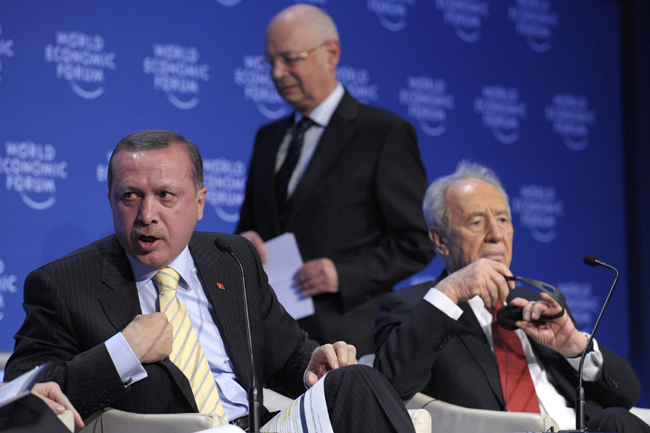
Erdogan reacts to his war criminal neighbour
A strange calm prevails on the Middle Eastern surface. Occasionally a wave breaks through from beneath – the killing of an Iranian scientist, a bomb targetting Hamas’s representative to Lebanon (which instead kills three Hizbullah men), a failed attack on Israeli diplomats travelling through Jordan – and psychological warfare rages, as usual, between Israel and Hizbullah, but the high drama seems to have shifted for now to the east, to Afghanistan and Pakistan. The Arab world (with the obvious exception of Yemen) appears to be holding its breath, waiting for what comes next.
Iraq’s civil war is over. The Shia majority, after grievous provocation from takfiri terrorists, and after its own leaderhip made grievous mistakes, decisively defeated the Sunni minority. Baghdad is no longer a mixed city but one with a large Shia majority and with no-go zones for all sects. In their defeat, a large section of the Sunni resistance started working for their American enemy. They did so for reasons of self-preservation and in order to remove Wahhabi-nihilists from the fortresses which Sunni mistakes had allowed them to build.
The collapse of the national resistance into sectarian civil war was a tragedy for the region, the Arabs and the entire Muslim world. The fact that it was partly engineered by the occupier does not excuse the Arabs. Imperialists will exploit any weaknesses they find. This is in the natural way of things. It is the task of the imperialised to rectify these weaknesses in order to be victorious.
Two Stages of the Syrian Ba’ath
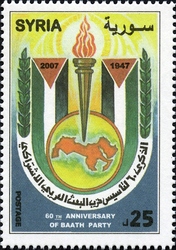
stamp commemorating the 60th anniversary of the Ba'ath's founding
Again inspired by Hanna Batatu’s excellent book, here are some notes on the first two of the three stages of the Ba’ath Party in Syria. I haven’t mentioned the party’s development in Iraq.
The first Ba’ath was the old Ba’ath, and it was led by ideals. The party’s founders, Michel Aflaq (a Christian) and the two Bitars (Sunnis) were the sons of grain merchants from the Damascus suburb of Maydan, and were genuinely motivated by the desire for a unified Arab state. They were of the commercial class that felt most immediately the loss of the natural Arab marketplace entailed by the Sykes-Picot partition and the actions of the French Mandate. The French had ceded Arab-majority areas north of Aleppo to Turkey, and in 1939 handed over the entire Iskenderoon governorate (which had an Arab and Alawi majority) in return for Turkish neutrality in the approaching European war. From 1925 to 26 the Druze had risen against the French under the anti-sectarian slogan ‘Religion is for God and the Homeland For All.’ The Ghuta peasant-gardeners, aflame with the nationalism of nearby Damascus, also struck, and the French bombarded the Ghuta with artillery and planes. The 1948 fall of Palestine added impetus to the pan-nationalist agenda. Sunnis from Deir ez-Zor, now cut off from their kinsmen and marketplaces in Iraq, were also attracted to Arabism.
Before it became a party of policemen and bureaucrats the Ba’ath was a party of schoolteachers (the leadership) and schoolboys (the mass membership). Pedagogic aims run deep in the Ba’ath’s family history. The subject of instruction at this stage was an unfeasibly romantic vision of the Arabs, something beyond the traditional nationalist picture of the Arabs as a people united by language and culture, in other words by historical forces. The Ba’ath saw the Arabs as a nation outide history, as an eternal creative force and unified will (Henri Bergson’s philosophy was important), and Ba’athist rhetoric transported spiritual language into nationalist discourse. Umma Arabiya Wahida, goes the slogan, Zat Risala Khalida. Or One Arab Nation Bearing an Eternal Message. Umma hitherto referred to the Islamic community, not the Arabs, and Risala is the word used for God’s message transmitted by Muhammad, the Rasool. Like Zionism, Stalinism, fascism and hedonist-consumerism, the Ba’ath was one of the 20th Century’s attempts to secularise and channel people’s religious impulses, to provide a substitute for the crumbling or crumbled traditional religions.
Five Books on Syria; Batatu on the Peasants
Inspired by the Browser interview concerning my five favourite books on Israel-Palestine, I’ve come up with a list of five on Syria. These are all books available in English, so my selection is inevitably skewed. I’ll name them, then talk at length about the first on the list, the Batatu book.
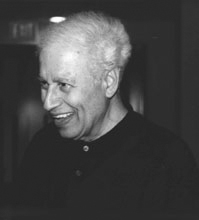
Hanna Batatu
1. Hanna Batatu. “Syria’s Peasantry, the Descendants of its Lesser Rural Notables, and Their Politics.”
2. Patrick Seale. “Asad: The Struggle for the Middle East.”
As essential for understanding power machinations in the US, the USSR, Palestine, Israel and Lebanon as in Syria, this is a biography of Syria’s ruthless, inscrutable, masterful dictator, Hafez al-Asad. Nation builder or gangster, as you will, but surely the most important Syrian of the 20th century.
3. Samuel Lyde. “The Asian Mystery Illustrated in the History, Religion, and Present State of the Ansaireeh or Nusairis of Syria.”
The End of the Arabs?
In 2007 I read Peter W. Galbraith’s “The End of Iraq“, which suggests cutting Iraq into three mini-states, and then responded in two parts. The first part criticises Galbraith’s thesis, and the second part criticises the failures of Arabism. Both are merged below. More recently it has been revealed that Galbraith actually stood to gain financially from the dismantlement of Iraq.
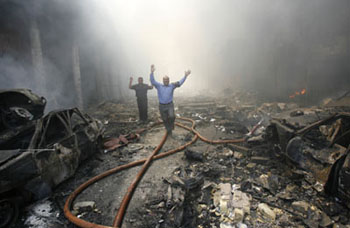
explosion at Baghdad's Mutanabi Street book market
Peter W. Galbraith’s book ‘The End of Iraq’ argues the initially persuasive thesis that Iraqis have already divided themselves into three separate countries roughly corresponding to the Ottoman provinces of Basra (the Shii Arab south), Baghdad (the Sunni Arab centre) and Mosul (the Kurdish north), and that American attempts to keep the country unified are bound to fail. I agree wholeheartedly with Galbraith’s call for America to withdraw from Iraq – America is incapable of stopping the civil war, and is in fact exacerbating it. (update: I stick by this. The civil war has to some extent calmed because of internal Iraqi dynamics, not because of the US ’surge’ – the Sunni forces turned on al-Qaida, and also realised that they had lost the battle for Baghdad and national power. Some groups then allied with the US for a variety of reasons to do with self-preservation). The rest of Galbraith’s argument is much more debatable.
Visiting the Great Satan

Notre Dame University
I’ve never before visited the USA. Like everybody else in the world, I’ve had it come to me. Its approach has been unstoppable, for good and for ill. For good first: the incredible achievement of American prose, which leaves British writing of the last century far behind. I am astounded by Faulkner, Bellow, Updike and Roth (when they’re good), Cheever, Scott Fitzgerald, and now Joshua Ferris. Formulaic Hollywood switches me off, but I can’t get enough Spike Lee or Martin Scorcese. I love Bob Dylan, Public Enemy and Miles Davis, just for starters. Jazz and particularly hip hop are American art forms which have travelled very well indeed. These two came originally from the black poor, and it’s the heterogeneity of America, and the possibility of marginalised genres and people being heard, which is so appealing. America is a continent-sized country of mixed-up Africans, Jews, Italians, Irish, Latinos, French, Wasps, and everyone else. It should be the most globally-minded and tolerant country in the world.
It isn’t of course. A narrow hyper-nationalism, the shaping of public discourse by corporations and lobbies, and a stupifying media and public education system have seen to that. Which brings us to the ill: America’s homogenising rage, which has ravaged first its own main streets (so Naomi Klein says in No Logo) and then the high streets of the world; its humourless TV gum; its advertising culture of false smiles and sugary platitudes; its racism, wars, military bases, aircraft carriers, support for dictators and apartheid regimes. These are the reasons why the US is known in some parts as the Great Satan, standing behind most of the little satans sitting on Asian and African thrones. In Muscat, Damascus, Shiraz and London I’ve met many people who have been made refugees by the USA.
America is the empire, admittedly in decline. In one sense, therefore, I haven’t needed to visit to know it. But last week I visited nevertheless, for a conference at Notre Dame University which I enjoyed very much.
To A Christian Zionist
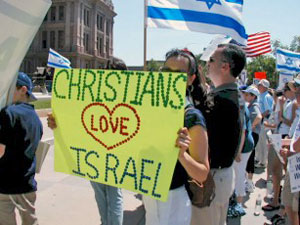 Update: I wrote this in 2006. If I wrote it today I would do it a little differently. Specifically, I would discuss the pernicious role of the Scofield Bible in perverting protestantism in America. I would discuss the meeting point of Christian Zionism, orientalism and racism in Western cultures. And I would point out that contemporary science has shown us that the direct descendants of the ancient Israelites are the Palestinians, not the Ashkenazi or Berber Jews who have colonised Palestine in recent years. Shlomo Sand’s excellent book The Invention of the Jewish People, reviewed here, summarises the science and undercuts the blood-and-soil aspects of Zionism which are so important to Christian Zionists and their ultimately anti-Semitic agenda.
I have recently been discussing Middle East issues with an American colleague who I would describe as a Christian Zionist. Although I like him personally I find some of his ideas (on Palestinian history, and Lebanon, and the wider Middle East) pretty offensive, and I have told him so. So as not to start an argument, I told him so in writing. He replied, saying that although he disapproves of collective punishment of the Palestinians he believes that the Bible clearly states that the Holy Land belongs to the Jews, and that the rebuilding of Israel prophesied in the Old Testament has happened since 1948. Hmm. My first response is anger. I understand Jews with memories of European anti-Semitism being attracted to Zionism, however wrong I think they are, but Americans? People who are not oppressed, who think Palestine is a Cecil B Demille set, who think real human beings (Arabs) are less important than their own narrow interpretations of scripture. Who think that ethnic cleansing, massacres, and apartheid are supported by God. It makes my blood boil. But I think responding intelligently to this kind of thing is important, because there are millions of Americans (with power) who see the Middle East through a Biblical prism. Anyway, here is my latest letter:
“Israeli Apartheid – A Beginner’s Guide”

settler graffitti in Hebron/al-Khalil
That there are striking parallels between white rule in apartheid South Africa and Zionist rule in Palestine – an analogy made by such mainstream figures as President Jimmy Carter and Archbishop Desmond Tutu – should no longer be controversial. But calling Israeli apartheid by its name will occasion the usual screams of anti-Semitism and ignorance from Zionist quarters, and for comprehensible reasons: the most politically inept American student knows that apartheid is a bad thing, a crime to be battled, not supported with weapons, vetoes in the Security Council and billions of dollars in ‘aid.’ Therefore the apartheid label must be vigorously resisted by Zionists and their fellow travellers.
Ben White’s “Israeli Apartheid – A Beginner’s Guide” begins by quoting Article II of the International Convention on the Suppression and Punishment of the Crime of Apartheid, UN General Assembly Resolution 3068, which defines the crime as “inhuman acts committed for the purpose of establishing and maintaining domination by one racial group of persons over any other racial group of persons and systematically oppressing them.” The rest of White’s book leaves the reader in no doubt that the Zionist instance of apartheid fits the bill even better than the erstwhile South African version.
Islam in the Writing Process
If all goes well I will be at Notre Dame University in the US later this month for a conference on the role of Islam in contemporary European literature. I wrote the piece below for the conference.
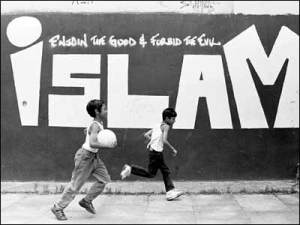
Photo by Rehan Jamil
Salman Rushdie once commented that ‘Islam’, in contrast to ‘the West’, is not a narrative civilisation. This, in my opinion, is obvious nonsense. Beyond the fact that human beings are narrative animals, whatever civilisation they live in, and that Islamic civilisation cannot be isolated from, for instance, Christian, Hindu or Arab civilisations, the Muslim world has a history of influential narratives which is second to none. These include Sufi tales, chivalric adventures, fantastical travelogues, romances and spiritual biographies written in several major languages.
Although the Arabic novel is generally considered to have developed in the early twentieth century from the experience of industrial urbanisation and the penetration of European genres and philosophies, Ibn Tufail’s 12th Century “Hayy ibn Yaqzan”, an inspiration for Defoe’s “Robinson Crusoe”, can reasonably stake a claim to being the world’s first novel. The Arabian Nights (via Don Quixote) is surely another source of the European novel tradition. And Islam the religion – as opposed to the even more nebulous ‘civilisation’ – is a text-based faith. The Qur’an is the religion’s only official miracle; the first word revealed to the Prophet was ‘iqra’ – ‘read’. Those who attempt to draw a distinction between literalist scripture and free and playful literature should pay attention to verse 26 of the Qur’an’s second chapter which, immediately after the first description of heaven and hell, proclaims: “Behold, God does not disdain to propound a parable of a gnat, or of something even less than that.” In other words, the Qur’an is a text unashamed to use metaphor, symbol and a whole range of literary devices in order to point to ineffable realities.
The Supreme Crime Against Satire
Ah, Tony Blair…. inheritor and champion of Thatcherite neo-liberal economics and Zionist neo-conservative foreign policy, presidor over a dramatic rise in British Islamophobia, appointer of unelected Zionist tycoons to manage the good behaviour of the Palestinians while they lose the last of their land and rights, holy liar, war criminal, hypocrite, a man complicit in the Gaza massacre, and in the 2006 assault on Lebanon’s civilian infrastructure … and soon, perhaps, first president of the European Union. I’ve written about this lovely chap before. Those of you who believe the appointment of Blair to the EU presidency would be the worst possible start to the post and a sure sign to the rest of the world that Europe has no interest in justice or good governance, can sign this petition. I certainly have. On the other hand, some of you may agree with George Monbiot’s provocative argument that Blair’s appointment to the post will provide the best opportunity for having him tried for war crimes. So far, Blair has only been rewarded for his crimes, with directorships, a book deal, and the joke post of ‘Middle East peace envoy’, which Monbiot calls “the supreme crime against satire.”
Monbiot’s article is here:
Why I Love Saul Bellow
Written five years ago, on the wonderful, appalling Bellow.
 There are many reasons for loving Saul Bellow’s work, and some reasons not to. I was first directed to Bellow by a friend of mine who is Jewish, the English-speaking grandchild of Russian immigrants, and interested in his heritage. He therefore has one easy point of access to Bellow, whose protagonists are usually first or second generation Jewish immigrants, which I do not. My friend suggested I read “Ravelstein.” Because I trust his literary judgment, I dutifully struggled through. Not a lot happens in this slim volume, but a lot of details, a lot of memories, are accumulated around the eponymous professor, an opinionated neo-conservative flaunting his newly acquired wealth in Paris. There are many references to expensive brand names and other status symbols. Ravelstein receives updates on the 1991 Gulf War from a previous student who is now important at the Pentagon. (I later discovered that Ravelstein is a fictionalized Allen Bloom, one of Mrs Thatcher’s favourite thinkers, and his pentagon protégé is based on Paul Wolfowitz). None of this endeared the character to me. I get emotional about neo-conservatives. I spit when I hear Wolfowitz’s name. Although there is a great deal of irony – and serious comment on social mobility – in the treatment of these arriviste Jews (the transformation of the Turnbull and Asser clothing label into Kisser and Asser is only the most obvious of the gags), all the luxury in the novel irritated me.
Sabra and Shatila
Genre-specific readers be alerted: this is first draft fiction, not reportage – though its material is entirely factual. Twenty seven years ago today.
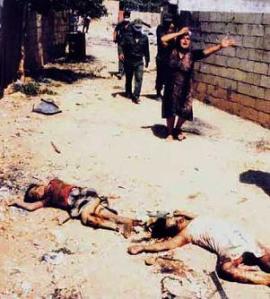 The militia were Arabs, brother Arabs.
The Phalangists were already baying from east Beirut, howling revenge. Now Israel flew Haddad’s militia, la crème de la crème, up from the south. Both groups assembled at the airport, for General Sharon to ensure all were properly kitted out: with weapons, military rations, medical supplies; Israeli cocaine and Lebanese hashish; Mediterranean testosterone, bad breath.
Then he uncaged them.
At six on Thursday evening. In the first penetration, three hundred and twenty men were brought on thirty trucks. Four gangs invading from four approaches. These were the most blood-addicted, rape-happy, battle-addled of militiamen, men long ago surfeited on outrage, men who required ever more extreme atrocities to stir their glutted senses. Ever wilder, ever sharper.
Israel lit the sky for them. White phosphorus flares trailing and dancing. Fire above like a terrible sun in the ceiling, a sun switched on in anger, while the children are sleeping.