Posts Tagged ‘Mazloum Abdi’
A Nobel Prize for Syria?
This article was first published at New Lines Magazine.
On Aug. 25, Mazloum Abdi, the commander in chief of the Syrian Democratic Forces (SDF), a Kurdish-led militia that had ruled swaths of northern and eastern Syria for over a decade, announced the group’s dissolution. This marked the end of the process of integrating SDF fighters into the Syrian Ministry of Defense. Three all-Kurdish brigades of the national army now serve in Hasakah and Qamishli, with a fourth in Kobani. That means Kurdish-majority areas are policed and guarded from external threats by local Kurds rather than by outsiders. Abdi has been appointed as an adviser to the Syrian presidency.
The integration process is a compromise for both sides. The dissolution of the SDF comes in concert with the winding up of the Autonomous Administration of North and East Syria (AANES) and the “Rojava” (or “Western Kurdistan”) experiment. This is experienced as liberation for many Arabs and others in northeastern Syria, who found SDF rule oppressive, but it also represents the end of Kurdish autonomy, leaving many Kurds wounded and worried about the future. For their part, many Syrian Arabs are discomfited that parts of their country are still managed by people who until recently ran their own state project, and who don’t necessarily believe in a unified and sovereign Syria.
But still, the process has more or less worked, and the northeast is no longer at war. A Syrian solution has been arrived at, rather than an international conflict. It could have all happened very differently, and Abdi and Syria’s transitional President Ahmad al-Sharaa should be credited with avoiding much worse scenarios.
In late November and early December 2024, while al-Sharaa’s Hayat Tahrir al-Sham (HTS) rebels were seizing Syria’s western cities from the collapsing regime of Bashar al-Assad, from Aleppo in the north via Homs to Damascus in the south, the Turkish-aligned militias of the so-called Syrian National Army (SNA) advanced eastward into SDF-controlled territory. Backed by the Turkish air force, the SNA took Tel Rifaat and Manbij from SDF control. In Manbij, according to a Kurdish resident I interviewed for my recent book on post-Assad Syria, SNA fighters and Arab residents together drove Kurds from their homes, which they then looted.
Motivated by homesickness as well as revenge, the SNA fighters wanted to continue. Many of them had been pushed out of their home areas in eastern Syria by the Islamic State group, then prevented from returning by the SDF. There were clear signs, too, that the Arab population of northern and eastern Syria would welcome a larger battle. As HTS arrived in Damascus, armed civilians attacked checkpoints in the city of Deir ez-Zor, and Arab fighters in the SDF defected. The city had liberated itself by Dec. 11, 2024, three days after Assad’s flight to Moscow.
The encouragements for war were plentiful. Both sides would have found powerful state backers: Turkey sponsoring Damascus, and Israel the SDF. The SDF had no wish to compromise with its archenemies. For their part, the SNA fighters were raring to go.
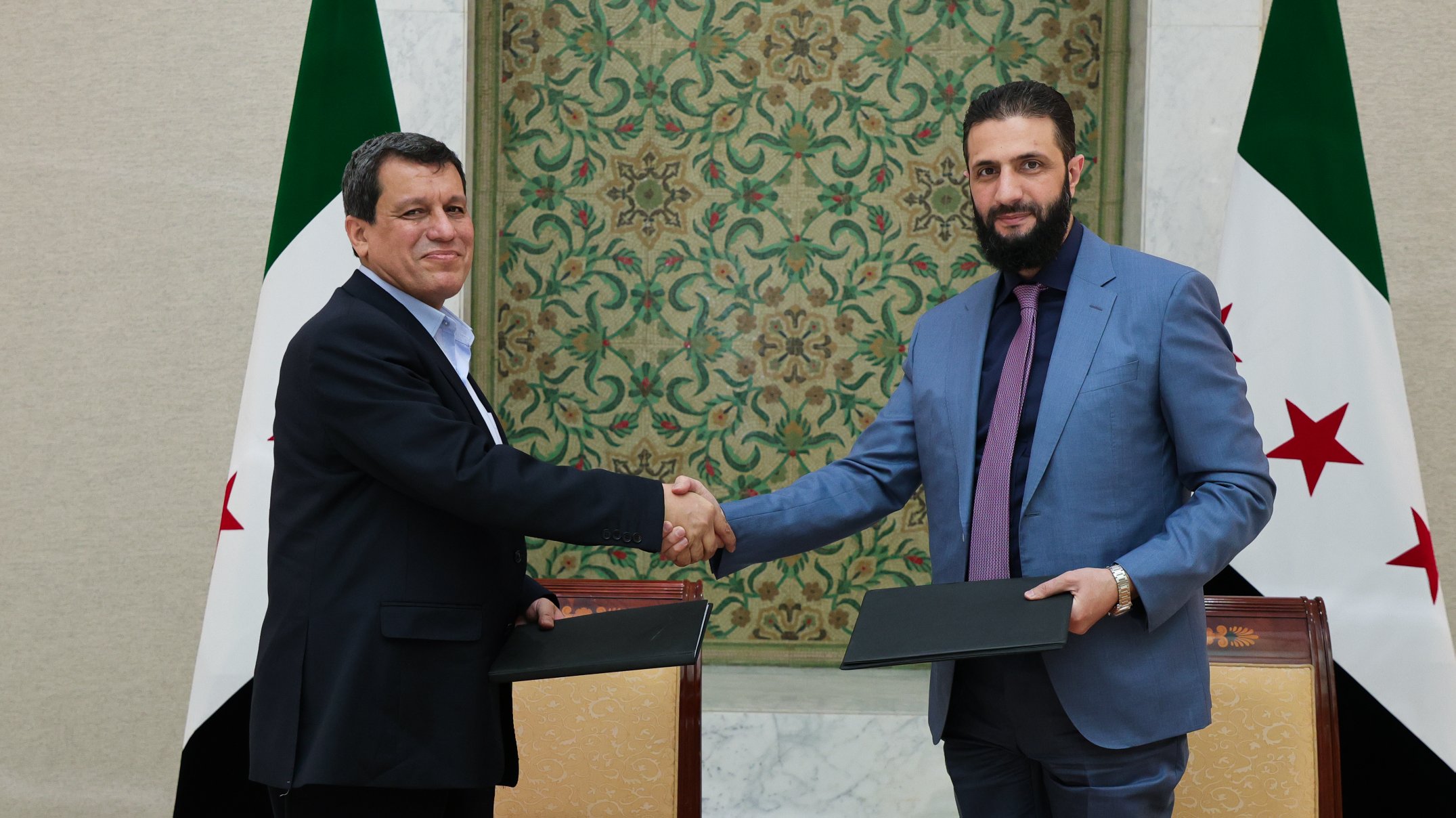
But al-Sharaa restrained them. Instead, he and Abdi signed the March 10, 2025, agreement to reintegrate the northeast into the Syrian state. This statement of intent was supported by the United States but opposed by hard-liners on both sides. The procedural nitty-gritty was consigned to committees. Each side understood the terms of the agreement differently. Often, the process seemed destined to fail.
Yet al-Sharaa and Abdi persevered, reining in both their respective hard-liners and cadres on the ground. For this reason, I’ve heard one Syrian journalist suggesting, and only partly tongue in cheek, that the two men deserve the Nobel Peace Prize.
Perhaps they do — even Henry Kissinger won the Nobel once, so it’s not a high bar — but if they do, it’s for their intelligent reading of reality rather than for any inherently pacific orientation. Both men have risen by accurately evaluating the potentials and risks presented by their changing environments. Both have survived the vicissitudes of the long Syrian conflict by understanding that war, like politics, is the art of the possible. When fighting is likely to achieve their aims, they fight. When it’s more likely to lead to disaster, they usually refrain. Unlike Assad or Israel’s Prime Minister Benjamin Netanyahu, their judgment has only rarely been clouded by hubris.
Read the rest of this entry »